17 December 2009

ALIEN 'WATER WORLD' FOUND


Exerpts From: http://cosmiclog.msnbc.msn.com/archive/2009/12/16/2152989.aspx
by Alan Boyle

Astronomers say they have detected a planet just six and a half times as massive as Earth - at a distance so close its atmosphere could be studied, and with a density so low it's almost certain to have abundant water.
The alien world known as GJ 1214b orbits a red dwarf star one-fifth the size of our own sun, 40 light-years away in the constellation Ophiuchus, the astronomers reported in Thursday's issue of the journal Nature.
"Astronomically speaking, this is on our block," David Charbonneau of the Harvard-Smithsonian Center for Astrophysics, lead author of the study, told reporters this week. "This is a next-door neighbor. For perspective, our own TV signals have already passed beyond the distance of this star."
He said the planet was detected using an array of eight off-the-shelf, 16-inch telescopes equipped with commercially available cameras.
"Since we found the super-Earth using a small ground-based telescope, this means that anyone else with a similar telescope and a good CCD camera can detect it too," Charbonneau said in a news release. "Students around the world can now study this super-Earth."
Super-Earths - planets that are roughly two to 10 times Earth's mass - represent the hottest frontier in the years-long search for worlds beyond our solar system. Planet-hunters reported finding their first transiting super-Earth in February, and earlier this week, other researchers addedtwo more super-Earths to the list.
Those planets orbit stars like our own sun, but the brightness of GJ 1214b's parent star is hundreds of times dimmer. The planet is also much closer to the star than any of our own solar system's planets, orbiting at a distance of only 1.3 million miles (2 million kilometers). That combination suggests that the planet's surface temperature would be about 400 degrees Fahrenheit (200 degrees Celsius), Charbonneau's research team reported.
Charbonneau speculated that GJ 1214b was a little too hot for life as we know it, "but it didn't miss it by very much."
The planet's discovery was hailed as a potential breakthrough by Geoffrey Marcy, an astronomer at the University of California at Berkeley who is a pioneer in the planet quest. In a commentary written for Nature, Marcy said Charbonneau and his colleagues "provide the most watertight evidence so far for a planet that is something like our own Earth, outside our solar system."
How it was found
GJ 1214b was detected thanks to an innovative telescope system, a cleverly focused observation campaign - and perhaps a little bit of luck. The eight-telescope array, dubbed the MEarth Project, was set up at the Whipple Observatory on Mount Hopkins in Arizona. The telescopes were programmed to gaze at 2,000 low-mass stars and check for slight, regular dips in light that could be caused by a dark planet's transit across the star's disk.
Relatively dim, relatively close stars were favored because the planet's dimming effect would be more noticeable than it would be with brighter, bigger, farther-out stars.
Just a few months after the MEarth Project began, graduate student Zachory Berta spotted the signature of GJ 1214b's 38-hour orbit. Based on the pattern of the dimming, the team figured out that the planet was 2.7 times as wide as Earth.
The astronomers then turned to another instrument, the HARPS spectrometer on the European Southern Observatory's La Silla telescope in Chile, to figure out the planet's mass. Such mass calculations depend on another technique that checks for the slight wobble in a star's motion caused by a planet's gravitational pull. The HARPS observations indicated that the planet was 6.55 times as massive as Earth.
Putting those measurements together, the team was able to model the planet's density and composition. The best fit for the data was a mixture consisting of about three-quarters water and other ices, one-quarter rock and a gaseous atmosphere.
Implications of a water world
Although the surface temperature on GJ 1214b would be well above water's boiling point on Earth's surface, Charbonneau said the planet could nonetheless possess an exotic form of liquid water due to extreme atmospheric pressure at the surface. In today's news release, Berta said the pressure may turn at least some of the water into a rare crystalline form known as ice-seven.
"Despite its hot temperature, this appears to be a water world," Berta said.
On Earth, organisms have been found living near deep-sea hydrothermal vents, where superheated water is held under high pressure. But Charbonneau said he wouldn't want to bet that life could endure under GJ 1214b's crushing conditions.
In fact, it's too early to bet heavily on any detailed description of GJ 1214b. Fortunately, Charbonneau said, the star is close enough that the Hubble Space Telescope could someday analyze the composition of the planet's atmosphere. "That will make it the first super-Earth with a confirmed atmosphere - even though that atmosphere probably won't be hospitable to life as we know it," he said.
Knowing what the atmosphere is made of, and how thick it is, could help astronomers determine whether their characterization of GJ 1214b as a water world is correct. "It's possible that what you have is a ball of rock with a much bigger envelope of light gas," Charbonneau said.
The larger implication of the Nature study is that other super-Earths may be waiting out there with just the right conditions for life. "We found this planet in the first six months," Charbonneau noted. "We had only looked at a small fraction of the stars that we planned to look at through the entire project. That means that either we got really lucky - which is possible - or these planets are common."
Two planet-hunting spacecraft, NASA's Kepler and the European Space Agency's COROT, are expected to find hundreds of super-Earths and Earth-sized planets in the years to come. The first scientific results from the Kepler mission are due to be reported next month in Washington at the winter meeting of the American Astronomical Society.

09 December 2009

Solar Plant in Space Gets Go-Ahead

From: http://greeninc.blogs.nytimes.com/2009/12/03/solar-plant-in-space-gets-go-ahead/

Solar Plant in Space Gets Go-Ahead

by Todd Wood


California regulators on Thursday went where no regulators have gone before — approving a utility contract for the nation’sfirst space-based solar power plant.
The 200-megawatt orbiting solar farm would convert solar energy collected in space into radio frequency waves, which would be beamed to a ground station near Fresno, Calif. The radio waves would then be transformed back into electricity and fed into the power grid.
“At the conceptual level, the advantages of space-based systems are significant,” said Michael Peevey, president of the California Public Utilities Commission, during a hearing on Thursday. “This technology would offer around-the-clock access to clean renewable energy, and while there’s no doubt this project has many hurdles to overcome, both regulatory and technological, it’s hard to argue with the audacity of the project.”

“It’s hard to argue with the audacity of the project.”


A Southern California start-up called Solaren will loft components for the solar power plant into orbit and sell the electricity it generates to Pacific Gas and Electric, the major utility in Northern California, under a 15-year contract. The project is supposed to be turned on in 2016.

Solaren, founded by veterans of Hughes Aircraft, Boeing and Lockheed, plans to deploy a free-floating inflatable Mylar mirror one kilometer (0.62 miles) in diameter. This will collect and concentrate sunlight on a smaller mirror, that in turn will focus the rays on photovoltaic modules, according to the company’s patent.
In an interview with Grist in April, Gary Spirnak, Solaren’s chief executive, said that the vital part of making a space-based solar farm economically viable was to take the weight out of the system to reduce the number of rocket launches.
Still, Mr. Spirnak, who previously ran space shuttle flights for the United States Air Force, acknowledged that putting a solar power plant in space would cost a few billion dollars more than a terrestrial photovoltaic farm generating the equivalent amount of electricity.
The rate that P.G.& E. agreed to pay Solaren for the electricity produced by the solar station remains confidential. Also, regulators said on Thursday that the utility could not count the project toward its renewable energy mandates unless certain milestones were met.

06 December 2009

Space Solar Power Discussed on Indian Defense Website Bharat-Rakshak


Space Solar Power discussed on Bharat-Rakshak, the premier website and blog on the Indian Military.
http://forums.bharat-rakshak.com/viewtopic.php?f=2&p=783446
The poster asks:
QUESTIONS FOR YOU, DEAR BRF MEMBER............
1. What do you think is the potential for "Space Based Solar Power" to meet the energy needs of India?
2. Have you seen this discussed in the Indian press/media? (If so, please provide links or outline discussions.)
3. Who seems 'on board' with this idea? (Politicians, academics, business people -- kindly provide names.)

Citizens for Space-Based Solar Power

Here is another Space Solar Power Blog, the Citizen's for Space-Based Solar Power:
http://c-sbsp.org/
As of today, it had received 8,005 hits...small, but an increasing number of people have heard of the idea since its renaissance post 2007.

SGAC releases a film about the true facts around asteroids that threaten Earth

From: http://www.spaceref.com/news/viewpr.html?pid=29733

The Space Generation Advisory Council (SGAC) Near Earth Object (NEO) Working Group has released a film about NEOs and planetary defense. The volunteer made documentary presents the opinions of international experts on issues surrounding defending Earth from asteroid and comet impacts.

The general public has constantly feared threatening asteroids. At the same time, scientists and astronomers have long analyzed the potential devastation that an impact from space could cause. Only recently, engineers have been designing realistic missions to stop these natural disasters. Encouraged by this fearful mystery that lies around asteroids, as well as by the latest intense planetary defense research, the SGAC NEO Working Group had the initiative of making a film that conveyed non-exaggerated facts about the dangers we face from space impacts, based on recent research and the opinion of international experts on planetary defense. The film can be watched athttp://www.spacegeneration.org/node/2681

[Film is in 4 Parts]

04 December 2009

China Academy of Space Technology (CAST) Reviews Space Solar Power

In a recent seminar coinciding with the International Conference on Space Information Technology (ICST09), held 24-28 Nov, the China Academy of Space Technology (CAST), held a special seminar on Space-Based Solar Power (SBSP) involving researchers from MIT and the Space Journal.

03 December 2009

Controversy flares over space-based power plan


From: http://www.msnbc.msn.com/id/34239347/ns/technology_and_science-future_of_energy/
...Last week, California regulators proposed a plan to approve a 15-year contract with the American company Solaren Corp. to supplyspace-based solar power to utility giant Pacific Gas & Electric (PG&E) by 2016. The Japan Aerospace Exploration Agency (JAXA) has also teamed up with a private Japanese coalition to design a solar space station for launch by the 2030s.
Such projects encourage scientists who dream of harnessing the sun's power directly, without the interruption of cloudy skies and Earth's day-night cycle. Marty Hoffert, a physicist at New York University and one of the staunchest supporters of space solar power, suggests that today's technologies allow space solar power to provide energy as cheaply as the usual solar panel arrays on Earth....Hoffert has pushed for the laser beaming approach as newly effective cost-cutting measure, and even submitted a proposal with his son to ARPA-E, the U.S. Department of Energy's new agency.  "The cost to first power doesn't have to be in the hundreds of billions," Hoffert said. His proposal includes laser transmission tests on the ground in an NYU lab, and then a space experiment launched to the International Space Station.

Jeff Foust Reviews Energy Crisis Solution From Space


http://www.thespacereview.com/article/1517/1

18 November 2009

Braun lays out a brilliant vision

It is terrific news that there is a committe to review NIAC, which for such a miniscule budget (~1$M) provided such a goldmine of imagination and innovative thinking.  And fantastic to see someone on the board put together a list so similar to what has been advocated in this Blog.  Kudo's Dr. Braun (Co-Chair of the Committee to Review the NASA Institute for Advanced Concepts Aeronautics and Space Engineering Board National Research Council)


Testimony given to the Subcommittee on Space & Aeronautics :: October 22, 2009
http://science.house.gov/publications/hearings_markups_details.aspx?NewsID=2640

Strengthening NASA’s Technology Development Programs

Dr. Braun Makes this statement in his testimony-

"I share with these recent high-school graduates a list of accomplishments that I believe our nationʼs civil aeronautics and space program is capable of achieving in my lifetime:

Ten Anticipated Paradigm-Changing Civil Aeronautics and Space Advances
1) Quantify Causes, Trends and Effects of Long-Term Earth Climate Change
2) Accurately Forecast the Emergence of Major Storms and Natural Disasters
3) Develop and Utilize Efficient Space-Based Energy Sources
4) Prepare an Asteroid Defense
5) Identify Life Elsewhere in our Solar System
6) Identify Earth-like Worlds Around Other Stars
7) Initiate Interstellar Robotic Exploration
8) Achieve Reliable Commercial Low-Earth Orbit Transportation
9) Achieve Affordable Supersonic Business Travel
10) Achieve Permanent Human Presence Beyond the Cradle of Earth"

12 November 2009

Ask Me about Space Solar Power: Space Solar T-Shirts and Coffee Cups!


http://www.cafepress.com/spacesolarpower
You can now display your vision for the future of Space Power...hats, coffee cups, etc.

10 November 2009

Japan eyes solar station in space


Japan eyes solar station in space (AP)

November 8, 2009
By Karyn Poupee
TOKYO (AFP) – It may sound like a sci-fi vision, but Japan's space agency is dead serious: by 2030 it wants to collect solar power in space and zap it down to Earth, using laser beams or microwaves.
The government has just picked a group of companies and a team of researchers tasked with turning the ambitious, multi-billion-dollar dream of unlimited clean energy into reality in coming decades.
With few energy resources of its own and heavily reliant on oil imports, Japan has long been a leader in solar and other renewable energies and this year set ambitious greenhouse gas reduction targets.
But Japan's boldest plan to date is the Space Solar Power System (SSPS), in which arrays of photovoltaic dishes several square kilometres (square miles) in size would hover in geostationary orbit outside the Earth's atmosphere.
"Since solar power is a clean and inexhaustible energy source, we believe that this system will be able to help solve the problems of energy shortage and global warming," researchers at Mitsubishi Heavy Industries, one of the project participants, wrote in a report.
"The sun's rays abound in space."
The solar cells would capture the solar energy, which is at least five times stronger in space than on Earth, and beam it down to the ground through clusters of lasers or microwaves.
These would be collected by gigantic parabolic antennae, likely to be located in restricted areas at sea or on dam reservoirs, said Tadashige Takiya, a spokesman at the Japan Aerospace Exploration Agency (JAXA).
The researchers are targeting a one gigawatt system, equivalent to a medium-sized atomic power plant, that would produce electricity at eight yen (cents) per kilowatt-hour, six times cheaper than its current cost in Japan.
The challenge -- including transporting the components to space -- may appear gigantic, but Japan has been pursuing the project since 1998, with some 130 researchers studying it under JAXA's oversight.
Last month Japan's Economy and Trade Ministry and the Science Ministry took another step toward making the project a reality, by selecting several Japanese high-tech giants as participants in the project.
The consortium, named the Institute for Unmanned Space Experiment Free Flyer, also includes Mitsubishi Electric, NEC, Fujitsu and Sharp.
The project's roadmap outlined several steps that would need to be taken before a full-blown launch in 2030.
Within several years, "a satellite designed to test the transmission by microwave should be put into low orbit with a Japanese rocket," said Tatsuhito Fujita, one of the JAXA researchers heading the project.
The next step, expected around 2020, would be to launch and test a large flexible photovoltaic structure with 10 megawatt power capacity, to be followed by a 250 megawatt prototype.
This would help evaluate the project's financial viability, say officials. The final aim is to produce electricity cheap enough to compete with other alternative energy sources.
JAXA says the transmission technology would be safe but concedes it would have to convince the public, which may harbour images of laser beams shooting down from the sky, roasting birds or slicing up aircraft in mid-air.
According to a 2004 study by JAXA, the words 'laser' and 'microwave' caused the most concern among the 1,000 people questioned.

05 November 2009

Space Based Solar Power on TED

Peter Sage from SpaceEnergy lays out the case for Space Based Solar Power


http://spacemovement.blogspot.com/2009/11/peter-sage-speaks-on-ssp-at-ted.html
http://www.facebook.com/pages/Space-Solar-Power/95417219921
http://www.youtube.com/watch?v=3_m6tlF901g&feature=player_embedded

Also, Space Solar Power made #1 of WSJ's top "Five Technologies that Could Change Everything":
From: http://online.wsj.com/article/SB10001424052748703746604574461342682276898.html

SPACE-BASED SOLAR POWER

For more than three decades, visionaries have imagined tapping solar power where the sun always shines—in space. If we could place giant solar panels in orbit around the Earth, and beam even a fraction of the available energy back to Earth, they could deliver nonstop electricity to any place on the planet.


Source: New Scientist
Sunlight is reflected off giant orbiting mirrors to an array of photovoltaic cells; the light is converted to electricity and then changed into microwaves, which are beamed to earth. Ground-based antennas capture the microwave energy and convert it back to electricity, which is sent to the grid.

The technology may sound like science fiction, but it's simple: Solar panels in orbit about 22,000 miles up beam energy in the form of microwaves to earth, where it's turned into electricity and plugged into the grid. (The low-powered beams are considered safe.) A ground receiving station a mile in diameter could deliver about 1,000 megawatts—enough to power on average about 1,000 U.S. homes.

The cost of sending solar collectors into space is the biggest obstacle, so it's necessary to design a system lightweight enough to require only a few launches. A handful of countries and companies aim to deliver space-based power as early as a decade from now.
Blogger's Note, as of right now, that list of companies include: 
SpaceEnergy (http://www.solarenspace.com/)
Solaren (http://www.solarenspace.com/)
ManagedEnergy (http://managedenergytech.com/)
Welsom Solar
PowerSat (http://www.powersat.com/)
HelioSat
PlanetPower
Packer Engineering (http://www.packereng.com/services/research_development.html)
Space Island Group http://www.spaceislandgroup.com/solarsat.html)
and several of the major Aerospace and Energy companies have displayed tepid interest.

01 November 2009

Stellar blast is record-breaker

From: http://news.bbc.co.uk/2/hi/science/nature/8329865.stm
By Victoria Gill 
Science reporter, BBC News


Astronomers have confirmed that an exploding star spotted by Nasa's Swift satellite is the most distant cosmic object to be detected by telescopes.
In the journal Nature, two teams of astronomers report their observations of a gamma-ray burst from a star that died 13.1 billion light-years away.
The massive star died about 630 million years after the Big Bang.
UK astronomer Nial Tanvir described the observation as "a step back in cosmic time".
Professor Tanvir led an international team studying the afterglow of the explosion, using the United Kingdom Infrared Telescope (UKIRT) in Hawaii.
Swift (Nasa)
Swift detects around 100 gamma ray bursts every year
He told BBC News that his team was able to observe the afterglow for 10 days, while the gamma ray burst itself lasted around 12 seconds.
The event, dubbed GRB 090423, is an example of one of the most violent explosions in the Universe.
It is thought to have been associated with the cataclysmic death of a massive star - triggered by the centre of the star collapsing to form a "stellar-sized" black hole.
"Swift detects something like 100 gamma ray bursts per year," said Professor Tanvir. "And we follow up on lots of them in the hope that eventually we will get one like this one - something really very distant."
Another team, led by Italian astronomer Ruben Salvaterra studied the afterglow independently with the National Galileo Telescope in La Palma.
Little red dot
He told BBC News: "This kind of observation is quite difficult, so having two groups have the same result with two different instruments makes this much more robust."
"It is not surprising - we expected to see an event this distant eventually," said Professor Salvaterra.
"But to be there when it happens is quite amazing - definitely something to tell the grandchildren."

A GAMMA-RAY BURST RECIPE
Artist's impression of GRB production (ESO)
Models assume GRBs arise when giant stars burn out and collapse
During collapse, super-fast jets of matter burst out from the stars
Collisions occur with gas already shed by the dying behemoths
The interaction generates the energetic signals detected by Swift
Remnants of the huge stars end their days as black holes
The astronomers were able to calculate the vast distance using a phenomenon known as "red shift".
Most of the light from the explosion was absorbed by intergalactic hydrogen gas. As that light travelled towards Earth, the expansion of the Universe "stretches" its wavelength, causing it to become redder.
"The greater that amount of movement [or stretching], the greater the distance." he said.
The image of this gamma ray burst was produced by combining several infrared images.
"So in this case, it's the redness of the dot that indicates that it is very distant," Professor Tanvir explained.
Before this record-breaking event, the furthest object observed from Earth was a gamma ray burst 12.9 billion light-years away.
"This is quite a big step back to the era when the first stars formed in the Universe," said Professor Tanvir.
"Not too long ago we had no idea where the first galaxies came from, so astronomers think this is a profound moment.
"This is... the last blank bit of the map of the Universe - the time between the Big Bang and the formation of these early galaxies."
Italian National Telescope Galileo (TNG)
Data from two powerful telescopes confirmed the result
And this is not the end of the story.
Bing Zhang, an astronomer from the University of Nevada, who was not involved in this study, wrote an article in Nature, explaining its significance.
The discovery, he said, opened up the exciting possibility of studying the "dark ages" of the Universe with gamma ray bursts.
And Professor Tanvir is already planning follow-up studies "looking for the galaxy this exploding star occurred in."
Next year, he and his team will be using the Hubble Space Telescope to try to locate that distant, very early galaxy.

Asteroid Explodes in the Atmosphere: It reveals gaps in planetary defense systems

Yet further confirmation that we need increased attention to short-term warning for small threats:
From: http://news.softpedia.com/news/Asteroids-Explodes-in-the-Atmosphere-125310.shtml
On Friday, the American space agency released a full report, in which it gave details about the asteroid that exploded high in the planet's atmosphere on October 8, in the skies over Indonesia. According to NASA, the asteroid blew up with the strength of 50,000 tons of TNT, an explosion about three times more powerful than the one that destroyed the Japanese city of Hiroshima at the end of the World War II. The recent explosion is therefore one of the largest ever recorded, the same source reveals.
Experts estimate that the asteroid was at least ten meters across, and that the extremely energetic explosion took place at an altitude of about 15 to 20 kilometers. The conclusion belongs to Peter Brown, who is an astronomer at the University of Western Ontario (UWO), in Canada, and also a member of the team that conducted the analysis of the rogue object. There were neither casualties at ground level, nor any material damages following the explosion.
The new event, astronomers highlight, should draw the governments' attention to the fact that the Earth's defense systems are not even remotely foolproof. Experts argue that an asteroid that is at least 20 meters across can possibly cause a lot of damage to the ground, but say that observatories equipped to identify such small space rocks are very few. “If you want to find the smallest objects you have to build more, larger telescopes. A survey that finds all of the 20-meter objects will cost probably multiple billions of dollars,” Minor Planet Center Director Tim Spahr says.
The expert and UWO colleague Elizabeth Silber estimated the immense energy of the explosion from infrasound waves that were collected halfway around the world by a listening network, specialized in detecting hidden nuclear explosions. The two astronomers say that this is not a rare event. Such a small asteroid hits the Earth about once every ten years, which is almost continuous by cosmic standards.
The White House needs to develop a defense policy against these space rocks by no later than October 2010. The deadline was imposed by the Congress. It is expected that the decision will be communicated through a National Research Council report, due to be released by the end of 2009, NewScientist informs.

28 October 2009

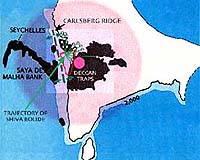
Shiva Crater


Did a very large comet or asteroid strike (600 by 400 kilometers across, likely made by a body 40 kilometers across) the Indian coastline and kill the dinosaurs?


Shiva: Another K-T Impact?


Diagram of Shiva impact area. Credit: Sankar Chatterjee.
by Leslie Mullen for Astrobiology Magazine
http://www.spacedaily.com/news/deepimpact-04r.html


Shoemaker-Levy 9 revisited: or The Geology of the K/T Impact Craters on Earth or Wiping out the Dinosaur with Five Simultaneous Impacts…or
Thomas J. Teters
http://starmon.com/KT_craters.html


http://books.google.com/books?hl=en&lr=&id=3IORF1Ei3LIC&oi=fnd&pg=PA31&dq=Chatterjee+and+Rudra+1996+Shiva&ots=ngYDm9C0s_&sig=pv_rRhdm0ZaWQ32GCjDhgN4SnuA#v=onepage&q=&f=false


THE SHIVA CRATER: IMPLICATIONS FOR DECCAN VOLCANISM, INDIA-SEYCHELLES RIFTING, DINOSAUR EXTINCTION, AND PETROLEUM ENTRAPMENT AT THE KT BOUNDARY
CHATTERJEE, Sankar1, GUVEN, Necip2, YOSHINOBU, Aaaron2, and DONOFRIO, Richard3, (1) Geosciences, Texas Tech Univ, MS Box 41053, Lubbock, TX 79409-3191, sankar.chatterjee@ttu.edu, (2) Department of Geosciences, Texas Tech Univ, Lubbock, TX 79409-1053, (3) Exploration and Development Geosciences, University of Oklahoma, Norman, OK 73069

http://gsa.confex.com/gsa/2003AM/finalprogram/abstract_58126.htm


THE SIGNIFICANCE OF THE CONTEMPORANEOUS SHIVA IMPACT STRUCTURE AND DECCAN VOLCANISM AT THE KT BOUNDARY
CHATTERJEE, Sankar, Geosciences, Texas Tech Univ, MS Box 41053, Lubbock, TX 79409-3191, sankar.chatterjee@ttu.edu and MEHROTRA, Naresh M., Paleobotany, Birbal Sahni Institute of Paleobotany, 53 University Road, Lucknow, 226007, India
http://gsa.confex.com/gsa/2009AM/finalprogram/abstract_160197.htm


Shiva: Another K-T impact?
by Leslie Mullen  
http://www.astrobio.net/exclusive/1281/shiva-another-k-t-impact

08 October 2009

NASA Refines Asteroid Apophis' Path Toward Earth

DC Agle 818-393-9011

Jet Propulsion Laboratory, Pasadena, Calif.
agle@jpl.nasa.gov

Dwayne Brown 202-358-1726
NASA Headquarters, Washington
dwayne.c.brown@nasa.gov

News release: 2009-151 Oct. 7, 2009

NASA Refines Asteroid Apophis' Path Toward Earth

PASADENA, Calif. -- Using updated information, NASA scientists have recalculated the path of a large asteroid. The refined path indicates a significantly reduced likelihood of a hazardous encounter with Earth in 2036.

The Apophis asteroid is approximately the size of two-and-a-half football fields. The new data were documented by near-Earth object scientists Steve Chesley and Paul Chodas at NASA's Jet Propulsion Laboratory in Pasadena, Calif. They will present their updated findings at a meeting of the American Astronomical Society's Division for Planetary Sciences in Puerto Rico on Oct. 8.

"Apophis has been one of those celestial bodies that has captured the public's interest since it was discovered in 2004," said Chesley. "Updated computational techniques and newly available data indicate the probability of an Earth encounter on April 13, 2036, for Apophis has dropped from one-in-45,000 to about four-in-a million."

A majority of the data that enabled the updated orbit of Apophis came from observations Dave Tholen and collaborators at the University of Hawaii's Institute for Astronomy in Manoa made. Tholen pored over hundreds of previously unreleased images of the night sky made with the University of Hawaii's 2.2-meter (88-inch) telescope, located near the summit of Mauna Kea.

Tholen made improved measurements of the asteroid's position in the images, enabling him to provide Chesley and Chodas with new data sets more precise than previous measures for Apophis. Measurements from the Steward Observatory's 2.3 meter (90-inch) Bok telescope on Kitt Peak in Arizona and the Arecibo Observatory on the island of Puerto Rico also were used in Chesley's calculations.

The information provided a more accurate glimpse of Apophis' orbit well into the latter part of this century. Among the findings is another close encounter by the asteroid with Earth in 2068 with chance of impact currently at approximately three-in-a-million. As with earlier orbital estimates where Earth impacts in 2029 and 2036 could not initially be ruled out due to the need for additional data, it is expected that the 2068 encounter will diminish in probability as more information about Apophis is acquired.


Initially, Apophis was thought to have a 2.7 percent chance of impacting Earth in 2029. Additional observations of the asteriod ruled out any possibility of an impact in 2029. However, the asteroid is expected to make a record-setting -- but harmless -- close approach to Earth on Friday, April 13, 2029, when it comes no closer than 29,450 kilometers (18,300 miles) above Earth's surface.

"The refined orbital determination further reinforces that Apophis is an asteroid we can look to as an opportunity for exciting science and not something that should be feared," said Don Yeomans, manager of the Near-Earth Object Program Office at JPL. "The public can follow along as we continue to study Apophis and other near-Earth objects by visiting us on our AsteroidWatch Web site and by following us on the @AsteroidWatch Twitter feed."

The science of predicting asteroid orbits is based on a physical model of the solar system which includes the gravitational influence of the sun, moon, other planets and the three largest asteroids.

NASA detects and tracks asteroids and comets passing close to Earth using both ground and space-based telescopes. The Near-Earth Object Observations Program, commonly called "Spaceguard," discovers these objects, characterizes a subset of them and plots their orbits to determine if any could be potentially hazardous to our planet.

JPL manages the Near-Earth Object Program Office for NASA's Science Mission Directorate in Washington. JPL is a division of the California Institute of Technology in Pasadena. Cornell University, Ithaca, N.Y., operates the Arecibo Observatory under a cooperative agreement with the National Science Foundation in Arlington, Va.

For more information about asteroids and near-Earth objects, visit:
http://www.jpl.nasa.gov/asteroidwatch
For more information about NASA, visit:
http://www.nasa.gov/

07 October 2009

Crashing to Ground: Anniversary of the Impact of 2008 TC3

From: http://365daysofastronomy.org/2009/10/06/october-6th/  (Listen to Podcast there)
October 6th: Crashing to Ground: Anniversary of the Impact of 2008 TC3Date: October 6, 2009
Title: Crashing to Ground: Anniversary of the Impact of 2008 TC3

Podcaster: Emily Lakdawalla
Organization: Planetary Society

Description: A year ago today was the first time ever that a celestial object was discovered before it was to crash into Earth. 2008 TC3 was discovered by a telescope in Arizona and tracked by astronomers in Australia, Asia, and Europe before igniting as a fireball in the sky over the Nubian desert of northern Sudan. I'll tell you about the discovery and how TC3 became the first direct link between asteroids and meteorites.

Bio: Emily Lakdawalla is a planetary geologist and writer who works for the world's largest space interest group, The Planetary Society, as its blogger, web writer, and contributor to the weekly Planetary Radio podcast. She lives in Los Angeles with a 3-year-old who can list all the planets for you, a new baby who has yet to learn their names, and a husband who likes to pretend he doesn't know anything about space.

Today's sponsor: This episode of "365 Days of Astronomy" is sponsored by the American Astronomical Society, the major organization for professional astronomers in North America, whose members remind everyone that One Sky Connects Us All. Find out more or join the AAS at aas.org.
Transcript:

Hi, I'm Emily Lakdawalla, and I write for The Planetary Society's website at planetary dot org slash blog. Today I'm remembering the impact of two thousand eight TC3, an asteroid that crashed into Earth a year ago today.

Both amateur and professional astronomers discover new near-Earth asteroids practically every day. And it's also pretty common for people standing on the ground to see a fireball streaking through the sky as a small asteroid burns up in the atmosphere. But until last year, no one had ever discovered a near-Earth asteroid that was going to hit Earth with 100 percent certainty. TC3 was the first. And it all happened really fast.

On October 6, two thousand and eight, astronomers at the University of Arizona were doing routine sky surveys to look for near-Earth asteroids. It was nighttime in Arizona, of course, but in order to tell this story without hopeless confusion I'll have to use Universal Time.

 time when the Arizona astronomers detected something moving against the background of known stars. Some quick computer work revealed that the object was new. But the computer also spat out an orbital path for the object that was a huge surprise: the predicted path intersected the path of Earth. The new object was on a collision course. The University of Arizona team submitted their observation to the Minor Planet Center, a clearinghouse for orbital data on the thousands upon thousands of tiny rocks that wander around the solar system. A little later, two more Arizona observatories spotted the object, and all of them arrived at the stunning conclusion that it was going to hit Earth.

Soon the rotation of Earth carried the new object out of view from Arizona and California; its position was now over the vast Pacific ocean. No one in Hawaii seems to have spotted it that night. More hours passed. The rotation of Earth finally brought sunset to Australia. In Moorook, near Adelaide in southern Australia, a remotely operated Global Rent-A-Scope instrument picked up the object too. With the Australian observation in hand, the Minor Planet Center finally had a long enough observational arc to issue a Minor Planet Electronic Circular. This was at about fifteen hundred hours Universal Time, eight hours after the initial discovery. The Minor Planet Center named the body two thousand eight TC3 and advised the astronomical community that, quote, "The nominal orbit given above has two thousand eight TC3 coming to within one earth radius around Oct. 7. The absolute magnitude indicates that the object will not survive passage through the atmosphere. Steve Chesley of the Jet Propulsion Laboratory reports that atmospheric entry will occur over northern Sudan." End of quote. The impact was predicted to occur less than thirteen hours after the circular was issued.

TC3 was so close and so dim that astronomers knew it was small, no more than a few meters across and maybe 80 tons in mass. This was a relief; such a small object would probably burn up and pose no risk to anything on the ground, especially since it was predicted to hit Earth in a remote and relatively unpopulated area of the Nubian desert. But this was the first time ever that an object had been seen before it was to hit Earth, and astronomers around the world scrambled to their telescopes to observe it.

They had to hurry; not only was the impact predicted to happen in less than thirteen hours, but TC3 would actually pass into Earth's shadow an hour before it hit. The discovery was too late for anyone in the Americas to spot it; now it was up to Asians, Europeans, and Africans.

I think most astronomers racing to their telescopes on the night of October six and seven did so mostly for the sheer thrill of tracking and following a heavenly body that was going to crash into Earth. But the observations had a more important purpose: to refine the orbit of the object, which would, in turn, improve astronomers' predictions of where it'd hit. Over the next eleven hours, twenty-four Minor Planet Electronic Circulars were issued with further details, pinning down TC3's flight path with high precision. Some of the observers were professionals, but the majority of the observations were done by amateurs, people who might be businessmen or bankers during the day but who harbored a passion for stargazing at night.

Astronomers weren't only gathering positional information. They were also racing to study TC3's color. Asteroids in space are classified according to the different ways they reflect and emit light. Using the science of spectroscopy, careful measurement of their brightness at different wavelengths of light gives scientists clues about an asteroid's composition, whether it's rocky or metallic, old and weathered or young and freshly broken. Professional astronomers at Armagh [ar-MAH] observatory in Ireland scrambled to spot TC3 and managed to record its spectra. Shortly later, the William Herschel telescope in the Canary Islands managed the same feat.

TC3 was so close to Earth that the different observing angles of different observers on different parts of the globe made its position appear to shift against background stars due to parallax. Parallax allowed the Minor Planet Center and the professional asteroid watchers at the Jet Propulsion Laboratory, or JPL, to predict its orbit with much greater precision than usual. The initial impact prediction was formally confirmed by JPL scientist Paul Chodas [CHO-duss] just an hour before its predicted impact time, oh two forty-six UTC.

Astronomers in Spain were the last to record an image. In fact, they captured a movie that showed TC3 winking out as it crossed into Earth's shadow, hiding it from view for its final hour of existence. With that, time had run out to observe the asteroid.

As TC3 entered the atmosphere, it began to compress the air in front of it. Do you remember the ideal gas law from high school chemistry? Pressure is proportional to temperature -- so if you jack up the pressure, so goes the temperature. Pretty soon, the incoming asteroid made the air so hot that it incandesced, glowing in visible light. TC3 had started out as a dim dark rock, but now it was a brilliant fireball.

One resourceful astronomy enthusiast, an aviation meteorologist at the Dutch National Weather Service, called an official at the Amsterdam airport and alerted him about the incoming asteroid. He radioed crews of planes in the air over northeastern Africa and told them to look out for the fireball. Amazingly, the alert worked! A KLM airliner that was about fourteen hundred kilometers to the southwest of the predicted atmospheric entry point observed a short flash just before the expected impact time.

Another detection came not from the flash but from the boom. A seismologist from the University of Western Ontario in Canada examined records from an infrasonic array, a set of remotely operated devices designed to listen for earthquakes. He found that he'd detected a one to two-kiloton blast just before the predicted impact time.

And that was it, for a while. TC3 had come in, excited the astronomical community, and then vanished.

But it turns out that wasn't the whole story. The next morning, on October 7, the Muslim faithful of the Nubian desert emerged from morning prayers to see a sky filled with twisted, white, smoky streaks. Faced with this strange phenomenon, the Sudanese villagers did what any citizens of the twenty-first century would do -- they took photos of the sky with their cell phones and shared them with their friends and relations.

A few months later, Peter Jenniskens, a meteor astronomer at NASA's Ames Research Center, contacted Mauwia Shaddad, a physicist at the University of Khartoum. Together the two men organized an expedition to the Nubian desert to search for any fragments of the asteroid that might have survived the fireball.

In December, Jenniskens, Shaddad, and 45 students and staff set off from Station 6 of the local railway line along the flight trajectory of TC3. Quickly one of the students, Mohammed Alameen, found a black odd-looking rock that looked like a meteorite. It proved to be the first fragment of 2008 TC3, now named "Almahata Sitta," Arabic for "Station 6." Over several weeks, the expedition collected nearly 280 pieces of the asteroid strewn over 29 kilometers of desert. Altogether the meteorites weighed less than 5 kilograms – all that remained of the 80-ton asteroid.

It was a remarkable find: For the first time ever a celestial body that was observed in space was subsequently collected on the ground on Earth and made available for laboratory study. Spectral measurements were compared with the direct analysis of the meteorite shards. The two studies agreed closely, reassuring astronomers that spectral analysis really is a reliable way to understand the composition of small asteroids. The close correspondence suggested that small bodies like TC3 aren't heavily coated with dust, which can distort spectroscopic measurements of larger objects.

All in all, I think the episode of 2008 TC3 has proven that the world's astronomical community, made up of amateurs and professionals both, is prepared to respond when an object on a collision course is detected. Within just a few hours of its discovery, the digitally connected world knew exactly where and when TC3 would hit, and also that it posed no threat. It was a wonderful simulation of the first part of the call to arms when a truly threatening object is detected.

But now we have to ask ourselves: what would have happened if the object was much bigger than a few meters across? One reassuring fact is that a bigger object would most likely have been spotted sooner, because it would have been brighter. Still, though, the warning time for a tens-of-meter-diameter object could only be measured in days. If we'd had three days' warning of a dangerous impactor heading for Sudan, what could the world have done? The remote location of the impact would have been fortunate for humanity in general, but disastrous for the few people who lived out in that remoteness. Could the developed world have done anything to prevent yet another humanitarian disaster from befalling the Sudanese?

Here at The Planetary Society, we're seeking answers to these questions. We've joined the Association of Space Explorers and the B612 Foundation in their efforts to develop an international framework for planetary defense. When the time is right, we'll push for action on this issue from the United Nations' Committee on the Peaceful Uses of Outer Space. In the meantime, we're supporting amateur astronomers around the world with our Shoemaker Near Earth Object Grant program, which allows amateurs to buy equipment that helps them to make those all-important tracking and followup observations.

You can learn more about asteroid TC3 and The Planetary Society's work to reduce the risk we face from near-Earth objects on our website at planetary.org. I'll have lots of photos and links for you on my blog at planetary dot org slash blog. Thanks for listenin