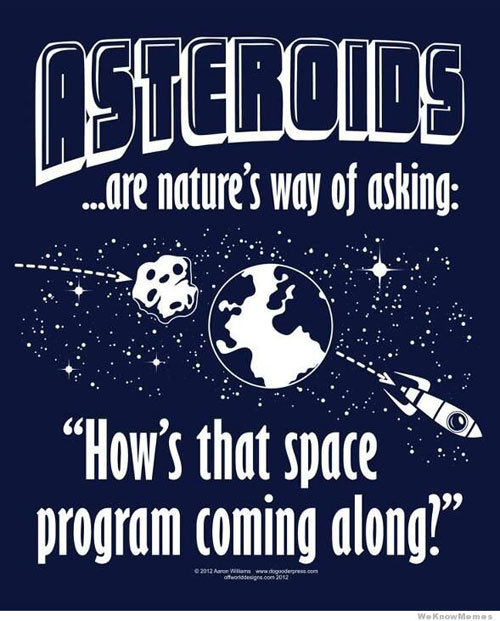
What an amazing and unprecedented post-Valentine's day surprise!
In the same day that the close approach of 2012 DA14, a 50 meter "city killer" class asteroid, discovered less than one year ago, came zipping by within 27,700 km of the Earth, well inside the band of communications satellites in Geosynchronous orbit, and less than 1/13th the distance to the Moon, there Siberia Russia experienced its second major meteor strike in barely 100 years, and the first-ever meteor strike in the modern era to result in human injuries. Is it wishful thinking that such events might elevate Asteroids in the public discourse and lead to some proactive policymaking?
From: http://www.latimes.com/news/world/worldnow/la-wn-fg-chelyabinsk-meteor-lessons-20130216,0,4643856.story
"It is high time Russia should start heavily investing in building an advanced space danger monitoring and warning system and above that a system capable of destroying such super bombs falling on us from the skies."
The Chelyabinsk region has long been one of the most important military-industrial regions of Russia, where you "can’t drive a mile without passing a defense or a nuclear industry installation," the scientist said.
"We should be thankful to fate that this meteor in fact was a blessing in disguise and instead of destroying a significant part of Russia with quite dire consequences to the rest of the world, it sent us a clear warning signal by simply blowing up a bunch of windows and lightly injuring over 1,000 people," Lipunov said.
Bagrov spoke in favor of creating an early warning system of satellites monitoring space for signs of approaching danger instead of restoring a global land- and sea-based system. Lipunov argues that a space system would be more expensive and may take a decade to install -- and even then it would not be as reliable as an Earth-based system equipped with powerful telescopes.
Regional Gov. Mikhail Yurevich told reporters Saturday that the material damage to the region already exceeds $33 million. He said that 30% of about 100 square meters of broken windows had already been replaced.
The explosion damaged 3,000 residential houses, 34 hospitals and clinics and 360 schools and kindergartens, as well as several businesses. High school and university students received a day off Saturday. At least three hockey games were canceled because of damage to the local rink.
Read more: http://www.foxnews.com/science/2013/02/15/injuries-reported-after-meteorite-falls-in-russia-ural-mountains/#ixzz2L5QFgH9U
In the same day that the close approach of 2012 DA14, a 50 meter "city killer" class asteroid, discovered less than one year ago, came zipping by within 27,700 km of the Earth, well inside the band of communications satellites in Geosynchronous orbit, and less than 1/13th the distance to the Moon, there Siberia Russia experienced its second major meteor strike in barely 100 years, and the first-ever meteor strike in the modern era to result in human injuries. Is it wishful thinking that such events might elevate Asteroids in the public discourse and lead to some proactive policymaking?
From: http://abcnews.go.com/GMA/video/russian-city-hit-meteor-1200-people-hurt-18518828
1,200 People injured, 4,000 Buildings damaged, 1 million square feet of glass shattered
Meteor weighed more than Eiffel Tower
"It is high time Russia should start heavily investing in building an advanced space danger monitoring and warning system and above that a system capable of destroying such super bombs falling on us from the skies."
The Chelyabinsk region has long been one of the most important military-industrial regions of Russia, where you "can’t drive a mile without passing a defense or a nuclear industry installation," the scientist said.
"We should be thankful to fate that this meteor in fact was a blessing in disguise and instead of destroying a significant part of Russia with quite dire consequences to the rest of the world, it sent us a clear warning signal by simply blowing up a bunch of windows and lightly injuring over 1,000 people," Lipunov said.
Bagrov spoke in favor of creating an early warning system of satellites monitoring space for signs of approaching danger instead of restoring a global land- and sea-based system. Lipunov argues that a space system would be more expensive and may take a decade to install -- and even then it would not be as reliable as an Earth-based system equipped with powerful telescopes.
Regional Gov. Mikhail Yurevich told reporters Saturday that the material damage to the region already exceeds $33 million. He said that 30% of about 100 square meters of broken windows had already been replaced.
The explosion damaged 3,000 residential houses, 34 hospitals and clinics and 360 schools and kindergartens, as well as several businesses. High school and university students received a day off Saturday. At least three hockey games were canceled because of damage to the local rink.
From: http://www.foxnews.com/science/2013/02/15/injuries-reported-after-meteorite-falls-in-russia-ural-mountains/
The meteor -- estimated to be about 10 tons and 49 feet wide -- entered the Earth's atmosphere at a hypersonic speed of at least 33,000 mph and shattered into pieces about 18-32 miles above the ground, the Russian Academy of Sciences said in a statement. But even small asteroids pack a tremendous punch, explained Andrew Cheng of the Johns Hopkins Applied Physics Laboratory.
"It doesn’t take a very large object. A 10-meter size object already packs the same energy as a nuclear bomb," Cheng, who led a 2000-2001 mission for NASA to orbit and land on an asteroid, told FoxNews.com.
"There was panic. People had no idea what was happening," said Sergey Hametov, a resident of Chelyabinsk, a city of 1 million about 930 miles east of Moscow.
The meteor hit less than a day before Asteroid 2012 DA14 is to make the closest recorded pass of an asteroid to the Earth for a rock of its size -- about 17,150 miles. But the European Space Agency said its experts had determined there was no connection -- just cosmic coincidence.
The meteor released several kilotons of energy above the region, the Russian science academy said. According to NASA, it was about 15 meters or 49 feet wide before it hit the atmosphere, about one-third the size of the passing asteroid.
Lessons had just started at Chelyabinsk schools when the meteor exploded, and officials said 258 schoolchildren were among those injured. Amateur video footage showed a teacher speaking to her class as a powerful shockwave hit the room.
The site of Friday's spectacular show is about 3,000 miles west of Tunguska, which in 1908 was the site of the largest recorded explosion of a space object plunging to Earth. That blast, attributed to a comet or asteroid fragment, is generally estimated to have been about 10 megatons; it leveled some 80 million trees.
Scientists believe that a far larger meteorite strike on what today is Mexico's Yucatan Peninsula may have been responsible for the extinction of the dinosaurs about 66 million years ago. According to that theory, the impact would have thrown up vast amounts of dust that blanketed the sky for decades and altered the climate on Earth.
The meteor could have produced much more serious problems. Chelyabinsk is an industrial town long held to be one of the world's most polluted areas, and the area around it hosts nuclear and chemical weapons disposal facilities.
Vladimir Chuprov of Greenpeace Russia said the Russian government has underestimated potential risks of the region. He noted that the meteor struck only 60 miles from the Mayak nuclear storage and disposal facility, which holds dozens of tons of weapons-grade plutonium.
A chemical weapons disposal facility at Shchuchye also contains some 6,000 tons of nerve agents, including sarin and VX, about 14 percent of the chemical weapons that Russia is committed to destroy.
Jim Green, NASA's director of planetary science, called the back-to-back celestial events an amazing display.
"This is indeed very rare and it is historic," he said on NASA TV. "These fireballs happen about once a day or so, but we just don't see them because many of them fall over the ocean or in remote areas."
Read more: http://www.foxnews.com/science/2013/02/15/injuries-reported-after-meteorite-falls-in-russia-ural-mountains/#ixzz2L5QFgH9U

