Unless mankind leaves the Earth, it will surely die there. This blog is dedicated to exploring the manifest destiny of mankind to fill all creation with life and intelligence.
Check out this presentation from Shreyankur Tripathi of Amity University, Uttar Pradesh, India, "The objective of the paper is to understand the Space based Solar Power along with its advantages, disadvantages, design and other important aspects and then finally discussing about its feasibility."
When I started looking at Space Solar Power close to 7 years ago, you could only find a very few links on the Internet...perhaps 1 on NASA, and 2 on Space.com, one on SFF, and Permanent.com. How things have changed. I was doing some surfing for images, and look at these beautiful NEW images and web articles:
Here is yet another move to meet the global energy needs. The solar power generation is not a new concept, however, placing solar arrays in space to capture the maximum energy of the Sun can be a step further. Californian utility PG & E and SolarEn corp. have joined hands to fix solar panel arrays in space. The concept is estimated to generate 200MW of power by 2016. The plant costing an estimated $2 billion will provide sufficient energy to light up 250,000 homes.
Converting solar energy in space to electricity
SolarEn proposes to launch satellite, draped with solar panels, in the Earths’ orbit 22,000 miles above the Equator. These satellites will collect and convert solar energy into radio frequencies. The RF is transferred to its ground station in California, which then converts it into electricity and transmitted through power grids to the PG&E delivery point.
Impact on Environment
The Space-based solar power plant has minimal impact on the environment. By placing the satellite into their proper orbit, natural fuels like H2, O2, etc will be made use of. When in proper operations, this power plant will have zero carbon emissions thus making the environment free from mercury and sulfur footprints. The SSP Ground Receiver Station, which converts RF energy into electricity, does not require water for thermal cooling and power generation.
Challenges
The SSP plant faces technological and economic challenges before it becomes a reality.
• Getting a supersized solar array into the space is the major concern of SolarEn.
• High development cost is a major drawback of the project.
Failed projects of Space based solar power
• In August 2008, NASA launched the Nano-Sail D mission into the space, which was designed to test the feasibility of solar sails. The mission failed a few minutes after its launch.
• On 21st June 2005, the engine of Volna booster rocket (a joint Russian - U.S. project), failed minutes after its takeoff.
• In 1999, Russia launched a project similar to Volna booster from its Mir space with a sun-reflecting device. Due to some technical failure, the system burned in the atmosphere.
Plan To Transform The Moon Into a Solar Plant is Sheer LUNAcy
by Ariel Schwartz, 06/01/10
filed under: Renewable Energy, Solar Power
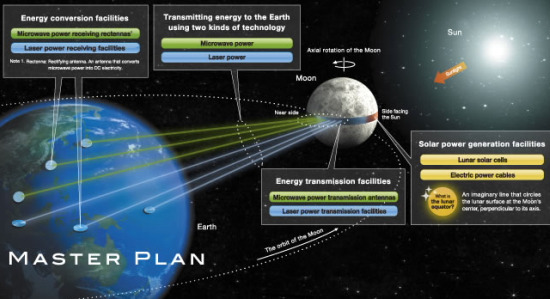
We’ve heard about schemes to gather solar power directly from space before, but designers at Japan’s Shimizu Corporation have taken the idea to a new level with the Luna Ring, a concept solar power plant on the moon. The plan involves building a 6,800 mile “solar belt” around the moon, beaming electricity to earth with microwaves and lasers, and setting up receiving stations on Earth where the power can then be used.
Shimizu even has a grand plan for bringing the resources for the solar plant to the moon. Humans will barely be involved–all construction will be taken care of by robots with oversight from astronauts. The company explains that, “Water can be produced by reducing lunar soil with hydrogen that is imported from the Earth. Cementing material can also be extracted from lunar resources. These materials will be mixed with lunar soil and gravel to make concrete. Bricks, glass fibers and other structural materials can also be produced by solar-heat treatments.”
Compelling ideas, to be sure, but we’d like to see evidence that any of this is possible. If we can’t get robots to fix an oil spill 5,000 feet below the ocean’s surface, how can we possibly expect them to build a gigantic solar power plant on the moon? Even if this whole scheme was proven possible, the costs would be astronomical — pun fully intended. Still, we can’t fault Shimizu for being ambitious. And while a 6,800 mile solar belt may be far-fetched, that doesn’t mean a more reasonably-sized solar power plant can’t someday end up on the moon.
+ Shimizu Corporation
Via Pink Tentacle
Read more: The Insane Plan to Transform The Moon Into a Giant Solar Plant | Inhabitat - Green Design Will Save the World
Mega-engineering: awesome future concepts from Shimizu Corporation
Paul Raven @ 02-06-2010
Get yourself over to Pink Tentacle right away; they’re hosting a bunch of mega-engineering promo images and design concepts from Japan’s Shimizu Corporation, who plainly aren’t afraid to think in directions with strong science fictional undertones. Directions such as floating lily-pad cities, million-citizen pyramidal cities, space hotels… and turning the moon into a gargantuan solar power station.
This one’s the winner for me, because any image of a planetary satellite re-engineered into a solar power plant that has the words “MASTER PLAN” masked onto it in large letters is, by any sane and reasonable metric, better than pretty much any other image. Of anything.
Bonus! Compare and contrast with these images of Russian space-race installations and rolling stock decaying the middle of nowhere [via Chairman Bruce]. Maybe one day in the deeper future, people will tut and shake their heads at images of Shimizu’s lunar power station, pocked with impact damage and slowly drowning in lunar dus
By Jennifer Kho Jun. 16, 2009, 5:05pm PDT 1 Comment
Do you like this story?
Solar from space: It may sound like a bad sci-fi movie, but a growing number of companies think it could solve the world’s energy crisis. Among them is Everett, Wash.-based PowerSat Corp., which said today it’s filed a provisional patent for two technologies it claims could help make the transmission of solar power from space more cost-effective. CEO William Maness also told us that the 8-year-old company has received commitments for $3-$5 million in angel funding, which it’s using to develop wireless power demonstrations on Earth, and is currently in negotiations for a first venture round in the single-digit millions.
The PowerSat news comes after Manhattan Beach, Calif.-based Solaren, another space solar company, in April signed a deal to provide power to northern California utility PG&E. And Swiss startup Space Energy recently said it’s working to launch a prototype satellite into space in 2-3 years.
Solar In Space
Space solar promises virtually unlimited power, with no carbon dioxide emissions. Undiminished by atmosphere or cloud cover, the sun’s energy is five times more powerful than can be found on even the brightest desert on the planet, according to PowerSat’s web site. And since the sun shines at full power all the time, solar energy-capturing satellites — called powersats — can receive more than 25 times as much power as a ground-based system of the same size, the company says.
Here’s how space solar would work: Power satellites armed with solar arrays would generate direct-current electricity, then convert that electricity into radio-frequency energy, which they would transmit the same way that radio travels to your car. But instead of using electricity to transmit information, as a radio signal does, these satellites would be sending the electricity itself. The radio frequency would get converted back into DC electricity at the receiver on the ground.
The huge potential has been apparent for decades, but space solar faces plenty of challenges. The biggest challenge so far, says Maness, is that it’s considered a risky investment. Nobody wants to invest billions of dollars to launch unproven technology into space, but it’s hard to prove the technology works without trying it out on location. Those billions of dollars represent another major hurdle. Even SpaceX‘s target price of $500 per pound, with its Falcon 9 spaceship, is about 20 percent too high to make a commercial space-solar project viable, and other launch estimates “aren’t even in the ballpark,” Maness said.
PowerSat’s Innovation
Now, PowerSat has come up with two technologies that it claims could shave off roughly $1 billion in launch and operation costs for a 2.5-megawatt power station. The first of these is called BrightStar. Instead of one large satellite, Brightstar uses a cluster of hundreds of small ones, which work together — similar to cloud computing — to transmit the power as a group.
The second technology, called Solar Power Orbital Transfer or SPOT, uses the same solar array needed for wireless power transmission to power the electronic thrusters that boost the satellites from what’s called “low Earth orbit,” which is 300-1,000 miles up, to “geosynchronous Earth orbit,” which is 22,236 miles up. Other satellites use a chemically fueled “space tug” to get to the geosynchronous level, and eliminating that power source reduces the weight of a satellite by 67 percent, dramatically decreasing launch costs, Maness said.
The company is developing a 10-kilowatt demonstration project with unnamed potential clients. In about three years, PowerSat hopes to launch a low-earth-orbit project, which will cost about $100 million. And within five years, the startup plans to look for a partnership with a utility, a public-private partnership involving the government or an initial public offering to raise the money for a full-sized project.
PowerSat plans to launch a prototype project into geosynchronous orbit in 2015 and to reach full power production between 2019 and 2021. It expects the smallest economically viable project, with a capacity of 2.5 gigawatts, to cost between $4-$5 billion.
Raising that kind of money, even with proof in place, will be a colossal task. And a long path — the company hasn’t even raised its first single-digit million venture round, although it has closed angel funding. It’s clear that while space solar may be flying closer, it still has a long way to go.
How Do You Feel About “Space Based Solar Power”?Filed Under Tech Questions
Tuesday, 20 October 2009 | Posted by John
That is correct. Solar Based Solar Power is one thing that might be considered and would change everything! I see the picture and I think to myself “what if this things is tilted 10 degrees in the wrong direction”? Is there any possibility of this thing creating a major disaster on Earth?
The article says that “low powered beams are considered safe”, but what happens when you put your cat in the microwave? (please do not abuse your kitty). The technology is simple and really, it seems like a great idea, but to only support the electricity for 1,000 homes, just doesn’t seem worth it to me.
There is a receiving grid a mile wide, even that takes up too much room. I would put the worth of the idea higher if it could power 10,000 homes. Small cities could take advantage and maybe even help to fund projects like this. To power only 1,000 homes, the city I live near would have to send up 50 light collectors and have a receiving area even larger to convert the light on Earth.
It is nice to see others “looking outside the box”, at least. The ideas may seem far fetched, but at least they are in idea form. I would like to talk to whomever thinks it’s cost effective to send up a solar collector that can only power 1,000 homes.
SSPS (Space Solar Power Satellites) & Ground Collectors
Nasa and a number of other agencies have proposed placing giant satellites in geosynchronous Earth Orbit (GEO) to collect sunlight with solar cells. The energy would be converted to a maser beam which would be beamed to the ground to supply earth's energy needs with free, clean, sustainable energy. The basic concept of the SSPS is to beam microwaves from space. The energy would be collected by vast collectors at the ground at high efficiency (around 90%).
The basic technology is now entirely proven with satellite communication relays. The barriers to its development to high power levels are mainly associated with launch costs, a limitation that may well be overcome with BEP technology.
Space Solar Power Satellite
Maser powered from space By concentrating on our future domestic energy supply, the proponents of SSPSs have so far failed to stress the very real potential this technology has to supply the energy needed to get the whole system into space both cheaply and efficiently. They also apparently ignore the obvious fact that, assuming BE propulsion is developed first, then the cost of launching these payloads into space could be reduced 1000x.
Enthusiasts propose placing a series of massive SSPS's (each 1km-5km in diameter) in GEO. Each 1km2 of satellite collector would receive 1.36Gigawatts of solar energy and, using solid-state technology, convert a modest percentage (~30%?) of this energy into coherent microwaves (ie a maser) to produce a near-constant 400Mw at the ground.
The higher E/D in space and the high total hours of operation, (24/7 for 99% of the year) would make a space installation 4x-5x more effective than any ground-based solar collector. The energy is also made available when other (solar-based) supplies are off line (ie in winter and at night.
When the world converts to solar, night time energy will be at a premium
Ground Power Stations
Ground stations would go hand-in-hand with the space collectors. An efficient ground reciever would be a light metal grid or netting 5km-6km in diameter. It could be situated almost anywhere on the ground below (or in shallow water) from the equator to the arctic circle. Aerial relays positioned in the upper atmosphere could also feed smaller ground arrays or extend this range, if necessary.
Around the clock, 1.3 gigawatts of energy pour through every square kilometre of space around the earth. This energy could be captured by vast arrays of photovoltaic cells mounted on a satellite in orbit around the planet. These solar cells would be illuminated at all times of day, whatever the weather or the season, overcoming one of the main drawbacks of solar power on the earth’s surface. And with no atmosphere in the way to absorb or scatter the incoming sunlight, solar panels in space would produce over five times as much energy as those on the ground. (Some proposals for SSP involve large arrays of mirrors or lenses to concentrate the light onto a smaller array of panels.)
The logical place to put the satellite would be in a geostationary orbit, 35,800 kilometres above the earth’s equator, so that it completes one circuit of the planet per day, and thus appears (from the ground) to hover in a fixed place in the sky, like the communications satellites used to broadcast television signals. The solar-power satellite would send the collected energy down to earth in the form of a microwave beam, which would be picked up on the ground by a huge array of antennae, spread over several square kilometres in open country. The power density of the beam at the receiver would be little greater than what leaks out from a domestic microwave oven, so there would be no danger of incinerating entire cities. Microwave communications links are already used in the telecoms industry without doing any harm to wildlife.
Posted by Robert Volpe at Saturday, January 31, 2009
Researcher Nobuyuki Kaya showed how solar power could be sent back to Earth from space using microwaves.
TYLER HAMILTON/TORONTO STAR
It sounds like something out of a sci-fi novel. Solar power plants orbiting the planet, each the size of 700 Canadian football fields, beaming clean energy down to Earth 24 hours a day so we can run our factories, charge our gadgets and keep our home appliances humming.
But for the scientists and engineers attending the International Symposium on Solar Energy from Space, a three-day conference this week in Toronto, there's nothing fictional about it. In their view, building massive space-based solar power systems represents, over the long term, one of the most effective ways of tackling the double menace of global warming and peak oil.
"Space-based solar power is a tremendously exciting prospect," said Liberal MP Marc Garneau, the first Canadian in space, speaking yesterday at the Ontario Science Centre about the potential for Canadian involvement in the project. "This country has all the fundamentals to play a leading role."
The Japanese are already leading the charge. Earlier this month, it was reported that Japan's government, working with a consortium of 16 companies, had committed to a $24 billion project to have a 1,000-megawatt solar station in space within three decades. This would generate enough electricity to power 300,000 homes, though getting the equipment into space would likely require more than 1,000 rocket launches.
Eco website TreeHugger called it Japan's "moon shot." The power station would consist of four square kilometres of solar photovoltaic arrays fixed in orbit about 36,000 kilometres above the planet's surface. Energy collected by the panels would be beamed by microwave to a receiving station back on Earth and converted into electricity before connecting to the land-based power grid.
Scientists say the advantage of putting a solar station in space is that it would face the sun 24 hours a day and would not be limited by cloud cover or air pollution. That would allow it to continuously generate power in the same manner as nuclear and fossil-fuel plants, but without the associated waste and greenhouse-gas emissions.
The idea has been around for 40 years, attracting serious attention from NASA and the U.S. Department of Defense during the 1970s, but funding eventually dried up. It wasn't until the late 1990s that interest in the concept resurfaced, partly as a result of concerns related to global warming and energy security.
Two years ago, the Pentagon's National Security Space Office issued a report that concluded solar-based power "is more technically executable than ever before."
The solar panels are more efficient and less costly to manufacture, technology exists to have robots assemble the station in space, and our understanding of wireless power transmission has improved dramatically.
Former NASA executive John Mankins, now president of the Space Power Association, said he believes space-based solar power could be economically competitive with other options.
Mankins added that he believes a small 10-megawatt demonstration plan could be in orbit within the next 10 years. "It's a reasonable time frame," he said.
At the conference, Nobuyuki Kaya, vice-dean of graduate engineering at Kobe University in Japan, demonstrated how the power could be transmitted wirelessly. Assisted by a team of students, he was able to light up a cluster of red LED lights and power a simple robot by beaming energy about 10 metres across a room.
Kieran Carroll, chief technology officer for Space Canada, which is hosting the conference, said such a system could be safely designed to accept and convert large amounts of energy from space. The trick is to transmit at low intensity by sending it down on a wide beam, about 10 kilometres across.
There would have to be no-fly zones around the area, but it wouldn't fry anyone walking through it.
"The power flux density in the middle of the (receiving) field would be perfectly safe for any life," said Carroll.
"In Canada, on a winter's day, one of the big problems would be that birds would probably hover over the field to get warm."
A reality check, however, came from power developer Wael Almazeedi, who warned of the legal, financial and regulatory challenges the plan would face, as well as the difficulty of "promoting a concept based on science fiction."
---------------------
Here is a Public Policy Discussion on YouTube regarding Space-Based Solar Power at "SpaceUP DC"
The International Academy of Astronautics, the most prestigious global body on Space Issues and Technology has taken up the study of space solar power!
Note also that the ISRO Chairman, Mr. G. Madhavan Nair has been elected the Chairman of the International Academy Astronautics (IAA), the first Indian and the first non-American to hold the post, and will take over 16 Oct (http://www.deccanchronicle.com/national/madhavan-nair-new-head-iaa-844). Already this year, the IAA did the world a tremendous service by publishing (via the support of ISRO) its book, Dealing with the Threat to Earth of Asteroids and Comets, and holding the first international Planetary Defense Conference in Granada, Spain. We can hope for such great support and promotion for Space Solar Power as a solution to the developing and developed world's concerns about energy security and climate change.
Neither India, the US, Canada or China has a program yet that responds to the Japanese $21 Billion program just announced in Space Solar Power.
Exerpts from: The vital need for America to develop space solar power http://www.thespacereview.com/article/1364/1 The vital need for America to develop space solar powerby James M. (Mike) SneadMonday, May 4, 2009
An interesting and timely debate has begun within the American pro-space community about the need to support the start of the commercial development of space solar power (SSP). Given strongly held personal and organizational preferences for space science, suborbital commercial human spaceflight, the human exploration of Mars, etc., it’s not surprising that achieving a consensus to support and strongly advocate for starting the commercial development of SSP has not yet been reached. I argue that the time for such support has arrived. Such support will not only help America and many other nations avoid energy scarcity later this century, but it will also help advance America into a new era of the space age focused on space industrialization that will broadly benefit all pro-space agendas. Given strongly held personal and organizational preferences for space science, suborbital commercial human spaceflight, the human exploration of Mars, etc., it’s not surprising that achieving a consensus to support and strongly advocate for starting the commercial development of SSP has not yet been reached. The SSP concept involves building extremely large space platforms, usually located in geostationary orbit (GEO), to convert sunlight into electrical energy and then transmit this energy to very large ground receivers where the energy is fed into electric utility grids. Invented in 1968 by Dr. Peter Glaser, the concept was promoted by Professor Gerald K. O’Neill of Princeton University in the 1970s and studied extensively by NASA and industry in the late 1970s and early 1980s and, again, in the late 1990s. (For additional information, see the SSP library on the National Space Society’s web site.) Interest in SSP has reemerged in response to the public’s growing appreciation of the need to develop new sustainable energy sources. Compared to other terrestrial renewable alternatives, GEO SSP has four important advantages: Its scale of potential generation capacity is very large, an important consideration in formulating policies and plans to avoid future energy scarcity. It should have the ability to provide high quality electrical power—nearly 365 days of the year, 24 hours a day—for baseload electrical power supply comparable to nuclear energy. It should have nearly worldwide access and usability enabling countries to achieve a degree of energy independence even when traditional renewable energy sources are not practical. It should have important terrestrial environmental benefits, including avoiding thermal waste heat ejection and minimizing the land area otherwise needed for terrestrial renewable energy generation. The threat of energy scarcity is quite real and should not be ignored by the pro-space community. When Professor O’Neill wrote The High Frontier: Human Colonies in Space in the 1970s, he addressed the need for humanity to develop new renewable energy sources to replace non-sustainable carbon fuels. He made use of Dr. Glaser’s SSP concept as the economic purpose for building off-world habitats and initiating space industrialization. In my recent white paper, “The End of Easy Energy and What to Do About It”, I focused on the issue of energy security and what needs to be done as we move toward 2100. To accept the paper’s conclusion that starting the development of SSP is now vital, an appreciation of the future energy needs and supply situation is needed. Thus, a few energy statistics are helpful to better understand the challenges that we all will face in the coming decades—within the lifetimes of our children and grandchildren—to successfully provide what is correctly described as the “lifeblood” of modern civilization. By 2100 and due entirely to population growth, the United States will require about 1.6X more energy than we are using today. With a population of about 307 million, the United States today uses about 17 billion barrels of oil equivalent (BOE) of energy annually from all sources—with roughly 85 percent coming from non-sustainable easy energy (oil, coal, and natural gas). By 2100, with a projected population of 560 million, the United States will require about 28 billion BOE annually even with a modest decrease in per capita energy use through “energy conservation”. From 2010 to 2100, the United States will need in total about 2,000 billion BOE of energy. At $100 per BOE, Americans would spend about $200 trillion on energy over the next nine decades. The world’s energy needs during the remainder of this century are likely to climb even more rapidly than those of the United States as the world’s developing nations seek economic prosperity and political stability. Today, with only about five billion modern energy consumers, the world uses about 81 billion BOE per year—at roughly the same average per capita energy use as in the United States in 1900. As in the United States, about 85 percent of the world’s energy comes from non-sustainable easy energy sources. To project the world’s energy needs in 2100, 90 percent of today’s average per capita energy use in Japan, Western Europe, and South Korea was used as the basis for the projection. Per capita energy use in these industrial nations—about one-half of that in the United States—represents an energy-frugal standard of living that still enables widespread prosperity and political stability. In 2100, with about 10 billion energy consumers in economically-prosperous and politically-stable countries, the world will need about 280 billion BOE annually. This constitutes an increase from today’s energy consumption by a factor of about 3.5X. With these assumptions, between 2010 and 2100, the world will need about 17,000 billion BOE of energy and, at $100 per BOE, would spend roughly $1,700 trillion on energy. With such a dramatic increase in world energy demand, a reasonable question is how much easy energy resources are left to use? Using the World Energy Council’s 2007 estimates, current world proved reserves of all oil, coal, and natural gas total about 6,000 billion BOE. Based on the optimistic estimates of some experts, a further 6,000 billion BOE of easy energy might be obtained through additional exploration and recovery improvements. For example, if nearly all shale oil in the United States were to be recovered, this could add upwards of 2,000 billion BOE. At best, one may conclude that there might be about 12,000 billion BOE of easy energy left to recover. A less optimistic planning value, due to growing legal and treaty constraints on exploration and recovery, would be 9,000 billion BOE. To highlight the difficulty in finding significant additional resources of this magnitude, the much debated Arctic National Wildlife Reserve (ANWR) has an optimistic total of only about 12 billion BOE of recoverable oil. To add 3,000 billion BOE of additional proved reserves this century, a new “ANWR” must be discovered about every four months! Recent oil exploration history shows that such new major “finds” are now rare. Most additional proved reserves will likely come from improved extraction methods that increase recovery from known deposits and from opening known deposits to production that have been previously set aside, such as shale oil. Today, Americans live at the peak of the era of easy energy. By the end of the century and perhaps decades earlier, this will change. The threat of energy scarcity, even in the United States, is very real. How long will easy energy supplies last? A prosperous world will require on the order of 17,000 billion BOE of energy through 2100. Against this demand, easy energy may be expected to supply 9,000-12,000 billion BOE. Without an aggressive increase in new sustainable energy sources—nuclear and renewables—world easy energy supplies will be exhausted before the end of the century unless a large portion of the world’s population remains in a state of energy deprivation. Even with an aggressive increase in building new sustainable energy sources, it is likely that all of the known 6,000 billion BOE of oil, coal, and natural gas proved reserves will be used as the world builds the sustainable energy infrastructure needed to supply 280 billion BOE of energy annually by 2100. Today, Americans live at the peak of the era of easy energy. By the end of the century and perhaps decades earlier, this will change as most of the world, including the United States, will be running on sustainable energy sources. The greater extent to which additional easy energy resources are excluded from exploration and production, the sooner we will by necessity transition to a general reliance on sustainable energy sources and the sooner we may experience energy scarcity by having insufficient sustainable energy supplies. Time is not on our side in addressing this challenge! The threat of energy scarcity, even in the United States, is very real. It will likely become a primary public policy driver as public awareness of the challenges inherent in transitioning to sustainable energy, as discussed in the following, are better understood. Today’s terrestrial sustainable energy sources can only provide a modest part of the solutionBoth the United States and the entire world get about 15 percent of their energy from sustainable sources. To meet the 2100 need for 1.6X more energy for the United States, our current sustainable energy production must expand by a factor of about 11. To meet the world’s needs for 3.5X more energy by 2100, current world sustainable energy production must expand by a factor of about 23. In the United States, this means that today’s total energy production capacity of nuclear, hydroelectric, geothermal, wind, ground solar electric, and land biomass must be added every decade through the end of the century. For the world, the current sustainable energy production capacity must be added every four years. To help put the needed growth into perspective, assume that hydroelectricity will be used to provide the world’s additional sustainable energy production. China’s Three Gorges Dam will have about 23 GW of generation capacity when completed. America’s Hoover Dam has 2 GW of generation capacity. If the world’s additional sustainable energy needs were to be met solely with hydroelectricity, 12 Three Gorges Dams (equal to 138 Hoover Dams) must be brought online every year through the end of the century. This raises the important planning questions: Can this be accomplished with only current terrestrial solutions? Can it be accomplished in the United States? Some argue that terrestrial sustainable energy sources can meet this challenge. In my white paper, this possibility was explored through a simple 2100 sustainable energy scenario focusing on meeting the United States’ 2100 needs. (Note that in 2100, the United States will need about 10 percent of the world’s total energy supplies.) In this scenario, these optimistic assumptions were made regarding nuclear and renewable energy expansion in the United States: Nuclear enriched uranium fission electrical power generation would be expanded from 101 GW today to 175 GW in 2100 (representing 10 percent of the world’s total 2100 nuclear capacity and consistent with a 120-year world supply of uranium from land resources without reprocessing or breeding). Hydroelectric generation capacity would be expanded from 78 GW to 108 GW (the estimated practical maximum in the US). Geothermal energy would be expanded from 3 GW to 150 GW (reflecting the Department of Energy’s goal for the western United States by 2050). 1.1 million 265-ton land and off-shore wind turbines would be built covering 390,000 square kilometers and stretching in a 8-kilometer wide band along 7,200 kilometers of coastline. 153,000 square kilometers of ground solar photovoltaic systems would be built in the southwestern desert states (with 100 percent land use). 1.3 billion dry tons of land biomass (based on 2005 Departments of Energy and Agriculture projections) would be collected annually from all cropland and accessible forestland and converted to biofuels and oil substitutes. Nuclear, hydroelectric, geothermal, and a modest percentage of wind-generated electrical power are assumed to provide dispatchable electrical power generation to replace coal- and natural gas-fired generators. (Dispatchable generation capacity is what utilities require to prevent brownouts and blackouts while ensuring that customer needs can be met anytime.) Because of the variability of the wind and ground insolation, most wind-generated electricity and all ground solar electricity is assumed to be used to produce hydrogen and hydrogen-based synfuels. All biomass is assumed to be converted to fuels and other oil substitutes. Even with these optimistic assumptions, these expanded sustainable energy sources would provide only about 30 percent of the United States’ needed 1,750 GW of 2100 dispatchable electrical power generation capacity and about 39 percent of the needed 17 billion BOE of 2100 annual fuels production. In the post-easy energy era, the United States would have a shortfall of about 1,200 GW of dispatchable generation capacity and 11 billion BOE of annual fuels production despite over 540,000 square kilometers of the continental United States being used for wind and solar farms. In 2100, with a population that will have nearly doubled, these optimistic projections of US sustainable energy sources would only provide about the same per capita energy supply as the United States had in 1900—about one-third of what is currently being provided. Three possible energy sources that could achieve sufficient generation capacity to close the 2100 shortfall are methane hydrates, advanced nuclear energy, and SSP. The key planning consideration is: Which of these are now able to enter engineering development and be integrated into an actionable sustainable energy transition plan? As discussed in my white paper, the 2100 sustainable energy supply situation for the entire world will be comparable to the United States. With 10X more energy needs and 20X more population than the United States, comparable projections for the sustainable energy production potential for the world finds that only about 47 percent of the needed 17,500 GW of 2100 dispatchable electrical power generation capacity and 37 percent of the needed 172 billion BOE of 2100 annual fuels production could be optimistically provided. The world would have a shortfall of about 9,300 GW of dispatchable generation capacity and 108 billion BOE of annual fuels production despite having nearly 5.2 million square kilometers of land being used for wind and solar farms, collecting and converting 12 billion dry tons of biomass from all cropland and accessible forestland, and building the equivalent of 3,000 Hoover Dams of hydroelectric, geothermal, and nuclear generation capacity. Absent a clear public consensus to dramatically reduce US per capita energy use to near 1900 levels and a willingness to let many billions of people worldwide continue to live in a state of energy deprivation—currently 1.6 billion people do not have access to electricity and 2.4 billion people do not have access to modern fuels per the UN—additional sustainable energy sources will need to be developed. A rational US energy policy and implementation plan must address this issue. This is why starting the commercial development of SSP gains importance. For filling the coming electrical power shortfall, SSP is today’s engineering development-ready answerA key element of a well-reasoned US energy policy is to maintain an adequate surplus of dispatchable electrical power generation capacity. Intelligent control of consumer electrical power use to moderate peak demand and improved transmission and distribution systems to more broadly share sustainable generation capacity will certainly help, but 250 million additional Americans and 5 billion additional electrical power consumers worldwide by 2100 will need substantially more assured generation capacity. Three possible energy sources that could achieve sufficient generation capacity to close the 2100 shortfall are methane hydrates, advanced nuclear energy, and SSP. The key planning consideration is: Which of these are now able to enter engineering development and be integrated into an actionable sustainable energy transition plan? Methane hydrate is a combination of methane and water ice where a methane molecule is trapped within water ice crystals. The unique conditions necessary for forming these hydrates exist at the low temperatures and elevated pressures under water, under permafrost, and under cold rock formations. Some experts estimate that the undersea methane hydrate resources are immense and may be able to meet world energy needs for a century or more. Why not plan to use methane hydrates? The issues are the technical feasibility of recovering methane at industrial-scale levels (tens to hundreds of billions BOE per year) and doing so with acceptable environmental impact. While research into practical industrial-scale levels of recovery with acceptable environmental impact is underway, acceptable production solutions have not yet emerged. As a result, a rational US energy plan cannot yet include methane hydrates as a solution ready to be implemented to avoid future energy scarcity. Most people would agree that an advanced nuclear generator scalable from tens of megawatts to a few gigawatts, with acceptable environmental impact and adequate security, is a desirable long-term sustainable energy solution. Whether this will be an improved form of enriched uranium nuclear fission; a different fission fuel cycle, such as thorium; or, the more advanced fusion energy is not yet known. Research into all of these options is proceeding with significant research advancements being achieved. However, until commercialized reactor designs are demonstrated and any environmental and security issues associated with their fueling, operation, and waste disposal are technically and politically resolved, a rational US energy plan cannot yet include advanced nuclear energy as a solution ready to be implemented to avoid future energy scarcity. We are left with SSP. Unless the US federal government is willing to forego addressing the very real possibility of energy scarcity in dispatchable electrical power generation, SSP is the one renewable energy solution capable of beginning engineering development and, as such, being incorporated into such a rational sustainable energy transition plan. Hence, beginning the engineering development of SSP now becomes a necessity. Planning and executing a rational US energy policy that undertakes the development of SSP will jump-start America on the path to acquiring the mastery of industrial space operations we need to become a true spacefaring nation. Of course, rapid advancements in advanced nuclear energy or methane hydrate recovery or the emergence of a new industrial-scale sustainable energy source may change the current circumstances favoring the start of the development of SSP. But not knowing how long affordable easy energy supplies will remain available and not knowing to what extent terrestrial nuclear fission and renewable energy production can be practically and politically expanded, reasonableness dictates that the serious engineering development of SSP be started now. SSP will jump-start the next era of the space age
Successfully developing SSP and building the integrated spacefaring logistics infrastructure necessary to demonstrate SSP and prepare for serial production of the geostationary platforms can only be successfully undertaken by a true spacefaring nation. The United States is not there yet because, as the US National Space Policy emphasizes, we have not yet developed the “robust, effective, and efficient space capabilities” needed for America to effectively utilize space this century. Planning and executing a rational US energy policy that undertakes the development of SSP will jump-start America on the path to acquiring the mastery of industrial space operations we need to become a true spacefaring nation. This path will follow our nation’s hard-earned success, as seafarers and aviators, of building a world-leading maritime industry in the 18th and 19th centuries and an aviation industry in the 20th century. With this new spacefaring mastery, today’s dreams of expanded human and robotic exploration of space, of humans on Mars, of space colonies, of lunar settlements, and so on, will all move from the realm of wishful daydreams into an exciting future of actionable possibilities. The goal of nearly all American pro-space organizations is to make such a future a reality. Energetically supporting the incorporation of SSP into US energy planning and strongly advocating for the start of the development of SSP is how pro-space organizations can now take action to make their vision part of America’s broad-based spacefaring future. This is, indeed, a win-win opportunity that we cannot afford to miss. -------------------------------------------------------------------------------- James M. (Mike) Snead. P.E., is a senior member of the American Institute of Aeronautics and Astronautics (AIAA) a past chair of the AIAA’s Space Logistics Technical Committee, and the founder and president of the Spacefaring Institute LLC. He focuses on transitioning America to a true spacefaring nation by using the current untapped technological capabilities of America’s aerospace professionals and industry to open the Earth-Moon frontier to American spacefarers. His white paper, “The End of Easy Energy and What to Do About It,” along with other papers on spacefaring logistics, can be downloaded at http://mikesnead.net/. He can be contacted at mike@mikesnead.net.
Space-based solar power: right here, right now? by John MarburryMonday, April 27, 2009 var idcomments_acct = 'd4715bbd82118c3d9cefeb8bde342467'; var idcomments_post_id; var idcomments_post_url; Comments (11)
The examination of space-based solar power (SBSP) by the National Security Space Office (NSSO) in 2007, in combination with ever more volatile energy prices and increasing concern over dependence on foreign sources of energy, has given rise to refocused attention on the idea of collecting energy from the Sun by spacecraft in Earth orbit and beaming it down to the ground. Though this idea may sound like science fiction to some, it was first proposed by Peter Glaser in his groundbreaking paper “Power from the Sun: Its Future” in 1968. Since that time, the concept has undergone several rounds of investigation by agencies including NASA, the Department of Energy, and, most recently, the NSSO. Obviously, the idea of tapping into the near limitless power of the Sun to achieve greater energy security is tantalizing, even to the casual observer. All else being equal, the benefits of an effective SBSP system are potentially enormous, ranging from the revitalization of the beleaguered aerospace industry to a means of reducing global emissions of greenhouse gasses. As is the case with all public policies, though, all else is not equal and one must ask if it is truly the right time for the United States to embark on a project of such epic proportions such as SBSP. With the economy in worse conditions than it has been at any point since, perhaps, the Great Depression, the last thing we need is to start throwing money hand over fist at a project that might end up being nothing more than a pie-in-the-sky fantasy. At this point, it does not seem to be exaggerating too much to say that the American economy is teetering on the edge of disaster. This is evidenced in no small part by ever-expanding federal budget deficits, the seizing up of credit markets for everything from new cars to large infrastructure projects, and increasing levels of unemployment. The issue, then, is not whether an effective and efficient SBSP system could provide the US—not to mention the rest of the world—enormous benefits but, rather, if using up scarce federal funding and investment dollars for a project of the scale and cost of SBSP is the wisest course of action at this moment in time. With the economy in worse conditions than it has been at any point since, perhaps, the Great Depression, the last thing we need is to start throwing money hand over fist at a project that might end up being nothing more than a pie-in-the-sky fantasy. To this end, its seems increasing likely that the new Obama Administration and Congress will enact some form of green stimulus program aimed at bolstering terrestrial solar, wind, and other so-called alternative energy programs. The hope in enacting this type of stimulus will be that such federal assistance will help drive investment dollars towards green energy projects that hold the potential to keep the American economy out of complete economic demise, get people back to work, and shore up America’s international technological and economic competitiveness. The issue with investing in SBSP at the current juncture is not that it would not produce similar, if not greater, positive economic outcomes. Instead, the issue is that those positive economic results will not be felt for some time whereas investments into terrestrial green energy projects can be rolled out and started in short order with near-immediate economic benefits. By the NSSO’s own estimate, SBSP technology will not be mature enough to supply a mere 10 percent of America’s baseload power needs until 2050 (NSSO 2007, p. 9). Even though SBSP could end up producing enormous benefits for all of society in the decades to come, we can not allow the best to become the enemy of the good. The danger in making large investments into SBSP while the economy is reeling is that there is only so much money to go around. As such, there is a danger that scarce investment dollars will be siphoned way from more immediately viable and beneficial programs such as terrestrial green energy programs. Some three decades ago the Department of Energy reported in its review of SBSP that “every dollar spent on solar satellites will not be spent on terrestrial research and commercialization”. Unfortunately, it is these very programs that may be critical to preventing a deepening of the current economic crisis. It would be nothing less than a tragedy of political judgment if the country was forced to forgo the near-term economic benefits of terrestrial green energy programs simply to fund a SBSP program that will not be viable for years, if not decades. The NSSO tangentially addresses this issue in that the report argues that the Department of Defense (DOD) should serve as the driving force behind SBSP development. The NSSO, rather simplistically, contends that the DOD is one of the only federal agencies for which SBSP currently makes economic sense. The NSSO reaches this conclusion by asserting that the military would achieve substantial cost savings by utilizing SBSP for overseas operations instead of continuing to bear the costs of traditional sources of energy that the NSSO estimates at approximately $1 per kilowatt hour. As such, the NSSO report concludes that the DOD should move forward with further investments into research and development of SBSP. The report, unfortunately, seems to overlook the fact that defense budgets are already stretched thin given continued operations in Iraq and Afghanistan in addition to the overall tightness in the broader federal budget. If the DOD were able to make investments into research and development for SBSP today and begin receiving energy beamed from space tomorrow for a price below that of its current energy supplies, such an investment would make sense. Yet, even with massive investment by the DOD into SBSP today, military units would not start being able to utilize these power sources for years. Even with massive investment by the DOD into SBSP today, military units would not start being able to utilize these power sources for years. As such, the problem with DOD investments in SBSP in the short term is that the military will end up having to pay not only for its traditional energy supplies but will have to also carry the extra burden of funding SBSP research and development costs. With readiness, maintenance, and procurement accounts already stretched thin, this is simply a situation the DOD can not afford. In a worst-case scenario, a mandate to pursue SBSP research and development could force the military to drastically scale back, if not cancel entirely, critical weapons programs to pay for an energy system that it will not be able to use for decades. It should go without saying that gambling with our national security today is too high of a price to pay for a source of energy that is decades away. These arguments aside, there are clear benefits associated with the successful commercialization of SBSP. More importantly, there are proactive steps the government can take to help facilitate such an outcome that do not sacrifice the needs of the nation today to give it what it wants tomorrow. For instance, the DOD could announce, through formal agreement if necessary, that it is willing to become an anchor tenant for commercial power beamed from space at a cost at or below $1 per kilowatt hour. Such an announcement and/or agreement would help drive private investment dollars into SBSP research and development as the economy begins to regain its footing. In short, investors would be compelled by the prospect of having an assured customer for the product should they successfully commercialize SBSP. Such an agreement would not require any federal outlays in the short term. Obviously, should industry begin to show progress towards accomplishing the goal of beaming energy from space at a cost at or below $1 per kilowatt hour it will become increasingly likely that the government will begin to supply additional investment capital down the line without running the risk of an economic boondoggle today. This approach is already being tried: earlier this month California utility Pacific Gas and Electric (PG&E) announced it would purchase electricity provided by a SBSP system planned by a startup company, Solaren, without any upfront investment by PG&E. Were the DOD to undertake such an initiative, it is important that the military make it exceedingly clear that it is merely agreeing to purchase commercial power beamed from space and that it is not funding nor will it own any portion of the space-based solar power systems. This level of clarity is important to prevent the international community from misperceiving our intentions. It takes no stretch of the imagination to realize that one of the fears associated with SBSP is the possibility that it will be used as a space-based weapons system. Making it clear that the DOD is merely agreeing to purchase commercial power from space and not the actual space-based solar power systems should help allay these concerns. This issue has little to do with the actual need for space-based weapons systems. Even for proponents of building and deploying space-based weapons doing otherwise makes little sense. Were the DOD to create the international perception that it is purchasing or funding space-based solar power systems, it is likely to fuel the fear that the DOD is actively pursuing the weaponization of space. Sending such a signal to the international community is likely to give further impetus for countries to develop their own brands of space-based weapons as well as the capabilities to destroy space-based systems from Earth. The danger is, then, that other countries are forced into a position of weaponizing space before the United States embarks on such a path but is then forced to in an attempt to respond to the actions of other nations. This scenario could set off an action-reaction cycle that heightens the risk of a space-based arms race and all of the dangers that would pose to international stability. As such, preventing the international community from misinterpreting our interests in pursuing SBSP could be seen as an important means of preserving our dominance in space simply by not giving potential military competitors reason to ramp up their own space-based weapons programs. This, then, will allow the United States to pursue, if it chooses such a path, a space weapons program at its own pace instead of having its hand dictated by the actions of other nations. It is also important for the DOD to place clear conditions on the price it is willing to pay for power beamed from space. As was discussed earlier, the NSSO believes that the DOD would be able to achieve cost savings if it were able to acquire power from SBSP systems at a price of $1 per kilowatt hour. Placing this price condition in any agreement for SBSP is important for two reasons. First, the condition will provide an added incentive to drive down the cost of beaming power from space. Obviously, this will increase the likelihood of the full-scale commercialization of SBSP by making it affordable for entities beyond the DOD. A DOD agreement to puchase space-based solar power would help drive private investment dollars into SBSP research and development as the economy begins to regain its footing. Second, were the DOD to make an unconditional agreement to purchase power from SBSP systems, industry is likely to take advantage of such an offer and pass along the majority of the costs for research and development to the military by charging exorbitant costs for the energy. This would force the DOD, again, to siphon resources from readiness, procurement, and maintenance accounts to pay for the project. In the same way that the DOD does not have the funds to pay for SBSP research and development outright because such funding runs the risk of forcing cuts to important weapons programs, it also does not have the funds to pay for the research and development of SBSP pushed through the back door. If there were such a thing as a money tree and the American economy were not in dire straits it would make perfect sense for the government to embark upon an all-out path towards the development of space-based solar power. Unfortunately, money trees only exist in our dreams and, quite simply, the nation currently has better uses for the money that would need to be spent by funding SBSP research and development. Fortunately, however, there is a more moderate path the government can take, agreeing to purchase commercial power beamed from space, which does not require any federal outlays in the near-term but will effectively help speed the development of SBSP. This is one case where we might be able to have our cake and eat it too. The author acknowledges Justin Skarb for the research assistance he provided for this essay. John Marburry holds a BS in political science, a BA in history, a MA in political communication, and currently serves as an independent policy analyst. He can be reached at john_marburry@hotmail.com.
And, take a look a look at this solicitation from ARPA-E. SSP Designers, please apply!
http://www.energy.gov/news2009/documents2009/ARPA-E_FOA.pdf Advanced Research Projects Agency – Energy DE-FOA-0000065 Executive Summary and Introduction This is the first solicitation for the Advanced Research Projects Agency – Energy (ARPA-E). ARPA-E is a new organization within the Department of Energy (DOE), created specifically to foster research and development (R&D) of transformational energy-related technologies. Transformational technologies are by definition technologies that disrupt the status quo. They are not merely better than current technologies, they are significantly better. Often, a technology is considered transformational when it so outperforms current approaches that it causes an industry to shift its technology base to the new technology. The Nation needs transformational energy-related technologies to overcome the threats posed by climate change and energy security, arising from its reliance on traditional uses of fossil fuels and the dominant use of oil in transportation. ARPA-E will fund scientists and technologists to take an immature technology that promises to make a large impact on the ARPA-E Mission Areas (see Section I.B) and develop it beyond the “valley of death” that prevents many transformational new technologies from becoming a market reality. The “valley of death” generally occurs in two phases. The first phase occurs at the point of determining whether a laboratory stage technology can ever become a real-world technology or it has some inherent unsuitability for real-world applications. Once it has been determined through R&D that the apparent barriers can be overcome and how they may be overcome, then additional investment from many other sources causes a new field of technology options to open up. The second phase of the “valley of death” occurs at the point of developing the immature transformational technology to the point where key risks have been lowered enough that industry can invest in the final stages of development and incorporate the technology into products. Success for ARPA-E as an organization will be gauged by (a) whether its portfolio of investments includes the most promising transformational energy technology options and (b) the agency’s ability to form and manage R&D efforts to mature these technologies rapidly. In the end, the nation will judge ARPA-E on whether these technologies come to market and are being used widely enough that they make a significant difference to reductions in domestic oil use and energy-related emissions of greenhouse gases. To accomplish these challenging goals, ARPA-E is willing to work with any R&D entity1 singly or in teams, that has a transformational technology idea and a credible plan to mature that technology beyond either phase of the “valley of death.” 1 Some restrictions apply to Federally Funded Research and Development Center (FFRDC), Foreign Entities and Federal Laboratories (see Section III). For early stage transformational technologies with the potential for broad transformational impact, the R&D project must carry the technology development to the point where others can recognize the major potential impact and the technology is suitable for development or can be made suitable. For the projects aimed at overcoming the later phase of the “valley of death,” the technology (component, system, hardware, software, or other) must be matured to the point that it can transition into industrial development and deployment. The kinds of technologies most suited to an ARPA-E style development are those that still have significant technical risks to overcome, but promise to meet the future costs and scale of products that can deeply penetrate into consumer and industrial use. ARPA-E intends to accelerate the development of these technologies and, in many cases, make possible transformational technologies that would normally not be able to reach enough maturity for industry to use them because of the risks at the current stage of development. ARPA-E intends to be a nimble, flat organization that is willing to take on high-risk projects to meet its ambitious goals. Working with the performer, ARPA-E will create an intellectual property strategy, technical data strategy, and procurement or financial assistance instrument that best manages the high risk inherent in this kind of R&D and optimizes the likelihood that the technology will move forward to market after the Government ceases funding. ARPA-E has the flexibilities to work with companies who do not traditionally work with the Federal Government. In the area of cost-sharing, ARPA-E will be flexible, working with the performer to determine the appropriate level and the appropriate type of cost-sharing arrangements, which may include monetary contributions and/or other (in-kind) contributions. As rules of thumb, when the project risk is very high, the cost sharing should be lower. When the technology is closer to market or the future market is large and potentially very profitable, the cost share should be higher2. 2 The cost sharing provisions for this first solicitation are detailed on page 10. Once the R&D project begins, ARPA-E Program Managers will interact frequently with performers, helping to identify problems as early as possible and seeking solutions to keep the R&D on track. ARPA-E’s role is more than simply providing R&D funds; ARPA-E will actively work to make your R&D succeed. This Funding Opportunity Announcement (FOA), funded through the American Recovery and Reinvestment Act of 20093, will focus on high-risk, high-payoff transformational energy-related R&D. 3 For all projects funded through the Recovery Act, special terms and conditions apply. Details are provided in this announcement. In this announcement, ARPA-E asks for the kernel of your technical idea in the form of a concept paper. ARPA-E will respond to you, indicating whether a full application based on that idea is likely to receive funding. We do this first step to save you the time and expense of preparing a full application that may have little chance of success. Please read carefully about the ARPA-E mission and decide if your R&D plan really satisfies these goals. Only truly transformational technologies that can contribute greatly to the ARPA-E’s Mission Areas have any chance of funding. We are not looking for incremental progress on current technologies. If you have a technical idea that can change the energy landscape and are looking to work with ARPA-E to move that technology beyond the technical risk barriers preventing its current use, read further. TABLE OF CONTENTS Section I - FUNDING OPPORTUNITY DESCRIPTION .A. American Recovery and Reinvestment Act of 2009 (Recovery Act) B. Advanced Research Projects Agency – Energy Section I - FUNDING OPPORTUNITY DESCRIPTION A. American Recovery and Reinvestment Act of 2009 (Recovery Act) Projects under this Funding Opportunity Announcement (FOA) will be funded, in whole or in part, with funds appropriated by the American Recovery and Reinvestment Act of 2009, P. L. 111-5 (Recovery Act or Act). The Recovery Act's purposes are to stimulate the economy and to create and retain jobs. The Act gives preference to activities that can be started and completed expeditiously. Accordingly, special consideration will be given to projects that promote and enhance the objectives of the Act, especially job creation, preservation and economic recovery, in an expeditious manner. Be advised that special terms and conditions may apply to projects funded by the Act. (See section VIII) B. Advanced Research Projects Agency – Energy The Advanced Research Projects Agency – Energy (ARPA-E) is an organization within the Department of Energy, chartered by Congress in the America COMPETES Act (P. L. 110-69) to create transformational new energy technologies and systems through funding and managing research and development (R&D) efforts. The mission of ARPA-E is to overcome the long-term and high risk technological barriers in the development of energy technologies that can achieve the following, with no direct detriment to any of ARPA-E’s Mission Areas: (1) Enhance the economic and energy security of the United States through the development of energy technologies that result in- a. reductions of imports of energy from foreign sources; b. reductions of energy-related emissions, including greenhouse gases; and c. improvement in the energy efficiency of all economic sectors; and (2) Ensure that the United States maintains a technological lead in developing and deploying advanced energy technologies. Under this announcement, ARPA-E will achieve these goals by funding energy technology projects that (1) translate scientific discoveries and cutting-edge inventions into technological innovations and (2) accelerate transformational technological advances in areas that industry by itself is not likely to undertake because of high technical or financial risk. ARPA-E is not intended to be a substitute for existing R&D organizations within the Department of Energy. ARPA-E complements the existing organizations by adding an organization focused on R&D that is both transformational and translational. ARPA-E’s purpose is not to support basic research aimed at discovery and knowledge generation for its own sake, nor will it undertake large-scale demonstration projects. Applicants interested in receiving basic research financial assistance should continue to work with the Department of Energy’s Office of Science. Similarly, projects focused on incremental improvement in existing technology platforms that fall under the applied programs, e.g., the Office of Energy Efficiency and Renewable Energy, Office of Fossil Energy and the Office of Nuclear Energy, should continue to be directed to those offices. ARPA-E does not own or manage any laboratories. ARPA-E will accomplish its mission by funding scientists and technologists outside ARPA-E to perform high-risk, high-payoff R&D efforts with the purpose of enabling major technological advances to overcome the problems of energy security and climate change. ARPA-E’s strategy is to define key challenges, develop solution concepts, support R&D projects that are transformational in nature, and bring those concepts to fruition. Transformational R&D is not about incremental improvements of the state of the art. It is about enabling major leaps forward in the technology base, technology components, and/or integrated systems. Transformational R&D emphasizes high-risk concepts with potentially high-payoff. Transformational energy technologies are those that have the potential to create new paradigms in how energy is produced, transmitted, used, and/or stored. Such advances are characterized by a clear view of a desired outcome, an understanding of the barriers that intervene, and innovative pathways toward a new frontier. They have the potential to radically change understanding of important energy-related concepts or to lead to the creation of new energy-related fields. As breakthroughs, they often depend on technical approaches that are novel, emergent, integrative, or enabling, and fall outside the established constructs of existing mission-directed or discipline-oriented R&D programs. The kinds of R&D activities supported by ARPA-E are not restricted. They may include targeted acceleration of novel, early-stage energy research with possible technology applications; development of techniques, processes, and technologies, and related testing and evaluation; research and development of manufacturing processes for novel energy technologies; and coordination with nongovernmental entities for demonstration of technologies and research applications to facilitate technology transfer. However, this announcement is focused on accelerated development of technologies. Within the spectrum of technology research activities, from basic research to full system validation, as defined within a framework of nine (9) “technology readiness levels” (TRL) in FOA. (See Appendix 4 – Technology Readiness Levels (TRL)) ARPA-E is expected to operate mainly within the range of TRL-2 through TRL-7. There is a strong expectation that ARPA-E funded R&D, if successful, will advance technology readiness from lower to higher levels over the course of a project. The test for how far to take technology maturation depends on: (1- early stage) whether the transformational objective is to open up a new field of technology through applied research; or (2 - late stage)whether the objective is to reduce the technology risk low enough for industry to invest in further development and deployment. Under this announcement, R&D projects should carry the technology development to one of these two decision points. For the later stage targeted development work, the R&D plan must overcome all key technical barriers currently preventing industrial absorption of the transformational technology, but should not carry the tax-payer investment beyond the point where industry should be able to shoulder the remaining technical and market risks. Depending on the specific technology and its industry, the industry absorption point may vary in TRL level. R&D performers funded by ARPA-E may include the full range of R&D entities. ARPA-E encourages the appropriate skills mix to perform the proposed R&D. This may be a single performer or team, may be one or more institutions, and may include operational experts along with the research team. The result of a later stage successful ARPA-E project will be such that the transformational technology originally conceived at the beginning of the R&D project will at the end of the project be sufficiently advanced and well defined in terms of performance and risk that industry can incorporate the new technology into product development. Projects under this FOA must be aimed at more than progress toward identified project goals; the project must be aimed at delivering on these project goals. The R&D effort on later stage technology development projects must carry the risk reduction process for the technology to the point entrepreneurial decisions can be made with confidence. ARPA-E is part of a broader national energy strategy. The elements of the Administration’s Energy and Environment Agenda (www.whitehouse.gov/agenda/energy_and_environment) relevant to this FOA include: • Reduce GHG emissions: Drive emissions to 80% below 1990 levels by 2050, and ensure 25 percent of our electricity comes from renewable sources by 2025. • Enhance Energy Security: Save more oil than the U.S. currently imports from the Middle East and Venezuela combined (more than 3.5 million barrels per day) within 10 years. • Restore Science Leadership: Strengthen America’s role as the world leader in science and technology. • Quickly Implement the Economic Recovery Package: Create millions of new green jobs and lay the foundation for the future. Under this FOA, ARPA-E is seeking R&D applications for technologies that, when in wide-spread use, will make substantial, significant, quantitative contributions to these national goals and ARPA-E Mission Areas. In addition, the proposed technology when in use may not have a negative impact on any of the ARPA-E Mission Areas.