http://news.slashdot.org/story/09/12/18/0516246/The-Social-Difficulty-of-Saving-Earth-From-an-Asteroid
"When it comes to stopping a cataclysmic Earth vs. asteroid event, social science and international political leaders have more difficult questions yet unanswered than physicists do, according to report delivered at this week's American Geophysical Union meeting. Wired has a discussion of an analysis authored by former astronaut Rusty Schweickart, who worries that the international community is nowhere near ready to begin the complex and inevitably controversial task of deflecting an asteroid on a collision course with Earth. Among the questions to be answered is whether to modify the Partial Test Ban Treaty to allow nuclear weapons in outer space. Another possibility to avoid the destruction of civilization would require the international community to choose an area on the globe where an asteroid might be 'aimed.' Who would decide which nations get placed in the asteroid's crosshairs?"
Showing posts with label comet. Show all posts
Showing posts with label comet. Show all posts
20 December 2009

28 October 2009
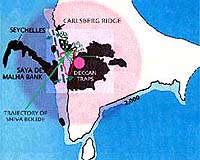
Shiva Crater

Did a very large comet or asteroid strike (600 by 400 kilometers across, likely made by a body 40 kilometers across) the Indian coastline and kill the dinosaurs?
Shiva: Another K-T Impact?
Diagram of Shiva impact area. Credit: Sankar Chatterjee. |
http://www.spacedaily.com/news/deepimpact-04r.html
Shoemaker-Levy 9 revisited: or The Geology of the K/T Impact Craters on Earth or Wiping out the Dinosaur with Five Simultaneous Impacts…or
Thomas J. Teters
http://starmon.com/KT_craters.html
http://books.google.com/books?hl=en&lr=&id=3IORF1Ei3LIC&oi=fnd&pg=PA31&dq=Chatterjee+and+Rudra+1996+Shiva&ots=ngYDm9C0s_&sig=pv_rRhdm0ZaWQ32GCjDhgN4SnuA#v=onepage&q=&f=false
THE SHIVA CRATER: IMPLICATIONS FOR DECCAN VOLCANISM, INDIA-SEYCHELLES RIFTING, DINOSAUR EXTINCTION, AND PETROLEUM ENTRAPMENT AT THE KT BOUNDARY
CHATTERJEE, Sankar1, GUVEN, Necip2, YOSHINOBU, Aaaron2, and DONOFRIO, Richard3, (1) Geosciences, Texas Tech Univ, MS Box 41053, Lubbock, TX 79409-3191, sankar.chatterjee@ttu.edu, (2) Department of Geosciences, Texas Tech Univ, Lubbock, TX 79409-1053, (3) Exploration and Development Geosciences, University of Oklahoma, Norman, OK 73069
http://gsa.confex.com/gsa/2003AM/finalprogram/abstract_58126.htm
THE SIGNIFICANCE OF THE CONTEMPORANEOUS SHIVA IMPACT STRUCTURE AND DECCAN VOLCANISM AT THE KT BOUNDARY
CHATTERJEE, Sankar, Geosciences, Texas Tech Univ, MS Box 41053, Lubbock, TX 79409-3191, sankar.chatterjee@ttu.edu and MEHROTRA, Naresh M., Paleobotany, Birbal Sahni Institute of Paleobotany, 53 University Road, Lucknow, 226007, India
http://gsa.confex.com/gsa/2009AM/finalprogram/abstract_160197.htm
Shiva: Another K-T impact?
by Leslie Mullen
http://www.astrobio.net/exclusive/1281/shiva-another-k-t-impact
08 September 2009
We just don't know enough about the Comet Threat
A recent article in science magazine (http://www.sciencemag.org/cgi/content/summary/325/5945/1211)suggests there is still a lot to learn about cometary object distributions. Author Martin Duncan states:
Simulations show that the inner Oort Cloud is the source of many more long-period comets
than expected.
The inner Oort Cloud was not previously thought to produce many LPCs, for the following
reason...The object might have spent most of its life in the inner cloud and very recently been nudged into its current (large aphelion) orbit by weak planetary perturbations when its perihelion was drawn in to just beyond the orbit of Saturn (see the fi gure). The simulations of Kaib and Quinn show that a large fraction of the LPCs are generated via this mechanism.
The results of these simulations not only change our view of where the progenitors of
LPCs are stored but may also provide constraints on models of planet formation and on
the properties of the stellar nursery in which the Sun spent its formative years
31 July 2009
Confusing Signals: Does this make you feel safer?
THE FOLLOWING RELEASE WAS RECEIVED FROM THE UNIVERSITY OF WASHINGTON IN SEATTLE, AND IS FORWARDED FOR YOUR INFORMATION. (FORWARDING DOES NOT IMPLY ENDORSEMENT BY THE AMERICAN ASTRONOMICAL SOCIETY.) Steve Maran, American Astronomical Society: steve.maran@aas.org, 1-202-328-2010 x116.
PIO Source:
Vince Stricherz
1-206-543-2580 vinces@u.washington.edu
(NOTE: researcher contact information at end)
For immediate release July 30, 2009
NOTE: An image may be downloaded at
http://uwnews.org/images/newsreleases/2009/July/20090730_pid51189_aid51186_c
omet2001rx14linear_sourceimage.jpg
CRASHING COMETS NOT LIKELY THE
CAUSE OF EARTH'S MASS EXTINCTIONS
Scientists have debated how many mass extinction events in Earth's
history were triggered by a space body crashing into the planet's surface.
Most agree that an asteroid collision 65 million years ago brought an end to
the age of dinosaurs, but there is uncertainty about how many other
extinctions might have resulted from asteroid or comet collisions with
Earth.
In fact, astronomers know the inner solar system has been protected
at least to some degree by Saturn and Jupiter, whose gravitational fields
can eject comets into interstellar space or sometimes send them crashing
into the giant planets. That point was reinforced last week (July 20) when a
huge scar appeared on Jupiter's surface, likely evidence of a comet impact.
New University of Washington research indicates it is highly
unlikely that comets have caused any mass extinctions or have been
responsible for more than one minor extinction event. The work also shows
that many long-period comets that end up in Earth-crossing orbits likely
originate from a region astronomers have long believed could not produce
observable comets. A long-period comet takes from 200 years to tens of
millions of years to make a single orbit of the sun.
"It was thought the long-period comets we see just tell us about the
outer Oort Cloud, but they really give us a murky picture of the entire Oort
Cloud," said Nathan Kaib, a University of Washington doctoral student in
astronomy and lead author of a paper on the work being published July 30 in
Science Express, the online edition of the journal Science. NASA and the
National Science Foundation funded the work.
The Oort Cloud is a remnant of the nebula from which the solar
system formed 4.5 billion years ago. It begins about 93 billion miles from
the sun (1,000 times Earth's distance from the sun) and stretches to about
three light years away (a light year is about 5.9 trillion miles). The Oort
Cloud could contain billions of comets, most so small and distant as to
never be observed.
There are about 3,200 known long-period comets. Among the
best-remembered is Hale-Bopp, which was easily visible to the naked eye for
much of 1996 and 1997 and was one of the brightest comets of the 20th
century. By comparison, Halley's comet, which reappears about every 75
years, is perhaps the best-known comet, but it is a short-period comet, most
of which are believed to originate in a different part of the solar system
called the Kuiper Belt.
It has been believed that nearly all long-period comets that move
inside Jupiter to Earth-crossing trajectories originated in the outer Oort
Cloud. Their orbits can change when they are nudged by the gravity of a
neighboring star as it passes close to the solar system, and it was thought
such encounters only affect very distant outer Oort Cloud bodies.
It also was believed that inner Oort Cloud bodies could reach
Earth-crossing orbits only during the rare close passage of a star, which
would cause a comet shower. But it turns out that even without a star
encounter, long-period comets from the inner Oort Cloud can slip past the
protective barrier posed by the presence of Jupiter and Saturn and travel a
path that crosses Earth's orbit.
In the new research, Kaib and co-author Thomas Quinn, a UW astronomy
professor and Kaib's doctoral adviser, used computer models to simulate the
evolution of comet clouds in the solar system for 1.2 billion years. They
found that even outside the periods of comet showers, the inner Oort Cloud
was a major source of long-period comets that eventually cross Earth's path.
By assuming the inner Oort Cloud as the only source of long-period
comets, they were able to estimate the highest possible number of comets in
the inner Oort Cloud. The actual number is not known. But by using the
maximum number possible, they determined that no more than two or three
comets could have struck Earth during what is believed to be the most
powerful comet shower of the last 500 million years.
"For the past 25 years, the inner Oort Cloud has been considered a
mysterious, unobserved region of the solar system capable of providing
bursts of bodies that occasionally wipe out life on Earth," Quinn said. "We
have shown that comets already discovered can actually be used to estimate
an upper limit on the number of bodies in this reservoir."
With three major impacts taking place nearly simultaneously, it had
been proposed that the minor extinction event about 40 million years ago
resulted from a comet shower. Kaib and Quinn's research implies that if that
relatively minor extinction event was caused by a comet shower, then that
was probably the most-intense comet shower since the fossil record began.
"That tells you that the most powerful comet showers caused minor
extinctions and other showers should have been less sev ere, so comet showers
are probably not likely causes of mass extinction events," Kaib said.
He noted that the work assumes the area surrounding the solar system
has remained relatively unchanged for the last 500 million years, but it is
unclear whether that is really the case. It is clear, though, that Earth has
benefitted from having Jupiter and Saturn standing guard like giant catchers
mitts, deflecting or absorbing comets that might otherwise strike Earth.
"We show that Jupiter and Saturn are not perfect and some of the
comets from the inner Oort Cloud are able to leak through. But most don't,"
Kaib said.
For more information, contact Kaib at 1-206-616-4549, 1-206-375-1048 or
kaib@astro.washington.edu; or Quinn at 1-206-685-9009 or
trq@astro.washington.edu.
Top 10 Ways to Destroy Earth
Holes in the Earth: 170 and Counting
Catastrophe Calculator
[Is the estimate correct using only visible comets? Do Dark Comets (see earlier post) affect this calculus?]
28 July 2009
Could Earth Be Hit, Like Jupiter Just Was?
From: http://news.yahoo.com/s/space/20090728/sc_space/couldearthbehitlikejupiterjustwas
AP – This image provided by NASA's Hubble Space Telescope taken with it's Wide Field Camera 3 on Thursday …

Could Earth Be Hit, Like Jupiter Just Was?
Charles Q. Choi
Special to SPACE.com
SPACE.com
Tue Jul 28, 10:45 am ET
The recent bruising Jupiter received from a cosmic impact is a violent reminder that our solar system is a shooting gallery that sometimes blasts Earth.
Still, what are the odds of a cosmic impact threatening our planet?
So far 784 near-Earth objects (NEOs) more than a half-mile wide (1 km) have been found.
"If an object of about the same size that just hit Jupiter also hit Earth — it was probably a typical cometary object of a kilometer or so in size (0.6 miles) — it would have been fairly catastrophic," explained astronomer Donald Yeomans, manager of NASA's Near-Earth Object program office at the Jet Propulsion Laboratory in Pasadena, Calif.
Scientists have ruled out the chances of an Earth impact for all of these 784 large NEOs. Still, lesser objects also pose a risk, and researchers estimate more than 100 large NEOS remain to be found.
Small risk
Billions of years ago, impacts were far more common. Our moon retains a record of the pummeling it and Earth took: the moon's craters remain, while on Earth, most scars of ancient impacts have been folded back into the planet or weathered away.
Today's solar system is far less crowded, and in fact Jupiter, having more mass and gravity, scoops up a lot of the dangerous objects, as does the sun.
Currently just one NEO of all the objects scientists are tracking poses any significant chance of hitting the Earth — 2007 VK184. If this roughly 425-foot-wide (130 meters) asteroid hit our planet, it would strike with an energy of roughly 150 million tons of TNT, or more than 10,000 times that of the atom bomb dropped on Hiroshima.
Roughly 100 telescopic observations made so far suggest that 2007 VK184 has a 1-in-2,940 chance of hitting Earth 40 to 50 years from now. However, if the past is any guide, further observations to refine computations of its orbit very likely will downgrade its probability of hitting Earth to virtually nothing, Yeomans said.
Of remaining concern are the NEOs that we do not see. Researchers suspect about 156 large NEOs 1 kilometer in diameter or larger remain to be found, and when it comes to dangerous NEOs in general, "when we get down to 140 meters (460 feet) or larger diameter objects, we think we've discovered about 15 percent of them, and with 50 meters (164 feet) or larger diameter, we've discovered less than 5 percent of them," Yeomans explained.
On average, an NEO roughly a half-mile wide or larger hits the Earth roughly every 500,000 years, "so we're not expecting one anytime soon," Yeomans explained.
"For 500 meters (1,640 feet), we're talking a mean interval of about 100,000 years," he added. "When you get down to 50 meters, the mean interval is about 700 years, and for 30 meters (98 feet), about 140 years or so, but by then you're getting down to a size where you won't expect any ground damage, as they burn up in the atmosphere at about 25 meters (82 feet) in diameter and smaller, probably for an impressive fireball event."
When it comes to truly monstrous NEOs some 10 kilometers (6.2 miles) or larger, of the size thought to have helped kill off the dinosaurs, "that's a 100 million year event, and in fact, I don't think there is anything like that we see right now," Yeomans said. "The largest near-Earth object that can actually cross the Earth's path, Sisyphus, has a diameter of 8 kilometers (5 miles), and the largest that is termed a potential hazard is Toutatis, which has a diameter of approximately 5.4 km (3.35 miles)."
Keeping watch
There are currently four teams worldwide actively looking for both large and small NEOs, Yeomans said. "We're concentrating on the large ones for now, but hopefully with the next generation of search, we'll be more efficient in finding the smaller objects, to find 90 percent of the total population of potential hazards larger than 140 meters," he added.
Keeping an eye on NEOs might not just be healthy for humanity, but also help lead us out into space.
"They're easy objectives to get to, and asteroids have significant metal resources that can be mined, while comets have significant water resources for space habitats or travel," Yeomans said. "If you want to build a habitat in space, you're not going to build it all on the ground and launch it up, since that's too expensive — you want to go up and look for resources instead."
Furthermore, asteroids and comets are among the objects that have changed the least since the birth of the solar system roughly 4.6 billion years ago, and might reveal vital clues behind the mysterious process.
"They may well have delivered the water and carbon-based molecules to Earth that allowed life to form, so they're extremely important for study in that direction," Yeomans added.
Note from Blogger: The IAA is expected to release its White Paper on Planetary Defense from the 1st International Planetary Defense Conference any day now. The conference was held in April.
21 July 2009
Another Wake-up call that will go unheeded?
 From: http://www.jpl.nasa.gov/news/news.cfm?release=2009-112
July 20, 2009
Scientists have found evidence that another object has bombarded Jupiter, exactly 15 years after the first impacts by the comet Shoemaker-Levy 9.
Following up on a tip by an amateur astronomer, Anthony Wesley of Australia, that a new dark "scar" had suddenly appeared on Jupiter, this morning between 3 and 9 a.m. PDT (6 a.m. and noon EDT) scientists at NASA's Jet Propulsion Laboratory in Pasadena, Calif., using NASA's Infrared Telescope Facility at the summit of Mauna Kea, Hawaii, gathered evidence indicating an impact.
New infrared images show the likely impact point was near the south polar region, with a visibly dark "scar" and bright upwelling particles in the upper atmosphere detected in near-infrared wavelengths, and a warming of the upper troposphere with possible extra emission from ammonia gas detected at mid-infrared wavelengths.
"We were extremely lucky to be seeing Jupiter at exactly the right time, the right hour, the right side of Jupiter to witness the event. We couldn't have planned it better," said Glenn Orton, a scientist at JPL.
Orton and his team of astronomers kicked into gear early in the morning and haven't stopped tracking the planet. They are downloading data now and are working to get additional observing time on this and other telescopes.
This image was taken at 1.65 microns, a wavelength sensitive to sunlight reflected from high in Jupiter's atmosphere, and it shows both the bright center of the scar (bottom left) and the debris to its northwest (upper left).
"It could be the impact of a comet, but we don't know for sure yet," said Orton. "It's been a whirlwind of a day, and this on the anniversary of the Shoemaker-Levy 9 and Apollo anniversaries is amazing."
Shoemaker-Levy 9 was a comet that had been seen to break into many pieces before the pieces hit Jupiter in 1994.
Leigh Fletcher, a NASA postdoctoral fellow at JPL who worked with Orton during these latest observations said, "Given the rarity of these events, it's extremely exciting to be involved in these observations. These are the most exciting observations I've seen in my five years of observing the outer planets!"
The observations were made possible in large measure by the extraordinary efforts of the Infrared Telescope Facility staff, including telescope operator William Golisch, who adroitly moved three instruments in and out of the field during the short time the scar was visible on the planet, providing the wide wavelength coverage.
JPL is managed for NASA by the California Institute of Technology in Pasadena.
06 January 2009
National Academies Takes Up Planetary Defense
http://www7.nationalacademies.org/ssb/NEO_surveys_mitigation.html#P16_19
Request for InformationTo: Members of the Space Science and Technology Community From: Irwin Shapiro, Chair, and Faith Vilas and Michael A’Hearn, Vice ChairsNRC Committee to Review Near-Earth Object Surveys and Hazard Mitigation StrategiesDate: December 17, 2008The Space Studies Board, in coordination with the Aeronautics and Space Engineering Board of the National Research Council (NRC), is beginning a two-part study to address issues concerning the detection, tracking, and characterization of potentially hazardous Near-Earth Objects (NEOs), and approaches to mitigating identified hazards. Both tasks will include an assessment of the costs of various alternatives, using independent cost estimating. More information about the committee can be found at: http://www7.nationalacademies.org/ssb/NEO_surveys_mitigation.html#P16_19To obtain the greatest possible input of ideas from the community about issues in surveying, detecting, and characterizing NEOs, as well as potential mission concepts for deflection/mitigation, we are soliciting information in these areas. Submitters may draw upon the use of different facilities (ground- or space-based), and/or involve international cooperation, in their proposed solutions.We invite you to write a program or mission concept for detecting, characterizing, or mitigating the hazards of NEOs, due by March 20, 2009. For logistical reasons, we ask that you first submit a Letter of Intent (LOI) by January 30, 2009. LOIs should be no longer than 1 page and include the authoring organization’s name and a short (no more than 200 words) description of the proposed solution.The NRC’s Committee to Review Near-Earth Object Surveys and Hazard Mitigation Strategies may select several proposed solutions for further study and invite the author of each to make a formal presentation at a future committee meeting. Identification of promising solutions by the committee does not imply future study funding by NASA or any other entity.Solutions should be devoted to detecting, characterizing, or mitigating NEOs; authors wishing to address two or more tasks should submit separate solutions for each. Authors may also submit as many separate solutions as they wish.The committee will use the following general criteria in evaluating submissions:1-The relative technical feasibility of the solutions; 2-The cost range into which each solution is likely to fall; and3-The relative merits of solutions and whether they outweigh their inherent challenges.More specific aspects of criterion 3 for the different types of proposed solutions are:i. Detecting and surveying NEOs: Does the proposal realistically address the requirements set by Congress for NASA to detect 90% of NEOs with perihelion distances of less than 1.3 astronomical units that are 140 meters in diameter or larger by 2020?ii. Characterizing NEOs: Does the proposal focus on any or all of the various key characteristics of any target, such as its size, density, composition, and inclination and speed of approach?iii. Hazard mitigation: Does the proposed solution offer a technically feasible method of deflecting an asteroid impact? Have the merits of the proposal been adequately compared to its disadvantages (if any), including the possibility of reduced costs over alternative courses of action? How much technical development is required for implementation? All responses will be considered non-proprietary public information for distribution with attribution. Those submitting responses must also fill out the relevant (i.e., government or non-government) NRC copyright form provided on the committee’s website.The proposed solutions should be no longer than ten pages in length (12-point font) and involve the following items (by numbered sections):
1. A summary of the proposal;
2. Preliminary cost estimates*; and
3. A summary of the advantages and disadvantages of your proposed method for detecting, characterizing, or mitigating the hazards of Near Earth Objects.
Please submit your LOI to the NRC by January 30, 2009 via email to neorfi@nas.edu.Please submit your proposed solution(s) to the NRC by March 20, 2009 via email to neorfi@nas.edu.Questions about the RFI may be directed to the study director, Dwayne A. Day (dday@nas.edu), or to us: (ishapiro@cfa.harvard.edu); (fvilas@mmto.org); (ma@astro.umd.edu).You can also contact Dr. Day by telephone at 202-334-3477, or by fax at 202-334-3701.* We recognize the lack of accuracy of cost estimates for space missions in the early conceptual stages of development. You may consider using the NASA Advanced Missions Cost Model located at http://cost.jsc.nasa.gov/AMCM.html to determine approximate costs.
Statement of Task
The National Research Council Space Studies Board, in cooperation with the Aeronautics and Space Engineering Board, shall conduct a two-part study to address issues in the detection of potentially hazardous NEOs and approaches to mitigating identified hazards. Both tasks should include an assessment of the costs of various alternatives, using independent cost estimating. Options that blend the use of different facilities (ground- or space-based), or involve international cooperation, may be considered. Each study phase will result in a report to be delivered on the schedule provided in the contract. Key questions to be addressed during each phase of the study are the following:Task 1: NEO Surveys What is the optimal approach to completing the NEO census called for in the George E. Brown, Jr. Near-Earth Object Survey section of the 2005 NASA Authorization Act to detect, track, catalogue and characterize the physical characteristics of at least 90% of potentially hazardous NEOs larger than 140 meters in diameter by the end of year 2020? Specific issues to be considered include, but are not limited to, the following:
• What observational, data-reduction, and data-analysis resources are necessary to achieve the Congressional mandate of detecting, tracking, and cataloguing the NEO population of interest?
• What physical characteristics of individual objects above and beyond the determination of accurate orbits should be obtained during the survey to support mitigation efforts?
• What role could be played by the National Science Foundation's Arecibo Observatory in characterizing these objects?
• What are possible roles of other ground- and space-based facilities in addressing survey goals, e.g., potential contributions of the Large Synoptic Survey Telescope (LSST) and the Panoramic Survey Telescope and Rapid Response System (Pan STARRS)?
Task 2: NEO Hazard Mitigation What is the optimal approach to developing a deflection capability, including options with a significant international component? Issues to be considered include, but are not limited to, the following:
• What mitigation strategy should be followed if a potentially hazardous NEO is identified?
• What are the relative merits and costs of various deflection scenarios that have been proposed?
Subscribe to:
Posts (Atom)
