From: http://www.moondaily.com/reports/Roscosmos_Revives_Permanent_Moon_Base_Plans_999.html
Roscosmos Revives Permanent Moon Base Plans
by Staff Writers
Moscow (RIA Novosti) Jan 20, 2012
Russian Space Agency Roscosmos is in talks with its European and U.S. partners on the creation of manned research bases on the Moon, the agencies chief, Vladimir Popovkin, said on Thursday.
"We don't want the man to just step on the Moon," Popovkin said in an interview with Vesti FM radio station.
"Today, we know enough about it, we know that there is water in its polar areas," he said, adding "we are now discussing how to begin [the Moon's] exploration with NASA and the European Space Agency ."
There are two options, he said: "either to set up a base on the Moon or to launch a station to orbit around it."
The project of a "prospective manned transportation system" to be sent to the Moon is currently being developed, the Roscosmos chief said.
The Moon base project seems to revive Cold War-era plans to create a permanent outpost on the Moon, which was talked about by some Soviet and U.S. scientists since the late 1950s.
Russia is also planning to send two unmanned missions to the Moon by 2020, the Luna Glob and the Luna Resource, Popovkin added.
Showing posts with label Russia. Show all posts
Showing posts with label Russia. Show all posts
18 February 2012

20 August 2010
A Seminar on Planetary Emergencies covers Impact Events
From: http://www.ccsem.infn.it/ep/EP2010_Programme.pdf
INTERNATIONAL SEMINARS ON
PLANETARY EMERGENCIES
43rd Session
Erice, 19 – 24 August 2010
THE ROLE OF SCIENCE IN THE
THIRD MILLENNIUM
WORLD ENERGY CRISIS
GLOBAL MONITORING OF THE PLANET
POLLUTION
INFORMATION SECURITY
DEFENCE AGAINST COSMIC OBJECTS
MITIGATION OF TERRORIST ACTS
PROGRAMME
Paul A.M. Dirac Lecture Hall – Patrick M.S. Blackett Institute
Chairman: A. Zichichi – Co-chair T.D. Lee
COSMIC OBJECTS
FOCUS:
Chairman A. Zichichi – Co-chair W. Huebner
0 9 . 3 0 – 11. 00 SESSION N° 8
∗ Professor Walter F. Huebner
Southwest Research Institute, San Antonio, USA
Progress on Defense against Potentially Hazardous Objects: An Overview
∗ Dr. J.D. Walker (and S. Chocron)
Impact Physics, Southwest Research Institute, San Antonio, USA
Momentum Enhancement from Kinetic Impactors and Conventional Explosives
∗ Dr. Catherine S. Plesko
Applied Physics Division, Los Alamos National Laboratory, USA
Looking before we Leap: A Quantitative Investigation of Asteroid and Comet Nucleus Impact Prevention by Nuclear Means
∗ Dr. Anatoly Zaitsev
Planetary Defense Center, Moscow, Russia
Defense Against Asteroid Danger – a Real Task of Today
14 August 2010
Very Interesting Russian Briefing on a Planetary Defense System
Check out this Russian Briefing:

"CONCEPTUAL, TECHNOLOGICAL AND LEGAL BASES OF CREATION OF THE INTERNATIONAL PLANETARY DEFENSE SYSTEM" called "CITADEL-1"
http://www.tsi.lv/space/SGS1020_221%20-%2005.07.10/Adushkin/IAA-RACT%20C2%20S3-03.pdf
Clearly a serious effort, considering who was involved:
1-Institute of Geosphere Dynamics of RAS, Moscow, Russia
V. V. Adushkin (marina.idgran@gmail.com)
A. V. Vityazev
2-Russian Federal Space Agency, Moscow, Russia
D. V. Gorobets (gorobets@roscosmos.ru)
3-Planetary Defense Center, Khimki, Russia
A. V. Zaitsev (pdc@berc.rssi.ru)
A. A. Кlapovsky
4-Yuzhnoye SDO, Dniepropetrovsk, Ukraine
N. N. Slyunyayev (info@yuzhnoye.com)
S. N. Konyukhov
5-Russian Academy of Cosmonautics by K.E. Tsiolkovsky, Moscow, Russia
A. S. Koroteev (ruac@list.ru)
B. A. Liaschuk
6-Working group of the RAS “Risks and safety”, Moscow, Russia
N. A. Makhutov (kei51@mail.ru)
7-Maximov Space Systems Research Institute, Yubileiny city, Russia
V. A. Menshikov (niiks@khrunichev.com)
8-Russian Federal Nuclear Center (RFNC–VNIITF), Snezhinsk, Russia
D. V. Petrov
V. A. Simonenko (v.a.simonenko@vniitf.ru)
O. N. Shubin
9-The Ministry of Emergency Situations, Moscow, Russia
A. A. Taranov (aataranov@mail.ru)
V. A. Puchkov
10-4-th Central Scientific-Research Institute of Ministry of Defense of RF, Yubilejny, Russia.
B. I. Semyonov
11-Institute of Applied Astronomy RAS, St.Petersburg, Russia
V. A. Shor (shor@ipa.nw.ru )


11 February 2010
Which Country Will Be The Next To Put An Astronaut On The Moon
This is nice information, but in a real sense, it misses the point entirely. It isn't about firsts, or being able to "get there," the important step is to be able to get there and stay there permanently. Only an architecture based upon Space Resource Utilization, conceived from the beginning as an industrial project with the private interests in mind, and with a nodal, reusable architecture with space logistics conceived from the start. The more important essay is the previous entry by Paul Spudis below, that outlines what the real race is about.
Which Country Will Be The Next To Put An Astronaut On The Moon?President Obama's 2011 budget cut NASA's Constellation program, his predecessor's plan to return humans to the Moon, en route to Mars. With the US government apparently out of the race to return to the Moon, who will now be next?
As Buzz Aldrin once so famously observed, "Second comes right after first." The Apollo program was a remarkable achievement - it was arguably the single greatest feat of engineering and human ingenuity in our history - but it proved a dead-end in terms of further human exploration of the solar system.
After nearly a half-century's worth of technological advancement at an exponential rate, a return of humans to the Moon figures to be more than just an end in and of itself. As such, the implications of which astronauts are the next to set foot on the Moon likely entails more than just which flag gets planted in the lunar soil.
There are a number of potential candidates for which country (or, more accurately, which geopolitical entity, but "country" is catchier) will be the next to put astronauts on the Moon. Let's take a look at the contenders, which include emerging global powers, veterans of the space race, and a dark horse or two.
China:
China has to be considered the odds-on favorite to reach the Moon next. The country made headlines when it launched its first taikonaut, Yang Liwei, into space in 2003. The mission itself was fairly primitive, recalling NASA's Mercury missions of the early 1960s. Indeed, that comparison to the American space race may be very appropriate, as a 2009 article in the UK's The Guardian noted:
"The attitude to the space programme in China is a little bit like the attitude towards space exploration in the western world in the 1960s," says Kevin Fong, an expert in space medicine at University College London. "There's a deep fervour among their university kids for space technology. The main difference between China and America now is that China can just do something - they don't need to ask permission or go through a democratic process and get the budget approved."Although China's proposed mission dates of 2025 and 2030 are not quite as ambitious as other countries, the sense among some experts is that China may have a much earlier date in mind. From the same article:
"It's all very dark out there and you're not really sure how much they're doing," says Fong. "They seem very serious about it and have mature thoughts about it, from the little you see in their presentations. They still have much to learn from the existing space community and don't want to be too overt about their ambitions at risk of looking like they've over-promised." China successfully placed the probe Chang'e-1 in lunar orbit in 2007.Current plans also include a sample return mission in 2017 before the crewed attempt in the next decade. Barring a major change, the smart money in this space race has to be on China.
[The Guardian]
India:
India's first satellite was put into orbit by the Soviets in 1975, and the country has been undertaking its own rocket launches since the early eighties. However, it was the launch of Chandrayaan-1 in October 2008 that marked the real giant leap for the Indian Space Research Organisation (ISRO). The probe is the first Indian spacecraft to travel beyond Earth's orbit, and its Moon Impact Probe successfully landed on the Moon on November 14, 2008.
After the success of this mission, ISRO has set 2020 as its date for the first crewed mission to the Moon. It has a big budget to work with - about $800 million a year, with another $1.2 billion committed solely to human spaceflight over the next ten year - but the specific plans for a return to the Moon remain unclear. Without a better sense of the logistics of the mission, it's still difficult to gauge how realistic India's goal of 2020 actually is.
[The Hindu]
Russia:
The current plan, as of August 2007, is for Russia to put cosmonauts on the Moon by 2025, with plans to establish a permanently crewed base on the lunar surface between 2027 and 2032. This is seen as a prelude for a mission to Mars in 2035.
The big problem for Russia is just how the country will be able to fund such a tremendously expensive endeavor. The economy did undergo massive growth in the previous decade under Vladimir Putin, but the global financial crisis has hit the country hard. Its fiscal situation remains precarious, and it may be difficult to consistently fund such ambitious programs. Russia's space tourism program has brought in about $30 million per ticket, but only eight plutocrats have thus far made the trip. That won't make much of a dent in the likely hundreds of billions of dollars needed for such a program.
One of the more interesting aspects of the Russian plan is thecreation between 2016 and 2025 of a low orbital platform around the Earth. From here, Russia hopes to assemble spacecraft, potentially including those that will take the cosmonauts to the Moon and eventually Mars. They also hope to use the International Space Station as a laboratory until 2020, five years past the US's stated date of decommission.
[Ria Novosti]
Europe:
The European Space Agency's Aurora Programme was an ambitious project established in 2001 with the lofty stated objectives of exploring the solar system and searching for life beyond Earth. The current timeline for Aurora is a crewed mission to the Moon in 2024.
Like with many cooperative projects undertaken by the European Union, budgetary considerations and clashing objectives of the member-states may prove to be huge complicating factors for Aurora. Even the ESA's official website still stresses that Europe has to decide how committed it is to space exploration, saying it can choose either to be a major player or junior partner in the global exploration of space. Although Europe likely has the technology and money to make Aurora a reality, it remains a very open question whether the public sentiment is there to see such a project through to its conclusion.
[ESA]
Japan:
The Japanese space agency JAXA announced back in 2006 that it intends to establish a base on the Moon by 2030. To accomplish this feat, Japan hopes to land astronauts on the Moon by 2020. The base itself will begin construction around 2025, if all goes according to plan.
Although JAXA and its predecessor organizations have a long history dating back to 1970 of space exploration, they have not yet developed a crewed spacecraft. When the plan was first announced, spokesman Satoki Kurokawa addressed the public relations challenges of such an ambitious program:
"The feasibility of the plan is unclear at this point as we need to gain understanding by the government and the Japanese people on our plan, but technologically it would be possible in a few decades," Kurokawa said.At the risk of microanalyzing that statement, it seems a bit strange to talk about the technology being possible in "a few decades" when 2020 is now just ten years away. Considering just how steep a gradient Japan would have to climb just to get astronauts in space, let alone on the Moon, this has to be considered a real long shot.
[Moon Daily]
Private enterprise:
The most serious challenger to China is likely not a country at all, but instead the free market. Space Adventures, the company that has booked most of Russia's space tourists, already offers a circumnavigation of the Moon aboard the Soyuz craft for $100 million. (No billionaire has yet been quite eccentric enough to take them up on the offer.) Many entrepreneurs already predict such trips to the Moon will be commonplace by 2020, and Elon Musk, founder of Space Exploration Technologies, is willing to predict there will be commercial trips to Mars by the end of this decade.
Indeed, the Obama Administration's decision to cancel the Constellation program came hand in hand with a plan to put six billion dollars over the next five years towards further development of commercial spaceflight. Current commercial spaceflight developers estimate that this decision could create up to 5,000 jobs, allow for routine and relatively cheap orbital flights to begin by 2014, and open up the serious possibility of commercial trips to the Moon in the near term.
[Space]
The field:
Other countries with some manner of plans for human spaceflight include Ecuador, Iran, Malaysia, North Korea, Turkey, and Romania. Although all of these programs remain very much in their infancy, it's worth remembering that NASA put astronauts on the Moon within just eleven years of its founding, using technology that by today's standards was unimaginably primitive. So it's probably best not to rule any country out. Speaking of which...
USA:
Yes, Constellation has been scrapped. Yes, the current administration seems to be pursuing a very different direction of space exploration that may end up being far more beneficial than just remaking the Apollo program. Yes, there is absolutely no reason to think the US is headed back to the Moon anytime soon. Even so, it's hard to completely discount what is still the only country to actually put humans on the Moon. Admittedly, this viewpoint is not backed up by any hard evidence or information, and my reasoning is pretty much the intellectual equivalent of chanting "USA! USA!" All of that may be true. But still, um...
USA! USA!
24 January 2010
Russia and Space Solar Power
From: Science & Technology Overview Russia Dec '09
Science&Technology Unit, Embassy of Switzerland in Moscow
Time To Build Space Solar Power Plants
The Russian science news agency Informnauka claims that more and more attention is drawn by scientists in Russia to the use of solar energy including the creation of space solar power plants. The researchers at the Lavochkin Scientific Production Association Federal State Unitary Enterprise suggest a new principle for building such power plants. The researchers propose to give up the idea of building extremely large constructions and to place the solar accumulators and transmitting antennas on a system of autonomous satellites controlled via a piloting signal from the Earth. They suppose to use the short-wave range of microwave frequency up to millimetric radio waves for the antenna, which will provide an opportunity to form narrow beams in the outer space with the minimal size of generators and amplifiers. Small generators will allow to reduce the size of receiving antennas by a factor of ten. Interestingly, the researchers plan to place them on captive balloons at a height of 4.000 km. Such location will ensure that the molecular oxygen will not absorb the millimetric radio waves. Moreover, a captive balloon can be put anywhere in any region. The beams of individual satellite antennas should converge at the spot of the receiving antenna location. Each autonomous satellite will present a single element of a large antenna field comprised of a fleet of such spacecrafts. To deploy this project, a rather large photoemitting panel which transforms solar radiation directly into microwave energy is required. Capabilities of modern space-rocket hardware make it possible to build spacecrafts equipped with the panels up to 500 м2 in size in the nearest term. Today, the photoconverter efficiency reaches 60 per cent. Perhaps, by the time the experimental design works to build space solar power plants commence such converters will be produced industrially. It will take quite a lot of effort. The researchers will have to create a semiconductor structure capable not only of transforming solar energy but also radiating it in the microwave range at the same time. A control system to operate the automatic spacecrafts should be developed as it will allow to form an integrated antenna field of single satellites. The experts believe that in order to address the issues of a future energy crisis and to keep up with the developed countries, Russia must begin the research today.
Sources:
RUSSIAN SCIENCE NEWS, PARK-MEDIA, 29.12.2009, www.informnauka.ru, article on the basis of a publication in
Russia Electronic Scientific Magazine by V. K. Sysoev, G. M. Polishchuk, K. M. Pichkhadze “The Solar Space Power
Plant: The Choice Of Solution.” , http://zhurnal.ape.relarn.ru/articles/2009/050.pdf
Contact for further information: Valentin Sysoev, Doctor of Technics, assistant director of the Federal State
Unitary Enterprise of Lavochkin Scientific Production Association, Khimki; sysoev@laspace.ru
01 January 2010
Russia weighs in on asteroid worries Space chief joins debate, calls for mission to divert near-Earth object

msnbc.com staff and news service reports
updated 9:34 p.m. ET Dec. 30, 2009
MOSCOW - Russia’s space chief said Wednesday that a spacecraft may be dispatched to shift an asteroid's course and reduce the chances of Earth impact, even though U.S. experts say such a scenario is unlikely.
Anatoly Perminov, the head of Russia's Federal Space Agency, told Golos Rossii (Voice of Russia) radio that officials would hold a meeting soon to assess a mission to the asteroid Apophis. He said his agency might eventually invite NASA, the European Space Agency, the Chinese space agency and others to join the project.
When the 270-meter (885-foot) asteroid was first discovered in 2004, astronomers estimated its chances of smashing into Earth in its first flyby, in 2029, at 1 in 37.
Further studies have ruled out the possibility of an impact in 2029, when the asteroid is expected to come no closer than 18,300 miles (29,450 kilometers) from Earth’s surface, but they indicated a small possibility of a hit on subsequent encounters.
Researchers currently put the chances that Apophis could hit Earth in 2036 at 1 in 233,000, and NASA says another close encounter in 2068 involves a 1-in-330,000 chance of impact. The collision risk is expected to fall to zero as more observations are made.
“It wasn’t anything to worry about before. Now it’s even less so,” said Steve Chesley, an astronomer with the Near Earth Object Program at NASA’s Jet Propulsion Laboratory.
Four years ago, NASA drew up a plan that called for a spacecraft to be sent to Apophis in 2019 if the threat did not disappear entirely by 2013, when the asteroid will be well-placed for detailed study.
The head of NASA's Near Earth Object Program, Don Yeomans, said in an e-mail that more accurate calculations "will almost certainly remove any possibility of an Earth collision" in 2036. "While Apophis is almost certainly not a problem, I am encouraged that the Russian science community is willing to study the various deflection options that would be available in the event of a future Earth threatening encounter by an asteroid,” Yeomans said.
Without mentioning NASA's findings, Perminov said that he heard from a scientist that Apophis is getting closer and may hit the planet. "I don't remember exactly, but it seems to me it could hit Earth by 2032," Perminov said.
"People's lives are at stake. We should pay several hundred million dollars and build a system that would allow to prevent a collision, rather than sit and wait for it to happen and kill hundreds of thousands of people," Perminov said.
How to dodge an asteroid
Scientists have long theorized about asteroid deflection strategies. Some have proposed sending a probe to rendezvous with a dangerous asteroid and use subtle gravitational effects to change its trajectory. Such a strategy, employing an "asteroid tractor," would require years or even decades to work.
Scientists have long theorized about asteroid deflection strategies. Some have proposed sending a probe to rendezvous with a dangerous asteroid and use subtle gravitational effects to change its trajectory. Such a strategy, employing an "asteroid tractor," would require years or even decades to work.

Others have suggested sending a spacecraft to collide with the asteroid and alter its momentum, or using nuclear weapons to hit it.
Perminov wouldn't disclose any details of the project, saying they still need to be worked out. But he said the mission wouldn't require any nuclear explosions.
Hollywood action films "Deep Impact" and "Armageddon," have featured space missions scrambling to avoid catastrophic collisions. In both movies, space crews use nuclear bombs in an attempt to prevent collisions.
"Calculations show that it's possible to create a special-purpose spacecraft within the time we have, which would help avoid the collision without destroying it (the asteroid) and without detonating any nuclear charges," Perminov said. "The threat of collision can be averted."
Boris Shustov, the director of the Institute of Astronomy under the Russian Academy of Sciences, hailed Perminov's statement as a signal that officials had come to recognize the danger posed by asteroids.
"Apophis is just a symbolic example, there are many other dangerous objects we know little about," he said, according to RIA Novosti news agency.
Questions about Russian role
NBC News space analyst James Oberg agreed that the asteroid impact threat merited more international attention, but he worried that the Russian statements were "way overblown" and might be counterproductive.
NBC News space analyst James Oberg agreed that the asteroid impact threat merited more international attention, but he worried that the Russian statements were "way overblown" and might be counterproductive.
"Naturally, Russia wants to link up with U.S. and European scientists to work out a plan, at our expense. This is a consistent Russian goal," he said in an e-mail. "Russia really has nothing to contribute to such an effort aside from cheap boosters — and all of them too small for any serious asteroid deflection effort."
Last year, space experts issued a report urging the world's governments to come up with contingency plans to address potential threats from near-Earth objects, with the final decision to be made by the U.N. Security Council. That report is currently under consideration by a U.N. committee.
"Asteroid deflection, and the much more pressing issue of orbital debris cleanup, must be undertaken in a world consensus mode, since unilateral efforts could be stymied by objections of some space powers not party to the project," Oberg said. "Once again, the problem is not in the stars, but in ourselves."
This report includes information from msnbc.com and The Associated Press.
Giant asteroid to pass earth at close range 270-metre rock will swing by in 2029 — and it could be back after that
from: http://www.thestar.com/news/sciencetech/article/744268--giant-asteroid-to-pass-earth-at-close-range
The head of Russia's space agency called on Wednesday for a massive planetary effort to deflect a massive asteroid as it skips by the Earth in 2029.
The head of Russia's space agency called on Wednesday for a massive planetary effort to deflect a massive asteroid as it skips by the Earth in 2029.
"People's lives are at stake," Anatoly Perminov told Voice of Russia radio. "We should pay several hundred million dollars and build a system that would allow us to prevent a collision, rather than sit and wait for it to happen and kill hundreds of thousands of people."
Perminov said that Russia will consider building a spacecraft designed to nudge the Apophis asteroid away from the Earth, and invited NASA, the European Space Agency and the Chinese space agency to join him.
The Apophis asteroid, the size of just under three football fields, was first spotted heading towards Earth five years ago. At that time, it was suggested that there was a 2.7 per cent chance it would strike our planet in 2029. That alarming initial estimate has been seriously downgraded since, but continues to hold the attention of expert observers.
Apophis will first pass us at close range in just under twenty years. It may graze the Earth, missing us by only 30,000 km, less than the distance between the earth and the moon. But, at this point, astronomers have ruled out the possibility that it will hit us.
However, there is a very small chance that it will pass through a 600 metre-wide "gravitational keyhole" as it swings by. That would alter the course of the rock and cause it to slingshot back and hit the Earth in 2036. New NASA calculations released in October put the chances of impact during the second pass at 1-in-250,000.
That doesn't sound too terribly alarming, but as Dr. William Ailor, of California's Aerospace Corporation said Wednesday, "That's a pretty high probability if you're betting the planet."
In April, Ailor chaired the bi-annual Planetary Defense Conference that brings together the world's leading asteroid experts.
"There are still issues around how great does the risk have to be before you start planning a mission like this. But ultimately, everyone agrees that we will have to do this sooner or later," Ailor said.
Prof. Donald K. Yeomans, manager of NASA's Near-Earth Object Program Office, says the time to make a decision on Apophis is in late 2012 and early 2013, when it makes another close approach, within about nine million miles of Earth.
"The additional optical and radar data taken then will almost certainly remove any possibility of an Earth collision in April 2036. To my mind it would make sense to wait until 2013, refine the orbit and in the very unlikely event that the impact probability increases, then begin planning possible deflection options.
"While Apophis is almost certainly not a problem, I am encouraged that the Russian science community is willing to study the various deflection options that would be available in the event of a future Earth threatening encounter by an asteroid. We haven't found one yet but it does make sense to study deflection options in advance."
A variety of deflection methods have been suggested in past: gravitational tractors, landing a manned mission on Apophis, knocking it off target by ramming it or striking it with nuclear weapons. There is no broad consensus on what might work best.
"There's also the question of how you design the 'campaign' to attack the asteroid. You'd probably have to launch multiple vehicles, in case some failed," Ailor said.
Five years ago, Ailor said, the Aerospace Corp. ballparked the cost of such a mission at $80 billion (U.S.). NASA's current annual budget is a little over $17 billion. Perminov, sounding less than expert on the whole subject, got the year of impact wrong (2032), couldn't cite the latest estimates accurately and seriously underestimated the potential cost. But he's right about the risk.
Ailor points out that the asteroid which exploded over Tunguska, Russia in 1908 was only 30 metres across. It devastated more than 2,000 square kilometres of forest. Apophis is 270 metres in diameter.
What if it hit the Earth directly?
"That'd be a very bad day," Ailor said. "Probably not the end of all life as we know it. But a bad day."
30 December 2009
Russia May Send Spacecraft to Asteroid
http://www.foxnews.com/
- AP
- December 30, 2009
Russia's space chief said Wednesday his agency will consider sending a spacecraft to a large asteroid to knock it off its path and prevent a possible collision with Earth.
MOSCOW — Russia is considering sending a spacecraft to a large asteroid to knock it off its path and prevent a possible collision with Earth, the head of the country's space agency said Wednesday.
Anatoly Perminov said the space agency will hold a meeting soon to assess a mission to Apophis, telling Golos Rossii radio that it would invite NASA, the European Space Agency, the Chinese space agency and others to join the project once it is finalized.
When the 885-foot asteroid was first discovered in 2004, astronomers estimated the chances of it smashing into Earth in its first flyby in 2029 were as high as 1-in-37, but have since lowered their estimate.
SLIDESHOW: How Could Scientists Prevent an Asteroid Impact?
Further studies ruled out the possibility of an impact in 2029, when the asteroid is expected to come no closer than 18,300 miles above Earth's surface, but they indicated a small possibility of a hit on subsequent encounters.
In October, NASA lowered the odds that Apophis could hit Earth in 2036 from a 1-in-45,000 as earlier thought to a 1-in-250,000 chance after researchers recalculated the asteroid's path. It said another close encounter in 2068 will involve a 1-in-330,000 chance of impact.
Without mentioning NASA findings, Perminov said that he heard from a scientist that Apophis is getting closer and may hit the planet. "I don't remember exactly, but it seems to me it could hit the Earth by 2032," Perminov said.
"People's lives are at stake. We should pay several hundred million dollars and build a system that would allow to prevent a collision, rather than sit and wait for it to happen and kill hundreds of thousands of people," Perminov said.
Scientists have long theorized about asteroid deflection strategies. Some have proposed sending a probe to circle around a dangerous asteroid to gradually change its trajectory. Others suggested sending a spacecraft to collide with the asteroid and alter its momentum, or using nuclear weapons to hit it.
Perminov wouldn't disclose any details of the project, saying they still need to be worked out. But he said the mission wouldn't require any nuclear explosions.
Hollywood action films "Deep Impact" and "Armageddon," have featured space missions scrambling to avoid catastrophic collisions. In both movies space crews use nuclear bombs in an attempt to prevent collisions.
"Calculations show that it's possible to create a special purpose spacecraft within the time we have, which would help avoid the collision without destroying it (the asteroid) and without detonating any nuclear charges," Perminov said. "The threat of collision can be averted."
Boris Shustov, the director of the Institute of Astronomy under the Russian Academy of Sciences, hailed Perminov's statement as a signal that officials had come to recognize the danger posed by asteroids.
"Apophis is just a symbolic example, there are many other dangerous objects we know little about," he said, according to RIA Novosti news agency.
21 July 2009
"If you gave me $2 billion today, I'd head for Brazil, quick :-) :-) -- but yes, I think it could be done" Discuss: Space Solar Power & Laser Launch
Today, ideas like Space Solar Power literally do not get off the ground because of the cost of launch. Space Solar Power needs high-volume launch, and today, there is not a sufficient market in being to justify the expense of taking the risk to develop new launch systems.
But that does not mean there are not ideas. From traditional Two-State to Orbit, to Ideas for airplane-like Single State to Orbit, to Partial Tether Stages, and Mag-lev first stages, to Lunar materials, and even mass-produced segmented expendables, ideas abound. One under-explored idea is Laser launch, for which a good open discussion led by Jordan Kare can be found here:
"I generally estimate the overall cost of a 100 MW "test" launch system at $2 billion (less than 1 shuttle orbiter, and well within the reach of, say, Boeing), and the cost of a 1GW system, built for continuous flat out use, at $20 billion. Someone at a talk once asked me "You mean, if I gave you $2 billion today, you would build this?", and I said, "If you gave me $2 billion today, I'd head for Brazil, quick :-) :-) -- but yes, I think it could be done".
In fact, Brazil has a laser launch research facility, under the supervision of Marco A. S. Minucci, Centro Technico Aerospacial - CTA, Instituto De Estudos Avancados, São José dos Campos, Brazil that has in the past collaborated with Leik Myrabo from RPI, inventor of the Lightcraft. (http://www.rpi.edu/dept/mane/deptweb/faculty/member/myrabo.html and http://www.lightcrafttechnologies.com/media.html). Brazil is attractive because it can launch directly from the equator, to equatorial orbits, which are highly desirable, particularly for Geostationary satellites.This year, the Sixth International Symposium on Beamed Energy Propulsion (http://www.aibep.org/ISBEP_6/ISBEP_6.htm), which will be held on November 1 – 5, 2009 at Doubletree Paradise Valley Resort, Scottsdale, Arizona. The program of ISBEP 6 will cover ALL aspects related to the science and technology of beamed-energy propulsion in its various forms and applications. One can see the impressive list of contributors and countries from the last symposium (http://www.aibep.org/ISBEP_5/Program.html), including the US Air Force, NASA, Brazil, Japan, Canada, Russia, Germany, Korea, China,
The subject is also likely to be covered at the Space, Propulsion & Energy Sciences International Forum (http://www.ias-spes.org/SPESIF.html), Feb 23-26, 2010 at John Hopkins University Applied Physics Laboratory (JHU/APL), which replaced the STAIF conference as the premier place to discuss advanced space concepts, particularly propulsion, and serious PhD-level, peer reviewed discussions on Physics related to interstellar travel & communication (everything from nuclear pulse detination Orion-style to VASIMIR, to IEC fusion, to FTL, Warp-Drive and Worm-hole physics)
A specific discussion on upscaling Laser Launch for Space Solar Power, with both an attractive financial return, and a scaling to levels that are relevant to both energy security and CO2 mitigation in our lifetime, see Keith Henson's Post on The Oil Drum:
http://www.theoildrum.com/node/5485 for which back-up calculations can be found here: www.htyp.org/dtc
Solar Satellite Power with Laser Propulsion and Reusable Launch Vehicle
This is a guest post by Keith Henson.
Could Satellite Solar Power (SSP) solve worldwide energy problems and even sequester serious amounts of carbon dioxide? In this post, I look at SSP built with laser propulsion and a new Reusable Launch Vehicle (RLV) combination, since this approach seems to be lower cost than other approaches and still could produce a huge amount of electric power. If there is enough electric power, some of it might even be used to sequester carbon dioxide by converting it to synthetic oil.
In this post, I prepare a financial model (available as a spreadsheet in PDF form) of what this approach to SSP might cost. Based on my calculations, the total investment required would be $58 billion, spread over a little over eight years. The system would produce a huge amount of electricity, so that long-term, the cost per kWh would only be $ .02.
While this proposed approach may not come about, or could take 20 years, it does offer a way out, if it can be made to work. There have been two recent posts on SSP that may be of interest to readers - one by Darel Preble and another by Big Gav.
With substantial input from Jordin Kare, Spike Jones, Howard Davidson, Ron Clark and others, I have been working for the past year on a new approach to SSP’s primary problem - reducing launch cost to orbit. If power from space were abundant and low enough in cost, we could even put carbon dioxide back into empty oil fields as synthetic oil.1 The goal is to reduce the cost of transport to Geosynchronous Earth Orbit (GEO) by a factor of ~200 over current expendable rockets.
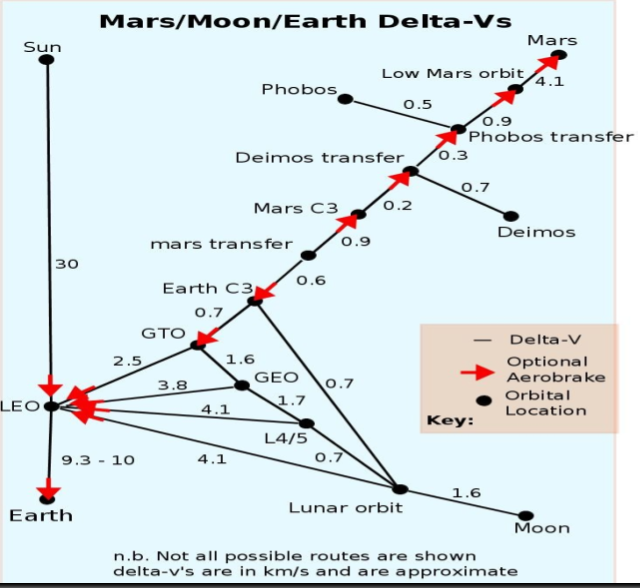
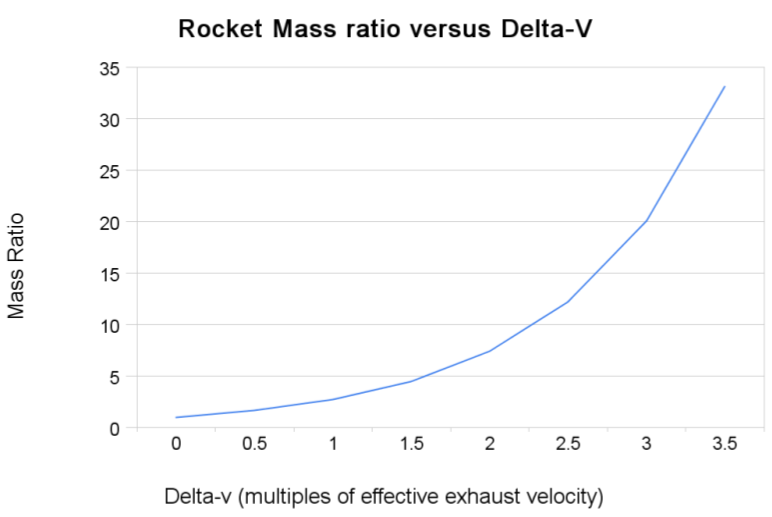
This work has been on "pop up and push," i.e., rocket boost to a few hundred km and a long ablation laser push for the rest of the delta V, (change in orbital velocity) to GEO. This takes advantage of the large thrust available from chemical rockets and the high exhaust velocity of lasers. The method allows much larger payloads than laser propulsion alone. It offers a substantial improvement over rockets. With chemical rockets, only one part in sixty of the lift off mass gets to GEO. It's 14 km/sec to GEO, (Figure 1), and 14/4.5 is about 3. As you can see from Figure 2, fuel is 20 times the rocket and payload together.

Figure 1

Figure 2
The combination of a mass ratio 3 rocket first stage (4 km/sec) and mass ratio 2 laser second stage (10 km/sec) could (according to the rocket equation) deliver one part in twelve of the lift-off mass to GEO, a significant 5 to one improvement.The problem with that scheme is that many very expensive lasers must be in place before the first launch. I have not run a pro forma financial analysis because the rough numbers (well over $100 billion) are so daunting.
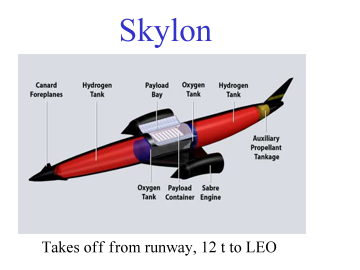
Recently another option came to my attention, the Skylon Spaceplane designed by Reaction Engines Ltd, in the UK.2 Performance, development and production cost of Skylon and SABRE (Synergic Air BReathing Engine) was obtained from Reaction Engines. By using air in place of oxygen to 26 km and Mach 5.5, then shifting SABRE to rocket mode, a Skylon is projected to place a modest (12 t) payload into LEO (Low Earth Orbit).

Figure 3 The April 2009 contract between PG&E and Solaren for 200 MW of space solar power generated many news stories and demonstrated the strong market for clean SSP energy - even though it has never been fully demonstrated (due to SSP’s intrinsically large scale).
A pro forma financial model was created using cost information provided by Reaction Engines, prior knowledge of laser propulsion, informal cost estimates for high kg/kW SSP and propulsion lasers and the 2016 delivery time for the PG&E/Solaren contract.
Pro Forma Model Assumptions (PDF spreadsheet here)
The model uses Reaction Engine's published development numbers. We doubled this to $21.7 B and compressed the development time in half to five years starting in 2010. First vehicle flies in 2015. Production Skylons in the pro forma model decline from $450 M to $292 M after 10,000 flights and vehicle life increases from 200 flights to 500.
Laser and GEO focusing mirror development is assumed to require $2 billion.
The proposed power satellite design is a very conservative 5 kg/kW or 5,000 tonnes per GW. (The project would still make money at 10,000 t per GW.) Development cost of $4 B seems reasonable by taking a low-tech approach and not being too concerned with mass. Four billion dollars should be enough money to rough design three (one PV and two solar dynamic cycles). A substantial fraction of this money will be for design of construction facilities at GEO. Other than being able to be broken down into loads that fit the transportation system, mass is even less of a factor for the "dockyard."
Working capital is also not included in the model because the time between purchasing parts for a power satellite and selling the new power satellite is under 90 days. The construction facility at GEO to build 1 GW power satellites is assumed in the model to be equal to the first power satellite mass (5000 tonnes). One GW is not optimal for power sats. As the increasing flow of materials makes larger-size power satellites practical, the model enlarges the construction facilities by 5000 tonnes per GW.
There is no provision in the financial model for robot assembly or teleoperators. The model assumes up to 1000 workers at GEO. Food and oxygen supply for the workers is not included because it is no more than 1 part in 240 (ten tons per day out of 2400). Wages for the workers in space is not included either because wages (at $500,000 per worker per year) would be one part in 365. (A GW turned out every two days and the net profit after transport cost and parts is a billion dollars per GW.)
Flights to orbit (sub-orbital as more lasers come on line) increase by three additional flights per day per quarter. I assumed the lasers to take over providing delta V in a linear way. As the lasers grow from a few MW to eight GW, payload per flight grows from six tonnes to twenty-five.3
Skylon's ability to go to LEO means that a single 6 MW laser built for $60 million (after development) can raise six tonnes of power sat parts from LEO to GEO in a day. This is a huge improvement over building $40 B of lasers.

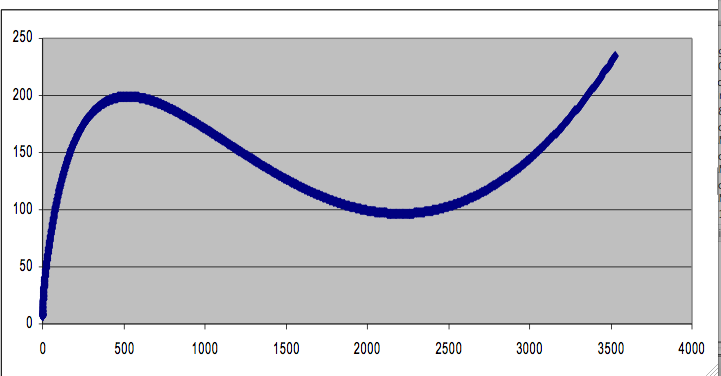
Figure 4. This graph shows the trajectory resulting from a 290 tonne Skylon booster vehicle, carrying a 40 tonne laser stage sub-orbital. The stage is then boosted to GEO by 4 GW of ground based lasers. Payload to GEO is 14.5 tonnes. Laser stage mass rises to 50 t and payload to GEO to 25 t with 8 GW of laser. The vertical axis is nautical miles altitude; horizontal axis is downrange. The constant laser acceleration applied is 1.1 g , much less than the rocket burnout of 3.5 g.
We still build the lasers, but in this model, we buy the lasers over a long time with power-satellite sales. Each laser requires a focusing mirror in GEO. Only one mirror has to go to GEO the hard way (with rockets). We bootstrap the rest up at 50 mirrors a quarter with laser power from the first.
The model has been adjusted so that by the end of 2016, there is ~10,000 tonnes at GEO, enough for the construction facility and parts for the first 1 GW power sat. A linear ramp from zero over 18 months would put the first flight in mid-2015. The flight rate over the next year ramps up to 12 per day. The fleet size assumes flying 1.5 times a day.
Production of Skylons (counting the prototype) by the end of 2016 is 14 with a peak rate of five per quarter. Skylons are similar in size to 747s. Boeing built 747s at higher rates.
The focusing mirrors for the lasers reduce net cargo to GEO by 250 tonnes per quarter. We assume the lasers and focusing mirrors will cost $10/watt. Depending on how much laser power will fit into a standard shipping module, the project installs 50-250 laser modules per quarter.
This involves purchase or construction of 200-1000 "on the ground" laser modules per year. Scaling the factory size from locomotives, the plant making the lasers might be a square mile. The cost of this factory has not been included. In this model, we ramp up and install lasers at a GW per year for 8 years. The factory should reach excellent economy of scale with a production run this long. Financing for the factory could be based on a firm order of this size.
The model accounts for power satellites not sold but diverted internally to make Skylon propellants and to power the lasers. (The cost of the propellant plant and the laser infrastructure such as a refrigeration plant to cool the lasers has not been included.) By the beginning of 2018, the lasers and propellant plants in the model are using ten GW of the 84 GW produced by that date (split almost evenly between lasers and propellant).

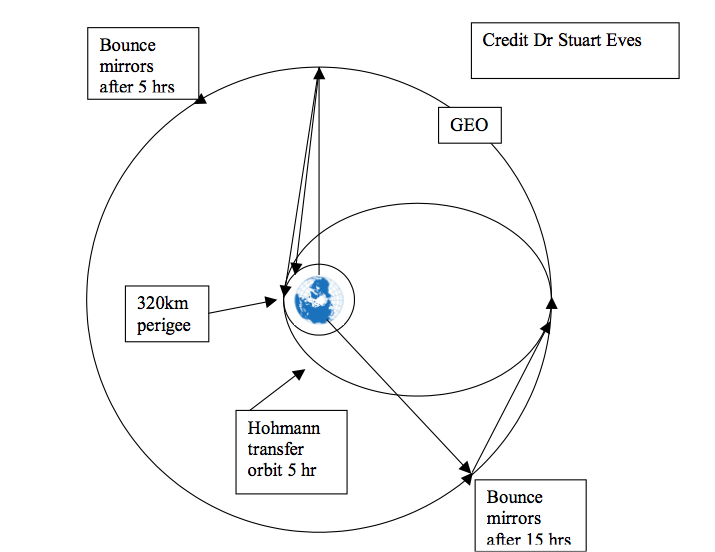
Figure 5. A mature laser boost system as envisioned by Dr. Stuart Eves, Surrey Satellite Technology. The laser stage makes 1 1/2 orbits so the mirrors will be in the correct place to circularize the orbit at GEO.
The initial design capacity of the system builds up over 8 years. At that point of maturity, it is launching 50-ton laser stages and using 8 GW of lasers (1600 modules). There are 4 sub-orbital Skylon flights an hour, less than 100 flights per day. They lift about 800 million kg per year on sub-orbital flights. Not taking the Skylons into LEO might extend their life (though it may complicate recovery). The price per kg lifted to GEO falls from an initial $750/kg (based on twice the depreciation of the Skylons and mass ratio 2 laser stages) to $50/kg. This reduction is due to the cost per flight (lower cost, higher life) and the payload at GEO rising from six t per flight to 25 t per flight due to more lasers.
For a simple financial model, we have conservatively figured net profit for power satellites (not counting transportation otherwise covered) at $1 per watt. If power satellite parts cost $600/kw, then a 1 GW power satellite would sell for $1.6 B. This is 2 cents per kWh based on a ten-year recovery of capital. (It does not include the customer’s associated rectenna.) The market for power in the 1-2 cents per kWh range is close to unlimited because of the demand for low cost synthetic oil.
The model is full of feedback loops because of the bootstrapping. When it first starts, one laser/mirror lifts the cargo of one Skylon flown once a day. That is 12 tons per to LEO and six tons per day to GEO. Two lasers/mirrors allow the Skylon to fly twice a day for 12 tons per day to GEO. More Skylon and lasers rapidly build up the cargo capacity (the effects multiply). (Missing, the cost to boost the first mirror to GEO. IOSTAR's tug may be how we maneuver it into place.)

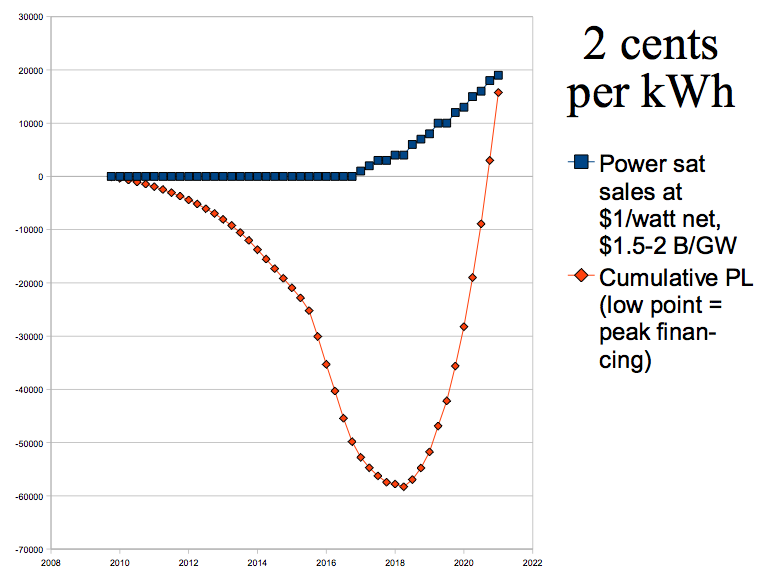
Figure 6. In this draft model the red line tracks cumulative profit / loss (in millions of dollars) each year and the black line shows annual sales - $1.5 - $2 Billion/Gigawatt. The debt bottoms out in 8.25 years at just over $58 billion dollars. That is about twice what the Chinese spent on Three Gorges Dam. For that they obtained 22 GW at a human cost of displacing 1.24 million people. Mature, this project would provide 22 GW of new generating capacity every 44 days.
At the peak investment, power satellite sales in the model are over $4B/year. Refining the model will cause this peak investment and timing to grow or shrink due to conceptual improvements, the minor items mentioned above, those cost items not yet considered and a more realistic (higher) initial sales price for power satellites.4
The current model shows repayment of the entire investment from selling power satellites only nine quarters after reaching the bottom at 8.25 years. (Interest on the capital investment has been included.) The delivery of power satellite parts and power satellite sales grows rapidly after that point.
Current world energy demand is around 15 TW. The "Manhattan Project" crash program outlined here has ~30 TW on line by 2043. World usage of fossil fuels beyond 2040 should be negligible. (Lower cost carbon neutral synthetic fuels would displace liquid fossil fuels.)
The model shows producing over four TW/year of new power satellites by 2040. Four years of power satellite production at this rate would be over 15 TW, enough to put 100 ppm of CO2 back in the ground as synthetic oil in two decades following 2040.
The proposed power satellite financial model makes considerable profit in addition to solving carbon dioxide and energy problems. How to finance it and who might finance this approach to solving the carbon dioxide and energy problems as well as potential military uses of the propulsion lasers are outside the scope of this analysis.
Notes
1 The area of the earth is ~5.1 x 10¹⁴ square meters; air pressure is ~100,000 N/m2. The force would be ~5.1 x 10¹⁹ and the mass (force/acceleration of 9.8 m/sec2) is ~5.2 x 10¹⁸kg or 5.2 x 10¹⁵ t. One ppm would be 5.2 x 10⁹ t and 100 ppm would be ~520 billion tonnes.
It takes ~100kWh to remove a ton of CO2 from the atmosphere.
http://www.eurekalert.org/pub_releases/2008-09/uoc-cd092908.php
Removing 100 ppm of CO2 from the air would take 52000 billion kWh or 52,000 TWh, or since a year is about 8700 hours, about six TW years. A TW is about twice the installed power in the US.
It would take a 1000 1GW nuclear reactors 6 years to bring the CO2 level back to the level of 1960 if no new CO2 was being added.
The problem is what to do with the CO2? Liquid CO2 has a density of 1.1. As liquid, this much CO2 would occupy ~470 cubic km. It would cause a real problem downwind if it blew out of storage. We know that oil stayed in the ground for millions of years.
It takes ~50 times as much energy to convert CO2 to synthetic oil as it does to capture it. So to convert 100 ppm of CO2 to synthetic oil would take ~300 TW-years. If we are already feeding 15 TW into making synthetic oil, we could dedicate another 15 TW into making more and pumping it back into empty oil fields. It would take two decades at this rate to bring the current CO2 level back to that of 1960. We might be able to take the CO2 level down far enough to get the earth to go into an ice age (for those who like to ski).
For the details on the energy cost of making synthetic oil see www.htyp.org/dtc
2 http://en.wikipedia.org/wiki/Reaction_Engines_Skylon
3It is our economic judgment that lasers become useful when there is enough power to raise a 12-ton stage with mass ratio of two to GEO in a day. LEO to GEO is 4.1 km/sec. For a mass ratio of two, the exhaust velocity is 4,1/.69 which is ~six km/sec (ISP of only 600!). We assume multi impulse Hohmann transfer rather than spiral. Twenty-four hours is 86,000 sec.
V=at, a=v/t a 4100/86000 =~0.05 m/sec2. One m/sec2 is ~0.1 g so this is half a percent of a g.
How much mass must be blown off in one second to get 0.05 m/sec2
MV = mv where M is the current laser stage mass, V is 0.05 m/sec and m is the mass blown off in one second at velocity v, 6000 m/sec.
m/sec = 0.05M/v = 0.05m/sec2 x 12,000kg/6000m/sec
m/sec is 0.1k/sec
Ke (of exhaust) =1/2mv2
Ke = 1/2 (0.1) (6000)2 =1.8 x MJ
Laser efficiency of 30% increases this to six MJ.
Since this is over a second, the laser power to provide six MJ/sec is six MW.
The payload multiplier as a function of laser power is from this number and other work indicating delivery of 25 t of payload from a 50 t laser stage placed in a 300 km sub orbital flight.
4There may be resistance to paying a great deal more than the projected cost in a few years.
Subscribe to:
Posts (Atom)
