From: http://www.moondaily.com/reports/Roscosmos_Revives_Permanent_Moon_Base_Plans_999.html
Roscosmos Revives Permanent Moon Base Plans
by Staff Writers
Moscow (RIA Novosti) Jan 20, 2012
Russian Space Agency Roscosmos is in talks with its European and U.S. partners on the creation of manned research bases on the Moon, the agencies chief, Vladimir Popovkin, said on Thursday.
"We don't want the man to just step on the Moon," Popovkin said in an interview with Vesti FM radio station.
"Today, we know enough about it, we know that there is water in its polar areas," he said, adding "we are now discussing how to begin [the Moon's] exploration with NASA and the European Space Agency ."
There are two options, he said: "either to set up a base on the Moon or to launch a station to orbit around it."
The project of a "prospective manned transportation system" to be sent to the Moon is currently being developed, the Roscosmos chief said.
The Moon base project seems to revive Cold War-era plans to create a permanent outpost on the Moon, which was talked about by some Soviet and U.S. scientists since the late 1950s.
Russia is also planning to send two unmanned missions to the Moon by 2020, the Luna Glob and the Luna Resource, Popovkin added.
Showing posts with label Moon. Show all posts
Showing posts with label Moon. Show all posts
18 February 2012

11 December 2011
The Failure of Durban
New frontiers of physics? Possible discovery of the Higgs Boson?
http://www.scientificamerican.com/article.cfm?id=higgs-lhc&print=true
An Earth-like exo-planet (Kepler 22b) discovered and top target for the Search for Extraterrestrial Life:
http://news.cnet.com/8301-17938_105-57338719-1/kepler-22-b-a-top-target-in-restarted-seti-alien-search/
Excellent Counterpoint to the Limits of Growth by Dennis Wingo:
http://wattsupwiththat.com/2011/12/10/the-true-failure-of-durban/#more-52789
The True Failure of Durban
Guest post by Dennis Ray Wingo
First I want to say thanks to Anthony for providing this forum for the discussion of climate in a different sense, that is to focus on Durban and what this conference means from the wider perspective of the direction of our global civilization.
When I was young and beginning in the world of technology I complained to my mentor, my company’s regional manager, about a bad performance review delivered to me by a boss who I and he thought was incompetent. His response was to say that “a performance review can be used as a tool or as a bludgeon”. The same thing is true about CO2 and its role on the global stage as providing a tool whereby the technocrats of the UN and its NGO’s seek to reorganize our planetary civilization In keeping with their desired future.
The fear of the negative consequences of the emission of CO2 is being used as a tool to bludgeon the developed world into economic and political suicide. We in the west are told that we must commit this suicide because we must commit to a “Fair and equitable allocation of the atmospheric space, taking into account the criteria of historic climate debt and population;” [bullet 33g of the FCCC/AWGLCA/2011/CRP.39 document]. We are told that the only just and equitable way to do this is to transfer large sums of money to the Non-Annex 1 world and that we must have peak CO2 emissions in Annex 1 (western civilization) immediately [bullet 33d, bullet 32].
There are two critical assumptions that underpin the entire Durban conference as well as previous efforts; the first assumption is that we live in a limited world and that this wealth transfer and the immediate cessation of CO2 emissions is the only possible path toward a “sustainable” future. The second is that technology cannot solve the problem but politics can. What are these assumptions built upon and are they valid? Is this the only path forward? Are we destined to leave our global posterity in a state of perpetual semi-poverty? Human nature rebels against this doom and gloom view of the future, and with good reason.
The Assumptions
I do not wish to seem overdramatic, but I can only conclude from the information that is available to me as Secretary-General, that the Members of the United Nations have perhaps ten years left in which to subordinate their ancient quarrels and launch a global partnership to curb the arms race, to improve the human environment, to defuse the population explosion, and to supply the required momentum to development efforts. If such a global partnership is not forged within the next decade, then I very much fear that the problems that I have mentioned will have reached staggering proportions that they will be beyond our capacity to control.
Who said this? This statement could have very well have been the preamble to the Durban conference but it actually was uttered by UN Secretary General U Thant in 1969 and is included as the introduction to the book, Limits to Growth. The book “Limits to Growth” (LTG) is the touchstone of the environmental movement as well as the ultimate source of the two underpinning assumptions of the Durban conference.
The Limited Earth
The first assumption that the Earth is all we have and that our resources are limited to only what we have here. This is a patently false assumption. In 2005 I was invited to contribute a chapter to a book on “Spacepower Theory” which was commissioned by the defense department as an extension of Clauswitz’s classic “Landpower Theory”, Alfred Mahan’s “Seapower Theory”, and General Billy Mitchell’s “Airpower Theory”. In my chapter on the “Economic Development of the Solar System as the Heart of a Spacepower Theory”, a word was coined and defined.
“geocentric” is defined as a mindset that sees spacepower and its application as focused primarily on actions, actors, and influences on earthly powers, the earth itself, and its nearby orbital environs. (available online at the NDU press here)
The underpinning assumption that the Earth and its resources constitutes all the wealth that exists for humans to access and use is by definition a geocentric mindset and has been falsified by the last three decades of NASA, ESA, and other nations scientific probes sent to the Moon and beyond. Just in the last few years we have discovered billions of tons of water on the Moon to support propulsion, trillions of tons of aluminum, titanium, iron, Uranium, thorium and other rare Earth metals along with Platinum Group Metals, Cobalt, nickel and iron derived from asteroid impacts. In the asteroid belt are untold riches of water, metals and other resources yet to be identified. Just a single small metal asteroid, 3554 Amun, has tens of trillions of dollars worth of metals, and an asteroid of the same type, 216 Cleopatra, has a billion trillion times more resources of the same type. We now know that Mars has extensive water resources and the two rovers Spirit and Opportunity, found in just a few kilometers of driving, enough metallic asteroid fragments to kick start industry on Mars. It is absurd to think that the geocentric mindset of LTG and today in Durban is correct.
No Faith In Technology
The supposed inability of technology to solve our current problems is the other key assumption of LTG and today in Durban. To anyone who understands history and technology this is absurd but here is what the authors of LTG say about technology;
Applying technology to the natural pressures that the environment exerts against any growth process has been so successful in the past that a whole culture has evolved around the principle of fighting against limits rather than learning to live with them. This culture has been reinforced by the apparent immensity of the earth and its resources and by the relative smallness of man and his activities….
(page 156, Limits to Growth)
… We have felt it necessary to dwell so long on an analysis of technology here because we have found that technological optimism is the most common and the most dangerous reaction to our findings from the world model. Technology can relieve the symptoms of a problem without affecting the underlying causes. Faith in technology as the ultimate solution to all fundamental problems can thus divert our attention from the most fundamental problem – the problem of growth in a finite system – and prevent us from taking effective action to solve it.
(Page 159, LTG)
If you think that this thought pattern is one of the 1970’s, here is what Al Gore said in his book, Earth in the Balance in 1992:
It is important, however, to remember that there is a great danger in seeing technology alone as the answer to the environmental crisis. In fact, the idea that new technology is the solution to all our problems is a central part of the faulty way of thinking that created the crisis in the first place.
Unless we come to a better understanding of both the potential and the danger of technology, the addition of more technological power simply ensures further degradation of the environment, and no matter what new technologies we discover, no matter how cleverly and efficiently we manage to get them into the hands of people throughout the world, the underlying crisis will worsen unless, at the same time, we redefine our relationship to the environment, stabilize human population, and use every possible means to bring the earth back into balance.
(Page 328, Earth in the Balance)
Technology and technological development, in the form of the industrial revolution (the faulty way of thinking according to Gore), has done more to lift mankind out of poverty than all of the political systems tried in the entire one hundred and seventy thousand year history of our species put together. It is amazing that this neo Luddite attitude could exist today, but it does, and as an example of how it influences the Durban conference, only 15% of the money from their massive wealth transfer would be applied to developing technology. That is less than their administrative overhead! At the end of the day, this a key divergence between the NGO’s and technocrats of the UN and those of us who see another way, one rooted in finding solutions to the problems that confront us today.
Developing an Alternative
Let us, for the sake of the hypothetical and to put us on the same page as the delegates in Durban, let us grant the following:
- The increase in CO2 and other IR absorbing gasses in the atmosphere are bad and we must do something about it or suffer the secular apocalypse.
- We apply the minimum financial resources of the $100 billion per year as set forth in Durban to the problem.
Let us set as the requirements the following as well:
- Whatever solution is found, it must in the end result in a more prosperous world for all mankind.
- Whatever solution is found, it must also preserve individual liberty and provide opportunity for the further advance of mankind.
Unfortunately the requirements of brevity in this forum preclude an advanced treatment of this but lets lay the groundwork and if the reader wants more it can be provided in the future.
Energy
The first area to attack is energy. At the end of the day, energy is the key to the future. Just think that if a megawatt of electrical power was as inexpensive as a kilowatt is today, how many things would be different. A trash compactor could atomize your trash and separate it into its basic constituents for recycling. You could easily create your own hydrogen at home for your fuel cell car. Mining on the Earth could extract metals from base rock with oxygen as the waste product.
Half of the $100 billion per year would be spent on a crash program to develop various fusion technologies, including advanced forms of the National Ignition Facility, Polywell Fusion, Thorium fission, and the “traditional” ITER type Tokomak fusion. Applying this much money to these energy technologies would do far more than all of the political world shaping of the wealth transfer of Durban. Providing advanced energy sources would do far more than solar panels or wind turbines to power a prosperous civilization. Both solar and wind are inherently low energy multiple technologies, meaning that the energy that you get out of either of these is only low multiples of the energy that it takes the make, install, and maintain them.
If we put the proper amount of resources into these energy technologies, then we would “solve” the CO2 problem as a side benefit and we could build a world energy grid that would do more than all the antipoverty programs in place today put together to improve life on Earth. In researching the history of the industrial revolution, human lifespan has been directly proportional to the amount of inexpensive energy available to us. human lifespans in the west went from 35 years of age in the year 1700 to almost 50 years of age at the peak of the age of coal in 1900. Today at the peak of the oil age that number has climbed to almost 80 years in Annex 1 countries. It is also in the advanced energy countries where population growth has dropped to replacement or even below. There is a direct correlation between wealth and population and it is far more fun to make everyone wealthy than to make everyone suffer in poverty as would be the ultimate result of Durban.
Space Resource Development
In just the past few years the Lunar Recon Orbiter, the LCROSS, and other missions have made a very preliminary map of the resources available on the surface of the Moon. It is inevitable that there are upside surprises waiting us there. Despite the problems of NASA in getting us back to the Moon, to the Moon is our first destination. Let us apply the other $50 billion a year to an effort to begin the industrialization of the Moon. In inflation adjusted terms, this is still only 40% of the budget spent per year at the peak of the Apollo program. If it is that important, then we can increase that budget to the full $100 billion a year (we are talking about building a sustainable global civilization) on a multi-pronged effort in this area.
This would not just be a NASA effort or a NASA, ESA, JAXA effort but an effort that would provide the means whereby private enterprise could contribute through their own efforts and funds. Tax relief, prizes, and other incentives. We begin with the industrialization of the Moon and the construction of a transportation infrastructure to allow humans to easily move about in the inner solar system. The resources of the Moon enable this. We move forward to build infrastructure in geosynch orbit that are many times larger than today, to enable communications and remote sensing infrastructure that would fundamentally transform our global society for the better.
These are not fantasies, these are not science fiction ideas, they are 100% doable today. The problem has been that the financial support has not been there, even considering the $18 billion dollar a year NASA. NASA is not designed to lead the economic development of the solar system, nor should it be, this is something that the American people and our fellows in western civilization are uniquely qualified to do. Dr. John Marburger, the head of the Office of Science and Technology Policy in the Bush administration had a marvelous speech on this subject at the Goddard symposium in 2006. In it he said:
The ultimate goal is not to impress others, or merely to explore our planetary system, but to use accessible space for the benefit of humankind. It is a goal that is not confined to a decade or a century. Nor is it confined to a single nearby destination, or to a fleeting dash to plant a flag. The idea is to begin preparing now for a future in which the material trapped in the Sun’s vicinity is available for incorporation into our way of life.
This is the alternative to the Durban failure that should be investigated and I submit that if we did this, our future would be far better in the year 2100 than even the most optimistic scenarios developed in any of these conferences that focus on how to split the existing pie up in a way that supports their political proclivities. We want to build a far bigger pie. Today the average welfare recipient in the United States lives a life style that Augustus Caesar or the greatest emperor of old China would think of as magic. Our goal should be to create a world in the year 2100 where the poor live a lifestyle that George Soros would envy.
Beyond Artificial Limits
For those of us who work in the space business and who develop new architectures for lunar development and beyond it seems absurd that these false assumptions should underpin serious global deliberations at crafting a better future for the citizens of our planetary civilization. This at the end of the day is my greatest objection to the role that climate scientists play in the arena of solutions to the “CO2 problem”. Whether or not you believe that CO2 is the secular apocalypse, one thing is certain, the people that are trained in the arcane science of climate proxies are inadequate in training and incompetent in execution of something as large as architecting a future for our civilization. We must open up the boundaries of the discussion to include energy development on the Earth and resource development off planet as serious and viable alternatives to plans such as the failed ones being drawn up in places like Durban.
There is a future out there, a glorious one, that while it may not solve all of our problems, it will certainly get us beyond these artificial limits to growth.
18 January 2011
Mining the Moon
Mining the Moon for Water:
Excerpt from FULL STORY at:
http://www.space.com/10619-mining-moon-water-bill-stone-110114.html
The moon has water, and lots of it. Permanently shadowed craters at both poles have likely been trapping and accumulating water ice for billions of years, recent research has shown.
These concentrated stores are a precious resource that could revolutionize space travel, some scientists and entrepreneurs have argued. Lunar ice can be mined, split into its component hydrogen and oxygen and transformed into rocket fuel, which could then be sold to spacecraft from orbiting "gas stations." Such an arrangement could spur a wave of space travel and exploration, the argument goes, since spaceships wouldn't have to lug all the fuel they need from Earth. One firm that wants to make this happen is Shackleton Energy Co. SEC is serious; it plans to launch robotic scouting missions to the lunar poles within four years, and hopes to be selling propellant in orbit by the end of the decade.
...Our analysis shows it is about 15 times cheaper to launch any mass from the moon to LEO than from the Earth. Lower-cost propellants in space will transform access to and invigorate operations in space. Importantly, our business model indicates this can be realistically done within the decade. Launch providers will now be able to use smaller, cheaper launch vehicles that do not carry excess fuel. They can now get that extra fuel from our orbiting "gas stations." What is very encouraging is that current space treaties and law permit commercial operations on the moon, so the opportunity is wide open to anyone.
...Initially, a crew of 6-12 operators will be trained and deployed to the LEO stations to fine-tune all required operations. When risk reduction and training is complete, an initial crew of 6-8 will descend to the lunar surface mining area and set up camp....Initially, the lunar operating base will be relatively small to accommodate about 6-8 crew for 24/7 operations. The startup crew may have to spend a year on the moon. Operations crews will subsequently be staged at 6-month intervals for normal operations, but we will have frequent transit flights back and forth to LEO/moon for resupply, contingency and medical issues. We will employ maximum use of inflatable structures for the habitat and modular high-power nuclear power supplies for all power operations (heating and electricity). The operations concept calls for human-tended robots to do most of the mining, transportation and processing functions with minimal EVAs [extra-vehicular activity]. The base camp will be expanded incrementally to accommodate increased operations as fuel demand increases. We envision providing at least four very large fuel transfers per year to LEO....Preliminary estimates are about $25 billion to reach the point of positive ROI following initial operations in LEO...With a global surface area of over 35 million square kilometers [13.5 million square miles], with proven reserves of over a billion tonnes of water ice, and with the likelihood that initial surface resource processing will be done in relatively small, localized crater areas, it is unlikely that lunar return and resource harvesting will even be detectable to other lunar explorers, scientists or users...To put this in a more practical perspective, the lunar north pole water alone (from LRO radar signature) is enough to launch one shuttle equivalent per day for over 2,300 years. But this is, literally, only the tip of the "iceberg."If the LCROSS data are correct and the ice zone extends as far as the area between each of the poles to a circle at 80 degrees latitude, there is likely to be enough ice on the moon to launch, again at one-per-day, an equivalent shuttle launch for 250 million years. The moon is a large body with lots of room and lots of resources. There is space enough for everybody on the moon for whatever purposes they envision.
29 August 2010
How Far We've Come! (Space-Based Solar Power)
Check out this presentation from Shreyankur Tripathi of Amity University, Uttar Pradesh, India, "The objective of the paper is to understand the Space based Solar Power along with its advantages, disadvantages, design and other important aspects and then finally discussing about its feasibility."


SolarEn to capture the Sun raw in outer space
Posted by: Shaweta Chauhan | May 4 2009
Here is yet another move to meet the global energy needs. The solar power generation is not a new concept, however, placing solar arrays in space to capture the maximum energy of the Sun can be a step further. Californian utility PG & E and SolarEn corp. have joined hands to fix solar panel arrays in space. The concept is estimated to generate 200MW of power by 2016. The plant costing an estimated $2 billion will provide sufficient energy to light up 250,000 homes.
Converting solar energy in space to electricity
SolarEn proposes to launch satellite, draped with solar panels, in the Earths’ orbit 22,000 miles above the Equator. These satellites will collect and convert solar energy into radio frequencies. The RF is transferred to its ground station in California, which then converts it into electricity and transmitted through power grids to the PG&E delivery point.
Impact on Environment
The Space-based solar power plant has minimal impact on the environment. By placing the satellite into their proper orbit, natural fuels like H2, O2, etc will be made use of. When in proper operations, this power plant will have zero carbon emissions thus making the environment free from mercury and sulfur footprints. The SSP Ground Receiver Station, which converts RF energy into electricity, does not require water for thermal cooling and power generation.
Challenges
The SSP plant faces technological and economic challenges before it becomes a reality.
• Getting a supersized solar array into the space is the major concern of SolarEn.
• High development cost is a major drawback of the project.
Failed projects of Space based solar power
• In August 2008, NASA launched the Nano-Sail D mission into the space, which was designed to test the feasibility of solar sails. The mission failed a few minutes after its launch.
• On 21st June 2005, the engine of Volna booster rocket (a joint Russian - U.S. project), failed minutes after its takeoff.
• In 1999, Russia launched a project similar to Volna booster from its Mir space with a sun-reflecting device. Due to some technical failure, the system burned in the atmosphere.
Read more: http://www.greendiary.com/entry/solaren-to-capture-the-sun-raw-in-outer-space/#ixzz0y218UGRx
from: http://inhabitat.com/2010/06/

Plan To Transform The Moon Into a Solar Plant is Sheer LUNAcy
by Ariel Schwartz, 06/01/10
filed under: Renewable Energy, Solar Power
We’ve heard about schemes to gather solar power directly from space before, but designers at Japan’s Shimizu Corporation have taken the idea to a new level with the Luna Ring, a concept solar power plant on the moon. The plan involves building a 6,800 mile “solar belt” around the moon, beaming electricity to earth with microwaves and lasers, and setting up receiving stations on Earth where the power can then be used.
Shimizu even has a grand plan for bringing the resources for the solar plant to the moon. Humans will barely be involved–all construction will be taken care of by robots with oversight from astronauts. The company explains that, “Water can be produced by reducing lunar soil with hydrogen that is imported from the Earth. Cementing material can also be extracted from lunar resources. These materials will be mixed with lunar soil and gravel to make concrete. Bricks, glass fibers and other structural materials can also be produced by solar-heat treatments.”
Compelling ideas, to be sure, but we’d like to see evidence that any of this is possible. If we can’t get robots to fix an oil spill 5,000 feet below the ocean’s surface, how can we possibly expect them to build a gigantic solar power plant on the moon? Even if this whole scheme was proven possible, the costs would be astronomical — pun fully intended. Still, we can’t fault Shimizu for being ambitious. And while a 6,800 mile solar belt may be far-fetched, that doesn’t mean a more reasonably-sized solar power plant can’t someday end up on the moon.
+ Shimizu Corporation
Via Pink Tentacle
Read more: The Insane Plan to Transform The Moon Into a Giant Solar Plant | Inhabitat - Green Design Will Save the World
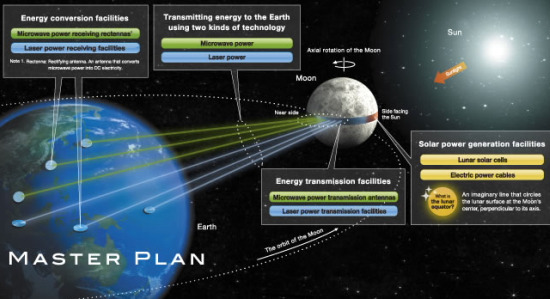
Mega-engineering: awesome future concepts from Shimizu Corporation
Paul Raven @ 02-06-2010
Get yourself over to Pink Tentacle right away; they’re hosting a bunch of mega-engineering promo images and design concepts from Japan’s Shimizu Corporation, who plainly aren’t afraid to think in directions with strong science fictional undertones. Directions such as floating lily-pad cities, million-citizen pyramidal cities, space hotels… and turning the moon into a gargantuan solar power station.
This one’s the winner for me, because any image of a planetary satellite re-engineered into a solar power plant that has the words “MASTER PLAN” masked onto it in large letters is, by any sane and reasonable metric, better than pretty much any other image. Of anything.
Bonus! Compare and contrast with these images of Russian space-race installations and rolling stock decaying the middle of nowhere [via Chairman Bruce]. Maybe one day in the deeper future, people will tut and shake their heads at images of Shimizu’s lunar power station, pocked with impact damage and slowly drowning in lunar dus
PowerSat: Space Solar Flies Closer to Earth
By Jennifer Kho Jun. 16, 2009, 5:05pm PDT 1 Comment
Do you like this story?
Solar from space: It may sound like a bad sci-fi movie, but a growing number of companies think it could solve the world’s energy crisis. Among them is Everett, Wash.-based PowerSat Corp., which said today it’s filed a provisional patent for two technologies it claims could help make the transmission of solar power from space more cost-effective. CEO William Maness also told us that the 8-year-old company has received commitments for $3-$5 million in angel funding, which it’s using to develop wireless power demonstrations on Earth, and is currently in negotiations for a first venture round in the single-digit millions.
The PowerSat news comes after Manhattan Beach, Calif.-based Solaren, another space solar company, in April signed a deal to provide power to northern California utility PG&E. And Swiss startup Space Energy recently said it’s working to launch a prototype satellite into space in 2-3 years.
Solar In Space
Space solar promises virtually unlimited power, with no carbon dioxide emissions. Undiminished by atmosphere or cloud cover, the sun’s energy is five times more powerful than can be found on even the brightest desert on the planet, according to PowerSat’s web site. And since the sun shines at full power all the time, solar energy-capturing satellites — called powersats — can receive more than 25 times as much power as a ground-based system of the same size, the company says.
Here’s how space solar would work: Power satellites armed with solar arrays would generate direct-current electricity, then convert that electricity into radio-frequency energy, which they would transmit the same way that radio travels to your car. But instead of using electricity to transmit information, as a radio signal does, these satellites would be sending the electricity itself. The radio frequency would get converted back into DC electricity at the receiver on the ground.
The huge potential has been apparent for decades, but space solar faces plenty of challenges. The biggest challenge so far, says Maness, is that it’s considered a risky investment. Nobody wants to invest billions of dollars to launch unproven technology into space, but it’s hard to prove the technology works without trying it out on location. Those billions of dollars represent another major hurdle. Even SpaceX‘s target price of $500 per pound, with its Falcon 9 spaceship, is about 20 percent too high to make a commercial space-solar project viable, and other launch estimates “aren’t even in the ballpark,” Maness said.
PowerSat’s Innovation
Now, PowerSat has come up with two technologies that it claims could shave off roughly $1 billion in launch and operation costs for a 2.5-megawatt power station. The first of these is called BrightStar. Instead of one large satellite, Brightstar uses a cluster of hundreds of small ones, which work together — similar to cloud computing — to transmit the power as a group.
The second technology, called Solar Power Orbital Transfer or SPOT, uses the same solar array needed for wireless power transmission to power the electronic thrusters that boost the satellites from what’s called “low Earth orbit,” which is 300-1,000 miles up, to “geosynchronous Earth orbit,” which is 22,236 miles up. Other satellites use a chemically fueled “space tug” to get to the geosynchronous level, and eliminating that power source reduces the weight of a satellite by 67 percent, dramatically decreasing launch costs, Maness said.
The company is developing a 10-kilowatt demonstration project with unnamed potential clients. In about three years, PowerSat hopes to launch a low-earth-orbit project, which will cost about $100 million. And within five years, the startup plans to look for a partnership with a utility, a public-private partnership involving the government or an initial public offering to raise the money for a full-sized project.
PowerSat plans to launch a prototype project into geosynchronous orbit in 2015 and to reach full power production between 2019 and 2021. It expects the smallest economically viable project, with a capacity of 2.5 gigawatts, to cost between $4-$5 billion.
Raising that kind of money, even with proof in place, will be a colossal task. And a long path — the company hasn’t even raised its first single-digit million venture round, although it has closed angel funding. It’s clear that while space solar may be flying closer, it still has a long way to go.

How Do You Feel About “Space Based Solar Power”?Filed Under Tech Questions
Tuesday, 20 October 2009 | Posted by John
That is correct. Solar Based Solar Power is one thing that might be considered and would change everything! I see the picture and I think to myself “what if this things is tilted 10 degrees in the wrong direction”? Is there any possibility of this thing creating a major disaster on Earth?
The article says that “low powered beams are considered safe”, but what happens when you put your cat in the microwave? (please do not abuse your kitty). The technology is simple and really, it seems like a great idea, but to only support the electricity for 1,000 homes, just doesn’t seem worth it to me.
There is a receiving grid a mile wide, even that takes up too much room. I would put the worth of the idea higher if it could power 10,000 homes. Small cities could take advantage and maybe even help to fund projects like this. To power only 1,000 homes, the city I live near would have to send up 50 light collectors and have a receiving area even larger to convert the light on Earth.
It is nice to see others “looking outside the box”, at least. The ideas may seem far fetched, but at least they are in idea form. I would like to talk to whomever thinks it’s cost effective to send up a solar collector that can only power 1,000 homes.

SSPS (Space Solar Power Satellites) & Ground Collectors
Nasa and a number of other agencies have proposed placing giant satellites in geosynchronous Earth Orbit (GEO) to collect sunlight with solar cells. The energy would be converted to a maser beam which would be beamed to the ground to supply earth's energy needs with free, clean, sustainable energy. The basic concept of the SSPS is to beam microwaves from space. The energy would be collected by vast collectors at the ground at high efficiency (around 90%).
The basic technology is now entirely proven with satellite communication relays. The barriers to its development to high power levels are mainly associated with launch costs, a limitation that may well be overcome with BEP technology.
Space Solar Power Satellite
Maser powered from space By concentrating on our future domestic energy supply, the proponents of SSPSs have so far failed to stress the very real potential this technology has to supply the energy needed to get the whole system into space both cheaply and efficiently. They also apparently ignore the obvious fact that, assuming BE propulsion is developed first, then the cost of launching these payloads into space could be reduced 1000x.
Enthusiasts propose placing a series of massive SSPS's (each 1km-5km in diameter) in GEO. Each 1km2 of satellite collector would receive 1.36Gigawatts of solar energy and, using solid-state technology, convert a modest percentage (~30%?) of this energy into coherent microwaves (ie a maser) to produce a near-constant 400Mw at the ground.
The higher E/D in space and the high total hours of operation, (24/7 for 99% of the year) would make a space installation 4x-5x more effective than any ground-based solar collector. The energy is also made available when other (solar-based) supplies are off line (ie in winter and at night.
When the world converts to solar, night time energy will be at a premium
Ground Power Stations
Ground stations would go hand-in-hand with the space collectors. An efficient ground reciever would be a light metal grid or netting 5km-6km in diameter. It could be situated almost anywhere on the ground below (or in shallow water) from the equator to the arctic circle. Aerial relays positioned in the upper atmosphere could also feed smaller ground arrays or extend this range, if necessary.

Space-Based Solar Power?
Labels: solar
Excerpt: The Economist (December 4, 2008)
Around the clock, 1.3 gigawatts of energy pour through every square kilometre of space around the earth. This energy could be captured by vast arrays of photovoltaic cells mounted on a satellite in orbit around the planet. These solar cells would be illuminated at all times of day, whatever the weather or the season, overcoming one of the main drawbacks of solar power on the earth’s surface. And with no atmosphere in the way to absorb or scatter the incoming sunlight, solar panels in space would produce over five times as much energy as those on the ground. (Some proposals for SSP involve large arrays of mirrors or lenses to concentrate the light onto a smaller array of panels.)
The logical place to put the satellite would be in a geostationary orbit, 35,800 kilometres above the earth’s equator, so that it completes one circuit of the planet per day, and thus appears (from the ground) to hover in a fixed place in the sky, like the communications satellites used to broadcast television signals. The solar-power satellite would send the collected energy down to earth in the form of a microwave beam, which would be picked up on the ground by a huge array of antennae, spread over several square kilometres in open country. The power density of the beam at the receiver would be little greater than what leaks out from a domestic microwave oven, so there would be no danger of incinerating entire cities. Microwave communications links are already used in the telecoms industry without doing any harm to wildlife.
Posted by Robert Volpe at Saturday, January 31, 2009

Back to Bright idea or sci-fi?
Bright idea or sci-fi?
September 09, 2009
Tyler Hamilton
Researcher Nobuyuki Kaya showed how solar power could be sent back to Earth from space using microwaves.
TYLER HAMILTON/TORONTO STAR
It sounds like something out of a sci-fi novel. Solar power plants orbiting the planet, each the size of 700 Canadian football fields, beaming clean energy down to Earth 24 hours a day so we can run our factories, charge our gadgets and keep our home appliances humming.
But for the scientists and engineers attending the International Symposium on Solar Energy from Space, a three-day conference this week in Toronto, there's nothing fictional about it. In their view, building massive space-based solar power systems represents, over the long term, one of the most effective ways of tackling the double menace of global warming and peak oil.
"Space-based solar power is a tremendously exciting prospect," said Liberal MP Marc Garneau, the first Canadian in space, speaking yesterday at the Ontario Science Centre about the potential for Canadian involvement in the project. "This country has all the fundamentals to play a leading role."
The Japanese are already leading the charge. Earlier this month, it was reported that Japan's government, working with a consortium of 16 companies, had committed to a $24 billion project to have a 1,000-megawatt solar station in space within three decades. This would generate enough electricity to power 300,000 homes, though getting the equipment into space would likely require more than 1,000 rocket launches.
Eco website TreeHugger called it Japan's "moon shot." The power station would consist of four square kilometres of solar photovoltaic arrays fixed in orbit about 36,000 kilometres above the planet's surface. Energy collected by the panels would be beamed by microwave to a receiving station back on Earth and converted into electricity before connecting to the land-based power grid.
Scientists say the advantage of putting a solar station in space is that it would face the sun 24 hours a day and would not be limited by cloud cover or air pollution. That would allow it to continuously generate power in the same manner as nuclear and fossil-fuel plants, but without the associated waste and greenhouse-gas emissions.
The idea has been around for 40 years, attracting serious attention from NASA and the U.S. Department of Defense during the 1970s, but funding eventually dried up. It wasn't until the late 1990s that interest in the concept resurfaced, partly as a result of concerns related to global warming and energy security.
Two years ago, the Pentagon's National Security Space Office issued a report that concluded solar-based power "is more technically executable than ever before."
The solar panels are more efficient and less costly to manufacture, technology exists to have robots assemble the station in space, and our understanding of wireless power transmission has improved dramatically.
Former NASA executive John Mankins, now president of the Space Power Association, said he believes space-based solar power could be economically competitive with other options.
Mankins added that he believes a small 10-megawatt demonstration plan could be in orbit within the next 10 years. "It's a reasonable time frame," he said.
At the conference, Nobuyuki Kaya, vice-dean of graduate engineering at Kobe University in Japan, demonstrated how the power could be transmitted wirelessly. Assisted by a team of students, he was able to light up a cluster of red LED lights and power a simple robot by beaming energy about 10 metres across a room.
Kieran Carroll, chief technology officer for Space Canada, which is hosting the conference, said such a system could be safely designed to accept and convert large amounts of energy from space. The trick is to transmit at low intensity by sending it down on a wide beam, about 10 kilometres across.
There would have to be no-fly zones around the area, but it wouldn't fry anyone walking through it.
"The power flux density in the middle of the (receiving) field would be perfectly safe for any life," said Carroll.
"In Canada, on a winter's day, one of the big problems would be that birds would probably hover over the field to get warm."
A reality check, however, came from power developer Wael Almazeedi, who warned of the legal, financial and regulatory challenges the plan would face, as well as the difficulty of "promoting a concept based on science fiction."
---------------------
Here is a Public Policy Discussion on YouTube regarding Space-Based Solar Power at "SpaceUP DC"
Subscribe to:
Posts (Atom)
