Showing posts with label Planetary defense. Show all posts

21 May 2012

NASA survey counts potentially hazardous asteroids

From: http://www.kurzweilai.net/nasa-survey-counts-potentially-hazardous-asteroids

NASA survey counts potentially hazardous asteroids

May 21, 2012
NASA_near_earth_asteroids1
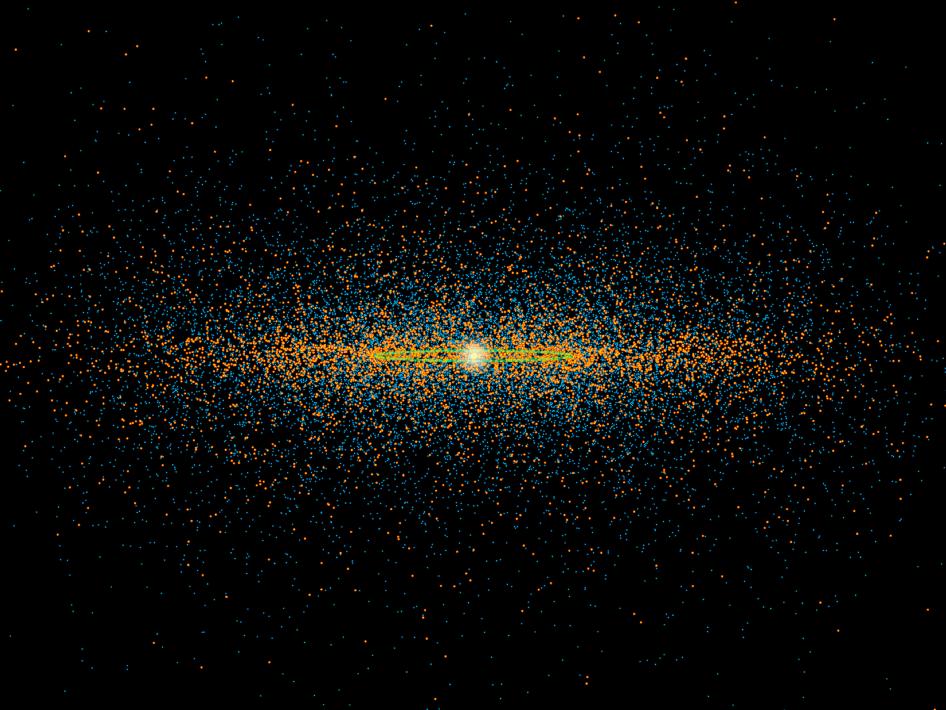
New results from NASA's NEOWISE survey find that more potentially hazardous asteroids, or PHAs, are closely aligned with the plane of our solar system than previous models suggested, coming within 5 million miles (about 8 million kilometers) of Earth (credit: NASA/JPL-Caltech)
There are roughly 4,700 potentially hazardous asteroids (PHAs) with diameters larger than 330 feet (about 100 meters). So far, an estimated 20 to 30 percent of these objects have been found, according to observations from NASA’s Wide-field Infrared Survey Explorer (WISE), which have led to the best assessment yet of our solar system’s population of potentially hazardous asteroids.
Potentially hazardous asteroids are a subset of the larger group of near-Earth asteroids. The PHAs have the closest orbits to Earth’s, coming within five million miles (about eight million kilometers), and they are big enough to survive passing through Earth’s atmosphere and cause damage on a regional, or greater, scale.
The new results come from the asteroid-hunting portion of the WISE mission, called NEOWISE. The project sampled 107 PHAs to make predictions about the entire population as a whole. Findings indicate there are roughly 4,700 PHAs, plus or minus 1,500, with diameters larger than 330 feet (about 100 meters). So far, an estimated 20 to 30 percent of these objects have been found.
While previous estimates of PHAs predicted similar numbers, they were rough approximations. NEOWISE has generated a more credible estimate of the objects’ total numbers and sizes. It suggests that about twice as many PHAs as previously thought are likely to reside in “lower-inclination” orbits, which are more aligned with the plane of Earth’s orbit.
In addition, these lower-inclination objects appear to be somewhat brighter and smaller than the other near-Earth asteroids that spend more time far away from Earth. A possible explanation is that many of the PHAs may have originated from a collision between two asteroids in the main belt lying between Mars and Jupiter. A larger body with a low-inclination orbit may have broken up in the main belt, causing some of the fragments to drift into orbits closer to Earth and eventually become PHAs.
NASA_hustle_bustle_solar_system
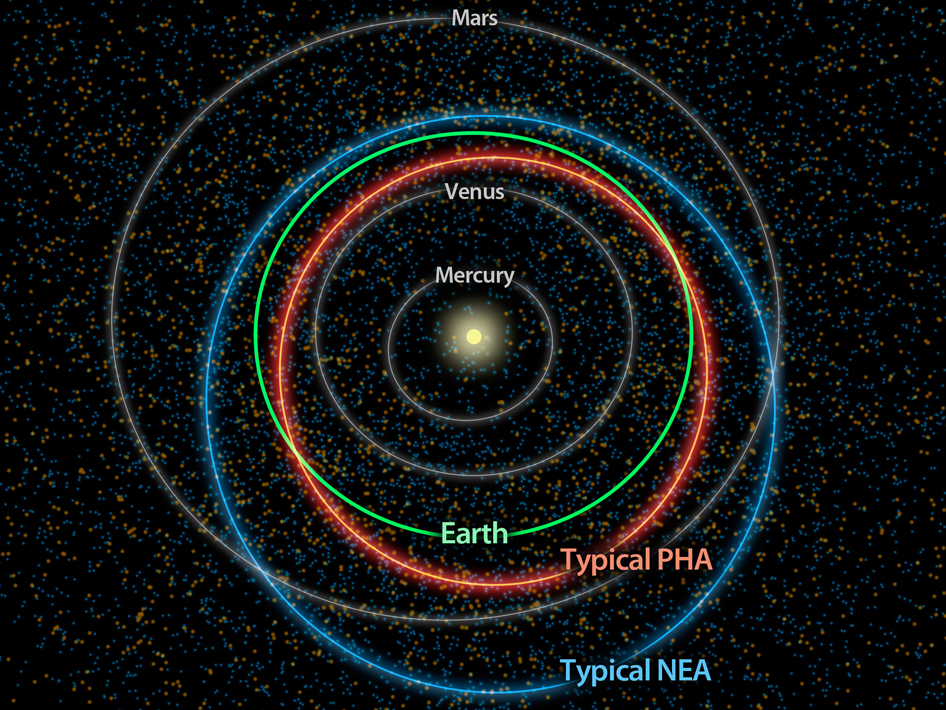
This diagram illustrates the differences between orbits of a typical near-Earth asteroid (blue) and a potentially hazardous asteroid, or PHA (orange). PHAs are a subset of the near-Earth asteroids (NEAs). They have the closest orbits to Earth's orbit, coming within 5 million miles (about 8 million kilometers), and they are large enough to survive passage through Earth's atmosphere and cause damage on a regional, or greater, scale. (Credit: NASA/JPL-Caltech)
Asteroids with lower-inclination orbits would be more likely to encounter Earth and would be easier to reach. The results therefore suggest more near-Earth objects might be available for future robotic or human missions.
“NASA’s NEOWISE project, which wasn’t originally planned as part of WISE, has turned out to be a huge bonus,” said Amy Mainzer, NEOWISE principal investigator, at NASA’s Jet Propulsion Laboratory in Pasadena, Calif. “Everything we can learn about these objects helps us understand their origins and fate. Our team was surprised to find the overabundance of low-inclination PHAs. Because they will tend to make more close approaches to Earth, these targets can provide the best opportunities for the next generation of human and robotic exploration.”
The discovery that many PHAs tend to be bright says something about their composition; they are more likely to be either stony, like granite, or metallic. This type of information is important in assessing the space rocks’ potential hazards to Earth. The composition of the bodies would affect how quickly they might burn up in our atmosphere if an encounter were to take place.

5 Kt Meteor Blast over California

NASA's Goddard Space Flight Center and Astrophysical Journal,
 A sonic boom heard in California last week had an out-of-this world origin as ”a large meteoric event” according to NASA’s Meteoroid Environment Office. Scientists now estimate the blast measured in near 5 kilotons or roughly 1/3 the power of the atomic bomb dropped on Hiroshima, Japan during World War II. Bill Cooke of the Meteoroid Environment Office at NASA’s Marshall Space Flight Center, estimates the object was about the size of a minivan, and weighed in at around 154,300 pounds.

"Most meteors you see in the night’s sky are the size of tiny stones or even grains of sand and their trail lasts all of a second or two," said Don Yeomans of NASA’s Near-Earth Object Program Office at the Jet Propulsion Laboratory in Pasadena, California. “Large meteors can be seen in the daytime and are many times that size – anywhere from a baseball-sized object to something as big as a minivan.”  The meteor appears to be much more valuable than scientists first thought. Meteorite hunters found fragments of the rock, identified by the "fusion crust" that forms when it burns in the atmosphere. NASA and the SETI Institute in Mountain View, California, also mobilized a search team of about 30 scientists to search for the small black rocks. The meteorite turned out to be a very rare type of rock called CM chondrite, which makes up less than 1 per cent of the meteorites that fall to Earth. According to Bill Cooke of NASA's Meteoroid Environment Office at the Marshall Space Flight Center in Huntsville, Alabama, it is not clear whether it is rare because it easily burns up in the atmosphere or there are just fewer of these rocks in space.

17 March 2012

2011 AG5 a 2040 risk?

From: http://www.space.com/14872-asteroid-2011-ag5-earth-impact.html


A massive asteroid that may be on a collision course with Earth should be studied in more detail, according to a former Apollo astronaut who specializes in monitoring potentially hazardous space rocks. Asteroid 2011 AG5 has been the object of attention because scientists say it may swing close to our planet in the year 2040. The big space rock is on NASA’s impact hazards list, but more definitive tracking of the object is still needed, scientists say. In fact, some near-Earth object (NEO) experts say it’s time to start hammering out a plan in case the asteroid needs to be deflected. Former Apollo astronaut Russell Schweickart is calling upon NASA to undertake a detailed engineering and mission planning analysis of 2011 AG5.

From: http://www.huffingtonpost.com/2012/03/13/asteroid-2011-ag5-risk-unclear_n_1341355.html


By: Leonard David
Published: 03/12/2012 06:09 PM EDT on SPACE.com
A massive asteroid that may be on a collision course with Earth should be studied in more detail, according to a former Apollo astronaut who specializes in monitoring potentially hazardous space rocks.
Asteroid 2011 AG5 has been the object of attention because scientists say it may swing close to our planet in the year 2040.
The big space rock is on NASA’s impact hazards list, but more definitive tracking of the object is still needed, scientists say. In fact, some near-Earth object (NEO) experts say it’s time to start hammering out a plan in case the asteroid needs to be deflected.
Former Apollo astronaut Russell Schweickart is calling upon NASA to undertake a detailed engineering and mission planning analysis of 2011 AG5.
In a March 3 open letter to NASA administrator Charles Bolden, Schweickart spotlighted what he sees as the potential deflection challenges posed by asteroid 2011 AG5, should the object happen to be headed for a so-called keyhole in 2023, setting up a possible impact with Earth in 2040. [The 7 Strangest Asteroids in the Solar System]
Keyholes are small regions in space near Earth through which a passing NEO may be perturbed — due to gravitational forces — placing it onto a path that would strike Earth.


In this most recent communiqué, Schweickart questioned a view held by Bolden from an earlier exchange of letters between the two that a Deep Impact-like intercept of asteroid 2011 AG5 could be staged in enough time to derail a space rock from hitting Earth.
NASA’s Deep Impact probe was purposely crashed into comet Tempel 1 on July 4, 2005.
A more daunting challenge
While Deep Impact was a very successful mission, it is a poor analogy for the potential deflection challenges presented by 2011 AG5, Schweickart noted. To depend on such an impact mission to justify waiting until after the next tracking opportunities — before doing any further engineering analysis — is ill advised, he said.
Schweickart contends that a 2011 AG5 deflection campaign requires two missions, not one, as was used on Deep Impact. In addition, intercepting and impacting 2011 AG5 presents far more daunting challenges than was posed by comet Tempel 1.
In his open letter, Schweickart told Bolden that, "neither you nor I would have risked our lives without solid engineering having gone into our respective missions. In this instance again, there are potentially lives at stake, and I know you take that responsibility seriously, as do I." [Photos: Asteroids in Deep Space]
"To be clear, what I am asking for is specific engineering and mission planning analysis to be performed now in order to insure that we fully understand the timeline requirements, in the unlikely event that AG5 should be headed for the 2023 keyhole," Schweickart wrote.
"We all realize it is highly likely that AG5 is not headed for an impact. But we must also hedge against the possibility that this will not be the case by being prepared to act, and not find ourselves awkwardly beyond the point where deflection remains an option," Schweickart concluded in his open letter to the NASA chief.
NASA's response
In response to the letter, Schweickart told SPACE.com that a NASA-organized teleconference was held on March 8 involving himself, as well as John Grunsfeld, NASA's Associate Administrator for the Science Mission Directorate, Jim Green, Director of Planetary Science, and Lindley Johnson, NEO Observations Program Executive.
"It was a very constructive discussion and as a result we will be getting together in the next few weeks to discuss the various issues and options which would apply to a variety of future scenarios regarding 2011 AG5," Schweickart said. "I’m looking forward to these substantive discussions and I commend John Grunsfeld and NASA for this positive response."
Schweickart's new letter to Bolden, "presents points we at NASA have considered in looking at the 2011 AG5 scenario," Lindley Johnson told SPACE.com.
"A big concern with any mission analysis is that they are only as good the initial input conditions. The results you obtain are always dependent on those conditions," he said.
Johnson said that if 2011 AG5’s orbit model in hand now turns out to be a good representation of where the NEO will be in the future, then a mission analysis could be done now, and such work would be worthwhile. [5 Reasons to Care About Asteroids]
But, if the asteroid’s orbit isn’t that well defined, then a mission analysis would need to be mostly re-done after a better orbit is ascertained, he said.
"We are certain we will have a higher confidence model after observations are collected in another orbit of AG5," Johnson said, "and we are confident we will have more than sufficient time to do both the mission analysis and undertake any response still necessary after that observation opportunity."
"However, we will continue to study the AG5 situation, as we do continuously for all objects on theimpact hazards list," Johnson concluded.
Tools to monitor 2011 AG5
"There are logical reasons to start really planning to do something really soon … and analyzing AG5 really soon," said Clark Chapman, a noted specialist in asteroids and a planetary scientist at the Southwest Research Institute in Boulder, Colo.
It has been generally thought that 2011 AG5 can't be observed again until September of 2013, Chapman told SPACE.com. "That’s not true. We can see it again in August of this year."
What’s needed is one of the largest ground-based telescopes on Earth, or the Hubble Space Telescope, Chapman advised. Doing so wouldn’t be too easy, "but in all probability could be done."
For one, the asteroid is very faint and ground-based telescopes would need to slew toward the horizon in a really dark sky.
"Telescopes are sort of designed to look more or less up … rather than over," Chapman noted. In the case of the Hubble Space Telescope, caution is the rule as it would be necessary to point the scope 42 degrees away from the sun to observe 2011 AG5, "but exceptions have been made in the past."
Odds of an impact
Still, whether using these tools to eye the asteroid will improve our understanding of the asteroid's track isn’t a given.
"We simply don’t know whether observations in August can make that much of a difference … but that's another arena in which studies should be done in the very near term," Chapman said.
In the meantime, more information about 2011 AG5 is needed, Chapman said.
"We don’t know how big this thing is," he said. "And if it’s on the big side, it would be hard to move it away from the keyhole with only a few years planning. And if it’s really big, it’s hard to move it away from the Earth if it goes through the keyhole."
Chapman stressed that the most probable result of more tracking of the asteroid is that the 2040 impact of Earth probability will drop to zero.
"I’m of the view that you can’t say, 'let’s just wait and the odds are likely to go to zero.' Yes, the odds are likely to go to zero…but suppose they don’t," Chapman said.
Leonard David has been reporting on the space industry for more than five decades. He is a winner of last year's National Space Club Press Award and a past editor-in-chief of the National Space Society's Ad Astra and Space World magazines. He has written for SPACE.com since 1999.
29 February 2012

Conceptual Design and Analysis of Planetary Defense Technology

http://www.aere.iastate.edu/events-2/conceptual-design-and-analysis-of-planetary-defense-technology-pdt-demonstration-missions/

22 October 2011

Amateurs Find Asteroids

From: http://www.dailymail.co.uk/sciencetech/article-2048797/Amateur-skywatchers-Tenerife-impact-threat-asteroid.html?ito=feeds-newsxml


Amateur skywatchers in Tenerife find 'impact threat' asteroid

By Daily Mail Reporter
Last updated at 7:30 PM on 13th October 2011


Amateur astronomers have for the first time spotted an asteroid that comes close enough to earth to pose a threat of impact.
Volunteers picked out the cosmic rock - named asteroid 2011 SF108 - last month from the observatory in the Canary Islands.
The breakthrough discovery could signal the first of many more asteroid sighting around the world as keen amateurs become more equipped with advanced technology.
Threat: Asteroid 2011 SF108 is seen in the centre of the picture circled by a red ring
Space experts said the sighting highlighting the value of ‘crowd-sourcing’ to science and planetary defense.
The discovery of asteroid 2011 SF108 was made by the volunteer Teide Observatory Tenerife Asteroid Survey (TOTAS) team during an observation slot sponsored by ESA’s Space Situational Awareness (SSA) program.
The four-night survey used the 1m-aperture telescope at ESA’s Optical Ground Station at Teide on Tenerife in the Canary Islands.

This is not the first asteroid found under SSA sponsorship, but it is the first that qualifies as a ‘near Earth object’ – an object that passes close enough to Earth during its orbit around the Sun that it could pose an impact threat.
During TOTAS observations, the telescope runs automated asteroid surveys for several hours using software developed by amateur astronomer and computer scientist Matthias Busch from the Starkenburg Amateur Observatory in Heppenheim, Germany.
However, potential sightings must still be evaluated by humans.
A team of 20 volunteers analyses each of the images to highlight anything that appears to be moving through space.
Breakthrough: The observatory in Tenerife at an altitude of 2393 metres from where the asteroid was detected

Keen: Amateur astronomers monitor the sky in the darkened control room of the ESA's Optical Ground Station in Tenerife
Recording developments: Amateur astronomers monitor the sky in the darkened control room of the ESA's Optical Ground Station in Tenerife
The team successfully picked out the anomaly  during the session on 28/29 September and it was was later confirmed as an asteroid.
Detlef Koschny, Head of asteroid activity for SSA, said: 'Images are distributed to the entire team for review, and any one of them could be the discoverer of a new asteroid. This time, the luck of the draw fell to Rainer Kracht.
'As volunteer work, it is very rewarding. When you do spot something, you contribute to Europe’s efforts in defending against asteroid hazards.'
'When you do spot something, you contribute to Europe’s efforts in defending against asteroid hazards.'
The orbit of asteroid 2011 SF108 brings it no closer than about 30 million km to Earth – a safe distance.
The object is the 46th asteroid discovered by Mr. Kracht, a retired school teacher who lives in Elmshorn, near Hamburg, Germany.
He said: 'Eight of us reviewed images on the night of the discovery, and I was lucky to be the one who found 2011 SF108 as part of this team.
'The discovery was only possible with the excellent software developed by Matthias Busch, who also spotted this object in the images on the second night and sent the observations to the Minor Planet Center.'
To date, some 8000 asteroids have been discovered worldwide but many thousands more are suspected to exist, particularly in the size of meters to hundreds of meters. It is important to find and track these to determine if any pose an impact threat to Earth.
TOTAS is helping to lay the foundation for a future European asteroid survey as part of the full SSA program, which is to be decided in 2012.
Such a survey would use multiple 1m telescopes to scan the complete sky every night, a much larger effort than at present, and is expected to discover several asteroid per week. It would use a mix of professional and ‘crowd-sourced’ astronomers.
Currently, professional asteroid surveys are performed only in the USA. The only significant asteroid survey in Europe now is the La Sagra Sky Survey, undertaken by amateur astronomers in southern Spain.


http://www.space.com/13272-asteroid-discovery-amateur-astronomers-2011-sf108.html

A team of amateur astronomers has discovered a previously unknown asteroid in orbit that brings it near the Earth, highlighting the contributions regular folks can make to planetary defense, scientists announced Wednesday (Oct. 12).
The skywatchers spotted the asteroid, which is known as 2011 SF108, in September using a telescope in the Canary Islands. While 2011 SF108's orbit appears to bring it no closer to Earth than about 18 million miles (30 million kilometers), it still qualifies as a near-Earth object — the class of space rocks that could pose a danger to our planet.
The team took advantage of an observation slot sponsored by the European Space Agency's Space Situational Awareness (SSA) program to make the find, according to an ESA announcement.
"As volunteer work, it is very rewarding," said Detlef Koschny, head of near-Earth object activity for SSA, in a statement. "When you do spot something, you contribute to Europe's efforts in defending against asteroid hazards." [Photo of newfound asteroid 2011 SF108]
Amateurs make a find
Asteroid 2011 SF108 was discovered by the Teide Observatory Tenerife Asteroid Survey (TOTAS) team, a group of 20 skywatching volunteers. They used the 1-meter telescope at the European Space Agency's Optical Ground Station on Tenerife in the Canary Islands.
Specifics on the asteroid's estimated size were not detailed in the ESA announcement.
The telescope observed for four nights, running automated asteroid surveys using software developed by amateur astronomer and computer scientist Matthias Busch from the Starkenburg Amateur Observatory in Heppenheim, Germany.
Busch's software flags potential space rocks, but the finds must be confirmed by human eyes. The software scored a hit during the observing session of Sept. 28 and 29, researchers said.
"Images are distributed to the entire team for review, and any one of them could be the discoverer of a new asteroid," Koschny said. "This time, the luck of the draw fell to Rainer Kracht."
Kracht, a retired schoolteacher who lives in Elmshorn, Germany, is therefore 2011 SF108's official discoverer. He now has found 46 asteroids, researchers said.
To date, about 8,000 near-Earth objects have been discovered worldwide, but many thousands more are suspected to exist. Astronomers are keen to find as many of them as possible, so they can better assess the chance that a big, dangerous space rock will slam into Earth sometime soon.
Since starting their SSA-sponsored survey work in January 2010, the TOTAS amateur astronomers have identified nearly 400 candidate asteroids, 20 of which have been confirmed and named, researchers said.
Determing the orbit
After examing telescope images from three separate nights, the TOTAS team was able to determine 2011 SF108's orbit well enough to declare it a near-Earth object.
The team sent news of its find to the Minor Planet Center in Cambridge, Mass., the worldwide clearinghouse of information about comets and asteroids.
While 2011 SF108 appears not to pose much risk to Earth for the foreseeable future, further observations could help refine its orbit and our assessment of just how dangerous it might be, researchers said. But for now, the team can bask in the glow of discovery for a spell.
"It was really an exciting moment when I saw 'our' asteroid appearing on my computer screen," Koschny said. "It confirms the excellent quality of work done by the entire TOTAS team."

From:
http://www.mnn.com/earth-matters/space/stories/amateur-astronomers-locate-near-earth-asteroid


Amateur astronomers locate near-Earth asteroid

Amateur astronomers have identified nearly 400 candidate asteroids since January 2010, 20 of which have been confirmed and named.

By Mike WallThu, Oct 13 2011 at 3:04 PM EST
NEW FIND: Observations coordinated by ESA's Space Situational Awareness program have led to the discovery of a previously unknown near-Earth object, asteroid 2011 SF108 in Sept. 2011. The asteroid orbits the sun in a path that brings it within about 18 million miles (30 million km) of Earth. (Photo: ESA)
A team of amateur astronomers has discovered a previously unknown asteroid in orbit that brings it near the Earth, highlighting the contributions regular folks can make to planetary defense, scientists announced Wednesday.
The skywatchers spotted the asteroid, which is known as 2011 SF108, in September using a telescope in the Canary Islands. While 2011 SF108's orbit appears to bring it no closer to Earth than about 18 million miles (30 million kilometers), it still qualifies as a near-Earth object — the class of space rocks that could pose adanger to our planet.
 
The team took advantage of an observation slot sponsored by the European Space Agency's Space Situational Awareness (SSA) program to make the find, according to an ESA announcement.
 
"As volunteer work, it is very rewarding," said Detlef Koschny, head of near-Earth object activity for SSA, in a statement. "When you do spot something, you contribute to Europe's efforts in defending against asteroid hazards." [Photo of newfound asteroid 2011 SF108]
 
Amateurs make a find
Asteroid 2011 SF108 was discovered by the Teide Observatory Tenerife Asteroid Survey (TOTAS) team, a group of 20 skywatching volunteers. They used the 1-meter telescope at the European Space Agency's Optical Ground Station on Tenerife in the Canary Islands.
 
Specifics on the asteroid's estimated size were not detailed in the ESA announcement.
 
The telescope observed for four nights, running automated asteroid surveys using software developed by amateur astronomer and computer scientist Matthias Busch from the Starkenburg Amateur Observatory in Heppenheim, Germany.
 
Busch's software flags potential space rocks, but the finds must be confirmed by human eyes. The software scored a hit during the observing session of Sept. 28 and 29, researchers said.
 
"Images are distributed to the entire team for review, and any one of them could be the discoverer of a new asteroid," Koschny said. "This time, the luck of the draw fell to Rainer Kracht."
 
Kracht, a retired schoolteacher who lives in Elmshorn, Germany, is therefore 2011 SF108's official discoverer. He now has found 46 asteroids, researchers said.
 
To date, about 8,000 near-Earth objects have been discovered worldwide, but many thousands more are suspected to exist. Astronomers are keen to find as many of them as possible, so they can better assess the chance that a big, dangerous space rock will slam into Earth sometime soon.
 
Since starting their SSA-sponsored survey work in January 2010, the TOTASamateur astronomers have identified nearly 400 candidate asteroids, 20 of which have been confirmed and named, researchers said.
 
Determing the orbit
After examing telescope images from three separate nights, the TOTAS team was able to determine 2011 SF108's orbit well enough to declare it a near-Earth object.
 
The team sent news of its find to the Minor Planet Center in Cambridge, Mass., the worldwide clearinghouse of information about comets and asteroids.
 
While 2011 SF108 appears not to pose much risk to Earth for the foreseeable future, further observations could help refine its orbit and our assessment of just how dangerous it might be, researchers said. But for now, the team can bask in the glow of discovery for a spell.
 
"It was really an exciting moment when I saw 'our' asteroid appearing on my computer screen," Koschny said. "It confirms the excellent quality of work done by the entire TOTAS team."

04 September 2011

Chinese Scientists Plan to Pull an Asteroid into Orbit Around Earth


Chinese Scientists Plan to Pull an Asteroid into Orbit Around Earth


Pictured: Humans Tempting God to Smite Them Hexi Baoyin, Yang Chen, Junfeng Li via arXiv
Last week Chinese scientists wanted to divert an asteroid away from Earth. This week, they want to pull one into orbit around the Earth. What’s possible objections could anyone have to this idea?
The notion stems from a phenomenon the researchers from Tsinghua University in Beijing noticed from time to time with Jupiter. Every now and then our solar systems biggest planet pulls in an object from space, which orbits the planet for a time before jetting off into interplanetary space again.

We could do something similar with a number of near earth objects (NEOs) that will pass near Earth in the coming years and decades. None of these objects will pass close enough to be naturally captured by Earth’s gravity, but a few will come so close that a small nudge in the right direction would put them in orbit--likely a temporary orbit--around Earth.
The idea isn’t simply to flirt with cataclysmic danger, but to bring a small object (they suggest a 10-meter object called 2008EA9 that will pass nearby in 2049) into a loop around the Earth so we can study it closely for a few years. If we can get the art of capturing asteroids orbitally down to a science, we could use it to temporarily make asteroids into Earth-bound satellites (orbiting at about twice the distance of the moon), mine them for minerals, and then send them on their ways.
Read the paper at arXiv.

How to Send Astronauts to Asteroids? Earth Needs to Know


From: http://www.space.com/12782-asteroid-missions-astronauts-humanity-survival.html
How to Send Astronauts to Asteroids? Earth Needs to Know, Report Suggests by Leonard David, SPACE.com’s Space Insider ColumnistDate: 31 August 2011 Time: 07:00 AM ET
Artist's concept of anchoring to the surface of an asteroid.
CREDIT: NASA 

Developing the capability to launch human missions to asteroids would aid humanity's ability to foil a potentially devastating asteroid strike and help spur our march to Mars, a new report finds.
What's most needed to make manned asteroid missions possible, the report further concludes, is a comprehensive survey of the Near Earth Object (NEO) population, which would greatly aid planning efforts.
The new report, entitled "Target NEO: Open Global Community NEO Workshop," is anchored in views expressed by experts who gathered at George Washington University (GWU) in Washington in February. But this latest appraisal includes extensive peer review and refined findings from a number of follow-up meetings, both in the United States and abroad. [Photos: Asteroids in Deep Space]

The key question posed by the GWU workshop: What information about NEOs is still needed to support a robust, sustainable human exploration program?
While this question prompted a variety of recommendations, a primary conclusion by the participants is the need for a space-based survey telescope to greatly expand the catalog of accessible asteroid targets for human exploration.
The space rock menace
There is a growing list of stakeholders supportive of NEO exploration, said Paul Abell, lead scientist for planetary small bodies at the Astromaterials Research and Exploration Science Directorate of NASA's Johnson Space Center in Houston.
"This report is timely," Abell told SPACE.com.
Small bodies have become a magnet for multiple interest groups in the U.S. and abroad, Abell said, be they space scientists, astrobiologists, planetary defense planners or NEO specialists who eye the rocky worlds as resource nodes.
An artist's interpretation of NASA's asteroid-sample mission OSIRIS-REx, which will rendezvous with the near-Earth asteroid designated 1999 RQ36 in 2020. The mission is expected to launch in 2016. 
An artist's interpretation of NASA's asteroid-sample mission OSIRIS-REx, which will rendezvous with the near-Earth asteroid designated 1999 RQ36 in 2020. The mission is expected to launch in 2016.
CREDIT: NASA/Goddard University
For example, NASA recently selected an asteroid sample return mission called Origins-Spectral Interpretation-Resource Identification-Security-Regolith Explorer, or OSIRIS-Rex. OSIRIS-Rex will be the first U.S. mission to carry samples from an asteroid back to Earth.
Japanese space officials are moving forward on their Hayabusa 2 asteroid explorer. Russia is readying its Phobos-Grunt spacecraft to explore a moon of Mars, and Canada is pressing forward on its dual-purpose microsatellite, NEOSSAT.
Then there’s the new, surprising data flooding in from NASA’s Dawn probe that’s taking a long look at Vesta, the second-largest object in the main asteroid belt between Mars and Jupiter. [5 Reasons to Care About Asteroids ]
"It shows you that, every time we go places, we’re always surprised and there’s so much to learn," Abell said. "That’s the fun part of science and exploration."
The "Target NEO" report points out that programs and planned missions to asteroids may be leveraged for mutual benefit in terms of data exchange. It also recommends coordination with the European Space Agency and other space agencies on a planetary defense demonstration mission.
Stepping stones to Mars
As for dispatching astronauts to asteroids, the report envisions that a target NEO will need to be discovered several years in advance to provide enough lead time to deliver robotic precursor missions, plan the human mission and deliver the crew to the chosen destination.
Abell also said that piloted flight to a NEO would hone techniques that could enable an exploration mission to the Red Planet.
"They provide good stepping stones out to Mars," Abell said.
Operating at an asteroid or Mars would be completely different than working at the moon, on the space shuttle or aboard the International Space Station.
Both asteroids and Mars, for example, would have much greater lags in communication times. So deep space missions would require the sharpening of true autonomy acumen, as well as a great deal of confidence in redundant hardware, deep space propulsion, life support gear and radiation shielding.
This composite image shows the comparative sizes of nine asteroids.  
Size matters…as well as composition! Comparative imagery of nine asteroids. Asteroid Vesta dwarfs all other small bodies and is considered a protoplanet because it’s a large body that almost became a planet and has a diameter of approximately 330 miles (530 kilometers).
CREDIT: NASA/JPL-Caltech/JAXA/ESA
Space exploration primer
A major report finding is that human spaceflight know-how — the body of data required to support the flinging of flesh outward to a NEO, a journey that would take many months roundtrip — "is severely limited at this time." [Video: Asteroid Collision Watch]
Furthermore, behavioral health support and the psychological and sociological issues associated with a NEO-bound crew cramped up in relatively small quarters "are also significant concerns that increase the risk to the mission."
Overall, the report flags the fact that deep space missions do not afford the abort opportunities and psychological comfort provided by rapid return to our home planet — a hallmark of missions in cislunar space, particularly those carried out in low-Earth orbit.
Bottom line: Far more work is necessary to support human sojourns outside of the Earth’s protective magnetosphere. A biological bugaboo is the acute and long-term physiological effects of space radiation on the human body.
Looming space decisions
"We will soon begin writing the next chapter of our human spaceflight saga, and a near-Earth object may be humanity’s first destination beyond the Earth-moon system," said Brent Barbee, editor of the report and a flight dynamics engineer at NASA’s Goddard Space Flight Center in Greenbelt, Maryland. "There are many decisions to be made regarding how we approach that challenge."
Barbee said that he and his colleagues hope the new workshop report will be a valuable reference that helps inform critical decision-making. And there are a number of decisions forthcoming to help focus on NEO visitation questions.
One of the most important messages in the report, Barbee told SPACE.com, is the wisdom of deploying a space-based survey telescope capable of detecting a significant portion of the undiscovered NEO population.
But while there are several capable NEO survey ideas that exist at varying degrees of maturity, the report recommends that more study of these potential concepts is necessary to objectively scrutinize them against a common set of requirements and in a way that permits direct cost comparison.
"Only a few of the currently known NEOs offer potentially feasible human mission opportunities during the 2025-2030 timeframe, and those NEOs are very small in size. A space-based survey has the capacity to escape the geometrical observing constraints which hinder ground-based surveys and thus discover many more NEOs relatively quickly, including a better set of candidate NEO destinations," Barbee said. "Those discoveries would simultaneously benefit the science, exploration, and planetary defense communities."
To read the full report, "Target NEO: Open Global Community NEO Workshop," visit:
Leonard David has been reporting on the space industry for more than five decades. He is a winner of this year's National Space Club Press Award and a past editor-in-chief of the National Space Society's Ad Astra and Space World magazines. He has written for SPACE.com since 1999.