23 July 2009

ARPA-E Update

Of course this author hopes that ARPA-E will live up to its mandate, and do something ambitious like space solar power, but we'll be watching closely to see what it does select. Here is an update:

Advanced Research Projects Agency – Energy

(ARPA-E) UPDATE

http://arpa-e.energy.gov/news.html

Issued on: July 8, 2009

High Interest in ARPA-E’s Initial Funding Opportunity for Transformational Energy Technology

ARPA-E Begins Review of 3,500 Potentially Transformational R&D Proposals

Washington, DC – The Advanced Research Projects Agency – Energy (ARPA-E) of the U.S. Department of Energy (DOE) completed the submission stage of its first Funding Opportunity Announcement (FOA) released April 27th, 2009. ARPA-E has received approximately 3,500 concept papers for the $150 million available as part of this FOA (DE-FOA-0000065).

The large number of submissions – “Concept Papers” - for ARPA-E’s initial FOA outstripped the expectations of industry observers and highlights America’s capacity for Energy technology innovation that can be applied to transformational research and development (R&D).

ARPA-E’s first solicitation is funded through the American Recovery and Reinvestment Act of 2009. The announcement is primarily aimed at prospective applicants who already have a relatively well-formed R&D plan for a transformational concept or new technology that can make a significant contribution if and when successfully deployed. Submitters of the most meritorious Concept Papers will be encouraged to submit Full Proposals. ARPA-E expects to provide responses to Concept Paper applicants by the end of the last week in July on whether a Concept is likely to form a basis of a successful Full Proposal. The deadline for Full Proposals is expected to be the end of August.

ARPA-E is currently planning future solicitations as part of its ongoing mission to fund and support transformational energy-related technology research and development.

For more information about ARPA-E, including updated FAQs, please visit http://arpa-e.energy.gov/.

http://arpa-e.energy.gov/faqs.html

FAQ’s

Q. When and how will ARPA-E provide responses to applicants who applied for the recent ARPA-E Funding Opportunity Announcement (DE-FOA-0000065)?


A. ARPA-E expects to provide responses to Concept Paper applicants by the end of the last week in July on whether a Concept is likely to form a basis of a successful Full Proposal. The deadline for Full Proposals is expected to be the end of August. ARPA-E expects to email both the administrative point of contact and the technical point of contact that the applicant provided on the cover page of their concept paper.

Q. How many concept papers has ARPA-E received in response to the recent ARPA-E Funding Opportunity Announcement (DE-FOA-0000065)?


A. ARPA-E has received approximately 3,500 concept papers for the $150 million available.

Q. What is the format of the Full Application for Funding Opportunity Announcement DE-FOA-0000065?


A. The FOA gives detailed requirements on what must be in a Full Application. Additionally, ARPA-E anticipates making some minor modifications to the FOA later in July. These modifications will include minor changes to the format and requirements of the Full Application. Modifications will be posted on our website (http://arpa-e.energy.gov/keydocs.html)

Q. Can I discuss my concept paper with an ARPA-E Program Manager?

A. No. In order to ensure a fair and equitable process, ARPA-E will not discuss concept paper or full applications with applicants.

Q. How do I access the attachments?

A. The complete application package is at the FedConnect web site; www.FedConnect.net - go to "Search Public Opportunities" and click on it. On the next screen under "Search Criteria" there is a drop down box. Select "Reference Number". Type in the blank box: DE-FOA-0000065, under "Advanced Options". Click on the "Search" button and you will have access to all the documentation. As alternatives you can go to: http://arpa-e.energy.gov/keydocs.html for a complete set of documents or phone FedConnect at 1.800.899.6665

Q. How do I submit a concept paper?

A. ARPA-E is not accepting new submissions at this time. ARPA-E has completed the initial steps of its first FOA and will be accepting proposals again in the near future.

Q. Is my idea what ARPA-E is looking for?


A. We will not make a pre-determination on if your proposals fit within ARPA-E. The decision to submit a concept paper is yours to make. However, there are some important points in the FOA that show what we are interested in funding. The proposed technology should have the potential to be a transformational idea. It must make a SIGNIFICANT impact on the President's energy goals and ARPA-E mission areas. Please take a look at the Merit Review Criteria for concept papers (Section V of the FOA) and assess if you have a strong case given our criteria. Please also review the Technology Readiness Level (TRL) appendix. There is a strong expectation that ARPA-E funded projects will advance technology readiness from lower to higher levels over the course of your proposed project.

Some information from the FOA:

"Under this announcement, ARPA-E will achieve these goals by funding energy technology projects that (1) translate scientific discoveries and cutting-edge inventions into technological innovations and (2) accelerate transformational technological advances in areas that industry by itself is not likely to undertake because of high technical or financial risk.

Transformational technologies are by definition technologies that disrupt the status quo. They are not merely better than current technologies, they are significantly better. Often, a technology is considered transformational when it so outperforms current approaches that it causes an industry to shift its technology base to the new technology.

Transformational energy technologies are those that have the potential to create new paradigms in how energy is produced, transmitted, used, and/or stored. Such advances are characterized by a clear view of a desired outcome, an understanding of the barriers that intervene, and innovative pathways toward a new frontier. They have the potential to radically change understanding of important energy-related concepts or to lead to the creation of new energy-related fields. As breakthroughs, they often depend on technical approaches that are novel, emergent, integrative, or enabling, and fall outside the established constructs of existing mission-directed or discipline-oriented R&D programs.

Under this FOA, ARPA-E is seeking R&D applications for technologies that, when in wide-spread use, will make substantial, significant, quantitative contributions to these national goals and ARPA-E Mission Areas."


Q. Is cost sharing a requirement?

A. Yes, the recipient must provide cost share of at least 20% of the total allowable costs for R&D projects of an applied nature.

Q. May I use prior costs incurred towards fulfilling my cost sharing requirement?

A. No, please see Appendix 2 for the applicable regulatory citations.

Q. What is a Technology Investment Agreement?

A. A Technology Investment Agreement is a special type of assistance instrument used to increase the involvement of commercial firms in the Department's programs. A Technology Investment Agreement offers more flexibility for tailoring requirements perhaps most importantly, intellectual property terms, than other award instruments. The implementing regulations (and additional information) can be found at 10 CFR 603.

Q. We are an entity of the United States owned by a foreign company. Am I eligible to participate in ARPA-E?

A. The lead organization that will enter into the agreement with ARPA-E must be a U.S. entity. Foreign entities (entities that are directly or indirectly owned or controlled by a foreign company or government) may only participate as part of collaboration, consortium, or other teaming arrangement, and may not lead the team.

A minimum of 90% of the work, as defined by total project costs, must be performed on U.S. soil, which includes the United States proper and its territories.

If a foreign entity participates in the proposed R&D project, no more than 25% of the ARPA-E funds may be expended by the combination of all foreign entities on the project (excluding equipment that is not available in the United States). This restriction applies to the combined performance of the foreign entities, regardless of whether the work is performed in the United States or a foreign location.

21 July 2009

"If you gave me $2 billion today, I'd head for Brazil, quick :-) :-) -- but yes, I think it could be done" Discuss: Space Solar Power & Laser Launch

Today, ideas like Space Solar Power literally do not get off the ground because of the cost of launch. Space Solar Power needs high-volume launch, and today, there is not a sufficient market in being to justify the expense of taking the risk to develop new launch systems.

But that does not mean there are not ideas. From traditional Two-State to Orbit, to Ideas for airplane-like Single State to Orbit, to Partial Tether Stages, and Mag-lev first stages, to Lunar materials, and even mass-produced segmented expendables, ideas abound. One under-explored idea is Laser launch, for which a good open discussion led by Jordan Kare can be found here:
"I generally estimate the overall cost of a 100 MW "test" launch system at $2 billion (less than 1 shuttle orbiter, and well within the reach of, say, Boeing), and the cost of a 1GW system, built for continuous flat out use, at $20 billion.  Someone at a talk once asked me "You mean, if I gave you $2 billion today, you would build this?", and I said, "If you gave me $2 billion today, I'd head for Brazil, quick :-) :-) -- but yes, I think it could be done".
In fact, Brazil has a laser launch research facility, under the supervision of Marco A. S. Minucci, Centro Technico Aerospacial - CTA, Instituto De Estudos Avancados, São José dos Campos, Brazil that has in the past collaborated with Leik Myrabo from RPI, inventor of the Lightcraft. (http://www.rpi.edu/dept/mane/deptweb/faculty/member/myrabo.html and http://www.lightcrafttechnologies.com/media.html). Brazil is attractive because it can launch directly from the equator, to equatorial orbits, which are highly desirable, particularly for Geostationary satellites.

This year, the Sixth International Symposium on Beamed Energy Propulsion (http://www.aibep.org/ISBEP_6/ISBEP_6.htm), which will be held on November 1 – 5, 2009 at Doubletree Paradise Valley Resort, Scottsdale, Arizona. The program of ISBEP 6 will cover ALL aspects related to the science and technology of beamed-energy propulsion in its various forms and applications. One can see the impressive list of contributors and countries from the last symposium (http://www.aibep.org/ISBEP_5/Program.html), including the US Air Force, NASA, Brazil, Japan, Canada, Russia, Germany, Korea, China,

The subject is also likely to be covered at the Space, Propulsion & Energy Sciences International Forum (http://www.ias-spes.org/SPESIF.html), Feb 23-26, 2010 at John Hopkins University Applied Physics Laboratory (JHU/APL), which replaced the STAIF conference as the premier place to discuss advanced space concepts, particularly propulsion, and serious PhD-level, peer reviewed discussions on Physics related to interstellar travel & communication (everything from nuclear pulse detination Orion-style to VASIMIR, to IEC fusion, to FTL, Warp-Drive and Worm-hole physics)

A specific discussion on upscaling Laser Launch for Space Solar Power, with both an attractive financial return, and a scaling to levels that are relevant to both energy security and CO2 mitigation in our lifetime, see Keith Henson's Post on The Oil Drum:
http://www.theoildrum.com/node/5485 for which back-up calculations can be found here: www.htyp.org/dtc

Solar Satellite Power with Laser Propulsion and Reusable Launch Vehicle

This is a guest post by Keith Henson.

Could Satellite Solar Power (SSP) solve worldwide energy problems and even sequester serious amounts of carbon dioxide? In this post, I look at SSP built with laser propulsion and a new Reusable Launch Vehicle (RLV) combination, since this approach seems to be lower cost than other approaches and still could produce a huge amount of electric power. If there is enough electric power, some of it might even be used to sequester carbon dioxide by converting it to synthetic oil.

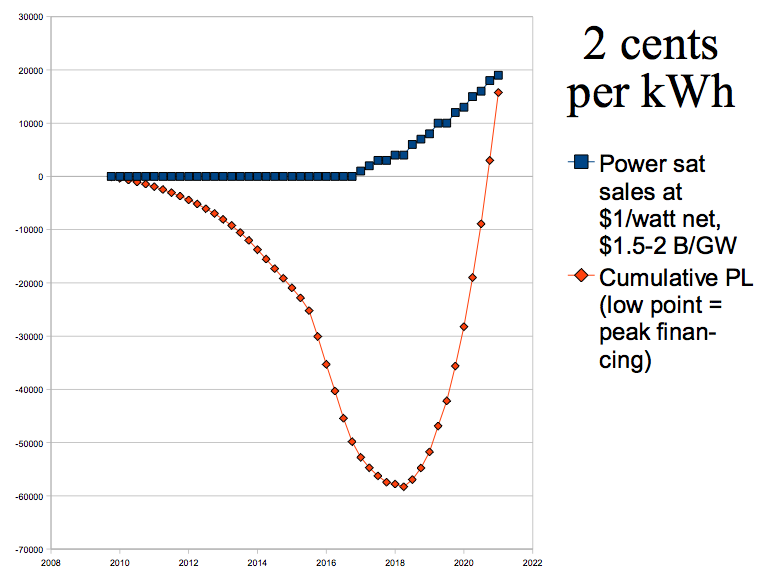
In this post, I prepare a financial model (available as a spreadsheet in PDF form) of what this approach to SSP might cost. Based on my calculations, the total investment required would be $58 billion, spread over a little over eight years. The system would produce a huge amount of electricity, so that long-term, the cost per kWh would only be $ .02.

While this proposed approach may not come about, or could take 20 years, it does offer a way out, if it can be made to work. There have been two recent posts on SSP that may be of interest to readers - one by Darel Preble and another by Big Gav.

With substantial input from Jordin Kare, Spike Jones, Howard Davidson, Ron Clark and others, I have been working for the past year on a new approach to SSP’s primary problem - reducing launch cost to orbit. If power from space were abundant and low enough in cost, we could even put carbon dioxide back into empty oil fields as synthetic oil.1 The goal is to reduce the cost of transport to Geosynchronous Earth Orbit (GEO) by a factor of ~200 over current expendable rockets.

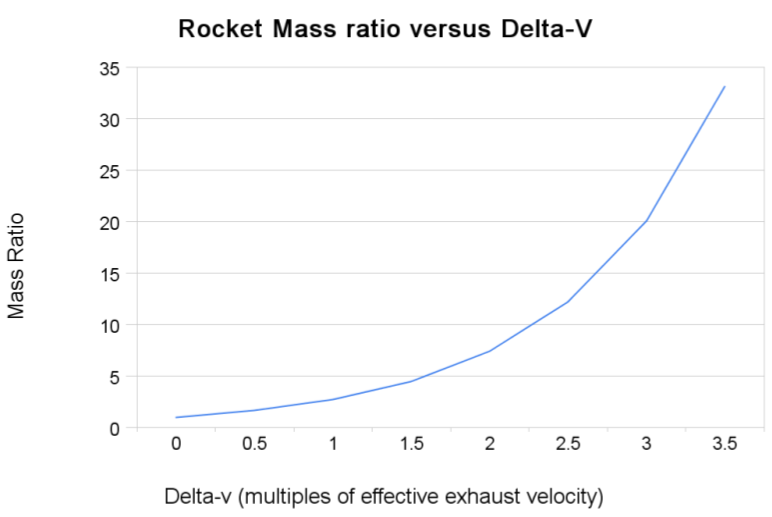
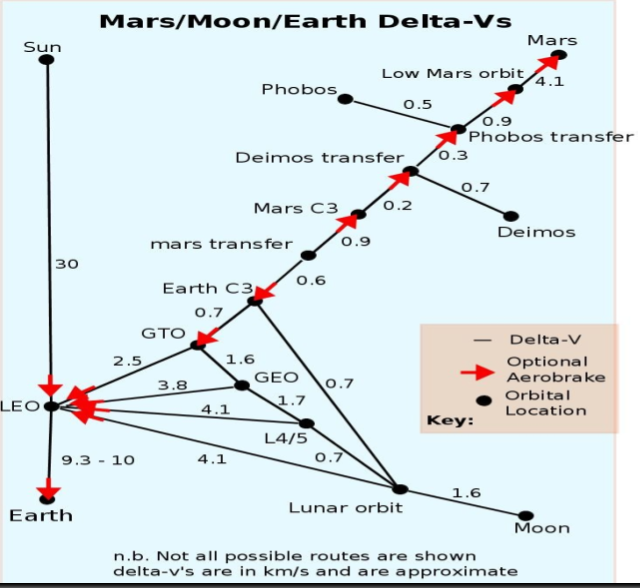
This work has been on "pop up and push," i.e., rocket boost to a few hundred km and a long ablation laser push for the rest of the delta V, (change in orbital velocity) to GEO. This takes advantage of the large thrust available from chemical rockets and the high exhaust velocity of lasers. The method allows much larger payloads than laser propulsion alone. It offers a substantial improvement over rockets. With chemical rockets, only one part in sixty of the lift off mass gets to GEO. It's 14 km/sec to GEO, (Figure 1), and 14/4.5 is about 3. As you can see from Figure 2, fuel is 20 times the rocket and payload together.


Figure 1


Figure 2

The combination of a mass ratio 3 rocket first stage (4 km/sec) and mass ratio 2 laser second stage (10 km/sec) could (according to the rocket equation)
deliver one part in twelve of the lift-off mass to GEO, a significant 5 to one improvement.

The problem with that scheme is that many very expensive lasers must be in place before the first launch. I have not run a pro forma financial analysis because the rough numbers (well over $100 billion) are so daunting.

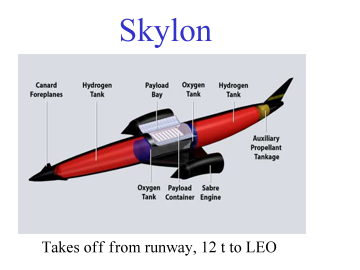
Recently another option came to my attention, the Skylon Spaceplane designed by Reaction Engines Ltd, in the UK.2 Performance, development and production cost of Skylon and SABRE (Synergic Air BReathing Engine) was obtained from Reaction Engines. By using air in place of oxygen to 26 km and Mach 5.5, then shifting SABRE to rocket mode, a Skylon is projected to place a modest (12 t) payload into LEO (Low Earth Orbit).


Figure 3

The April 2009 contract between PG&E and Solaren for 200 MW of space solar power generated many news stories and demonstrated the strong market for clean SSP energy - even though it has never been fully demonstrated (due to SSP’s intrinsically large scale).

A pro forma financial model was created using cost information provided by Reaction Engines, prior knowledge of laser propulsion, informal cost estimates for high kg/kW SSP and propulsion lasers and the 2016 delivery time for the PG&E/Solaren contract.

Pro Forma Model Assumptions (PDF spreadsheet here)

The model uses Reaction Engine's published development numbers. We doubled this to $21.7 B and compressed the development time in half to five years starting in 2010. First vehicle flies in 2015. Production Skylons in the pro forma model decline from $450 M to $292 M after 10,000 flights and vehicle life increases from 200 flights to 500.

Laser and GEO focusing mirror development is assumed to require $2 billion.

The proposed power satellite design is a very conservative 5 kg/kW or 5,000 tonnes per GW. (The project would still make money at 10,000 t per GW.) Development cost of $4 B seems reasonable by taking a low-tech approach and not being too concerned with mass. Four billion dollars should be enough money to rough design three (one PV and two solar dynamic cycles). A substantial fraction of this money will be for design of construction facilities at GEO. Other than being able to be broken down into loads that fit the transportation system, mass is even less of a factor for the "dockyard."

Working capital is also not included in the model because the time between purchasing parts for a power satellite and selling the new power satellite is under 90 days. The construction facility at GEO to build 1 GW power satellites is assumed in the model to be equal to the first power satellite mass (5000 tonnes). One GW is not optimal for power sats. As the increasing flow of materials makes larger-size power satellites practical, the model enlarges the construction facilities by 5000 tonnes per GW.

There is no provision in the financial model for robot assembly or teleoperators. The model assumes up to 1000 workers at GEO. Food and oxygen supply for the workers is not included because it is no more than 1 part in 240 (ten tons per day out of 2400). Wages for the workers in space is not included either because wages (at $500,000 per worker per year) would be one part in 365. (A GW turned out every two days and the net profit after transport cost and parts is a billion dollars per GW.)

Flights to orbit (sub-orbital as more lasers come on line) increase by three additional flights per day per quarter. I assumed the lasers to take over providing delta V in a linear way. As the lasers grow from a few MW to eight GW, payload per flight grows from six tonnes to twenty-five.3

Skylon's ability to go to LEO means that a single 6 MW laser built for $60 million (after development) can raise six tonnes of power sat parts from LEO to GEO in a day. This is a huge improvement over building $40 B of lasers.

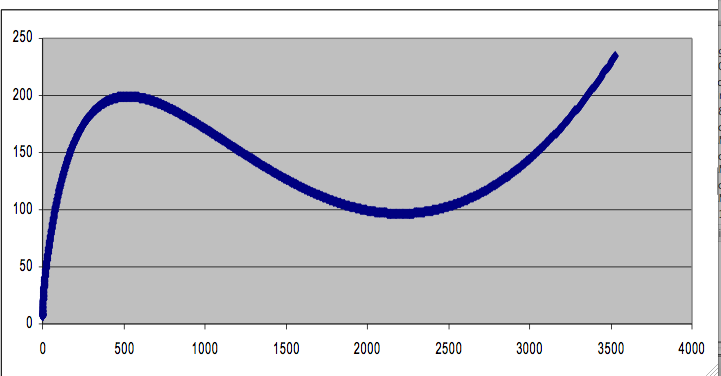
Figure 4. This graph shows the trajectory resulting from a 290 tonne Skylon booster vehicle, carrying a 40 tonne laser stage sub-orbital. The stage is then boosted to GEO by 4 GW of ground based lasers. Payload to GEO is 14.5 tonnes. Laser stage mass rises to 50 t and payload to GEO to 25 t with 8 GW of laser. The vertical axis is nautical miles altitude; horizontal axis is downrange. The constant laser acceleration applied is 1.1 g , much less than the rocket burnout of 3.5 g.

We still build the lasers, but in this model, we buy the lasers over a long time with power-satellite sales. Each laser requires a focusing mirror in GEO. Only one mirror has to go to GEO the hard way (with rockets). We bootstrap the rest up at 50 mirrors a quarter with laser power from the first.

The model has been adjusted so that by the end of 2016, there is ~10,000 tonnes at GEO, enough for the construction facility and parts for the first 1 GW power sat. A linear ramp from zero over 18 months would put the first flight in mid-2015. The flight rate over the next year ramps up to 12 per day. The fleet size assumes flying 1.5 times a day.

Production of Skylons (counting the prototype) by the end of 2016 is 14 with a peak rate of five per quarter. Skylons are similar in size to 747s. Boeing built 747s at higher rates.

The focusing mirrors for the lasers reduce net cargo to GEO by 250 tonnes per quarter. We assume the lasers and focusing mirrors will cost $10/watt. Depending on how much laser power will fit into a standard shipping module, the project installs 50-250 laser modules per quarter.

This involves purchase or construction of 200-1000 "on the ground" laser modules per year. Scaling the factory size from locomotives, the plant making the lasers might be a square mile. The cost of this factory has not been included. In this model, we ramp up and install lasers at a GW per year for 8 years. The factory should reach excellent economy of scale with a production run this long. Financing for the factory could be based on a firm order of this size.

The model accounts for power satellites not sold but diverted internally to make Skylon propellants and to power the lasers. (The cost of the propellant plant and the laser infrastructure such as a refrigeration plant to cool the lasers has not been included.) By the beginning of 2018, the lasers and propellant plants in the model are using ten GW of the 84 GW produced by that date (split almost evenly between lasers and propellant).

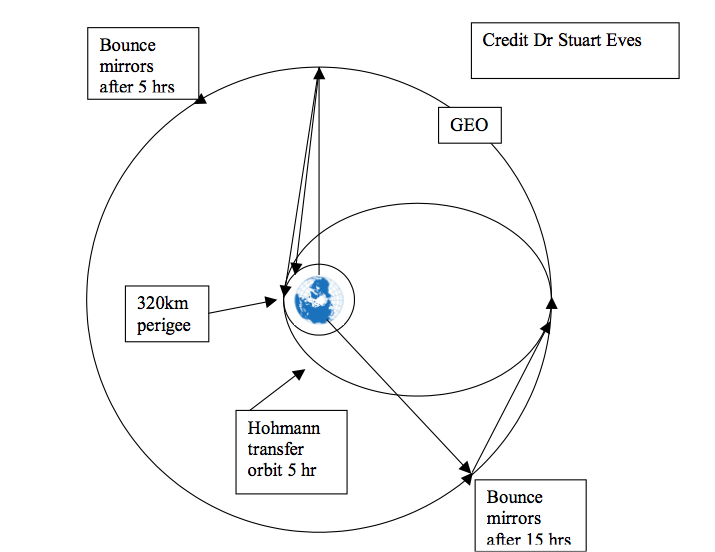
Figure 5. A mature laser boost system as envisioned by Dr. Stuart Eves, Surrey Satellite Technology. The laser stage makes 1 1/2 orbits so the mirrors will be in the correct place to circularize the orbit at GEO.

The initial design capacity of the system builds up over 8 years. At that point of maturity, it is launching 50-ton laser stages and using 8 GW of lasers (1600 modules). There are 4 sub-orbital Skylon flights an hour, less than 100 flights per day. They lift about 800 million kg per year on sub-orbital flights. Not taking the Skylons into LEO might extend their life (though it may complicate recovery). The price per kg lifted to GEO falls from an initial $750/kg (based on twice the depreciation of the Skylons and mass ratio 2 laser stages) to $50/kg. This reduction is due to the cost per flight (lower cost, higher life) and the payload at GEO rising from six t per flight to 25 t per flight due to more lasers.

For a simple financial model, we have conservatively figured net profit for power satellites (not counting transportation otherwise covered) at $1 per watt. If power satellite parts cost $600/kw, then a 1 GW power satellite would sell for $1.6 B. This is 2 cents per kWh based on a ten-year recovery of capital. (It does not include the customer’s associated rectenna.) The market for power in the 1-2 cents per kWh range is close to unlimited because of the demand for low cost synthetic oil.

The model is full of feedback loops because of the bootstrapping. When it first starts, one laser/mirror lifts the cargo of one Skylon flown once a day. That is 12 tons per to LEO and six tons per day to GEO. Two lasers/mirrors allow the Skylon to fly twice a day for 12 tons per day to GEO. More Skylon and lasers rapidly build up the cargo capacity (the effects multiply). (Missing, the cost to boost the first mirror to GEO. IOSTAR's tug may be how we maneuver it into place.)

Figure 6. In this draft model the red line tracks cumulative profit / loss (in millions of dollars) each year and the black line shows annual sales - $1.5 - $2 Billion/Gigawatt. The debt bottoms out in 8.25 years at just over $58 billion dollars. That is about twice what the Chinese spent on Three Gorges Dam. For that they obtained 22 GW at a human cost of displacing 1.24 million people. Mature, this project would provide 22 GW of new generating capacity every 44 days.

At the peak investment, power satellite sales in the model are over $4B/year. Refining the model will cause this peak investment and timing to grow or shrink due to conceptual improvements, the minor items mentioned above, those cost items not yet considered and a more realistic (higher) initial sales price for power satellites.4

The current model shows repayment of the entire investment from selling power satellites only nine quarters after reaching the bottom at 8.25 years. (Interest on the capital investment has been included.) The delivery of power satellite parts and power satellite sales grows rapidly after that point.

Current world energy demand is around 15 TW. The "Manhattan Project" crash program outlined here has ~30 TW on line by 2043. World usage of fossil fuels beyond 2040 should be negligible. (Lower cost carbon neutral synthetic fuels would displace liquid fossil fuels.)

The model shows producing over four TW/year of new power satellites by 2040. Four years of power satellite production at this rate would be over 15 TW, enough to put 100 ppm of CO2 back in the ground as synthetic oil in two decades following 2040.

The proposed power satellite financial model makes considerable profit in addition to solving carbon dioxide and energy problems. How to finance it and who might finance this approach to solving the carbon dioxide and energy problems as well as potential military uses of the propulsion lasers are outside the scope of this analysis.

Notes

1 The area of the earth is ~5.1 x 10¹⁴ square meters; air pressure is ~100,000 N/m2. The force would be ~5.1 x 10¹⁹ and the mass (force/acceleration of 9.8 m/sec2) is ~5.2 x 10¹⁸kg or 5.2 x 10¹⁵ t. One ppm would be 5.2 x 10⁹ t and 100 ppm would be ~520 billion tonnes.

It takes ~100kWh to remove a ton of CO2 from the atmosphere.

http://www.eurekalert.org/pub_releases/2008-09/uoc-cd092908.php

Removing 100 ppm of CO2 from the air would take 52000 billion kWh or 52,000 TWh, or since a year is about 8700 hours, about six TW years. A TW is about twice the installed power in the US.

It would take a 1000 1GW nuclear reactors 6 years to bring the CO2 level back to the level of 1960 if no new CO2 was being added.

The problem is what to do with the CO2? Liquid CO2 has a density of 1.1. As liquid, this much CO2 would occupy ~470 cubic km. It would cause a real problem downwind if it blew out of storage. We know that oil stayed in the ground for millions of years.

It takes ~50 times as much energy to convert CO2 to synthetic oil as it does to capture it. So to convert 100 ppm of CO2 to synthetic oil would take ~300 TW-years. If we are already feeding 15 TW into making synthetic oil, we could dedicate another 15 TW into making more and pumping it back into empty oil fields. It would take two decades at this rate to bring the current CO2 level back to that of 1960. We might be able to take the CO2 level down far enough to get the earth to go into an ice age (for those who like to ski).

For the details on the energy cost of making synthetic oil see www.htyp.org/dtc

2 http://en.wikipedia.org/wiki/Reaction_Engines_Skylon

3It is our economic judgment that lasers become useful when there is enough power to raise a 12-ton stage with mass ratio of two to GEO in a day. LEO to GEO is 4.1 km/sec. For a mass ratio of two, the exhaust velocity is 4,1/.69 which is ~six km/sec (ISP of only 600!). We assume multi impulse Hohmann transfer rather than spiral. Twenty-four hours is 86,000 sec.

V=at, a=v/t a 4100/86000 =~0.05 m/sec2. One m/sec2 is ~0.1 g so this is half a percent of a g.

How much mass must be blown off in one second to get 0.05 m/sec2

MV = mv where M is the current laser stage mass, V is 0.05 m/sec and m is the mass blown off in one second at velocity v, 6000 m/sec.

m/sec = 0.05M/v = 0.05m/sec2 x 12,000kg/6000m/sec

m/sec is 0.1k/sec

Ke (of exhaust) =1/2mv2

Ke = 1/2 (0.1) (6000)2 =1.8 x MJ

Laser efficiency of 30% increases this to six MJ.

Since this is over a second, the laser power to provide six MJ/sec is six MW.

The payload multiplier as a function of laser power is from this number and other work indicating delivery of 25 t of payload from a 50 t laser stage placed in a 300 km sub orbital flight.

4There may be resistance to paying a great deal more than the projected cost in a few years.


Another Wake-up call that will go unheeded?

From: http://www.jpl.nasa.gov/news/news.cfm?release=2009-112

July 20, 2009

Scientists have found evidence that another object has bombarded Jupiter, exactly 15 years after the first impacts by the comet Shoemaker-Levy 9.

Following up on
a tip by an amateur astronomer, Anthony Wesley of Australia, that a new dark "scar" had suddenly appeared on Jupiter, this morning between 3 and 9 a.m. PDT (6 a.m. and noon EDT) scientists at NASA's Jet Propulsion Laboratory in Pasadena, Calif., using NASA's Infrared Telescope Facility at the summit of Mauna Kea, Hawaii, gathered evidence indicating an impact.

New infrared images show the likely impact point was near the south polar region, with a visibly dark "scar" and bright upwelling particles in the upper atmosphere detected in near-infrared wavelengths, and a warming of the upper troposphere with possible extra emission from ammonia gas detected at mid-infrared wavelengths.

"We were extremely lucky to be seeing Jupiter at exactly the right time, the right hour, the right side of Jupiter to witness the event. We couldn't have planned it better," said Glenn Orton, a scientist at JPL.

Orton and his team of astronomers kicked into gear early in the morning and haven't stopped tracking the planet. They are downloading data now and are working to get additional observing time on this and other telescopes.

This image was taken at 1.65 microns, a wavelength sensitive to sunlight reflected from high in Jupiter's atmosphere, and it shows both the bright center of the scar (bottom left) and the debris to its northwest (upper left).

"It could be the impact of a comet, but we don't know for sure yet," said Orton. "It's been a whirlwind of a day, and this on the anniversary of the Shoemaker-Levy 9 and Apollo anniversaries is amazing."

Shoemaker-Levy 9 was a comet that had been seen to break into many pieces before the pieces hit Jupiter in 1994.

Leigh Fletcher, a NASA postdoctoral fellow at JPL who worked with Orton during these latest observations said, "Given the rarity of these events, it's extremely exciting to be involved in these observations. These are the most exciting observations I've seen in my five years of observing the outer planets!"

The observations were made possible in large measure by the extraordinary efforts of the Infrared Telescope Facility staff, including telescope operator William Golisch, who adroitly moved three instruments in and out of the field during the short time the scar was visible on the planet, providing the wide wavelength coverage.

JPL is managed for NASA by the California Institute of Technology in Pasadena.

17 July 2009

First space-to-earth solar power station targeted for Oct. 2010

From: http://asianenergy.blogspot.com/2009/07/first-space-to-earth-solar-power.html
...Last Monday, I interviewed Sir Charles Shults III of Xenotech Research which has several projects under way: 1) moving near the New Mexico space port to expedite development of an orbital solar power project for deployment in Oct. 2010; 2) ramping up for manufacturing of an affordable, modular 500W Solar Pod for purchase within six months; 3) designing a residential wind turbine expected to be 1/3 the cost of others.


Space-Based Solar

Because of his work with what apparently will be the first functioning space-based solar array for transmitting power to earth, Sir Charles was invited to be part of the recent groundbreaking for Spaceport America on June 19 in New Mexico, near Truth or Consequences -- yes, that's the name of a town. Shults is
relocating Xenotech Research there so they'll be conveniently located for their work in conjunction with the deployment of what apparently will be the world's first space-based solar collector and transmission project, to be carried out by the Space Island Group. Space Island Group (SIG) is the leader in the commercialization of space and plans to design, build and operate commercial space transportation systems and destinations that are dedicated to commerce, research, space solar power, satellite repair, manufacturing and tourism. (Ref.)

The solar collector components will be piggy-backed to space along with the space tourism that will be carried out. Sir Charles told me he has recently been negotiating with Gene Meyers and Terry Martin of SIG. They are looking to him to supply some technologies for their orbital solar power project, having received permission to orbit a solar power satellite demonstrator and will soon be building receiving stations on the ground for the proof of principle. Sir Charles' involvement includes advising on methods for moving craft from lower to higher orbits using less rocket fuel; energy generation technology; and technology for power-receiving antennas on the ground.

They plan for the first proof of concept solar station to be deployed in a low earth orbit of 300 miles in October of 2010, generating around 12-13 kilowatts. The power will be transmitted via precisely-tuned microwave frequencies, and will require "no fly zones" above the receiver area on earth.

By 2012, they intend to deploy a 1 gigawatt (akin to a nuclear power plant output) geosynchronous space solar station up around 22,300 miles, which will be constantly available on earth except during lunar eclipses of the solar station. The intensity of solar energy in space above the Earth's atmosphere is 1360 watts per square meter, compared to a maximum of 960 Watts/m2, depending on angle through the earth's atmosphere. (Ref.) Taking into consideration the day-night cycles and cloud cover, an earth-based solar system, even in an ideal location, will only generate about 20% as much power as what the same sized space-based array could generate.

At first, the receiving stations will be fixed-location utilities, but Sir Charles said that in the future, it's conceivable that one could have a mobile device with a subscription to receive power, very similar to a cell phone account. For this reason, the military has been especially interested in the technology, as it would resolve fuel supply-line issues.

The transmission of power apparently can be done very efficiently as well. Sir Charles said that according to new work being done by Mitsubishi in Japan for cell phone power, wireless point-to-point transmission on earth presently exceeds the efficiency of copper wire-based transmission.

The space solar initiative has been in development since 1970, when the original proposal was made.

The space tourism initiative has been given momentum recently by Burt Rutan who made the first successful non-government-sponsored space flight (actually three). His technology was purchased by Sir Richard Branson's Virgin Galactic, who then hired Burt to design a larger transport system which will be the basis of the first commercial space flights. (Ref.)


Russia SSP

I often wonder what innovation might be going on in Russia on SSP. I recently did a web search, and found a few interesting leads:

http://www.kcn.ru/tat_en/science/ans/journals/rasj_cnt/07_2_7.html


One would guess that Russia being one of the true aerospace pioneers would be a major contributor to Solar Power Satellite Design--perhaps they are in journals we in the West don't/can't read. At least, for humanity, we hope so, and that the brilliance of the community is not dulled by the current short term hydrocarbon wealth that has proven itself a developmental curse all over the world.

16 July 2009

Financial and Organizational Analysis for a Space Solar Power System.

http://www.nss.org/settlement/ssp/library/2009-FinancialAndOrganizationalAnalysisForSSP.pdf
A collaborative research effort between multi-cultural team Raul Gutierrez Gomez, a Lt Col with the Colombian Air Force, Evelyn Panier, a former finance application consultant, Xin Sun, formerly the IT Director China Academy of Space and Technology, and Cornelius Zund, formely a Control Systems Engineer with Aviya Technologies in Canada, these authors at the Toulouse Business School covers some new ground with respect to Space Solar Power Satellites, discussing Net Present Value calculations, structuring of business entities along an INTELSAT model, and a splitting of developer and operator to overcome cash-flow problems, and niche microwave applications including military, and stakeholder analysis. It also treats issues like intellectual property and government involvement. Draws on recent interviews with start-up SpaceEnergy, EADS Astrium, and a significant stakeholder poll, with many respondents in China.

09 July 2009

'Space-based solar power could solve energy crisis'

From: http://timesofindia.indiatimes.com/Interviews/Space-based-solar-power-could-solve-energy-crisis/articleshow/4759530.cms
...Former president A P J Abdul Kalam has suggested that SBSP be made a national and international goal.

The Aerospace Society of India (AeSI) has called for a global aerospace and energy mission, and articulated the need for a directed academic, industry and government study, as well as consideration of a leadership role in an International Thermonuclear Experimental Reactor-like experiment.

Some people I have talked with have mentioned putting it on the Indo-US strategic agenda as part of the renewable energy and space partnerships.

SpaceEnergy to Engage China on SSP

According to its newsletter: On the 18th and 19th of this month, Space Energy will also conduct a workshop on SBSP in Shanghai. In attendance will be several representatives from the Chinese Government’s energy sector, along with commercial and technical experts in the photovoltaic field.

Does SSP have supporters? See this list:

Who has been supportive of establishing a program in SSP, and what they have said in public:

1) From the Space Enterprise Council (SEC) [then under US Chamber] white paper, 2008:

…the urgency of energy needs requires ongoing Federal investment in a balanced portfolio of alternative energy research programs, which should include study of SBSP. Major technical progress already achieved in SBSP-related technologies strengthens the case for including SBSP in the mix of alternative sources to explore...Beyond enhancement of energy production per se, SBSP might help create new economic opportunities through resultant
technology advances in space launch, space utilization, and technological spin-offs applicable to a host of materials and processes...For example, SBSP research might lead to improvements in the efficiency of solar cells that power communications satellites, as well as power management systems for terrestrial solar power systems...Also, to the extent that SBSP is integrated into terrestrial solar power production, development of SBSP ground infrastructure might generate revenue even before deployment of systems in space. In this and related applications, SBSP could emerge as an enhancement for, rather than a competitor with, terrestrial solar power generation.
http://www.nss.org/settlement/ ssp/library/2008- SECSpaceBasedSolarPowerWhitePa per.pdf

2) From the Abbey-Lane / Baker Institute Report, Maximizing NASA's Potential In Flight and On the Ground: Recommendations for the Next Administration, 2009:

Recommendation 3: Deliver longer-term payoffs (within four to eight years) for energy and the environment…As a potential long-term energy solution, an effort would be made to demonstrate—initially on a small scale—wireless power transmission from space to Earth using shuttle and ISS…this concept has made major strides since its inception …Demonstrating space solar power on a small scale would help us better understand what would need to be done to utilize this concept for electrical power needs.
http://www.bakerinstitute.org/ publications/SPACE-pub- ObamaTransitionAbbeyLaneMurato re-012009.pdf

3) From the Buzz Aldrin / ATWG Policy Statement on NSS Blog
Bush VSE missed (or lacked) almost entirely any strategic vision and goals for supporting and enabling space-based human economic expansion or industrialization in space.
…proposed cabinet-level U.S.
Department of Space (DOS), as discussed earlier, should manage and take charge of the government functions of supporting and incubating space-based industrial capability and transportation infrastructure development
…investing in SBSP (space based solar power) and
space tourism infrastructures as a significant part of the national space economy and energy programs—is the choice of a strategic space goal that certainly will re-ignite the American spirit
http://blog.nss.org/?p=360

4) National Space Society (NSS), [largest Space Advocacy organization] Position Paper

The National Space Society believes that one of the most important long-term solutions for meeting those energy needs is Space Solar Power (SSP), which gathers energy from sunlight in space and sends it to Earth. We believe that SSP can solve our energy and greenhouse gas emissions problems.
http://www.nss.org/ legislative/positions/NSS-SSP- PositionPaper.pdf

5) The
Space Frontier Foundation (SFF) [most significant space entrepreneur organization] Position

A fundamental challenge in this century is how to provide for the world's growing energy needs. In meeting this challenge, it is vital that we protect the Earth's fragile biosphere. Space Solar Power, or SSP, may be part of the energy solution. SSP could be an environmentally friendly economical energy producing technology that simultaneously promotes the human realization that the Earth is an open system and the
human settlement of space.
http://space-frontier.org/ Projects/spacesolarpower/

6) The American Institute of Aeronautics and Astronautics (AIAA), the premier world aerospace technical society Policy Paper

The SPS is one of several potentially competitive options for providing a nondepletable source of baseload electric power in the future…The SPS appears to be technologically feasible.
http://pdf.aiaa.org// downloads/ publicpolicypositionpapers// SolarSats-1978.pdf

7) The report of the DoD/NSSO (the only interagency and independent voice for space security) Study Group's 2007 Report:

Space-Based Solar Power does present a strategic opportunity that could significantly advance US and partner security, capability, and freedom of action, and merits significant further attention on the part of the United States Government and the private sector...The SBSP Study Group concluded that SBSP requires a coordinated national program with high-level leadership and resourcing commensurate with its promise, but at least on the level of fusion energy research or International Space Station construction and operations...The SBSP Study Group concluded that should the U.S. begin a coordinated national program to develop SBSP, it should expect to find that broad interest in SBSP exists outside of the US Government, ranging from aerospace and energy industries; to foreign governments such as Japan, the EU, Canada, India, China, Russia, and others; to many individual citizens who are increasingly concerned about the preservation of energy security and environmental quality. While the best chances for development are likely to occur with US Government support, it is entirely possible that SBSP development may be independently pursued elsewhere without U.S. leadership.
http://www.nss.org/settlement/ ssp/library/final-sbsp- interim-assessment-release-01. pdf

8) The Department of Commerce, Office of Space Commercialization website currently reads:
As society seeks to identify and develop
alternative energy sources for the future that are clean, safe, and continuously available, the concept of space-based solar power (SBSP) is beginning to gain traction as a potential answer to the world's long-term energy needs.

http://www.space.commerce.gov/ power/

9) The
Change.gov Visionary White Paper, one of the first 10 circulated by the transition team on Change.gov:

The U.S. federal government has invested over $21 Billion in fusion research in the last 50 years, and the DOE is currently spending $300 million per year on fusion energy research. When choosing a lead agency for SSP, the Administration should establish an SSP research budget within that agency that grows to at least the level of the DOE’s fusion energy research program.
http://change.gov/open_ government/entry/space_solar_ power_ssp_a_solution_for_ energy_independence_climate_ change

10) Spacefaring America White Paper on The End of Easy Energy and What to Do About It:
This paper’s assessment of the
energy production potential of conventional nuclear, geothermal, wind, ground solar electric, and land biomass finds that these will fall significantly short of both the U.S.’s or the world’s 2100 sustainable energy needs. To fill the substantial sustainable energy shortfall that will emerge by 2100 as the era of easy energy ends, space solar power and algae biodiesel—absent the extensive use of advanced nuclear energy and/or undersea methane hydrates—will need to be substantially developed. Space solar power will be needed to supply most of the U.S.’s and the world’s dispatchable electrical power generation.
http://mikesnead.net/ resources/spacefaring/white_ paper_the_end_of_easy_energy_ and_what_to_do_about_it.pdf

11) Naval Research Lab Report, 2008
The NRL SBSP Study Group concurs with the conclusions of the numerous previous studies
of preceding decades that the SBSP concept is technically feasible
but that there remain significant system risks in many areas...The Group concurs that SBSP offers one of several possible solutions to the energy independence and dominance of our country and our military; and that those alternative solutions (including terrestrial solar, nuclear, and wind) must be an integral part of the solution
http://www.nss.org/settlement/ ssp/library/2008-NRLSBSP- PossibleDefenseApplicationsAnd Opportunities.pdf

12) Dr. Kalam, at the time India's President, and national hero as their lead rocket scientist from both their civil and military programs, address to Boston University on the Future of Human Space Exploration:
However solar flux on earth is available for just 6-8 hours every day whereas incident radiation on
space solar power station would be 24 hrs every day. What better vision can there be for the future of space exploration, than participating in a global mission for perennial supply of renewable energy from space?...Space based solar power stations have six to fifteen times greater capital utilization than equivalent sized ground solar stations. Linking Space solar power to reverse osmosis technology for large-scale drinking water supplies could be yet another major contribution of Space.
http://www.rites.com/rites- journal/A.P.J.Abdul%20kalam. pdf

13) The Aeronautical Society of India (AeSI) 2007 conference recommendations:
…generate a national consensus for the Global Aerospace and Energy initiative, determine the sources and uses of funding, and evolve a suitable management structure and system to plan and implement the mission
http://www.aesi-hyd.com/ conference07/Panel_ recommendation.htm

14) Interview with Hiroaki Suzuki with the
Japan Aerospace Exploration Agency, also known as JAXA. He is one of 180 Japanese scientists working on the program, according to Scientific American.

We expect space
solar panel systems will be competitive with the existing power plants in 20 to 30 years, if the space transportation cost is considerably reduced. It should be noted that solar systems do not emit CO2, nor do they create nuclear waste...We are proposing a roadmap that consists of a stepped approach to achieve 1-gigawatt-class commercial space solar panel systems in 20 to 30 years. That means 2030 would see the very beginning of commercial systems. We expect the ultimate percentage of electricity derived from space will be more than several tens of percent. By the way, Japanese total electricity generation was about 275 gigawatts or 990,000 gigawatt-hours in 2005.
http://energycentral. fileburst.com/EnergyBizOnline/ 2008-5-sep-oct/Tech_Frontier_ Solar_Space.pdf

15) ESA Advanced Concepts project summary page:
The big advantage of space based
solar power collection is the 24h availability: unlike the situation on the surface of Earth, in geostationary orbit there is no night and the sun is never shadowed by clouds, rain or fog...We are therefore currently studying how e.g. space assets might best integrate into the management of future, complex energy grids with large components of renewable energy plants.
http://www.esa.int/gsp/ACT/ nrg/op/SPS/index.htm http://www.esa.int/gsp/ACT/ nrg/index.htm

16) The Space Solar Alliance for Future Energy (SSAFE) press release:
The Space Solar Alliance for Future Energy (SSAFE), a new organization advocating investment in space-based
solar power technologies to address the planet’s future energy needs, was announced today at the National Press Club. The coalition of thirteen leading research organizations and space advocacy groups focused their inaugural event on the announcement of a new study of space-based solar power led by the National Security Space Office (NSSO)...The new Space Solar Alliance for Future Energy (SSAFE) will promote the findings of the NSSO-led study, and seek to communicate the benefits of the technology to business, government and the general public...The founding members of SSAFE are the National Space Society, Space Frontier Foundation, Space Power Association, Aerospace Technology Working Group, Marshall Institute, Moon Society, ShareSpace Foundation, Space Studies Institute, Spaceward Foundation, AIAA Space Colonization Technical Committee, ProSpace, Space Enterprise Council, and Space Generation Foundation.
http://ssafe.wordpress.com/

17) Aerospace Technology Working Group (ATWG) Recommended Actions Paper, 2008

We judge this is not a NASA-centric aerospace technological issue. It is a national security issue, an energy security issue, an environmental solution, and an economic security issue, and, thus, needs to be addressed within a framework that includes all these dimensions, perspectives, and players, including considerable participation by private energy enterprise. The role of government should be to mature a limited number of components and processes to prove their economic and technical viability; then, step back, while continuing to support a strategy that addresses all elements of the problem. The government should lend support to this potential new industry, as done before for other fuel sources. While completing the maturing phase, the government program should work with industry to collaborate so that the private sector can pick up the costs and implement the SBSP system, if practical. This can be done in a sequence of steps with each step creating an increasing level of energy production to meet legitimate market demand profitably step by step, ultimately scaling to the level of provision of significant base load power in the U.S.http://www.atwg.org/ public/ATWG%20space-based% 20solar%20power.pdf

18) Taylor Dinerman in Space Review

In Washington lots of people have complained that the Obama Administration has so far not given the India-US relationship the attention it deserves... The one area in which there seems to be movement on, though, is a “renewable energy partnership”...Any analysis of the potential of terrestrial solar energy in India or elsewhere runs up against the awesome size of the future demand for power...they cannot by any stretch of the imagination fulfill the requirements of a huge growing economy like India’s. ...Only SSP, which operates 24 hours a day, 7 days a week, year after year, can hope to meet this need....Fortunately both India and the US have space programs and technologies that could, if developed together and possibly with other interested nations such as Japan, bring SSP systems into service sometime late next decade or the early 2020s. With its commitment to develop a new low cost reusable spaceplane, the India Space Research Organisation (ISRO) is already working on one of the key technologies needed for an SSP system. Indian participation in both private and public SSP programs should be welcomed by the US. In the near term the new Indo-US renewable energy partnership would seem to be the right place to start this collaboration. Together the partners can identify what will be needed in the way of technological and scientific investments over the next decade in order to make SSP a reality. India has lots of talent that can be committed to this effort and so does the US. In fact, the kind of ambitious idealism that we saw at NASA during the Apollo years could be engendered by this goal. Safe, clean, abundant energy from the Sun is not an impossible dream. The technology has not been perfected and the need for new, low-cost Earth-to-orbit transportation systems is as urgent as ever, but there are no requirements for any scientific breakthroughs.

http://www.thespacereview.com/article/1389/1