18 November 2009

Braun lays out a brilliant vision

It is terrific news that there is a committe to review NIAC, which for such a miniscule budget (~1$M) provided such a goldmine of imagination and innovative thinking.  And fantastic to see someone on the board put together a list so similar to what has been advocated in this Blog.  Kudo's Dr. Braun (Co-Chair of the Committee to Review the NASA Institute for Advanced Concepts Aeronautics and Space Engineering Board National Research Council)


Testimony given to the Subcommittee on Space & Aeronautics :: October 22, 2009
http://science.house.gov/publications/hearings_markups_details.aspx?NewsID=2640

Strengthening NASA’s Technology Development Programs

Dr. Braun Makes this statement in his testimony-

"I share with these recent high-school graduates a list of accomplishments that I believe our nationʼs civil aeronautics and space program is capable of achieving in my lifetime:

Ten Anticipated Paradigm-Changing Civil Aeronautics and Space Advances
1) Quantify Causes, Trends and Effects of Long-Term Earth Climate Change
2) Accurately Forecast the Emergence of Major Storms and Natural Disasters
3) Develop and Utilize Efficient Space-Based Energy Sources
4) Prepare an Asteroid Defense
5) Identify Life Elsewhere in our Solar System
6) Identify Earth-like Worlds Around Other Stars
7) Initiate Interstellar Robotic Exploration
8) Achieve Reliable Commercial Low-Earth Orbit Transportation
9) Achieve Affordable Supersonic Business Travel
10) Achieve Permanent Human Presence Beyond the Cradle of Earth"

12 November 2009

Ask Me about Space Solar Power: Space Solar T-Shirts and Coffee Cups!


http://www.cafepress.com/spacesolarpower
You can now display your vision for the future of Space Power...hats, coffee cups, etc.

10 November 2009

Japan eyes solar station in space


Japan eyes solar station in space (AP)

November 8, 2009
By Karyn Poupee
TOKYO (AFP) – It may sound like a sci-fi vision, but Japan's space agency is dead serious: by 2030 it wants to collect solar power in space and zap it down to Earth, using laser beams or microwaves.
The government has just picked a group of companies and a team of researchers tasked with turning the ambitious, multi-billion-dollar dream of unlimited clean energy into reality in coming decades.
With few energy resources of its own and heavily reliant on oil imports, Japan has long been a leader in solar and other renewable energies and this year set ambitious greenhouse gas reduction targets.
But Japan's boldest plan to date is the Space Solar Power System (SSPS), in which arrays of photovoltaic dishes several square kilometres (square miles) in size would hover in geostationary orbit outside the Earth's atmosphere.
"Since solar power is a clean and inexhaustible energy source, we believe that this system will be able to help solve the problems of energy shortage and global warming," researchers at Mitsubishi Heavy Industries, one of the project participants, wrote in a report.
"The sun's rays abound in space."
The solar cells would capture the solar energy, which is at least five times stronger in space than on Earth, and beam it down to the ground through clusters of lasers or microwaves.
These would be collected by gigantic parabolic antennae, likely to be located in restricted areas at sea or on dam reservoirs, said Tadashige Takiya, a spokesman at the Japan Aerospace Exploration Agency (JAXA).
The researchers are targeting a one gigawatt system, equivalent to a medium-sized atomic power plant, that would produce electricity at eight yen (cents) per kilowatt-hour, six times cheaper than its current cost in Japan.
The challenge -- including transporting the components to space -- may appear gigantic, but Japan has been pursuing the project since 1998, with some 130 researchers studying it under JAXA's oversight.
Last month Japan's Economy and Trade Ministry and the Science Ministry took another step toward making the project a reality, by selecting several Japanese high-tech giants as participants in the project.
The consortium, named the Institute for Unmanned Space Experiment Free Flyer, also includes Mitsubishi Electric, NEC, Fujitsu and Sharp.
The project's roadmap outlined several steps that would need to be taken before a full-blown launch in 2030.
Within several years, "a satellite designed to test the transmission by microwave should be put into low orbit with a Japanese rocket," said Tatsuhito Fujita, one of the JAXA researchers heading the project.
The next step, expected around 2020, would be to launch and test a large flexible photovoltaic structure with 10 megawatt power capacity, to be followed by a 250 megawatt prototype.
This would help evaluate the project's financial viability, say officials. The final aim is to produce electricity cheap enough to compete with other alternative energy sources.
JAXA says the transmission technology would be safe but concedes it would have to convince the public, which may harbour images of laser beams shooting down from the sky, roasting birds or slicing up aircraft in mid-air.
According to a 2004 study by JAXA, the words 'laser' and 'microwave' caused the most concern among the 1,000 people questioned.

05 November 2009

Space Based Solar Power on TED

Peter Sage from SpaceEnergy lays out the case for Space Based Solar Power


http://spacemovement.blogspot.com/2009/11/peter-sage-speaks-on-ssp-at-ted.html
http://www.facebook.com/pages/Space-Solar-Power/95417219921
http://www.youtube.com/watch?v=3_m6tlF901g&feature=player_embedded

Also, Space Solar Power made #1 of WSJ's top "Five Technologies that Could Change Everything":
From: http://online.wsj.com/article/SB10001424052748703746604574461342682276898.html

SPACE-BASED SOLAR POWER

For more than three decades, visionaries have imagined tapping solar power where the sun always shines—in space. If we could place giant solar panels in orbit around the Earth, and beam even a fraction of the available energy back to Earth, they could deliver nonstop electricity to any place on the planet.


Source: New Scientist
Sunlight is reflected off giant orbiting mirrors to an array of photovoltaic cells; the light is converted to electricity and then changed into microwaves, which are beamed to earth. Ground-based antennas capture the microwave energy and convert it back to electricity, which is sent to the grid.

The technology may sound like science fiction, but it's simple: Solar panels in orbit about 22,000 miles up beam energy in the form of microwaves to earth, where it's turned into electricity and plugged into the grid. (The low-powered beams are considered safe.) A ground receiving station a mile in diameter could deliver about 1,000 megawatts—enough to power on average about 1,000 U.S. homes.

The cost of sending solar collectors into space is the biggest obstacle, so it's necessary to design a system lightweight enough to require only a few launches. A handful of countries and companies aim to deliver space-based power as early as a decade from now.
Blogger's Note, as of right now, that list of companies include: 
SpaceEnergy (http://www.solarenspace.com/)
Solaren (http://www.solarenspace.com/)
ManagedEnergy (http://managedenergytech.com/)
Welsom Solar
PowerSat (http://www.powersat.com/)
HelioSat
PlanetPower
Packer Engineering (http://www.packereng.com/services/research_development.html)
Space Island Group http://www.spaceislandgroup.com/solarsat.html)
and several of the major Aerospace and Energy companies have displayed tepid interest.

01 November 2009

Stellar blast is record-breaker

From: http://news.bbc.co.uk/2/hi/science/nature/8329865.stm
By Victoria Gill 
Science reporter, BBC News


Astronomers have confirmed that an exploding star spotted by Nasa's Swift satellite is the most distant cosmic object to be detected by telescopes.
In the journal Nature, two teams of astronomers report their observations of a gamma-ray burst from a star that died 13.1 billion light-years away.
The massive star died about 630 million years after the Big Bang.
UK astronomer Nial Tanvir described the observation as "a step back in cosmic time".
Professor Tanvir led an international team studying the afterglow of the explosion, using the United Kingdom Infrared Telescope (UKIRT) in Hawaii.
Swift (Nasa)
Swift detects around 100 gamma ray bursts every year
He told BBC News that his team was able to observe the afterglow for 10 days, while the gamma ray burst itself lasted around 12 seconds.
The event, dubbed GRB 090423, is an example of one of the most violent explosions in the Universe.
It is thought to have been associated with the cataclysmic death of a massive star - triggered by the centre of the star collapsing to form a "stellar-sized" black hole.
"Swift detects something like 100 gamma ray bursts per year," said Professor Tanvir. "And we follow up on lots of them in the hope that eventually we will get one like this one - something really very distant."
Another team, led by Italian astronomer Ruben Salvaterra studied the afterglow independently with the National Galileo Telescope in La Palma.
Little red dot
He told BBC News: "This kind of observation is quite difficult, so having two groups have the same result with two different instruments makes this much more robust."
"It is not surprising - we expected to see an event this distant eventually," said Professor Salvaterra.
"But to be there when it happens is quite amazing - definitely something to tell the grandchildren."

A GAMMA-RAY BURST RECIPE
Artist's impression of GRB production (ESO)
Models assume GRBs arise when giant stars burn out and collapse
During collapse, super-fast jets of matter burst out from the stars
Collisions occur with gas already shed by the dying behemoths
The interaction generates the energetic signals detected by Swift
Remnants of the huge stars end their days as black holes
The astronomers were able to calculate the vast distance using a phenomenon known as "red shift".
Most of the light from the explosion was absorbed by intergalactic hydrogen gas. As that light travelled towards Earth, the expansion of the Universe "stretches" its wavelength, causing it to become redder.
"The greater that amount of movement [or stretching], the greater the distance." he said.
The image of this gamma ray burst was produced by combining several infrared images.
"So in this case, it's the redness of the dot that indicates that it is very distant," Professor Tanvir explained.
Before this record-breaking event, the furthest object observed from Earth was a gamma ray burst 12.9 billion light-years away.
"This is quite a big step back to the era when the first stars formed in the Universe," said Professor Tanvir.
"Not too long ago we had no idea where the first galaxies came from, so astronomers think this is a profound moment.
"This is... the last blank bit of the map of the Universe - the time between the Big Bang and the formation of these early galaxies."
Italian National Telescope Galileo (TNG)
Data from two powerful telescopes confirmed the result
And this is not the end of the story.
Bing Zhang, an astronomer from the University of Nevada, who was not involved in this study, wrote an article in Nature, explaining its significance.
The discovery, he said, opened up the exciting possibility of studying the "dark ages" of the Universe with gamma ray bursts.
And Professor Tanvir is already planning follow-up studies "looking for the galaxy this exploding star occurred in."
Next year, he and his team will be using the Hubble Space Telescope to try to locate that distant, very early galaxy.

Asteroid Explodes in the Atmosphere: It reveals gaps in planetary defense systems

Yet further confirmation that we need increased attention to short-term warning for small threats:
From: http://news.softpedia.com/news/Asteroids-Explodes-in-the-Atmosphere-125310.shtml
On Friday, the American space agency released a full report, in which it gave details about the asteroid that exploded high in the planet's atmosphere on October 8, in the skies over Indonesia. According to NASA, the asteroid blew up with the strength of 50,000 tons of TNT, an explosion about three times more powerful than the one that destroyed the Japanese city of Hiroshima at the end of the World War II. The recent explosion is therefore one of the largest ever recorded, the same source reveals.
Experts estimate that the asteroid was at least ten meters across, and that the extremely energetic explosion took place at an altitude of about 15 to 20 kilometers. The conclusion belongs to Peter Brown, who is an astronomer at the University of Western Ontario (UWO), in Canada, and also a member of the team that conducted the analysis of the rogue object. There were neither casualties at ground level, nor any material damages following the explosion.
The new event, astronomers highlight, should draw the governments' attention to the fact that the Earth's defense systems are not even remotely foolproof. Experts argue that an asteroid that is at least 20 meters across can possibly cause a lot of damage to the ground, but say that observatories equipped to identify such small space rocks are very few. “If you want to find the smallest objects you have to build more, larger telescopes. A survey that finds all of the 20-meter objects will cost probably multiple billions of dollars,” Minor Planet Center Director Tim Spahr says.
The expert and UWO colleague Elizabeth Silber estimated the immense energy of the explosion from infrasound waves that were collected halfway around the world by a listening network, specialized in detecting hidden nuclear explosions. The two astronomers say that this is not a rare event. Such a small asteroid hits the Earth about once every ten years, which is almost continuous by cosmic standards.
The White House needs to develop a defense policy against these space rocks by no later than October 2010. The deadline was imposed by the Congress. It is expected that the decision will be communicated through a National Research Council report, due to be released by the end of 2009, NewScientist informs.

28 October 2009

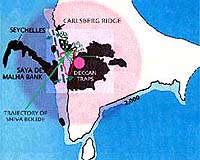
Shiva Crater


Did a very large comet or asteroid strike (600 by 400 kilometers across, likely made by a body 40 kilometers across) the Indian coastline and kill the dinosaurs?


Shiva: Another K-T Impact?


Diagram of Shiva impact area. Credit: Sankar Chatterjee.
by Leslie Mullen for Astrobiology Magazine
http://www.spacedaily.com/news/deepimpact-04r.html


Shoemaker-Levy 9 revisited: or The Geology of the K/T Impact Craters on Earth or Wiping out the Dinosaur with Five Simultaneous Impacts…or
Thomas J. Teters
http://starmon.com/KT_craters.html


http://books.google.com/books?hl=en&lr=&id=3IORF1Ei3LIC&oi=fnd&pg=PA31&dq=Chatterjee+and+Rudra+1996+Shiva&ots=ngYDm9C0s_&sig=pv_rRhdm0ZaWQ32GCjDhgN4SnuA#v=onepage&q=&f=false


THE SHIVA CRATER: IMPLICATIONS FOR DECCAN VOLCANISM, INDIA-SEYCHELLES RIFTING, DINOSAUR EXTINCTION, AND PETROLEUM ENTRAPMENT AT THE KT BOUNDARY
CHATTERJEE, Sankar1, GUVEN, Necip2, YOSHINOBU, Aaaron2, and DONOFRIO, Richard3, (1) Geosciences, Texas Tech Univ, MS Box 41053, Lubbock, TX 79409-3191, sankar.chatterjee@ttu.edu, (2) Department of Geosciences, Texas Tech Univ, Lubbock, TX 79409-1053, (3) Exploration and Development Geosciences, University of Oklahoma, Norman, OK 73069

http://gsa.confex.com/gsa/2003AM/finalprogram/abstract_58126.htm


THE SIGNIFICANCE OF THE CONTEMPORANEOUS SHIVA IMPACT STRUCTURE AND DECCAN VOLCANISM AT THE KT BOUNDARY
CHATTERJEE, Sankar, Geosciences, Texas Tech Univ, MS Box 41053, Lubbock, TX 79409-3191, sankar.chatterjee@ttu.edu and MEHROTRA, Naresh M., Paleobotany, Birbal Sahni Institute of Paleobotany, 53 University Road, Lucknow, 226007, India
http://gsa.confex.com/gsa/2009AM/finalprogram/abstract_160197.htm


Shiva: Another K-T impact?
by Leslie Mullen  
http://www.astrobio.net/exclusive/1281/shiva-another-k-t-impact

08 October 2009

NASA Refines Asteroid Apophis' Path Toward Earth

DC Agle 818-393-9011

Jet Propulsion Laboratory, Pasadena, Calif.
agle@jpl.nasa.gov

Dwayne Brown 202-358-1726
NASA Headquarters, Washington
dwayne.c.brown@nasa.gov

News release: 2009-151 Oct. 7, 2009

NASA Refines Asteroid Apophis' Path Toward Earth

PASADENA, Calif. -- Using updated information, NASA scientists have recalculated the path of a large asteroid. The refined path indicates a significantly reduced likelihood of a hazardous encounter with Earth in 2036.

The Apophis asteroid is approximately the size of two-and-a-half football fields. The new data were documented by near-Earth object scientists Steve Chesley and Paul Chodas at NASA's Jet Propulsion Laboratory in Pasadena, Calif. They will present their updated findings at a meeting of the American Astronomical Society's Division for Planetary Sciences in Puerto Rico on Oct. 8.

"Apophis has been one of those celestial bodies that has captured the public's interest since it was discovered in 2004," said Chesley. "Updated computational techniques and newly available data indicate the probability of an Earth encounter on April 13, 2036, for Apophis has dropped from one-in-45,000 to about four-in-a million."

A majority of the data that enabled the updated orbit of Apophis came from observations Dave Tholen and collaborators at the University of Hawaii's Institute for Astronomy in Manoa made. Tholen pored over hundreds of previously unreleased images of the night sky made with the University of Hawaii's 2.2-meter (88-inch) telescope, located near the summit of Mauna Kea.

Tholen made improved measurements of the asteroid's position in the images, enabling him to provide Chesley and Chodas with new data sets more precise than previous measures for Apophis. Measurements from the Steward Observatory's 2.3 meter (90-inch) Bok telescope on Kitt Peak in Arizona and the Arecibo Observatory on the island of Puerto Rico also were used in Chesley's calculations.

The information provided a more accurate glimpse of Apophis' orbit well into the latter part of this century. Among the findings is another close encounter by the asteroid with Earth in 2068 with chance of impact currently at approximately three-in-a-million. As with earlier orbital estimates where Earth impacts in 2029 and 2036 could not initially be ruled out due to the need for additional data, it is expected that the 2068 encounter will diminish in probability as more information about Apophis is acquired.


Initially, Apophis was thought to have a 2.7 percent chance of impacting Earth in 2029. Additional observations of the asteriod ruled out any possibility of an impact in 2029. However, the asteroid is expected to make a record-setting -- but harmless -- close approach to Earth on Friday, April 13, 2029, when it comes no closer than 29,450 kilometers (18,300 miles) above Earth's surface.

"The refined orbital determination further reinforces that Apophis is an asteroid we can look to as an opportunity for exciting science and not something that should be feared," said Don Yeomans, manager of the Near-Earth Object Program Office at JPL. "The public can follow along as we continue to study Apophis and other near-Earth objects by visiting us on our AsteroidWatch Web site and by following us on the @AsteroidWatch Twitter feed."

The science of predicting asteroid orbits is based on a physical model of the solar system which includes the gravitational influence of the sun, moon, other planets and the three largest asteroids.

NASA detects and tracks asteroids and comets passing close to Earth using both ground and space-based telescopes. The Near-Earth Object Observations Program, commonly called "Spaceguard," discovers these objects, characterizes a subset of them and plots their orbits to determine if any could be potentially hazardous to our planet.

JPL manages the Near-Earth Object Program Office for NASA's Science Mission Directorate in Washington. JPL is a division of the California Institute of Technology in Pasadena. Cornell University, Ithaca, N.Y., operates the Arecibo Observatory under a cooperative agreement with the National Science Foundation in Arlington, Va.

For more information about asteroids and near-Earth objects, visit:
http://www.jpl.nasa.gov/asteroidwatch
For more information about NASA, visit:
http://www.nasa.gov/

07 October 2009

Crashing to Ground: Anniversary of the Impact of 2008 TC3

From: http://365daysofastronomy.org/2009/10/06/october-6th/  (Listen to Podcast there)
October 6th: Crashing to Ground: Anniversary of the Impact of 2008 TC3Date: October 6, 2009
Title: Crashing to Ground: Anniversary of the Impact of 2008 TC3

Podcaster: Emily Lakdawalla
Organization: Planetary Society

Description: A year ago today was the first time ever that a celestial object was discovered before it was to crash into Earth. 2008 TC3 was discovered by a telescope in Arizona and tracked by astronomers in Australia, Asia, and Europe before igniting as a fireball in the sky over the Nubian desert of northern Sudan. I'll tell you about the discovery and how TC3 became the first direct link between asteroids and meteorites.

Bio: Emily Lakdawalla is a planetary geologist and writer who works for the world's largest space interest group, The Planetary Society, as its blogger, web writer, and contributor to the weekly Planetary Radio podcast. She lives in Los Angeles with a 3-year-old who can list all the planets for you, a new baby who has yet to learn their names, and a husband who likes to pretend he doesn't know anything about space.

Today's sponsor: This episode of "365 Days of Astronomy" is sponsored by the American Astronomical Society, the major organization for professional astronomers in North America, whose members remind everyone that One Sky Connects Us All. Find out more or join the AAS at aas.org.
Transcript:

Hi, I'm Emily Lakdawalla, and I write for The Planetary Society's website at planetary dot org slash blog. Today I'm remembering the impact of two thousand eight TC3, an asteroid that crashed into Earth a year ago today.

Both amateur and professional astronomers discover new near-Earth asteroids practically every day. And it's also pretty common for people standing on the ground to see a fireball streaking through the sky as a small asteroid burns up in the atmosphere. But until last year, no one had ever discovered a near-Earth asteroid that was going to hit Earth with 100 percent certainty. TC3 was the first. And it all happened really fast.

On October 6, two thousand and eight, astronomers at the University of Arizona were doing routine sky surveys to look for near-Earth asteroids. It was nighttime in Arizona, of course, but in order to tell this story without hopeless confusion I'll have to use Universal Time.

 time when the Arizona astronomers detected something moving against the background of known stars. Some quick computer work revealed that the object was new. But the computer also spat out an orbital path for the object that was a huge surprise: the predicted path intersected the path of Earth. The new object was on a collision course. The University of Arizona team submitted their observation to the Minor Planet Center, a clearinghouse for orbital data on the thousands upon thousands of tiny rocks that wander around the solar system. A little later, two more Arizona observatories spotted the object, and all of them arrived at the stunning conclusion that it was going to hit Earth.

Soon the rotation of Earth carried the new object out of view from Arizona and California; its position was now over the vast Pacific ocean. No one in Hawaii seems to have spotted it that night. More hours passed. The rotation of Earth finally brought sunset to Australia. In Moorook, near Adelaide in southern Australia, a remotely operated Global Rent-A-Scope instrument picked up the object too. With the Australian observation in hand, the Minor Planet Center finally had a long enough observational arc to issue a Minor Planet Electronic Circular. This was at about fifteen hundred hours Universal Time, eight hours after the initial discovery. The Minor Planet Center named the body two thousand eight TC3 and advised the astronomical community that, quote, "The nominal orbit given above has two thousand eight TC3 coming to within one earth radius around Oct. 7. The absolute magnitude indicates that the object will not survive passage through the atmosphere. Steve Chesley of the Jet Propulsion Laboratory reports that atmospheric entry will occur over northern Sudan." End of quote. The impact was predicted to occur less than thirteen hours after the circular was issued.

TC3 was so close and so dim that astronomers knew it was small, no more than a few meters across and maybe 80 tons in mass. This was a relief; such a small object would probably burn up and pose no risk to anything on the ground, especially since it was predicted to hit Earth in a remote and relatively unpopulated area of the Nubian desert. But this was the first time ever that an object had been seen before it was to hit Earth, and astronomers around the world scrambled to their telescopes to observe it.

They had to hurry; not only was the impact predicted to happen in less than thirteen hours, but TC3 would actually pass into Earth's shadow an hour before it hit. The discovery was too late for anyone in the Americas to spot it; now it was up to Asians, Europeans, and Africans.

I think most astronomers racing to their telescopes on the night of October six and seven did so mostly for the sheer thrill of tracking and following a heavenly body that was going to crash into Earth. But the observations had a more important purpose: to refine the orbit of the object, which would, in turn, improve astronomers' predictions of where it'd hit. Over the next eleven hours, twenty-four Minor Planet Electronic Circulars were issued with further details, pinning down TC3's flight path with high precision. Some of the observers were professionals, but the majority of the observations were done by amateurs, people who might be businessmen or bankers during the day but who harbored a passion for stargazing at night.

Astronomers weren't only gathering positional information. They were also racing to study TC3's color. Asteroids in space are classified according to the different ways they reflect and emit light. Using the science of spectroscopy, careful measurement of their brightness at different wavelengths of light gives scientists clues about an asteroid's composition, whether it's rocky or metallic, old and weathered or young and freshly broken. Professional astronomers at Armagh [ar-MAH] observatory in Ireland scrambled to spot TC3 and managed to record its spectra. Shortly later, the William Herschel telescope in the Canary Islands managed the same feat.

TC3 was so close to Earth that the different observing angles of different observers on different parts of the globe made its position appear to shift against background stars due to parallax. Parallax allowed the Minor Planet Center and the professional asteroid watchers at the Jet Propulsion Laboratory, or JPL, to predict its orbit with much greater precision than usual. The initial impact prediction was formally confirmed by JPL scientist Paul Chodas [CHO-duss] just an hour before its predicted impact time, oh two forty-six UTC.

Astronomers in Spain were the last to record an image. In fact, they captured a movie that showed TC3 winking out as it crossed into Earth's shadow, hiding it from view for its final hour of existence. With that, time had run out to observe the asteroid.

As TC3 entered the atmosphere, it began to compress the air in front of it. Do you remember the ideal gas law from high school chemistry? Pressure is proportional to temperature -- so if you jack up the pressure, so goes the temperature. Pretty soon, the incoming asteroid made the air so hot that it incandesced, glowing in visible light. TC3 had started out as a dim dark rock, but now it was a brilliant fireball.

One resourceful astronomy enthusiast, an aviation meteorologist at the Dutch National Weather Service, called an official at the Amsterdam airport and alerted him about the incoming asteroid. He radioed crews of planes in the air over northeastern Africa and told them to look out for the fireball. Amazingly, the alert worked! A KLM airliner that was about fourteen hundred kilometers to the southwest of the predicted atmospheric entry point observed a short flash just before the expected impact time.

Another detection came not from the flash but from the boom. A seismologist from the University of Western Ontario in Canada examined records from an infrasonic array, a set of remotely operated devices designed to listen for earthquakes. He found that he'd detected a one to two-kiloton blast just before the predicted impact time.

And that was it, for a while. TC3 had come in, excited the astronomical community, and then vanished.

But it turns out that wasn't the whole story. The next morning, on October 7, the Muslim faithful of the Nubian desert emerged from morning prayers to see a sky filled with twisted, white, smoky streaks. Faced with this strange phenomenon, the Sudanese villagers did what any citizens of the twenty-first century would do -- they took photos of the sky with their cell phones and shared them with their friends and relations.

A few months later, Peter Jenniskens, a meteor astronomer at NASA's Ames Research Center, contacted Mauwia Shaddad, a physicist at the University of Khartoum. Together the two men organized an expedition to the Nubian desert to search for any fragments of the asteroid that might have survived the fireball.

In December, Jenniskens, Shaddad, and 45 students and staff set off from Station 6 of the local railway line along the flight trajectory of TC3. Quickly one of the students, Mohammed Alameen, found a black odd-looking rock that looked like a meteorite. It proved to be the first fragment of 2008 TC3, now named "Almahata Sitta," Arabic for "Station 6." Over several weeks, the expedition collected nearly 280 pieces of the asteroid strewn over 29 kilometers of desert. Altogether the meteorites weighed less than 5 kilograms – all that remained of the 80-ton asteroid.

It was a remarkable find: For the first time ever a celestial body that was observed in space was subsequently collected on the ground on Earth and made available for laboratory study. Spectral measurements were compared with the direct analysis of the meteorite shards. The two studies agreed closely, reassuring astronomers that spectral analysis really is a reliable way to understand the composition of small asteroids. The close correspondence suggested that small bodies like TC3 aren't heavily coated with dust, which can distort spectroscopic measurements of larger objects.

All in all, I think the episode of 2008 TC3 has proven that the world's astronomical community, made up of amateurs and professionals both, is prepared to respond when an object on a collision course is detected. Within just a few hours of its discovery, the digitally connected world knew exactly where and when TC3 would hit, and also that it posed no threat. It was a wonderful simulation of the first part of the call to arms when a truly threatening object is detected.

But now we have to ask ourselves: what would have happened if the object was much bigger than a few meters across? One reassuring fact is that a bigger object would most likely have been spotted sooner, because it would have been brighter. Still, though, the warning time for a tens-of-meter-diameter object could only be measured in days. If we'd had three days' warning of a dangerous impactor heading for Sudan, what could the world have done? The remote location of the impact would have been fortunate for humanity in general, but disastrous for the few people who lived out in that remoteness. Could the developed world have done anything to prevent yet another humanitarian disaster from befalling the Sudanese?

Here at The Planetary Society, we're seeking answers to these questions. We've joined the Association of Space Explorers and the B612 Foundation in their efforts to develop an international framework for planetary defense. When the time is right, we'll push for action on this issue from the United Nations' Committee on the Peaceful Uses of Outer Space. In the meantime, we're supporting amateur astronomers around the world with our Shoemaker Near Earth Object Grant program, which allows amateurs to buy equipment that helps them to make those all-important tracking and followup observations.

You can learn more about asteroid TC3 and The Planetary Society's work to reduce the risk we face from near-Earth objects on our website at planetary.org. I'll have lots of photos and links for you on my blog at planetary dot org slash blog. Thanks for listenin

29 September 2009

One big step for India, a giant leap for mankind

See this Video on NDTV: http://www.ndtv.com/news/sci-tech/chandrayaan_discovers_water_on_moon.php

http://timesofindia.indiatimes.com/news/india/One-big-step-for-India-a-giant-leap-for-mankind/articleshow/5053202.cms
One big step for India, a giant leap for mankind

Srinivas Laxman & Prashanth G N, TNN 25 September 2009, 12:47am IST
BANGALORE/MUMBAI: It is a giant leap for India's space programme and the biggest scientific discovery of the 21st Century. India's maiden moon mission, Chandrayaan-1 has found water, a discovery that scientists say will upend thinking about space and boost research. And, of course, it has helped shake off the failure tag from the Rs 386-crore Chandrayaan-I project that was aborted last month.
The historic development, that TOI in a global newsbreak reported in Wednesday's edition, took place just prior to the termination of the mission on August 30, 2009. Although water was spotted by the Moon Mineralogy Mapper (M3), a NASA probe and one of the 11 payloads on the spacecraft, glory shone on ISRO for the discovery that was made after nearly five decades of lunar exploration by Western nations.
``If it weren't for them (ISRO), we wouldn't have been able to make this discovery,'' Carle Pieters, the Brown University researcher who analyzed the data from the NASA probe.
Pieters, a planetary geologist, has told scientists the discovery ``opens a whole new avenue of lunar research but that we have to understand the physics of it to utilize it''. A Brown University statement on Thursday said, ``The discovery by M3 promises to reinvigorate studies of the moon and potentially upend thinking of how it originated.''
Water molecules (H20) and hydroxyl ^ a charged molecule consisting of one oxygen atom and one hydrogen atom ^ were discovered across the surface of the Moon. The M3 had covered almost 97% of the Moon before Chandrayaan-1 was terminated.
Brown University scientists say that while the abundance is not precisely known, ``as much as 1,000 water molecule parts-per-million could be in the lunar soil: harvesting one tonne of the top layer of the Moon's surface would yield as much as 32 ounces of water''.
ISRO chairman Madhavan Nair described it a path-breaking event and Chandrayaan-I project director Mylswamy Annadurai called it one of the greatest examples in international collaboration in space.
Chandrayaan's surprise find triggered tremendous excitement among Indian space scientists who were disappointed that the mission had to be terminated because of a communication breakdown.
Narendra Bhandari, who is associated with Chandrayaan, told TOI from Ahmedabad: ``It is a good observation and after all it was one of the main aims of the Indian Moon programme. According to well-known astrophysicist, S M Chitre, water on the Moon could have been deposited by the comets several billion years ago. ``The comets are like water carriers,'' he told TOI.
Regarding the significance of the discovery, Chitre said that it will have far reaching consequences with regard to the human colonization of the Moon and future rocket launches from the lunar surface. ``The real significance of this mission is that it surveyed the entire moon. Nasa's Apollo manned missions between 1969 and 1972 did not find any water at all because they surveyed only a bare 25% of the lunar surface,'' he said.
President of National Space Society (NSS), Suresh Naik, told TOI finding water will help in making rocket fuel.
``Launching rockets from the Moon definitely have an advantage because the escape velocity is much less than on Earth,'' he said. On Earth, the escape velocity, ie, the speed a rocket needs to escape the Earth's gravity, is 11km per second. With the Moon's gravity being one-sixth that of the Earth's, the escape velocity would be much less, he explained. In plain terms, it means less energy is needed to launch rockets from the Moon.
The US, Russia and China are exploring the possibility of building human habitats on the Moon after 2020. Space experts said that in this race, India cannot lag behind and Isro officials also have not ruled this out.
Pieters said findings from M3 reveal new questions about ``where the water molecules come from and where they may be going''. Scientists have for long speculated that water molecules may migrate from non-polar regions of the Moon to the poles, where they are stored as ice in ultra-frigid pockets of craters that never receive sunlight. If, indeed, the water molecules are mobile, there is then the possibility of getting water to the permanently shadowed craters.  She said: ``When we say water on the Moon, we are not talking about lakes, oceans or even puddles. Water on the Moon means molecules of water and hydroxyl that interact with molecules of rock and dust specifically in the top millimeters of the Moon's surface,'' she explained. The M3 team found water molecules and hydroxyl at diverse areas of the sunlit region of the Moon's surface as well as at the Moon's higher latitudes where it seemed more definitive in presence. The M3 discovery has been confirmed by data from two NASA spacecrafts ^ the Visual and Infrared Mapping Spectrometer (VIMS) ^ on the Cassini spacecraft and High-Resolution Infrared Imaging Spectrometer on the EPOXI spacecraft. 
The M3 is a joint project of Nasa's Propulsion Laboratory (JPL) and Brown University.

http://www.indianexpress.com/news/kalam-advises-isro-nasa-on-chandrayaanii/521893/
The Indian Space Research Organisation (ISRO) and US space agency NASA should deploy surface robotic penetrator in 'Chandrayaan-II' mission to study more about the presence of water molecules on moon, former President APJ Abdul Kalam has suggested.

"I suggested to both ISRO and NASA to work on future mission of Chandrayaan-II using moon surface robotic penetrator during my recent visit to California Institute of Technology in US, where NASA scientists presented the findings of Moon Mineralogy Mapper (M3) to Indian scientists," Kalam told students during an interaction on Saturday.

26 September 2009

Asteroid attack: Putting Earth's defences to the test

From: http://www.newscientist.com/article/mg20327271.300-asteroid-attack-putting-earths-defences-to-the-test.html
(See the outstanding video)
http://www.newscientist.com/articlevideo/mg20327271.300/41841503001-asteroid-attack-putting-earths-defences-to-the-test.html

IT LOOKS inconsequential enough, the faint little spot moving leisurely across the sky. The mountain-top telescope that just detected it is taking it very seriously, though. It is an asteroid, one never seen before. Rapid-survey telescopes discover thousands of asteroids every year, but there's something very particular about this one. The telescope's software decides to wake several human astronomers with a text message they hoped they would never receive. The asteroid is on a collision course with Earth. It is the size of a skyscraper and it's big enough to raze a city to the ground. Oh, and it will be here in three days.


Far-fetched it might seem, but this scenario is all too plausible. Certainly it is realistic enough that the US air force recently brought together scientists, military officers and emergency-response officials for the first time to assess the nation's ability to cope, should it come to pass.

They were asked to imagine how their respective organisations would respond to a mythical asteroid called Innoculatus striking the Earth after just three days' warning. The asteroid consisted of two parts: a pile of rubble 270 metres across which was destined to splash down in the Atlantic Ocean off the west coast of Africa, and a 50-metre-wide rock heading, in true Hollywood style, directly for Washington DC.

The exercise, which took place in December 2008, exposed the chilling dangers asteroids pose. Not only is there no plan for what to do when an asteroid hits, but our early-warning systems - which could make the difference between life and death - are woefully inadequate. The meeting provided just the wake-up call organiser Peter Garreston had hoped to create. He has long been concerned about the threat of an impact. "As a taxpayer, I would appreciate my air force taking a look at something that would be certainly as bad as nuclear terrorism in a city, and potentially a civilisation-ending event," he says.

The latest space rock to put the frighteners on us was 2008 TC3. This car-sized object exploded in the atmosphere over Sudan in October last year. A telescope first spotted it just 20 hours before impact - at a distance of 500,000 kilometres - and astronomers say we were lucky to get any warning at all.

Thankfully, 2008 TC3 was far too small to do any damage on the ground, but we are nearly as blind to objects big enough to do serious harm. We have barely begun to track down the millions of skyscraper-sized asteroids zipping around Earth's neighbourhood, any one of which could unleash as much destructive power as a nuclear bomb on impact.

Asteroid impacts are not as rare as you might think. It is widely accepted that an asteroid or comet 30 to 50 metres across exploded over Tunguska in Siberia in 1908, flattening trees for dozens of kilometres all around. The chance of a similar impact is about 1 in 500 each year (Nature, vol 453, p 1178). Put another way, that's a 10 per cent chance of an impact in the next 50 years (see "Should we panic?").

"Fifty-metre asteroids scare me to death," says Timothy Spahr, director of the Minor Planet Center in Cambridge, Massachusetts. "I could easily see a 50-metre object hitting in three days causing absolute pandemonium."

During the US air force planning exercise, the participating scientists explained that with so little warning there would be no hope of preventing an impact. Even Innoculatus's smaller 50-metre asteroid would weigh hundreds of thousands of tonnes, requiring an enormous push to change its trajectory appreciably - so much so that detonating a nuke near it in space would not provide a sufficient impulse so late in the game to cause a miss. To deflect an asteroid sufficiently, force would need to be applied years in advance (see "Could we nuke it?").

In fact, it could make things worse by breaking the asteroid into pieces, some of which could be large enough to do damage, and even create a blizzard of meteors that would destroy satellites in Earth orbit.

Panic on the streets

Realistically, though, the nuclear option would not be on the table in the first place: the nuclear-tipped missiles sitting patiently in silos around the world are not designed to track and home in on an asteroid or even survive for more than a few minutes in space. Instead, we would simply have to brace ourselves for the impact.

The good news is that even a little warning makes a big difference, simply because it would allow us to predict the time and location of impact. In the case of 2008 TC3, just a few hours after the asteroid's discovery, NASA scientists completed calculations that predicted an atmospheric plunge over an unpopulated desert area of northern Sudan, with timing accurate to within a minute.

But participants in the planning exercise worried that if an asteroid posing an imminent threat to a populated area were discovered, and the situation were not handled properly, panic and lack of coordination could lead to chaos on the roads.

Spahr was not involved in the exercise, but shares those concerns. "With a three-day warning, you can walk away and be safe. But it scares me, given how poorly we've handled things of this nature in the past," he says, citing the failure to fully evacuate New Orleans ahead of hurricane Katrina in 2005. "I'm picturing people panicking and driving the wrong way on the freeway, screaming 'Oh my god, it's going to kill us!'"

To prevent panic and disorganised movement, it is crucial for authorities to develop an evacuation plan and communicate it to the public as soon as possible after discovery of the dangerous object, since such discoveries are posted automatically online and would cause a media firestorm.

Such measures should ensure the streets would be very quiet as an object such as Innoculatus plunges into the atmosphere and makes its final approach to Washington DC. The compression of the atmosphere in front of the asteroid and friction with the air would cause rapid heating. At lower altitudes, where the air is denser, the heating becomes so intense that the asteroid vaporises and explodes. For the Tunguska event, this happened at about 8 kilometres above ground.

Supersonic shock wave

If you were unfortunate enough to be looking up from directly below, the explosion would be brighter than the sun. The visible and infrared radiation would be strong enough to make anything flammable ignite, says Mark Boslough of Sandia National Laboratory in Livermore, California. "It's like being in a broiler oven," he says. Anyone directly exposed would quickly be very badly burned.

Even before the sound of the blast reaches you, your body would be smashed by a devastating supersonic shock wave as the explosion creates a bubble of high-pressure air that expands faster than the speed of sound. Planetary scientist Jay Melosh of Purdue University in New York once experienced a shock wave from an experiment that exploded 500 tonnes of TNT, a tiny blast in comparison with the blast from an asteroid. "I was standing on top of a hill about 1.5 kilometres away wearing earplugs," he recalls. Melosh says you would see the shockwave in the air due to the way it refracts light. "It's a shimmering bubble," he says. "It spreads out in complete silence until it reaches you, then you hear a double boom."

Melosh was at a safe distance, but at ground zero below an exploding asteroid, the shock wave would be powerful enough to knock down buildings. It would arrive about 30 seconds after the blazing hot flash of light, and could also knock any nearby planes out of the sky, Boslough says. Any surviving buildings would be pummelled by raging winds blowing faster than any hurricane can muster.

Of course, two-thirds of Earth's surface is ocean. While our atmosphere is likely to protect us from asteroids smaller than 100 metres across, anything larger hitting the ocean - including chunks of Innoculatus's rubble pile - would cause a giant splash that could smash coastal buildings with high-speed volleys of water. The tremendous damage and loss of life that would ensue if multiple cities around an ocean basin were flooded led NASA scientists in 2003 to rate ocean impacts by asteroids as far more dangerous than those on or over land.

Recent computer simulations offer some hope, though. They suggest that the monster waves generated by ocean impacts would typically break far from shore, dissipating most of their energy before they could reach cities - unless the impact was very close to the coast, of course. Another ray of hope is that 100-metre asteroids hit Earth only about one-tenth as often as 30-metre objects.

Lasting just one day, the 2008 US air force exercise could barely scratch the surface of the incoming-asteroid problem. Not surprisingly, it discovered that should the nightmare come true, there is no plan for how to coordinate the activities of NASA, emergency planners, the US military and other parts of government. Further planning exercises are needed: the time saved through early preparation will be crucial if an evacuation is ever required at short notice.

Our chance of having any prior warning at all for an approaching 30-metre asteroid is no better than 25 to 35 per cent with existing sky surveillance, calculates astronomer Alan Harris of the Space Science Institute in Boulder, Colorado (see graphic). The sun washes out half of the sky with daylight, blinding us to 50 per cent of threatening objects. Even glare from the moon can hide unwelcome incoming guests.

What's more, two of the world's three leading asteroid surveys are based in Arizona, including the Catalina Sky Survey, which discovered 2008 TC3. The region tends to cloud over between July and September. "Shift 2008 TC3 back to July and forget it. It wouldn't have been seen," says Spahr.

Now picture this ugly scenario, which worried some participants in the air force exercise: an asteroid flies out of nowhere and explodes over a sensitive nuclear-armed region, like South Asia or the Middle East. There's a reasonable chance that such an airburst could be misinterpreted as a nuclear attack. Both produce a bright flash, a blast wave and raging winds.

An asteroid flying out of nowhere and exploding over a sensitive region like the Middle East could be misinterpreted as a nuclear attack

Such concerns were one reason why, when NASA found 2008 TC3 in its sights, it not only issued a press release but also alerted the US State Department, military commanders, and White House officials, says Lindley Johnson at NASA headquarters, who oversees the agency's work on near-Earth objects. "If it had been going down in the middle of the Pacific somewhere, we probably would not have worried too much more about it, but since it was [going to be] on land and near the Middle East, we did our full alerting," he says.

There is one major way to improve our prospects - point more eyes at the skies. The European Space Agency wants to get into the monitoring game and may set its telescopes at the European Southern Observatory in Chile on the problem. This could fill a gap in the NASA-funded surveys, which are limited to watching the skies of the northern hemisphere, says Richard Crowther of the UK's Science and Technology Facilities Council, who is a consultant for ESA and heads a United Nations working group on near-Earth objects.

Be prepared

"Up to now, the US has taken the majority of the responsibility for dealing with this issue and I think it's time for other states to take on a more equitable share of that," he says.

Help will also come from two new US observatories designed to survey the entire sky visible from their locations every few days. The Panoramic Survey Telescope and Rapid Response System (Pan-STARRS), will consist of four 1.8-metre telescopes, the first of which is already up and running in Hawaii. Plans are afoot to construct the 8.4-metre Large Synoptic Survey Telescope in Chile by 2015, though the project is still raising funds. These will improve the chances of an early detection and potentially extend warning times for 30-metre objects to more than a month. But even so, every ground-based lookout suffers from interference from the sun and moon.

A dedicated space telescope would fix this problem, but such a mission could cost more than a billion dollars. "We're talking about investing in an insurance policy," says Irwin Shapiro of the Harvard-Smithsonian Center for Astrophysics in Cambridge, Massachusetts.

Shapiro is leading a US National Research Council panel that by year's end will recommend a strategy to better address the threat from near-Earth objects. That study, along with the air force's report on its asteroid impact exercise, is intended to help the White House develop an official policy on the near-Earth object hazard by October 2010, which Congress has requested.

While asteroid impacts are much rarer than hurricanes and earthquakes, they have the potential to do much greater damage, Johnson warns: "It's not something I think there needs to be billions of dollars per year spent on, but it does warrant some priority in the list of things that we ought to be worried about." The cash would at least give us a better idea of when the next asteroid might strike. "From what we know today," he says, "it could be next week."

Should we panic?

An asteroid blast like the one that flattened Tunguska in Siberia in 1908 is expected only once every 500 years or so, on average. It is likely to be a lot longer than that before one hits a populated area, given how small a fraction of Earth's surface is taken up by cities and towns. A NASA study in 2003 concluded that only one in four Tunguska-like impacts would kill anyone, and only one in 17 such impacts would have a death toll of 10,000 or more, comparable to severe earthquakes and tsunamis.

Can we nuke it?

The fastest way to deflect an asteroid away from Earth would be to send a nuclear bomb aboard a spacecraft, Ă  la the film Deep Impact, though we'd still need several years' warning.

The spacecraft would have to be able to home in on the asteroid and to trigger the explosion at just the right distance. Precision is needed to avoid breaking up the hurtling rock while still giving it enough of a nudge to prevent the Earth impact years down the line.

That assumes we're already prepared. Designing and building new spacecraft typically takes a few years. With current rocket technology, it would probably take several additional years to reach a threatening asteroid. And since the explosion would need to occur years ahead of the predicted impact in order to make the asteroid miss Earth, we'd need decades of lead time if we hoped to deflect Armageddon. A confounding factor is that nukes in space are forbidden by the Outer Space Treaty of 1967, signed by the US, Russia, and other nuclear powers, though they might agree to turn a blind eye on this one.

With several decades of warning time, other deflection technologies could come into play. The gravity tractor, for example, would see a spacecraft hover near the asteroid for several years, gradually pulling the asteroid off its collision course using the tiny gravitational pull of the spacecraft's mass.

Another option would be to focus sunlight on a spot on the asteroid using a fleet of mirror-bearing spacecraft, heating it enough to vaporise rock. The escaping gases would act like the exhaust from a rocket engine, giving the asteroid a slight push in the opposite direction that could produce a substantial course change over many years.

David Shiga is New Scientist's physical sciences reporter in Boston
 
Find the Air Force Report Here:
http://www.nss.org/resources/library/planetarydefense/index.htm

19 September 2009

The Sky is Falling Now

http://ieet.org/index.php/IEET/more/brownfield20090917/
Dale Brownfield of Gaia Shield Group agrues for the need for funding, and apprehending the true threat:

Every asteroid that will ever strike Earth is already out there and already on course to strike Earth. Every future asteroid impact event is already an event in progress.


This note is in reply to Mike Treder’s recent article (with which I generally agree) about the threat of near-Earth objects.

Here are my responses to a few of the points made:

You’ll notice, though, that these things happen periodically; not on a regular basis, but every so often…

This seems self contradictory. Periodic means to occur at regular intervals. I think you wanted to say non-periodically, or aperiodically, or at random, without a recursive pattern. Maybe “You’ll notice, though, that these things happen; not on a regular basis, but every so often,” would have been better. However “You’ll notice, though, that these things happen ‘at random’; not on a regular basis, but every so often,” would have been best.

The reason I would pick on this semantic is that the leading astronomy ‘experts’ in this issue have seemed to come to believe in their own intellectual artifacts: population estimates, average relative frequencies, statistical probabilities, power law distribution curves, as if they were hard empirical definitive evidence and not simply academic fabrications. When portrayed to the public or government, the consequence is a gross misapprehension of the threat. Clark Chapman even recently used the phrase ‘known frequency’ in arguing against the possibility of a given large asteroid event 12,000 years ago.

I’m just sayin’, words are symbols for ideas. And here, there has never been a more critical time in the life of mankind for us to get the ideas right.

(If astronomers and aerospace engineers were as sloppy with their mathematical semantics as they are with their linguistic semantics we would still be observing the Sun as it revolved around the Earth.)

...and somewhat predictably. Most of them result from impacts of asteroids or comets. And guess what—those “planet killers” are still out there.

I don’t know what other extinction events you may be referring to here but speaking for asteroid impact events, at least in this context they are wholly unpredictable. In referencing the past occasion of these events or the systemic geometric dynamics of these objects there is no recursive pattern or potential for recursive pattern in their occasion.

The problem with predictability is that every asteroid that will ever strike Earth is already out there and already on course to strike Earth. Every future asteroid impact event is already an event in progress—there is simply nothing to predict! Which and when and how large the next one will be is a never-ending matter of seeing it coming soon enough and with a high enough degree of certainty for us to mount and effective response. The current and proposed observational efforts can only do that as a matter of very good luck.

We can state with absolute certainty that another large impactor will be on a collision course with Earth at some point in the relatively near future. It could be a hundred years from now, a thousand years, a million years, ten million years—or it could be, metaphorically, tomorrow.

Why ‘metaphorically’? Tomorrow is true, precise and literal—and as such the threat is evergreen. If we expect more money from the public and government to address this issue we must scare them better. No Fear = No Funding. No Funding = No Planetary Defense. No Planetary Defense = No More Mankind. This much ain’t rocket science… okay, maybe a little.

Thousands of near-Earth objects (NEOs) are in orbits that bring them into close proximity with the Earth. In addition, there are millions of icy and rocky objects out in the Kuiper belt, any one of which could be jostled from its orbit and sent plummeting toward the Earth at any time. It is estimated that at least 70,000 of these objects are more than 100 km in diameter, large enough to cause the next major extinction event.

Deflecting impending comet impact threats (Oort Cloud/Kuiper Belt Objects) would be virtually impossible from Earth. Perhaps from the orbit of Mars—and at 100 km, not without something a lot bigger than nukes. Probably why none of the proposed discovery surveys even try to look for comets. For now, our response to comet impact threats is the same as to the threat of Rogue Black Holes or Gamma Bursts… Hope!

FYI: At 25 meters (the floor of the threat/harm threshold) or greater, the estimated NEO asteroid population is ~10 million. And whereas extinction level threats begin at 10 km for asteroids, given their greater velocity it is only 6 km for comets.

However the number of asteroids or comets in itself is strategically irrelevant. After all, how many 10 km asteroids or 6 km comets does it take to constitute one extinction level event?

The search for NEOs can be conducted at relatively low cost, especially if it’s done on a cooperative international basis and involves government, academic, and individual volunteer efforts.

In this context you could say that seeing them coming’individually, a few decades before impact, is as close to predictably as we can get.

I trust you understand that if we are going to respond to this threat, and do so successfully, then the detection element will be only a small fraction of the cost in terms of human endeavor. And that when you say ‘relatively low cost’ it would be relative to the cost of deflection or perhaps relative to the magnitude of the loss of our species due to extinction by NEO.

To attempt to deflect a 10 km asteroid with nuclear ablation today, all things considered, would require 10,000 megatons (twice the worlds current nuclear arsenal) delivered by 1,000 Aries V (on the drawing board) heavy launch vehicles. And through 1,000 launch windows…

We can build more nukes and rockets. But even one launch window is a matter of chance and we would need 1,000 of them. If we are to succeed here we need to build and pre-position such a capability to some circumstellar orbit (orbit of Mars?) before we see it coming. And ‘before’ we see it coming begins… Now! Then we can afford to worry about comets.

(For a 100 km object multiply everything above by 1,000 times.)

Although the odds of detecting and stopping a major comet or asteroid that could threaten civilization are small, they are greater than zero, and the cost of ignoring the search is, well, potentially everything.

If you mean exactly what you say here I agree. I’m just surprised that anyone else would say it!

In other words: As things stand, our failure, so far, to develop our conceptual abilities into manifest capabilities will most likely result in a failure of any effort to respond to and deflect any extinction level threat.

However, if you were in fact somehow referring to some academic random-chance probabilistic assessment of the next extinction level event any time soon, then that would be irrelevant, strategically speaking.


See Mike Treder's article at: http://ieet.org/index.php/IEET/more/3408/

"Although the odds of detecting and stopping a major comet or asteroid that could threaten civilization are small, they are greater than zero, and the cost of ignoring the search is, well, potentially everything.

Roller coaster rides are fun. But when the survival of human—and posthuman—civilization is at stake, it’s imperative that we set a high priority on detecting and then deflecting the next planet killer before it gets here."