From: http://www.spaceguarduk.com/news/305-is-the-world
IS THE WORLD READY FOR AN ASTEROID THREAT? APOLLO’S SCHWEICKART PUSHES FOR ACTION
If we discover an asteroid heading directly towards Earth, are we ready to deal with the challenges of either deflection strategies or an evacuation prior to impact?
Apollo 9 astronaut Rusty Schweickart has spent years championing the need for the human race to prepare for what will certainly happen one day: an asteroid threat to Earth. Schweickart is Chairman of the Board of the B612 Foundation, a non-profit private foundation that supports the development and testing of a spaceflight concept to protect the Earth from future asteroid impacts, and he says we have the technology today to deal with it, but nothing has been verified or tested. “We need to mobilize that technology and achieve an international consensus on what actions should be taken,” he said.
Schweickart also co-chairs — with another former astronaut, Tom Jones — the Planetary Defense Task Force of the NASA Advisory Council. On October 6, 2010, the Task Force submitted a list of five recommendations to the Council to suggest how NASA should organize, investigate, prepare, and lead national and international efforts defending our planet from an asteroid impact.
“Our report and recommendations are a necessary, but not sufficient element of a sequence of actions which hopefully will lead to humanity being able to prevent future asteroid impacts with Earth,” Schweickart explained. “Assuming positive action by OSTP (Office of Science and Technology Policy) and the Congress, we’ll be well on our way to preventing future impact disasters.”
The report stresses that NASA should significantly improve the ability to discover and track potential NEO impactors to allow for early detection, develop effective impact mitigation techniques, and prepare an adequate response to the range of potential impact scenarios.
These recommendations have been approved by the Advisory Council, and the report was submitted to the NASA Administrator. Then, the Office of Science and Technology Policy (OSTP) is supposed to make a decision by tomorrow – Friday, October 15, 2010 –to make assignments in the US government as to what the breakdown of work should be to protect the Earth from an asteroid impact.
Among the recommendations in the PDTF report is developing mitigation techniques. But could NASA do this type of work within their new budget? “People intuitively think that if you’re going to be pushing asteroids around, that work will take over NASA,” said Schweickart said in a phone interview with Universe Today . “Wrong. It would be a ripple in NASA’s budget, a pimple, 1.5-2.0 percent at the most of NASA’s annual budget for 10 years then dropping back to less than 0.5%. It does not displace anything else that NASA is doing. It would be a small budgetary issue, but the importance of it is huge. This saves lives, protects the global environment, and saves future generations.”
The technology needed exists today, Schweickart said, “that is, we do not have to go into a big technology development program in order to deflect most asteroids that would pose a threat of impact. However, that technology has not been put together in a system design, and not been verified, tested or demonstrated that it could actually deflect an asteroid. So, we need to test everything – test the very sequence we would use for a deflection campaign.”
The best way to test it would be to have NASA, or perhaps a consortium of space agencies, carry out an actual mission to test the entire system.
“Not with an asteroid that threatens an impact,” said Schweickart, “but with an asteroid that is just minding its own business, and we’d have the opportunity to show we can change its orbit slightly in a controlled way.”
Schweickart said the B612 foundation, and the Association of Space Explorers (ASE; the professional organization of astronauts and cosmonauts from around the world) and every planetary defense conference held recently has discussed the need for such a capability validation.
But the recommendations made by the PDTF are, for now just suggestions, and certainly not a mandate for NASA to prepare in a meaningful way for an asteroid threat.
“There’s no official design of a deflection mission because there is no responsibility to do it,” Schweickart said. “Right now, NASA’s assignment is only to find these asteroids. Period. That’s it.”
But, with the October 15 deadline almost here, Schweickart is hopeful. “Hopefully, that will begin the process of NASA actually having this responsibility,” he said, “and that Congress will respect that and a budget be allocated in order to do the job. Then mission planners can start designing demonstration missions.”
However, if the past is any indication, any mandate wouldn’t necessarily mean a mission would happen soon.
Congress directed NASA to do the “Spaceguard” survey to find all asteroids around 40 meters and larger by 2020. “To come close to achieving that, we need to have new telescopes that will have greater capabilities than what we’ve been using to date,” said Schweickart. “Right now the Pan-STARRS telescope has the equivalent of one eye squinting, and it is not exactly knocking everybody’s socks off. LSST (Large Synoptic Survey Telescope) is still hundreds of millions of dollars before being a fully funded project.”
Schweickart said the Task Force heard presentations on perhaps better ways to complete that Congressional goal and their report indicates that at least 87% of the large asteroids whose impacts could pose a global threat to our civilization have been discovered. Right now, none pose a credible threat of a collision with Earth for the foreseeable future. But the discovery rate of the much more numerous smaller NEOs, — which represent a regional or local impact hazard — “will soon confront us with objects presenting worrisome but uncertain probabilities for a future collision with Earth. Such situations will appear more frequently as the discovery rate increases, and the nation presently has no clear policy on how to address such a situation,” the report says.
“Congress’s favorite thing to do is to tell you to do something and not give you any money for it,” Schweickart said. “That is not very responsible and it doesn’t always work and it’s not the right way a government should operate, especially where public safety is at issue. Therefore it is important that the OSTP lead the way on this issue on October 15.”
The Spaceguard Centre, Llanshay Lane,
Knighton, Powys, LD7 1LW. United Kingdom.
Tel: 01547 520247 mail@spaceguarduk.com
19 October 2010

How to Deflect an Asteroid with Today’s Technology
From: http://www.universetoday.com/75816/how-to-deflect-an-asteroid-with-today%E2%80%99s-technology/
Oct 15th
2010
How to Deflect an Asteroid with Today’s Technology
Posted in: Asteroids, Earth by Nancy Atkinson (11 Comments »)
Artist concept of a space tug. Credit: NASA
Apollo 9 astronaut Rusty Schweickart is among an international group of people championing the need for the human race to prepare for what will certainly happen one day: an asteroid threat to Earth. In an article on Universe Today published yesterday, Schweickart said the technology is available today to send a mission to an asteroid in an attempt to move it, or change its orbit so that an asteroid that threatens to hit Earth will pass by harmlessly. What would such a mission entail?
In a phone interview, Schweickart described two types of “deflection campaigns” for a threatening asteroid: a kinetic impact would roughly “push” the asteroid into a different orbit, and a gravity tractor would “tug slowly” on the asteroid to precisely “trim” the resultant change course by using nothing more than the gravitational attraction between the two bodies. Together these two methods comprise a deflection campaign.
Artist Impression of Deep Impact - Credit: NASA
“In a way, the kinetic impact was demonstrated by the Deep Impact mission back in 2005,” said Schweickart. “But that was a very big target and a small impactor that had relatively no effect on the comet. So, we haven’t really demonstrated the capability to have the guidance necessary to deflect a moderately sized asteroid.”
Most important, the gravity tractor spacecraft would arrive prior to the kinetic impactor, precisely determine the asteroid’s orbit and observe the kinetic impact to determine its effectiveness. Following the kinetic impact it would then determine whether or not any adjustment trim were required.
“You want to know what happens when you do a kinetic impact, so you want an ‘observer’ spacecraft up there as well,” Schweickart explained. “You don’t do a kinetic impact without an observation, because the impactor destroys itself in the process and without the observer you wouldn’t know what happened except by tracking the object over time, which is not the best way to find out whether you got the job done.”
So, 10-15 years ahead of an impact threat — or 50 years if you have that much time — an observer spacecraft is sent up. “This, in fact, would also be a gravity tractor,” Schweickart said. “It doesn’t have to be real big, but bigger gets the job done a little faster. The feature you are interested in the outset is not the gravity tractor but the transponder that flies in formation with the asteroid and you track the NEO, and back on Earth we can know exactly where it is.”
Schweickart said even from ground tracking, we couldn’t get as precise an orbit determination of an NEO as we could by sending a spacecraft to the object. Additionally, generally speaking, we may not know when we send an observer spacecraft what action will be required; whether an impact will be required or if we could rely on the gravity tractor. “You may launch at the latest possible time, but at that time the probability of impact may be 1 in 5 or 1 or 2,” Schweickart said. “So the first thing you are going to do with the observer spacecraft is make a precise orbit determination and now you’re going to know if it really will impact Earth and even perhaps where it will impact.”
Artist concept of an impactor heading towards an asteroid. Credit: ESA
After the precise orbit is known, the required action would be determined. “So now, if needed you launch a kinetic impactor and now you know what job has to be done,” Schweickart said. “As the impactor is getting ready to impact the asteroid, the observer spacecraft pulls back and images what is going on so you can confirm the impact was solid, –not a glancing blow — and then after impact is done, the observer spacecraft goes back in and makes another precision orbit determination so that you can confirm that you changed its velocity so that it no longer will hit the Earth.”
The second issue is, even if the NEO’s orbit has been changed so that it won’t hit Earth this time around, there’s the possibility that during its near miss it might go through what is called a “keyhole,” whereby Earth’s gravity would affect it just enough that it would make an impact during a subsequent encounter with Earth. This is a concern with the asteroid Apophis, which is projected to miss Earth in 2029, but depending on several factors, could pass through a keyhole causing it to return to hit Earth in 2036.
“So if it does go through that keyhole,” said Schweickart, “now you can use the gravity tractor capability of the spacecraft to make a small adjustment so that it goes between keyholes on that close approach. And now you have a complete verified deflection campaign.”
Schweickart said a Delta-sized rocket would be able to get a spacecraft to meet up with an asteroid. “A Delta rocket would work,” he said, “but if there is a more challenging orbit we might have to use something bigger, or we may have to use a gravity assist and do mission planning for type of thing which hasn’t been done yet. So we can get there, we can do it – but ultimately we will probably need a heavy lift vehicle.”
As for the spacecraft, we can use a design similar to vehicles that have already been sent into space.
“A gravity tractor could be like Deep Space 1 that launched in 1998,” Schweickart said. “ You can make any spacecraft into a gravity tractor fairly easily.”
Rusty Schweickart
But it hasn’t been demonstrated and Schweickart says we need to do so.
“We need to demonstrate it because we – NASA, the technical community, the international community — need to learn what you find out when you do something for the first time,” he said. “Playing a concerto in front of an audience is quite different from playing it alone in your house.”
Next week: What will it take until the world gets serious about planetary defense?
17 October 2010
Close Flyby
From: http://www.universetoday.com/75564/video-asteroid-2010-td54-whizzes-close-to-earth/
 Oct 12th
2010
Video: Asteroid 2010 TD54 Whizzes Close to Earth
Posted in: Asteroids, Astrophotos by Nancy Atkinson (4 Comments »)
A 'movie' put together from images of the October 12, 2010 approach of asteroid 2010 TD54. Image credit: Patrick Wiggins, NASA/JPL Solar System Ambassador to Utah
Amateur astronomer Patrick Wiggins from Utah (and fellow Solar System Ambassador) was able to capture images this morning of the newly found asteroid 2010 TD54 that whizzed by Earth — harmlessly — coming within about 46,000 km (less than 30,000 miles) of our planet. The small asteroid was only detected this past Saturday, and NASA’s Near Earth Object Office predicted there was only 1 in a million chance it would hit Earth, and was small enough that it wouldn’t survive a fiery trip through the atmosphere even if it was going to make crash head-on into Earth. Patrick put together a couple of “movies” from the images he captured. They show the asteroid whispering silently through the sky, although moving along fairly quickly at 17.37 km/s. Estimates are the asteroid is about 7.3 m wide, and contained the energy of about 22 kilotons if it would have come crashing through Earth’s atmosphere. For this animation, the mount was set to allow the target to pass through the field of view, and includes 16 five-second exposures shot between 08:51:51 and 08:54:04 UTC.
There’s an additional image below.

In this animation, asteroid 2010 TD54 appears stationary as the stars move. Image credit: Patrick Wiggins, NASA/JPL Solar System Ambassador to Utah
For this set of images, Patrick set the mount set to nearly follow the target. The animation includes 23 five- second exposures shot between 09:01:27 and 09:04:39 UTC.
Patrick uses a Paramount ME, Celestron C-14 operating at f/5.5, SBIG ST-10 binned 3×3 with clear filter. The field of view in this image is about 18×26 arc minutes.
“The target was rotating quickly during both sequences which is “reflected” (pun intended) by its rapidly changing brightness,” Patrick wrote on a news group webpage for asteroid and comet researchers.
Great work! And Universe Today thanks Patrick for allowing us to post his images/animations.
While most people are breathing a sigh of relief that this asteroid didn’t hit Earth, others are of the opinion this near miss was a missed opportunity. “The message here should be: It was a pity that TD54 *missed* Earth because it would have made a nice fireball and meteorite shower!” said astronomer and writer Daniel Fischer, who writes the Cosmos4U blog.
Other astronomers and meteorite buffs said this asteroid could have ended up like the famous 2008 TC3, the first asteroid to have been spotted before hitting Earth, which crashed in northern Sudan, providing a treasure trove of information about asteroids and the early solar system in a very handy “sample return.”
X-Shaped Space Thing Is Smashed-Up Asteroid (Collision)
From: http://www.wired.com/wiredscience/2010/10/hubble-asteroid-collision/
X-Shaped Space Thing Is Smashed-Up Asteroid
* By Dave Mosher Email Author
* October 13, 2010 |

Astronomers are now almost certain an x-shaped object discovered in the asteroid belt earlier this year is the first documented asteroid-to-asteroid collision.
There’s a small chance a space rock may have instead spun itself into pieces, but two independent teams of scientists think it’s a matter of time before that explanation is snuffed out. Whatever happened to create the trail, it’s a big clue to what’s littering the solar system with fine particles.
“This is the first time we’ve seen anything like this,” said David Jewitt, an astronomer at the University of California Los Angeles and author of one of two studies of the object, P/2010 A2, published Oct. 13 in the journal Nature. “It’s a door-opener to the study of disintegrating asteroids.”
Jewitt, who used new Hubble Space Telescope images to chart P/2010 A2’s progress from January through May, said asteroid belt objects die either by colliding with one another or by rotating so quickly they fly apart.
“What we don’t know is which is more frequent or important,” Jewitt said, adding that such smash-ups contribute to a persistent cloud of dust in the solar system known as the Zodiacal cloud.
The U.S. Air Force’s near-Earth asteroid program discovered the dust trail on January 6 and reported it as a comet. But astronomers later determined the 30,000-mile-long trail is made of rocky dust, signaling the remains of an asteroid. If a collision did spew out the dust, Jewitt said a small asteroid traveling more than 3 miles per second careened into a 75-mile-wide asteroid, blasting off 100,000 tons of rocky dust.
“The energy would have been comparable to a small atomic bomb, maybe a kiloton of TNT,” he said.
Despite the finding, Jewitt thinks such events are less likely than previously thought to contribute to the Zodiacal cloud of dust littering the solar system.
“The dust just doesn’t come from asteroids, it comes from comets,” he said, noting that P/2010 A2’s cloud expanded more slowly than anyone expected. “Our best guess now is that comets are the bigger source.”
Colin Snodgrass, an astronomer at the Max-Planck Institute for Solar System Research in Germany who worked with a different team of scientists, agrees.
“It’s about 1,000 to 10,000 times less than what you would expect if asteroid collisions were the major contributors,” Snodgrass said.
Snodgrass said big new telescopes, such as the Large Synoptic Survey Telescope, should pick more asteroid collisions out of the sky in the coming years.
“This size we’ll see every 1 to 10 years,” he said, referring to P/2010 A2. “The smaller collisions are more common, so we’ll see those once a year, maybe every month or so.”
From: http://www.cbsnews.com/8301-501465_162-20019678-501465.html
October 14, 2010 6:33 PM
Aftermath of Asteroid Collision Caught on Camera
Somewhere between the orbits of Mars and Jupiter, a peculiar object with the even more peculiar-sounding name of P/2010 A2 was recently observed cruising through an asteroid belt in a way that astronomers found, well, peculiar.
Hubble Image of P/2010 A2
(Credit: NASA, ESA, and D. Jewitt (UCLA))
Judging from the debris in its tail, P/2010 A2 was thought at first to be a comet. But astronomers studying the object through the Hubble Space Telescope subsequently changed their minds, suggesting that what they'd been looking at was an asteroid. The asteroid with a comet-like tail explanation has now been reinforced by the European Space Agency's Rosetta spacecraft. UCLA astronomer David Jewitt, who authored one of the two papers on the topic noted in an interview with Nature News the rarity of the event, adding that this marked the first time that astronomers have actually observed an asteroid being disrupted.
The finding was particularly excited to scientists searching for evidence that would shed more light on the origins of dust found in the solar system. The thinking is that the asteroid got diverted from its usual orbit sometime early in 2009.
"I knew that this was an object the likes of which we hadn't seen before," he said.
The researchers led by Jewitt posit that the tail might have resulted from a collision with a smaller asteroid. (A competing explanation suggests it might be due to solar radiation.) A second paper on the debris trail lines up behind the asteroid collision scenario.
Forget Big Asteroids: It's the Smaller Rocks That Sneak In and Blow Up
From: http://news.yahoo.com/s/space/20101011/sc_space/forgetbigasteroidsitsthesmallerrocksthatsneakinandblowup
Forget Big Asteroids: It's the Smaller Rocks That Sneak In and Blow Up
Leonard David
Put aside the vision of Bruce Willis wrestling with huge space rocks threatening to doom Earth "Armageddon"-style. It turns out that people should be more worried about smaller space rocks that explode in our atmosphere.
While smaller than Earth-busting asteroids, these "airbursters" — like the space rock that exploded in 1908 high over Tunguska, Siberia — are more immediate threats, scientists say. They can cause localized destruction and may intrude in our airspace with little warning time.
When an airbursting asteroid, called a bolide, exploded over an island region of Indonesia late last year, it rocked the residents' world with an estimated energy release of about 50 kilotons, equal to some 110,000 pounds of TNT.
Such objects are expected to impact the Earth on average every two to 12 years. [Brilliant Fireball Video]
Physics of airbursts
The risks of exploding asteroids and the need to keep watch for hazardous near-Earth objects took center stage at September's Space 2010 conference in California, �sponsored by the American Institute of Aeronautics and Astronautics.
"We used to think that the only real threat was from impacts that hit the ground ... and that the atmosphere would protect us from the small ones," said physicist Mark Boslough of Sandia National Laboratories in Albuquerque, N.M. "We never really thought about the physics of airbursts. ... There hasn't been that much research."
Given his modeling of airbursts, Boslough pointed out that smaller NEOs detonating in the atmosphere release intense heat and create very high blasts of wind that can reach the ground.
"So yes, you do have to sweat the small stuff," Boslough told SPACE.com.
Also, a space rock big enough to make it deeper into the Earth's atmosphere before it explodes can result in a sizzling jet of gases that incinerates anything volatile on the ground. Vegetation would be vaporized. Rocks would melt to form glass — in short, a hellish explosion.
A similar situation is thought to have occurred in the Libyan desert some 30 million years ago, Boslough said. The region was strewn with surface material fused into glass. Large deposits of shattered glass were discovered where there should be none.
"Just statistically, it's almost certain that the next destructive impact will be an airburst," Boslough said.
More and more of the big NEOs are being found, he said, so the statistical probability of Earth getting slam-dunked by a large object is going down.
"But there are many, many more small ones," Boslough said, advocating a priority on spotting less hefty, imminent impactors. "If big dollars are to be spent, I think they should be spent on more telescopes."
If a small NEO were discovered, say, two weeks in advance, "we have no choice but to take the hit," Boslough said.
In terms of planetary defense and mitigation efforts, Boslough advised focusing more attention on small airbursting objects, with "mitigation being a form of civil defense."
Tunguska fallout
The classic asteroid event occurred 102 years ago in Tunguska, Boslough said. It involved an object that broke up in a cascading way, leading to a rapidly expanding fireball and subsequent blast wave.
"That blast wave hit the ground, and the wind associated with it was high enough to actually blow over trees," he said.
The downed trees covered at least 2,000 square kilometers (more than 770 square miles) — with no crater associated with the explosion located.
Boslough said that, in his opinion, the Tunguska asteroid was probably a 40-meter (131-foot) object. "Tunguska wasn't the lower threshold. You could imagine something 30 meters (98 feet) across," he said, and in that case, it would explode with a little bit less energy and a little higher in the atmosphere.
[Video: Plane's emergency landing on highway]
"But if you just happened to be directly under it, yes, it could be fatal," Boslough added.
Boslough stressed that the probability of a Tunguska is on the order of once every thousand years. "But the next object that has the chance of killing somebody is almost certainly going to be an airburst like Tunguska — maybe bigger, maybe smaller," he said.
Continuing threat
Other panel members of the AIAA session, while highlighting varying aspects of NEO research, concurred about the troublesome issue of smaller incoming objects.
"We talk about the big ones all the time, and we're getting rid of the threat for those," said Bill Ailor, director of the Center for Orbital and Reentry Debris Studies.
"But the small ones are going to be a continuing threat. And the challenge is what do we do about that," said Ailor, also a leading planetary defense expert at The Aerospace Corp. in El Segundo, Calif. �"We might not see them in time."
Similar in view was Don Yeomans, manager of NASA's Near-Earth Object Program Office at the Jet Propulsion Laboratory in Pasadena, Calif.
"We're doing very well with detecting the large ones. But we've got a long way to go for the small ones," Yeomans added.
His message regarding planetary defense:
"We need to find them before they find us."
* 5 Reasons to Care About Asteroids
* Images - Asteroids Up Close
* Brilliant Fireball Over New Mexico Caught in Video
Leonard David has been reporting on the space industry for more than five decades. He is past editor-in-chief of the National Space Society's Ad Astra and Space World magazines and has written for SPACE.com since 1999.
Asteroid? Our leaders are on the case.
From: http://www2.macleans.ca/2010/09/16/asteroid-our-leaders-are-on-the-case/
Asteroid? Our leaders are on the case.
Already the UN is think-tanking a proposal to facilitate naming a Special Envoy
by Scott Feschuk on Thursday, September 16, 2010 4:00pm - 6 Comments
GETTY IMAGES/ REUTERS/ ISTOCK/ PHOTO ILLUSTRATION BY TAYLOR SHUTE
Look up, waaaaay up. See anything suspicious? Canadian and American astronauts have warned that our planet is a sitting duck for massive asteroids—one of which may ultimately smash into Earth, dooming billions to death and prompting thousands to turn to their god and plaintively inquire: “Why? Why couldn’t this have happened in 1983 when I still had six LPs left on my Columbia House obligation?”
The warning comes from an organization headed by Canadian astronaut Chris Hadfield. It’s called the Association of Space Explorers, which surely ranks among the most badass and awesome-sounding of private clubs out there—although members do have to put up with Buzz Aldrin ending every argument with younger astronauts by hollering: “How did your moon walk go? Oh, right, you never walked on the moon like I walked on the moon! [pause] Moon!”
The association’s report about the asteroid menace got some coverage in the media. Permit me to direct you to a critical sentence from one of the news articles: “The United Nations is currently studying the report, which outlines plans to detect and deflect any objects that might threaten the planet.”
Did you catch that? The UN’s got our backs. They’re totally on top of this. Even as you read these words, the Executive Secretary to the Director-General of the Under-Under-Secretariat is totally think-tanking the Proposed Action Item of facilitating the appointment of a Special Envoy for The Asteroid That Will Kill Us All. This will be followed by a decade of fruitless negotiations with the hurtling death rock.
Special envoy: If you turn your agenda to page four, you’ll see it’s time to discuss the heritage of your basaltic crust, after which I will talk reason with your nickel-iron core.
Asteroid: [methodically maintains speed and course to apocalyptic impact]
Special envoy: Good idea. Muffin break.
I’m telling you: one toothless embargo and a series of empty, sternly worded resolutions later, the General Assembly will finally be ready to take decisive action against the imminent asteroid threat by passing a resolution condemning Israel for something.
(Not that the wholesale annihilation of our species would be all bad. For one thing, it would save me from confronting the backyard. We had a bunch of people over and my “landscaping” consisted of taking a large flower pot and placing it strategically over the gaping hole in our rotting deck. Sure, the lawn was still patchy and brown, part of the fence was falling down and there was a tire fire burning over in one corner—but that splintery limb trap was now somewhat less likely to claim a child’s life. Look for me on the cover of next month’s Lawsuit-Avoidance Gardening.)
Hadfield and colleagues say we urgently need to build on the efforts of Spaceguard, which sounds like an astronaut’s deodorant but is actually an ongoing survey of the skies that scans for potential threats.
But why bother? If a big-time asteroid is coming our way, we’re done for. In the movies, it’s Bruce Willis and his gang of character actors to the rescue, saving humanity with the power of macho posturing and Aerosmith power ballads. But real life brings with it the grim fact of real governments. And how would they respond?
I think it’s safe to say that Russia would fire off several nuclear warheads at the asteroid. These missiles would destroy the moon. Meanwhile, Sarah Palin and Glenn Beck would encourage Americans to run simultaneously in the same direction, thinking perhaps that this will speed up the Earth’s rotation and let China take the worst of the impact. In Canada, Stephen Harper would dispatch an emergency mission to the asteroid, but only to spruce it up a bit and put a government stimulus sign on it.
The New York Times recently reported that nine years after the 9/11 attacks, and after billions of dollars spent, U.S. officials still haven’t figured out how to allow firefighters and police officers from different jurisdictions to talk to each other over their radios at emergency sites. Nine years! And these guys are going to successfully deflect a 200-million-ton planetoid travelling at 30 km per second? Riiiight.
I don’t care how much Spaceguard you apply—we’d might as well move straight to the widespread looting.
Will An Asteroid Hit Earth?
From: http://news.discovery.com/space/will-an-asteroid-hit-earth.html
Will An Asteroid Hit Earth?
By Robert Lamb | Fri Jul 23, 2010 03:27 PM ET
PS1_dome_skyThe Panoramic Survey Telescope & Rapid Response System (Pann-STARRS) scans the sky. (Image courtesy University of Hawaii)
If you happen to live in fear of asteroids, then here's a sobering fact for you: Our planet absorbs asteroid impacts like a truck grille eats bugs. Plus, according to NASA's Dr. Donald K. Yeomans, most of them aren’t worth getting bent out of shape over.
"On a daily basis, we're hit with basketball-sized objects, and Volkswagen-sized objects come in a few times a year," Yeomans says. "Fortunately, the limiting size for something that will actually do ground damage is about 30 meters [98 feet], and you'd expect something like that to come in every 200 years or so on average."
SLIDE SHOW: Top 10 Ways to Stop an Asteroid
Fireball
WATCH VIDEOS: From meteors to asteroids, browse the Discovery News playlist and discover what it takes for a piece of space rock to turn potentially hazardous for life on Earth.
Yeomans heads NASA's Near Earth Object (NEO) Program Office, which continues to spearhead the global effort to identify and track significantly large asteroids in near-Earth space. That directive includes rocks more than a kilometer (0.6 miles) across, which typically hit the Earth in million-year intervals. These asteroids are capable of causing global consequences. Larger objects, including the ten kilometer “dinosaur killer” that occurred 65 million years ago, are capable of plunging the globe into apocalyptic winters that last for years. Fortunately, these large object impacts are even less frequent, hitting Earth at intervals in the tens of millions of years.
"Asteroid size has this interesting distribution where there are very few of the big ones," says Lowell Observatory research scientist Bruce Koehn. "The smaller the size, the more there are."
Just think of a bag of potato chips that's been shaken and crushed in a cramped grocery bag. How many full-sized chips do you think you'll find? Outer space, however, is a lot larger than a bag of chips.
"We've discovered almost 90 percent of the total population of NEOs larger than a kilometer, and none of them are a threat," Yeomans says. "So the next step is to extend the survey down to 140 meters [459 feet], which Congress has asked NASA to handle. That will take larger, wider field telescopes, which hopefully will come on line within a few years. Actually one of them is already on line, the Pan-STARRS telescope on Maui."
SLIDE SHOW: The top 10 asteroids and near-Earth objects as selected by the Discovery News team.
Cosmic Intelligence Gathering
It's a situation where knowledge is power, and just knowing where the asteroids are has decreased Earths' estimated risk factor tremendously.
"When our project started in the late '90s, the risk of dying from an asteroid impact was approximately the same as dying from an airplane crash," says Koehn. "Twelve years of near-Earth asteroid surveys have reduced the risk simply by increasing our knowledge. So the risk of being hit by something we haven't found is 10 times less than it was."
Will an asteroid hit the Earth? Certainly. A small asteroid might be burning up in the atmosphere or touching down in the wilderness right now without any consequence. Meanwhile, the risk of catastrophic impact continues to grow ever fainter. Still, Yeomans admits that the NEO search will likely continue for the foreseeable future.
astrophysicist asteroid
WATCH VIDEO: Astrophysicist Andy Puckett explores the universe, especially undiscovered asteroids that could one day smack into our planet.
"We'll never completely find every object that has an Earth-threatening trajectory," Yeomans says. "Some of them are quite small and difficult to find till they're almost upon us."
Plus as Bruce Koehn points out, our solar system's dance of asteroids is hardly set in stone.
"Orbits change," Koehn says. "They change due to interactions with major planets and large asteroids. They change because of [close approaches between asteroids] and for a variety of other reasons. So while we know whether most of these asteroids are coming near the Earth, we don't know the details of these interactions because we don't know the orbits well enough to calculate these close approaches. So there is kind of a fundamental level beyond which we cannot know, and we'll always have that level of risk."
Eyes on the Future
As scientists continue to watch the skies, it's important to realize that charting NEOs is far from merely a matter of planetary defense. They're also items of great scientific interest.
"The asteroids in the most Earth-like orbit are the ones that threaten us most, but they're also the ones that are easiest to get to," Yeomans says. "The Obama administration has said that the next human space flight target is likely an asteroid, so these near-Earth asteroids are not only a threat, but they're opportunities for exploration and future space resources."
Near earth asteroids may even unlock secrets about the origins of life on Earth, as asteroid likely brought life-necessitating water and carbon-based molecules to the early planet.
So if you've ever cowered under your covers at the thought of an asteroid impact, lighten up and try to focus on their scientific importance. Even if a real threat should present itself, scientists already have mitigation strategies lined up to deflect them.
"The risk is quite small," Koehn says. "It was never anything to lose sleep about, but it's even less now."
India's Red Rain of Commet Origin?
India's Red Rain Contained Life Not Seen on Earth - (Herald Sun - September 3, 2010)
Cells from India's red rain of 2001 multiply under extreme heat - and they don't contain DNA. The first theories to emerge were that it was simply sand or dust picked up from a desert, but a local physicist, Godfrey Louis, found that under a microscope, the water contained cells that looked like bugs. Five years later, he published a theory suggesting the bugs that turned the rain red in India may have come from a comet that exploded above the Earth and seeded clouds. The cells - inert at room temperature - begin to reproduce at 121C. While many spores on Earth can survive that kind of extreme heat, none have yet been discovered that can reproduce in those conditions, much less require it to begin reproducing. The only other lifeforms that occur or Earth without DNA are "prions", best known as the cause of Mad Cow Disease.
Cells from India's red rain of 2001 multiply under extreme heat - and they don't contain DNA. The first theories to emerge were that it was simply sand or dust picked up from a desert, but a local physicist, Godfrey Louis, found that under a microscope, the water contained cells that looked like bugs. Five years later, he published a theory suggesting the bugs that turned the rain red in India may have come from a comet that exploded above the Earth and seeded clouds. The cells - inert at room temperature - begin to reproduce at 121C. While many spores on Earth can survive that kind of extreme heat, none have yet been discovered that can reproduce in those conditions, much less require it to begin reproducing. The only other lifeforms that occur or Earth without DNA are "prions", best known as the cause of Mad Cow Disease.
10 October 2010
Former USAF and NASA Engineer Hu Davis lays out recommendations for a National Space Solar Power Program
Friday October 8, 2010
Recommendations Regarding the United States Space Program In Support of Developing a Space Based Solar Power System
The United States must start now to ambitiously solve its long-term energy crisis. It is proposed that a Space-Based Solar Power (SBSP) Program be initiated, developing design and program information sufficient to support a “go / no go” decision in GFY 2013 to develop & deploy a large system of Solar Power Satellites by 2050. The amount of power generated will be adequate to supplement U.S. baseload power and begin to replace older, coal-fired base power plants. This plan for SBSP includes conducting an early, thorough, updated and comprehensive systems study, including addressing near term "niche markets" and cost competitiveness. Market forces may permit expansion and continuation of this plan to eventually provide most of Earth’s energy needs.
To support development and deployment of a SBSP system, a robust United States space program must be concurrently developed. The elements of such a program include:
1. Extension of the ISS to at least 2020 and the Space Shuttle program to 2015 or later if needed. The ISS is an excellent site to space-test many technologies for future space endeavors. The Shuttle provides the means to bring solar power test-bed systems (along with other flagship technology demonstrations) to ISS along with the personnel to support them. Use of the ISS is needed to develop and demonstrate the technologies needed to produce, in space, for Earth’s use, large quantities of electrical power (Space-based Solar Power, or SBSP, or SSP or Solar High) Demonstrations will include:
· Transmission to Earth of space generated power by microwave or laser to accomplish demonstration of atmospheric transmission and safety. These tests will also raise public awareness. The duration of each test from the ISS to any ground station will be limited to a few minutes due to the orbital rate of ISS.
· Continuous transmissions to rectennae on co-orbiting satellites some distance away from ISS, allowing continuous and long-term tests of most of the SBSP system elements.
2. By a government / private sector / international partnership, develop, produce and place into service by 2016 a kerosene-fuel, winged, fully reusable, vertical takeoff, horizontal landing (VTOHL) Fly-Back Booster (FBB) having the following applications:
a. Used as a replacement for the RSRBs for a NASA 70-mt heavy-lift Space Launch System that has been approved by Congress for a development start in 2011 and an operational date of 2016.
b. Mated to a hydrogen fuel expendable upper stage that places over 100 metric tons of payload into orbit on each flight. This approach has been termed hybrid launch system by USAF and might be developed by them. Large demonstration Solar Power Satellites and elements of its operational system infrastructure can be deployed with such a system, as can future missions to Mars, its moons, and nearby asteroids.
c. Mated with a nose-mounted circa 2020 unmanned winged, fully reusable Orbiter of 50 metric tons cargo capability; It will be heavily used to provide launch services for large-scale deployment of a system of commercial SBSP satellites.
Low launch cost of this vehicle is paramount for use at the unprecedented high launch rates expected for the SPS application. A collaborative U.S. and international / federal / commercial program to develop this launch systems must be capable of launch to equatorial orbit, at a marginal cost of $1.0 million or less per metric ton of net payload Amortization of R&D, acquisition of a small initial fleet and a single initial facility would be negotiated. A possible financial mechanism for development is a guarantee of federal purchase of 10 successful flights per year for 15 years, plus government guarantees on long-term bonds as required to permit private sector leadership in development and operations.
4. Support economical development of large scale SBSP satellites and other beyond-LEO missions by arranging for international involvement to launch from equatorial sites, either on or offshore, permitting ten or more daily “launch windows”, with runway recovery and less than one week “turn-around” for each launch vehicle of the fleet.
5. Concurrently develop and deploy a fleet of large Electric Orbit Transfer Vehicles (EOTVs) capable of efficiently transferring hundred-ton-class payloads between LEO and GEO.
6. Support the development and routine operations of commercial transportation for personnel and high priority cargo between LEO, GEO and other space locations.
7. Develop a strategy to exploit lunar resources before 2030 to help support the deployment of a SBSP Satellite System starting with:
· An ambitious Robotic Lunar Lander project to be developed by an international team to land two tons or more of useful payload near the lunar poles twice per year from 2015 to 2020.
· Use these missions:
o to explore the territory near the lunar poles and select a site for a lunar habitat;
o to find and extract lunar ice;
o to demonstrate production of water, oxygen and hydrogen from lunar soil & ice.
o to develop an operational propellant manufacturing capability
o to develop prototype metals production on Earth’s moon from lunar regolith and fabrication there of useful end items
8. With the lunar propellant and other manufacturing capabilities in place, develop and demonstrate operational propellant depots in GEO and Earth-Moon L1 orbits. Propellant manufactured at the lunar base can supply these depots. Such propellants will support the movement of time-critical SBSP elements, personnel and logistics from LEO to GEO in a much more cost-effective manner than supplying such propellants from Earth. They will also aid in transferring SBSP elements manufactured on the Moon to their operational location in Earth geo-stationary orbit (GSO) for use there.
9. Design, develop and operate a NASA space exploration system using the above space transportation system permitting both robotic and human exploration of the moons of Mars, nearby celestial objects and advanced robotic missions beyond the inner solar system.
Recommended by:
Hubert P. Davis, NASA & USAF engineer - retired
email: hudavis@gvtc.com
Telephone: (210) 698-6896
"Folk's we need a Planetary Defense System for Earth"
If You Were On an Aircraft Carrier in the Middle of the Ocean Would You Want to Defend It?
By Lance Winslow Platinum Quality Author
From: http://ezinearticles.com/?If-You-Were-On-an-Aircraft-Carrier-in-the-Middle-of-the-Ocean-Would-You-Want-to-Defend-It?&id=5143638
Folk's we need a Planetary Defense System for Earth. We need to protect our "Pale Blue Dot" from threats from Space. Things like NEOs or Near Earth Objects, Solar Flares, and any other challenges we may face, otherwise the human race could go extinct, which would be a complete shame considering the large brains, cognition, and evolutionary strength to get this far and dominate the top of the food chain. Strong species survive for a reason, and when they don't they also die-out for a reason.
So, my reasoning is that we must create a planetary defense system.
Not long ago, Stephen Hawking said that if the human race which is to survive, it needs to branch out and colonize other planets, and Arthur C. Clarke basically said the same thing that we were at risk if we put all of our eggs in one basket. If there is an event here on Earth which causes our species to go extinct then those humans that are on other planets can come back after the problem has subsided and reseed the human race.
This is not a topic that normal people wish to discuss, it is rather depressing, but the dinosaurs did not colonize on other planets, and they are no longer with us, all we have is their remnants and bones to prove they were once here. And yes we have a little bit of DNA where we might be able to re-create them one day, but their species is long gone. The same thing could happen to humans, and it is really only a matter of time.
For such a great species with such a large brain, it is incomprehensible that we are not working harder to colonize other planets. It is rather alarming that we haven't built underground cities, or cities under the ocean which were separate and could protect against calamities that could happen on the surface of the planet. If we don't do something then one day, maybe not this year or the next, or even within the next century, but some day an event will occur, and if we don't have the technology to stop it - it will take out the entire human race.
It appears to have happened before to other species who once dominated the planet, and therefore it could happen to us as well. We need to safeguard against us, and as the coordinator of the online think tank I am for the human colonization of nearby planets. Please consider all this.
Lance Winslow is a retired Founder of a Nationwide Franchise Chain, and now runs the Online Think Tank. Lance Winslow realizes that even if you have phone service you still need someone to phone home too in the case of a catastrophic event.
-------------
Also:

Comet-Chasing Rosetta Spacecraft Gets an Up-Close Look at Asteroid Lutetia [Slide Show]
Maybe you already know all about this???
By John Matson
The Rosetta spacecraft got a good look at the large, main-belt asteroid during a July flyby
http://www.scientificamerican.com/article.cfm?id=21-lutetia
US-India Friendship Net identifies Space-Based Solar Power as a Big Idea
From: Ram Narayanan <ramn_wins@roadrunner.com>
Subject: A POSSIBLE BIG TICKET ITEM FOR THE OBAMA VISIT
To: Undisclosed-Recipient@yahoo.com
Date: Sunday, 10 October, 2010, 7:04 AM
Dear Friends:
A keen observer of US-India relations writes:
"Based on several conversations in the last two weeks in Washington, it’s obvious that teams of dedicated government officials are working very, very hard in advance of President Obama’s trip to India to make it a success. Much effort is being expended to break down interagency barriers on previously trenchant issues. One expects positive developments could be seen in areas such as export control and the Entities List." "As the search for big ideas continues, one of the focus areas for the future of security dialog is likely going to be security of the ’Global Commons’. India and the US can and must work together as large democracies to set norms for behavior in the Commons."
"In the context of ’big ideas’, IDSA recently released a paper by USAF Lt. Col. Peter Garretson, who was visiting on a Council on Foreign Relations fellowship. The paper suggests solar satellites as a joint project between the US and India as a possible vehicle to take the partnership to the next level. "
"This is the type of big idea that both bureaucracies and political decision-makers could get their arms around as being ’unique’. In the initial phases, the study of the applicability of such technology to Indian and American needs, as well as its export potential, would not be prohibitive and on the Indian side could interest entities like BHEL and ISRO."
Peter A. Garretson was a Council on Foreign Relations (CFR) International Fellow in India, and a Visiting Fellow at the Institute for Defence Studies and Analyses (IDSA) New Delhi. He is an active duty Air Force officer on sabbatical as an Air Force Fellow. He was previously the Chief of Future Science and Technology Exploration for Headquarters Air Force, Directorate of Strategic Plans and Programs, and is a former DARPA Service Chiefs’ Intern, and former Los Alamos National Laboratory (LANL) Service Academy Research Associate. He is a published author on Space Grand Strategy, and is a recipient of the National Space Society’s (NSS) Space Pioneer Award.
His paper is titled,
"Sky’s no limit: Space-based Solar Power, the next
major step in the Indo-US Strategic Partnership".
The paper "provides a policymaker’s overview of a highly scalable, revolutionary, renewable energy technology, Space-Based Solar Power (SBSP), and evaluates its utility within the context of the Indo-US strategic partnership. After providing an overview of the concept and its significance to the compelling problems of sustainable growth, economic development, energy security and climate change, it evaluates the utility of the concept in the context of respective Indian and US political context and energy-climate trajectories. The paper concludes that a bilateral initiative to develop Space-Based Solar Power is highly consistent with the objectives of the Indo-US strategic partnership, and ultimately recommends an actionable three-tiered programme to realize its potential."
The paper can be read at http://www.idsa.in/sites/default/files/OP_SkysNoLimit.pdf
Cheers,
Ram Narayanan
US-India Friendship http://www.usindiafriendship.net/
New Ideas Regarding Space Based Solar Economics
How big is the market opportunity for Electrical Power of the next two decades? Huge!
From: http://www.prnewswire.com/news-releases/us-china-energy-partnership-can-create-jobs-in-both-countries-104405788.html
Jim Rogers of Duke Energy recently spoke at the Wilson Center, introducing a new report by Garten-Rothcock. The report can be found here: http://www.wilsoncenter.org/events/docs/Anatomy%20of%20a%20Partnership%20Report.pdf
Of note, presently some Chinese utilities are expanding at 30% a year. Last year China spent $35B on electricity. But the future is more extreme. China and the US together represent 42% of global energy consumption and are the two largest emitters. Though they use it differently (80% of power in China is used for industrial application, whereas 70% is used for residential commercial in the US), both are very dependent on coal for electrical power (50% in the US and 80% in China). But by 2025 China will have added 40B square meters of floor space, 5000 buildings...the equivalent of two Chicago's! Of 61 Nuclear reactors being built worldwide, 24 are being built in China.
Over next 20 years, US will spend $2.1Trillion and China will spend $3.1 Trillion in the power sector! While China must build new infrastructure as 700M people transition from rural to developed lifestyles, the US will have to recapitalize a tremendous amount of its aging infrastructure. Rogers predicted that by 2020, one third of all US coal plants will be shut down by EPA regulation, and by 2050 ALL US powerplants with the exception of hydro dams will need to be replaced. While Rogers was dissapointed that there was not yet a price on carbon, he felt that regulation of carbon was inevitable, and that they were making 50-yr decisions today based on the assumption that Carbon will be regulated. "Only technology will solve the problem in the long run." A positive point about international collaboration is that regardless of where the materials for such major power infrastructure projects are sourced, 70% of the jobs created are in the localities of the project, not a the source. Rogers also said that while the real cost of power had remained low for decades, that the future price of energy would be increasing for a number of factors (cost of new infrastructure, renewables, and CO2 costs).
A total $5.2Trillion over 20 years is a lot...and that is not counting India, ASEAN, Africa....
"RWE, Germany's biggest power company, estimate in an internal study that Europe will require a staggering €3 trillion ($4 trillion) of investment just to convert its power generation to green energy." (http://www.spiegel.de/international/germany/0,1518,718951,00.html)
Now SpaceWorks Engineering presented several SBSP papers a the recently concluded 61st International Astronautical Congress (IAC) in Prague. Significantly SpaceWorks provided an initial economic analysis of what we call a SSP First Revenue Satellite (FRS). This was for a non optimized system and can be applied to other 5-10 MW class SSP systems. It gives the outline of what SpaceWorks thinks is a more achievable near term operable demonstrator of SSP that is developed and purchased on government dollars and turned over to operators.
Not surprisingly, for a first demonstrator with existing launch systems, the economic bar is too high for profit and revenue outside of a PPP where the government pays for the Development and Testing, and acquisition. Here are the papers and presentations.
A Rational Roadmap for Developing a First Revenue Space Solar Power Satellite
Economic Assessments of Space Solar Power (SSP): Past and Present
07 October 2010
Planetary Defense
From: http://www.space.com/news/moon-mining-rare-elements-security-101004.html
The seemingly barren moon may actually be a treasure-trove of priceless resources: a potentially bountiful, mineral-rich – yet untapped – cosmic quarry. Still, few see the moon as an alluring mining site, ripe for the picking of rare elements of strategic and national security importance...."Resource knowledge is one aspect of lunar exploration that certainly drives the non-US space-faring nations. It is disappointing that planners in our [U.S.] space program have not invested in that scope or time scale," Pieters added. "Other than the flurry over looking for water in lunar polar shadows, no serious effort has been taken to document and evaluate the mineral resources that occur on Earth's nearest neighbor. Frustrating!"
From: http://www.space.com/scienceastronomy/small-exploding-asteroids-big-risk-101005.html
Forget Big Asteroids: It's the Smaller Rocks That Sneak In and Blow Up
By Leonard David
SPACE.com’s Space Insider Columnist
posted: 05 October 2010
08:08 am ET
Put aside the vision of Bruce Willis wrestling with huge space rocks threatening to doom Earth "Armageddon"-style. It turns out that people should be more worried about smaller space rocks that explode in our atmosphere.
While smaller than Earth-busting asteroids, these "airbursters" — like the space rock that exploded in 1908 high over Tunguska, Siberia — are more immediate threats, scientists say. They can cause localized destruction and may intrude in our airspace with little warning time.
When an airbursting asteroid, called a bolide, exploded over an island region of Indonesia late last year, it rocked the residents' world with an estimated energy release of about 50 kilotons, equal to some 110,000 pounds of TNT.
Such objects are expected to impact the Earth on average every two to 12 years. [Brilliant Fireball Video]
Physics of airbursts
The risks of exploding asteroids and the need to keep watch for hazardous near-Earth objects took center stage at September's Space 2010 conference in California, sponsored by the American Institute of Aeronautics and Astronautics.
"We used to think that the only real threat was from impacts that hit the ground ... and that the atmosphere would protect us from the small ones," said physicist Mark Boslough of Sandia National Laboratories in Albuquerque, N.M. "We never really thought about the physics of airbursts. ... There hasn't been that much research."
Given his modeling of airbursts, Boslough pointed out that smaller NEOs detonating in the atmosphere release intense heat and create very high blasts of wind that can reach the ground.
"So yes, you do have to sweat the small stuff," Boslough told SPACE.com.
Also, a space rock big enough to make it deeper into the Earth's atmosphere before it explodes can result in a sizzling jet of gases that incinerates anything volatile on the ground. Vegetation would be vaporized. Rocks would melt to form glass — in short, a hellish explosion.
A similar situation is thought to have occurred in the Libyan desert some 30 million years ago, Boslough said. The region was strewn with surface material fused into glass. Large deposits of shattered glass were discovered where there should be none.
"Just statistically, it's almost certain that the next destructive impact will be an airburst," Boslough said.
More and more of the big NEOs are being found, he said, so the statistical probability of Earth getting slam-dunked by a large object is going down.
"But there are many, many more small ones," Boslough said, advocating a priority on spotting less hefty, imminent impactors. "If big dollars are to be spent, I think they should be spent on more telescopes."
If a small NEO were discovered, say, two weeks in advance, "we have no choice but to take the hit," Boslough said.
In terms of planetary defense and mitigation efforts, Boslough advised focusing more attention on small airbursting objects, with "mitigation being a form of civil defense."
Tunguska fallout
The classic asteroid event occurred 102 years ago in Tunguska, Boslough said. It involved an object that broke up in a cascading way, leading to a rapidly expanding fireball and subsequent blast wave.
"That blast wave hit the ground, and the wind associated with it was high enough to actually blow over trees," he said.
The downed trees covered at least 2,000 square kilometers (more than 770 square miles) — with no crater associated with the explosion located.
Boslough said that, in his opinion, the Tunguska asteroid was probably a 40-meter (131-foot) object. "Tunguska wasn't the lower threshold. You could imagine something 30 meters (98 feet) across," he said, and in that case, it would explode with a little bit less energy and a little higher in the atmosphere.
"But if you just happened to be directly under it, yes, it could be fatal," Boslough added.
Boslough stressed that the probability of a Tunguska is on the order of once every thousand years. "But the next object that has the chance of killing somebody is almost certainly going to be an airburst like Tunguska — maybe bigger, maybe smaller," he said.
Continuing threat
Other panel members of the AIAA session, while highlighting varying aspects of NEO research, concurred about the troublesome issue of smaller incoming objects.
"We talk about the big ones all the time, and we're getting rid of the threat for those," said Bill Ailor, director of the Center for Orbital and Reentry Debris Studies.
"But the small ones are going to be a continuing threat. And the challenge is what do we do about that," said Ailor, also a leading planetary defense expert at The Aerospace Corp. in El Segundo, Calif. "We might not see them in time."
Similar in view was Don Yeomans, manager of NASA's Near-Earth Object Program Office at the Jet Propulsion Laboratory in Pasadena, Calif.
"We're doing very well with detecting the large ones. But we've got a long way to go for the small ones," Yeomans added.
His message regarding planetary defense:
"We need to find them before they find us."
From: http://fireballs-meteorites.blogspot.com/2010/10/october-2010.html
 With all the rumblings about 'Disclosure' going on all around, I can't help but wonder why those who are interested in this topic seem to be missing the biggest cover-up of all: cometary/asteroid disruptors/destroyers of history.
Destroying history means, of course, destroying large segments of the human population who pass history on to their offspring. When you find a blank spot in history, a discontinuity, you can pretty well figure out that something really awful must have happened.
I've recently been wading through the complete works of Anatoly Fomenko. Those of you who have read my book The Secret History of the World know that I referred to him and his theories, but this was based on the available articles about it in English at the time. I've now been gifted with volumes 1 through 4 of his 7 volume work, along with the images from the final three volumes which are still being translated. It's a real revelation.
Now, for those of you who are familiar with this work, let me assure you that I am not reading uncritically. What I do find is that Fomenko's deconstruction is masterful. His method and results that prove that our history has been falsified are, in my opinion, incontrovertible. The numbers simply do not lie. What I am not very impressed by are some of his interpretations of what he does accept as data and his reconstruction is not satisfactory at all. He seems to be entirely unaware of why history must have needed to be re-written: repeated cometary destruction of Europe and the Mediterranean regions over the past 2000 years or more. That general ignorance is widespread and it has a powerful bearing on the 'Disclosure' issue, I think.
Some of the recent 'Disclosure' trends seem to include information from 'government insiders' who have told their stories, or whispered hints of amazing technology just waiting for all of us when this 'inevitable' event happens. Sorry, but I think its all wishful thinking. Why? Because what is interesting to me is the fact that, with all the tracking of government documents and conspiracies and so on, it seems that no one has mentioned to the purveyors of 'Disclosure' just how interested the government actually is in cometary impacts.
On 4 November 1996, Edward Teller wrote to then British Prime Minister, John Major:
Some groups within the military believe the problem to be very serious indeed. A document on the subject of impact threat - now cleared for public release but formerly classified - was prepared by the U.S. Department of Defense in 1996. (Planetary Defense: Catastrophic Health Insurance for Planet Earth, 1996)
The technology needed to detect and deflect these 'small' high-speed objects simply does not exist.
Something like 250 atomic-bomb-sized detonations due to comets and asteroids have been registered by the USA's nuclear-detection system and spy satellites over the course of a single decade up through 1999. These explosions were all at relatively high altitudes, but came with a frequency of at least 2 per month. The recent closing of this data to scientists and the public suggests that there is something to be hidden.
There is a 1-in-24,000 chance that you will be killed by a comet or asteroid impact during a 70 year lifespan. The chances of you getting CJD (mad-cow disease) is 1-in 15 million during the same lifespan. Despite the fact that you are 625 times more likely to die from a comet or asteroid impact and are extremely unlikely to die from CJD, the CJD risk has been highly propagandized, British beef was banned from tables, and everyone totally ignored the far more pressing problem of possible imminent death from space rocks. The MOD has taken no action while the Ministry of Agriculture certainly did.
Why such a strange state of schizophrenia?
Perception. The people perceive that the government can do something about a disease, but can do nothing about space rocks.
The approach of those promoting 'Disclosure' reflects the general lack of knowledge of the problems we face that are real and far more pressing than aliens on our planet. Mike Baillie points out that there is still enormous ignorance of the dangers even within the archaeological community. There is still no archaeological or historical paradigm to deal with the historical presence and influence of impacts. This is particularly troublesome in regards to 'Disclosure' since strange sightings in the skies and strange beings and events historically accompany cometary events. It's as though there is some dimensional doorway-opening capacity connected to the comets/asteroids.
Mike Baillie once asked for a show of hands at an archaeological conference, when he asked the audience if they were aware of the impact phenomenon and its probable role in killing off the dinosaurs and its relevance to human history. Only 10% raised their hands.
Is this an example of "ignorance is bliss"? Do people really think that all will be well if we close our eyes and minds to reality? Unfortunately, Nature is not usually very kind to the slothful or apathetic. It's not adaptive and such individuals may not pass on their genes to future generations.
Because of the hold that religious uniformitarianism has on the minds of most members of our civilization, the concept of cometary impacts has been relegated to popular fiction and entertainment. The scientific community has been uniformly slow in understanding the wider implications across disciplines from astronomy to geology to economics and history.
It all seems so remote to them... what with our Earthly troubles, politics, war, economic troubles, etc. If people could only step back for a moment and really understand that those problems are meaningless in the context of the fact that it all could come to a sudden, fiery end in an instant; death that is unwelcome, terrible, and without mercy.
In 1979, Victor Clube and Bill Napier published their seminal scientific paper in the British journal Nature, titled "A Theory of Terrestrial Catastrophism". There was little notice paid to this paper. It was seven months later that Luis Alvarez and his son, Walter, linked this theory with their geological mystery: the extinction of the dinosaurs. They published their work in 1980 in the American journal, Science. There was an uproar and an immediate backlash from the Uniformitarian school. In 1990, ten years after the Alvarez paper, the K/T impact crater was found in data obtained from oil drilling geophysicists. Here we notice that it is private industry that is controlling the scientific data that is needed so desperately by all of humanity. This should change!
Nowadays, the detractors of the impact theory are in the minority and look increasingly like lunatics in denial. The Uniformitarian view has gripped science for so long that some of them will go to their graves denying the overwhelming evidence. Some of them will accept the K/T impact, and then comfort themselves with the idea that it only happens at millions of years intervals.
Not so.
We must not be seduced into thinking that this is a threat that is remote from us, nor be hypnotized by thinking only about large, global extinction impactors such as the K/T event. The primary threat is that of the 'deathrock' in the size range of 300 meters to 2 kilometers. The risk from these objects is very, very real and can produce catastrophes that kill millions, if not billions, and render vast tracts of the globe uninhabitable for long periods.
Tree-ring chronologies along with ice-cores have been very valuable in assessing the possibility that impacts have been far more frequent, and dangerous, than ever previously suspected. Many events have occurred since 2345 BC and have continued to the present day.
Historical records can also provide precious clues if they are looked at properly. There are many historical accounts of what can only be understood as impact phenomena in history that have been, up to now, wrongly interpreted.
The only way to develop coherent understanding and theories about these matters is via cross-disciplinary studies. There is so much information available in all fields that, if it is all cross-referenced and correlated, a true picture of our past - and future - can be had.
Unfortunately, very few scientists are studying the matter in a polymathic way. I'm not a scientist, but I guess I'm a polymath. More of such are needed, desperately.
The U.S. Military is, apparently, as I've already noted, quite concerned about these matters and it is surprising that the 'Disclosure' advocates have missed this fact. A 1 kilometer asteroid traveling at an average speed of 50 km/s will impact the Earth with an explosive force equivalent to 30,000 megatons of TNT. That is the equivalent of 2.5 million Hiroshima-sized bombs!
Smaller impactors in the 50 to 1 meter range can generate H-bomb-sized explosions, the equivalent of 10 to 20 megatons of TNT. Tunguska experienced just such an event in 1908, as did Brazil in 1931.
The Tunguska event produced a global scattering of iridium discovered in the Greenland ice cores.
As noted, you have a 1-in-24,000 chance of being killed by a comet or asteroid. This is about the same risk factor you experience when you get on an airplane. See the problem? An enormous amount of money is spent on aircraft safety, and virtually none spent on the same time-averaged risk of impact threat.
Since the 'Disclosure' advocates have gotten so close to the military technology people (according to them), perhaps they are aware that military contractors such as Lockheed Martin and government agencies such as NASA, have become extremely concerned by the potential impact threat. Lockheed Martin used its energy laboratory at Sandia to research the impact threat. Using energy equations similar to those developed by Teller, which take into account environmental and atmospheric factors, Sandia's team of scientists were able to create virtual-reality simulations of a catastrophic impact. This project was led by David Crawford and Arthurine Breckenridge. They modeled the impact of a 1.4 kilometer-diameter comet, weighing approximately 1,000 million tons and traveling at 60 km/s as it strikes the Atlantic Ocean 25 miles south of New York. This work was done with the most advanced computation equipment on the planet. This was no computer game. Sandia's team also modeled the impacts of Shoemaker-Levy on Jupiter with stunning accuracy.
The conclusions were horrifying.
The comet impacts with the ocean and instantly vaporizes 300 to 500 cubic kilometers of water forming a temporary cavity in the ocean. The equivalent of 300 gigatons of TNT energy is released at that instant - ten times the explosive power of all the world's nuclear weapons together. The heat generated is in excess of 5,000 degrees Celsius.
Five seconds after the comet hits the ocean, a tremendous impact plume composed of superheated debris, earth and water, smothers most of Long Island.
Eleven seconds after impact, the New York coastline is swept by superheated steam and ejected debris. At the same time, a large proportion of the ejected debris has now penetrated Earth's atmosphere in sub-orbital trajectories. Molten ejecta begins to fall on New York and the heat generated by the impact has begun to incinerate everything in its path - entire cities and forests are turned into cinders almost instantly.
Finally, the global debris cloud rapidly lowers temperatures worldwide and this is followed by the moisture evaporated into the atmosphere starting to fall as snow. David Crawford, leader of the Sandia team, said:
My guess is that they are trying to get everything locked down so that they can eliminate a lot of people with plausible excuses, and get away with it; that is, do it without risking the entire population turning against the PTB. And so, they play war games, they create terrorism, they play out farces of being at odds with one another when it is really the average human being in all countries who is the enemy of the leaders, all of whom - even if they play at being opposed to one another - are in the same club.
The seemingly barren moon may actually be a treasure-trove of priceless resources: a potentially bountiful, mineral-rich – yet untapped – cosmic quarry. Still, few see the moon as an alluring mining site, ripe for the picking of rare elements of strategic and national security importance...."Resource knowledge is one aspect of lunar exploration that certainly drives the non-US space-faring nations. It is disappointing that planners in our [U.S.] space program have not invested in that scope or time scale," Pieters added. "Other than the flurry over looking for water in lunar polar shadows, no serious effort has been taken to document and evaluate the mineral resources that occur on Earth's nearest neighbor. Frustrating!"
From: http://www.space.com/scienceastronomy/small-exploding-asteroids-big-risk-101005.html
Forget Big Asteroids: It's the Smaller Rocks That Sneak In and Blow Up
By Leonard David
SPACE.com’s Space Insider Columnist
posted: 05 October 2010
08:08 am ET
Put aside the vision of Bruce Willis wrestling with huge space rocks threatening to doom Earth "Armageddon"-style. It turns out that people should be more worried about smaller space rocks that explode in our atmosphere.
While smaller than Earth-busting asteroids, these "airbursters" — like the space rock that exploded in 1908 high over Tunguska, Siberia — are more immediate threats, scientists say. They can cause localized destruction and may intrude in our airspace with little warning time.
When an airbursting asteroid, called a bolide, exploded over an island region of Indonesia late last year, it rocked the residents' world with an estimated energy release of about 50 kilotons, equal to some 110,000 pounds of TNT.
Such objects are expected to impact the Earth on average every two to 12 years. [Brilliant Fireball Video]
Physics of airbursts
The risks of exploding asteroids and the need to keep watch for hazardous near-Earth objects took center stage at September's Space 2010 conference in California, sponsored by the American Institute of Aeronautics and Astronautics.
"We used to think that the only real threat was from impacts that hit the ground ... and that the atmosphere would protect us from the small ones," said physicist Mark Boslough of Sandia National Laboratories in Albuquerque, N.M. "We never really thought about the physics of airbursts. ... There hasn't been that much research."
Given his modeling of airbursts, Boslough pointed out that smaller NEOs detonating in the atmosphere release intense heat and create very high blasts of wind that can reach the ground.
"So yes, you do have to sweat the small stuff," Boslough told SPACE.com.
Also, a space rock big enough to make it deeper into the Earth's atmosphere before it explodes can result in a sizzling jet of gases that incinerates anything volatile on the ground. Vegetation would be vaporized. Rocks would melt to form glass — in short, a hellish explosion.
A similar situation is thought to have occurred in the Libyan desert some 30 million years ago, Boslough said. The region was strewn with surface material fused into glass. Large deposits of shattered glass were discovered where there should be none.
"Just statistically, it's almost certain that the next destructive impact will be an airburst," Boslough said.
More and more of the big NEOs are being found, he said, so the statistical probability of Earth getting slam-dunked by a large object is going down.
"But there are many, many more small ones," Boslough said, advocating a priority on spotting less hefty, imminent impactors. "If big dollars are to be spent, I think they should be spent on more telescopes."
If a small NEO were discovered, say, two weeks in advance, "we have no choice but to take the hit," Boslough said.
In terms of planetary defense and mitigation efforts, Boslough advised focusing more attention on small airbursting objects, with "mitigation being a form of civil defense."
Tunguska fallout
The classic asteroid event occurred 102 years ago in Tunguska, Boslough said. It involved an object that broke up in a cascading way, leading to a rapidly expanding fireball and subsequent blast wave.
"That blast wave hit the ground, and the wind associated with it was high enough to actually blow over trees," he said.
The downed trees covered at least 2,000 square kilometers (more than 770 square miles) — with no crater associated with the explosion located.
Boslough said that, in his opinion, the Tunguska asteroid was probably a 40-meter (131-foot) object. "Tunguska wasn't the lower threshold. You could imagine something 30 meters (98 feet) across," he said, and in that case, it would explode with a little bit less energy and a little higher in the atmosphere.
"But if you just happened to be directly under it, yes, it could be fatal," Boslough added.
Boslough stressed that the probability of a Tunguska is on the order of once every thousand years. "But the next object that has the chance of killing somebody is almost certainly going to be an airburst like Tunguska — maybe bigger, maybe smaller," he said.
Continuing threat
Other panel members of the AIAA session, while highlighting varying aspects of NEO research, concurred about the troublesome issue of smaller incoming objects.
"We talk about the big ones all the time, and we're getting rid of the threat for those," said Bill Ailor, director of the Center for Orbital and Reentry Debris Studies.
"But the small ones are going to be a continuing threat. And the challenge is what do we do about that," said Ailor, also a leading planetary defense expert at The Aerospace Corp. in El Segundo, Calif. "We might not see them in time."
Similar in view was Don Yeomans, manager of NASA's Near-Earth Object Program Office at the Jet Propulsion Laboratory in Pasadena, Calif.
"We're doing very well with detecting the large ones. But we've got a long way to go for the small ones," Yeomans added.
His message regarding planetary defense:
"We need to find them before they find us."
From: http://fireballs-meteorites.blogspot.com/2010/10/october-2010.html
Laura Knight-Jadczyk
Sott.net
Thu, 30 Sep 2010 09:00 CDT
Sott.net
Thu, 30 Sep 2010 09:00 CDT
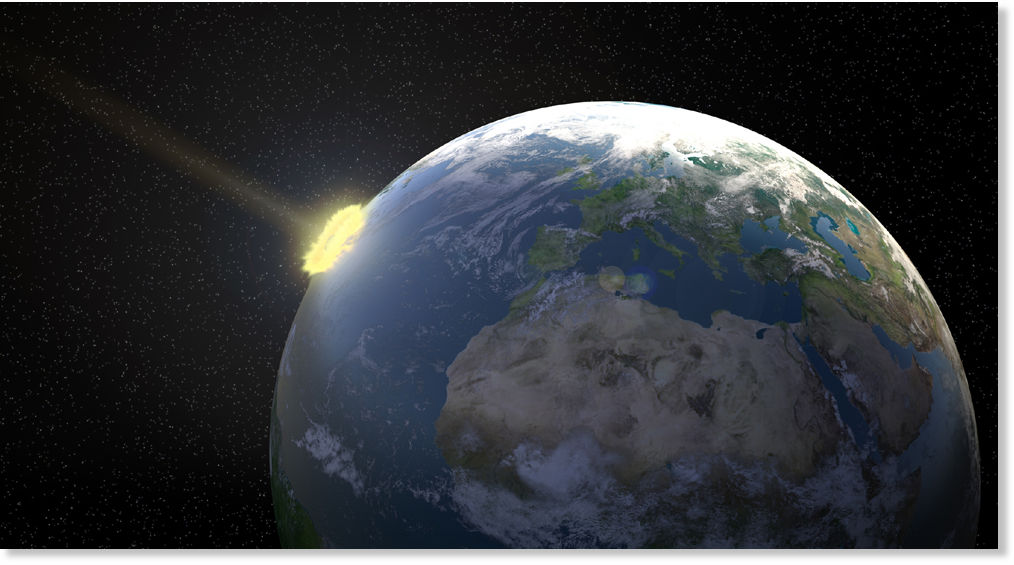
Destroying history means, of course, destroying large segments of the human population who pass history on to their offspring. When you find a blank spot in history, a discontinuity, you can pretty well figure out that something really awful must have happened.
I've recently been wading through the complete works of Anatoly Fomenko. Those of you who have read my book The Secret History of the World know that I referred to him and his theories, but this was based on the available articles about it in English at the time. I've now been gifted with volumes 1 through 4 of his 7 volume work, along with the images from the final three volumes which are still being translated. It's a real revelation.
Now, for those of you who are familiar with this work, let me assure you that I am not reading uncritically. What I do find is that Fomenko's deconstruction is masterful. His method and results that prove that our history has been falsified are, in my opinion, incontrovertible. The numbers simply do not lie. What I am not very impressed by are some of his interpretations of what he does accept as data and his reconstruction is not satisfactory at all. He seems to be entirely unaware of why history must have needed to be re-written: repeated cometary destruction of Europe and the Mediterranean regions over the past 2000 years or more. That general ignorance is widespread and it has a powerful bearing on the 'Disclosure' issue, I think.
Some of the recent 'Disclosure' trends seem to include information from 'government insiders' who have told their stories, or whispered hints of amazing technology just waiting for all of us when this 'inevitable' event happens. Sorry, but I think its all wishful thinking. Why? Because what is interesting to me is the fact that, with all the tracking of government documents and conspiracies and so on, it seems that no one has mentioned to the purveyors of 'Disclosure' just how interested the government actually is in cometary impacts.
On 4 November 1996, Edward Teller wrote to then British Prime Minister, John Major:
Every few human lifetimes, there is a bombardment event like that which occurred in Siberia in 1908, wiping out most life over an area of about 10,000 square miles... Quantitatively, the time-averaged loss-of-life is comparable to that due to large floods, earthquakes and aeroplane crashes... The advent during the last half-century of reasonably large-scale rocket propulsion has given us the technological means necessary to avert such impacts.Teller, apparently, believed that the greatest threat to humankind is not nuclear war, but asteroid or comet impact.
Some groups within the military believe the problem to be very serious indeed. A document on the subject of impact threat - now cleared for public release but formerly classified - was prepared by the U.S. Department of Defense in 1996. (Planetary Defense: Catastrophic Health Insurance for Planet Earth, 1996)
Due to a lack of awareness and emphasis, the world is not socially, economically, or politically prepared to deal with the vulnerability of impacts and their potential consequences. Further, in terms of existing capabilities, there is currently a lack of adequate means of detection, command, control, communications, computers, and intelligence (C41), and mitigation...Dr. Jasper Wall, director of Britain's Royal Greenwich Observatory, Cambridge noted that the Tunguska blast could have had far more serious consequences, would have changed history, if it had occurred at a different time.
In terms of courses of action in the event of a likely impact of an ECO, [earth crossing object], other than a nuclear option, no defensive capability exists today. However, new technologies may yield safer and more cost-effective solutions by 2025. These authors contend that the stakes are simply too high not to pursue direct and viable solutions to the ECO problem. Indeed, the survival of humanity is at stake.
Had Earth moved for another three hours or so before the impact occurred, the target would not have been a barely populated corner of Siberia, but Moscow itself. Ten million people would have died. [interview conducted by Austen Atkinson, 1998]Tunguska sized events occur every 30 to 100 years and smaller incidents occur more frequently. Just such an event occurred in Brazil in 1931. They seem to be increasing, so any day there could be another Tunguska anywhere on the planet... or multiple Tunguska-size events.
The technology needed to detect and deflect these 'small' high-speed objects simply does not exist.
Something like 250 atomic-bomb-sized detonations due to comets and asteroids have been registered by the USA's nuclear-detection system and spy satellites over the course of a single decade up through 1999. These explosions were all at relatively high altitudes, but came with a frequency of at least 2 per month. The recent closing of this data to scientists and the public suggests that there is something to be hidden.
There is a 1-in-24,000 chance that you will be killed by a comet or asteroid impact during a 70 year lifespan. The chances of you getting CJD (mad-cow disease) is 1-in 15 million during the same lifespan. Despite the fact that you are 625 times more likely to die from a comet or asteroid impact and are extremely unlikely to die from CJD, the CJD risk has been highly propagandized, British beef was banned from tables, and everyone totally ignored the far more pressing problem of possible imminent death from space rocks. The MOD has taken no action while the Ministry of Agriculture certainly did.
Why such a strange state of schizophrenia?
Perception. The people perceive that the government can do something about a disease, but can do nothing about space rocks.
The approach of those promoting 'Disclosure' reflects the general lack of knowledge of the problems we face that are real and far more pressing than aliens on our planet. Mike Baillie points out that there is still enormous ignorance of the dangers even within the archaeological community. There is still no archaeological or historical paradigm to deal with the historical presence and influence of impacts. This is particularly troublesome in regards to 'Disclosure' since strange sightings in the skies and strange beings and events historically accompany cometary events. It's as though there is some dimensional doorway-opening capacity connected to the comets/asteroids.
Mike Baillie once asked for a show of hands at an archaeological conference, when he asked the audience if they were aware of the impact phenomenon and its probable role in killing off the dinosaurs and its relevance to human history. Only 10% raised their hands.
Is this an example of "ignorance is bliss"? Do people really think that all will be well if we close our eyes and minds to reality? Unfortunately, Nature is not usually very kind to the slothful or apathetic. It's not adaptive and such individuals may not pass on their genes to future generations.
Because of the hold that religious uniformitarianism has on the minds of most members of our civilization, the concept of cometary impacts has been relegated to popular fiction and entertainment. The scientific community has been uniformly slow in understanding the wider implications across disciplines from astronomy to geology to economics and history.
It all seems so remote to them... what with our Earthly troubles, politics, war, economic troubles, etc. If people could only step back for a moment and really understand that those problems are meaningless in the context of the fact that it all could come to a sudden, fiery end in an instant; death that is unwelcome, terrible, and without mercy.
In 1979, Victor Clube and Bill Napier published their seminal scientific paper in the British journal Nature, titled "A Theory of Terrestrial Catastrophism". There was little notice paid to this paper. It was seven months later that Luis Alvarez and his son, Walter, linked this theory with their geological mystery: the extinction of the dinosaurs. They published their work in 1980 in the American journal, Science. There was an uproar and an immediate backlash from the Uniformitarian school. In 1990, ten years after the Alvarez paper, the K/T impact crater was found in data obtained from oil drilling geophysicists. Here we notice that it is private industry that is controlling the scientific data that is needed so desperately by all of humanity. This should change!
Nowadays, the detractors of the impact theory are in the minority and look increasingly like lunatics in denial. The Uniformitarian view has gripped science for so long that some of them will go to their graves denying the overwhelming evidence. Some of them will accept the K/T impact, and then comfort themselves with the idea that it only happens at millions of years intervals.
Not so.
We must not be seduced into thinking that this is a threat that is remote from us, nor be hypnotized by thinking only about large, global extinction impactors such as the K/T event. The primary threat is that of the 'deathrock' in the size range of 300 meters to 2 kilometers. The risk from these objects is very, very real and can produce catastrophes that kill millions, if not billions, and render vast tracts of the globe uninhabitable for long periods.
Tree-ring chronologies along with ice-cores have been very valuable in assessing the possibility that impacts have been far more frequent, and dangerous, than ever previously suspected. Many events have occurred since 2345 BC and have continued to the present day.
Historical records can also provide precious clues if they are looked at properly. There are many historical accounts of what can only be understood as impact phenomena in history that have been, up to now, wrongly interpreted.
The only way to develop coherent understanding and theories about these matters is via cross-disciplinary studies. There is so much information available in all fields that, if it is all cross-referenced and correlated, a true picture of our past - and future - can be had.
Unfortunately, very few scientists are studying the matter in a polymathic way. I'm not a scientist, but I guess I'm a polymath. More of such are needed, desperately.
The U.S. Military is, apparently, as I've already noted, quite concerned about these matters and it is surprising that the 'Disclosure' advocates have missed this fact. A 1 kilometer asteroid traveling at an average speed of 50 km/s will impact the Earth with an explosive force equivalent to 30,000 megatons of TNT. That is the equivalent of 2.5 million Hiroshima-sized bombs!
Smaller impactors in the 50 to 1 meter range can generate H-bomb-sized explosions, the equivalent of 10 to 20 megatons of TNT. Tunguska experienced just such an event in 1908, as did Brazil in 1931.
The Tunguska event produced a global scattering of iridium discovered in the Greenland ice cores.
As noted, you have a 1-in-24,000 chance of being killed by a comet or asteroid. This is about the same risk factor you experience when you get on an airplane. See the problem? An enormous amount of money is spent on aircraft safety, and virtually none spent on the same time-averaged risk of impact threat.
Since the 'Disclosure' advocates have gotten so close to the military technology people (according to them), perhaps they are aware that military contractors such as Lockheed Martin and government agencies such as NASA, have become extremely concerned by the potential impact threat. Lockheed Martin used its energy laboratory at Sandia to research the impact threat. Using energy equations similar to those developed by Teller, which take into account environmental and atmospheric factors, Sandia's team of scientists were able to create virtual-reality simulations of a catastrophic impact. This project was led by David Crawford and Arthurine Breckenridge. They modeled the impact of a 1.4 kilometer-diameter comet, weighing approximately 1,000 million tons and traveling at 60 km/s as it strikes the Atlantic Ocean 25 miles south of New York. This work was done with the most advanced computation equipment on the planet. This was no computer game. Sandia's team also modeled the impacts of Shoemaker-Levy on Jupiter with stunning accuracy.
The conclusions were horrifying.
The comet impacts with the ocean and instantly vaporizes 300 to 500 cubic kilometers of water forming a temporary cavity in the ocean. The equivalent of 300 gigatons of TNT energy is released at that instant - ten times the explosive power of all the world's nuclear weapons together. The heat generated is in excess of 5,000 degrees Celsius.
Five seconds after the comet hits the ocean, a tremendous impact plume composed of superheated debris, earth and water, smothers most of Long Island.
Eleven seconds after impact, the New York coastline is swept by superheated steam and ejected debris. At the same time, a large proportion of the ejected debris has now penetrated Earth's atmosphere in sub-orbital trajectories. Molten ejecta begins to fall on New York and the heat generated by the impact has begun to incinerate everything in its path - entire cities and forests are turned into cinders almost instantly.
Finally, the global debris cloud rapidly lowers temperatures worldwide and this is followed by the moisture evaporated into the atmosphere starting to fall as snow. David Crawford, leader of the Sandia team, said:
It's almost like doing an experiment - one you could never do. One you would never want to do. {Sandia National Laboratory, PR: 5 May 1998}What is interesting is how our "fearless leaders" are looking at this problem. Their question is: "Is Earth and its human population worth saving?"
My guess is that they are trying to get everything locked down so that they can eliminate a lot of people with plausible excuses, and get away with it; that is, do it without risking the entire population turning against the PTB. And so, they play war games, they create terrorism, they play out farces of being at odds with one another when it is really the average human being in all countries who is the enemy of the leaders, all of whom - even if they play at being opposed to one another - are in the same club.
03 October 2010
New Space Solar Tech?
http://www.thaindian.com/newsportal/health/satellites-harnessing-solar-winds-can-meet-worlds-energy-needs100bn-times-over_100434444.html
London, Sep 25 (ANI): Bid adieu to wind power or conventional solar power, for scientists have suggested that the world’s energy needs could be met 100 billion times over using a satellite to harness the solar wind and beam the energy to Earth - though focussing the beam could be tricky.
The concept for the so-called Dyson-Harrop satellite begins with a long metal wire loop pointed at the sun.
This wire is charged to generate a cylindrical magnetic field that snags the electrons that make up half the solar wind.
These electrons get funnelled into a metal spherical receiver to produce a current, which generates the wire’s magnetic field - making the system self-sustaining.
Any current not needed for the magnetic field powers an infrared laser trained on satellite dishes back on Earth, designed to collect the energy.
Air is transparent to infrared so Earth’s atmosphere won’t suck up energy from the beam before it reaches the ground.
Back on the satellite, the current has been drained of its electrical energy by the laser - the electrons fall onto a ring-shaped sail, where incoming sunlight can re-energise them enough to keep the satellite in orbit around the sun.
A satellite with the same-sized receiver at the same distance from the sun but with a 1-kilometre-long wire and a sail 8400 kilometres wide could generate roughly 1 billion billion gigawatts (1027 watts) of power, “which is actually 100 billion times the power humanity currently requires”, said researcher Brooks Harrop, a physicist at Washington State University in Pullman who designed the satellite.
Since the satellites are made up mostly of copper, they would be relatively easy to construct.
“This satellite is actually something that we can build, using modern technology and delivery methods,” New Scientist quoted Harrop as saying.
Satellites laden with solar panels that can beam their energy down 24 hours a day have been discussed for decades.
California agreed last December to a deal involving the sale of space-based solar power.
Solar panels cost more per pound than the copper making up the Dyson-Harrop satellites, so according to Harrop, “the cost of a solar wind power satellite project should be lower than a comparative solar panel project”.
However, there is one major drawback-to draw significant amounts of power Dyson-Harrop satellites rely on the constant solar wind found high above the ecliptic - the plane defined by the Earth’s orbit around the sun.
Consequently, the satellite would lie tens of millions of kilometres from the Earth. Over those distances, even a sharp laser beam would spread to thousands of kilometres wide by the time it reached Earth.
The study has been published in the International Journal of Astrobiology. (ANI)
From: http://newenergyandfuel.com/http:/newenergyandfuel/com/2010/09/28/a-great-idea-from-the-dyson-sphere/
The quick refresher – a Dyson Sphere is an idea to encase the sun in a ball to collect the whole solar energy output. There are problems – one is if all the matter in the solar systems was used and made into a material at about steel’s density it would be about 8cm or a little over 3 inches thick at a radius of 1 AU – but that’s too close, it would soon melt. To get to a low enough temperature the sphere would have to get at least 1.6 AU out – then the material is insufficient to self-support at steel’s strength.
Then moving the sphere – to keep the sun orbiting in the galaxy centered would consume practically all the power output. The Dyson idea while ambitious remains impractical.
Brian Wang at NextBigFuture caught up to a pdf file and paper abstract that explores an idea based on the Dyson idea called the Dyson-Harrop satellite (DHS). The modeling of such a device pops some big energy gathering numbers. Brooks L. Harrop and Dirk Schulze-Makuch at Washington State University published this idea in the International Journal of Astrobiology.
A DHS could be built – a 1-kilometre-long wire and sail 8400 kilometers wide could generate roughly 1 billion billion gigawatts (10^27 watts) of power, which is 100 billion times the power humanity currently requires. Time to sit up and take notice of orbital solar power?
But all that power has a drawback as well. To beam power from a Dyson-Harrop satellite to Earth, one “would require stupendously huge optics, such as a virtually perfect lens between maybe 10 to 100 kilometers across.”
A DHS would be relatively cheap to construct, given that the system is composed almost entirely of copper and doesn’t require circuitry. As Wang points out in his narrative, “Later versions could use carbon nanotubes (when they are cheaper and made in higher quantity) for lighter wires that can handle more current.”
A DHS is actually a simplistic, self-sustaining system that draws power from the solar wind and uses a laser to fire energy to collectors (on space stations, bases, etc.) positioned anywhere in the Solar System. The DHS draws energy from the solar wind’s electrons, using the Sun’s high-energy photons only to eject the electrons once their useful electronic energy has been collected. That means the electrons out there are collected which can’t get through the atmosphere and the much lower energy photos are used to keep the collector clean. Physics can be marvelous sometimes.
 Here’s how it works. Looking at the diagram above you’ll see the Sun (A) emits plasma half-composed of electrons, half of protons and positive ions (B). Electrons are diverted via the Lorentz force from a cylindrical magnetic field (C) from their radial trajectory towards the ‘Receiver’ (D), a metallic spherical shell. When the Receiver is “full”, excess electrons are diverted through the hole in the Sail. The large positive potential on the Sail drives an electron current through the ‘Pre-Wire’ (E), which is a long, folded wire designed to cancel out the magnetic fields of the current towards the Sun. Once it reaches the end of the Pre-Wire, it travels down the ‘Main Wire’ (F), creating the magnetic field (C), which makes the field-current a self-sustaining system. The current passes through a hole in the Receiver and then through the ‘Sail’ (G), passing through the ‘Inductor’ (H), and the ‘Resistor’ (I), which draws off all of the electrical power of the Satellite to the ‘Laser’ (J), which fires the electrical-turned-photonic energy off to a designated target. Drained of its electrical energy, the current continues to “fall” to the Sail (G). Here, electrons will stay until hit by appropriately-energetic photons from the Sun, at which point they will leap off (K) from the Sail towards the Sun, and then be repelled by the magnetic fields (C) and excess solar wind electrons (B) away from the Satellite, imparting kinetic energy to the Satellite away from the Sun.
A bit complicated – but way elegant and self-position supporting as well.
Because the magnetic field diverts positive particles away from the satellite and electrons toward the Receiver, the DHS remains virtually untouched by excess solar wind particles. And since the satellite ejects electrons when their current cycle is complete, even large satellites have a minimal impact on the Sun’s solar wind output. Plus the kinetic energy from the photoelectrical ejection of electrons from the Sail provides a strong stabilizing force; in fact, it may be possible to design a satellite that can remain in a stationary position.
Sounds great – the other hand holds some major problems that could well be solvable. The DHS isn’t very efficient so its big, then so is outer space. Being so simple and large, protection from that high-speed stuff out there is a major concern. Staying in position while seemingly designed in has to be engineered and work. Then the DHS doesn’t self-start – a pre charge to get it in a self-sustaining cycle needs to be provided. Finally the DHS is going to get hot – shedding the heat is going pose an engineering task of considerable significance.
These all seem to be solvable problems, but there is one more.
One DHS could fully power humanity’s needs if the power could be brought down. Various transmission ideas are working, but so far nothing really seizes attention as a great way to get the power down here.
When such a space energy collection system exists, the orbital photovoltaic projects will need a rethink. Meanwhile, so much power so cheap can be its own lure. Its not such a giant leap to imagine that life off planet is much more practical if the DHS is made fully workable and redundantly reliable. That makes ideas like life off planet would be the main while the life on the planet itself would be a privilege or a resort kind of thing.
The resources out there are stupendous and with cheap energy at hand the idea of getting to them is quite alluring. The DHS concept is certainly one to watch – the numbers are simply too good to ignore.
More at: http://www.lpi.usra.edu/meetings/abscicon2010/pdf/5469.pdf
From: http://nextbigfuture.com/2010/09/interview-of-david-criswell-who.html
September 01, 2010
Interview of David Criswell Who Advocates Solar Power on the Moon by Sander Olson
32Share
Ad Support : Nano Technology Netbook Technology News Computer Software
Here is the David Criswell interview by Sander Olson. Dr. Criswell is an advocate of building solar power stations on the moon to generate solar power that can be beamed to the earth. Dr. Criswell believes that a series of solar power stations on the moon could be made from materials found in lunar regolith, and that these stations could continuously send electricity to earth. Such stations would only need to take up .2% of the lunar surface in order to meet the current energy needs of earth.
Question: How much continuous power does a sustainably prosperous Earth require?
Answer: Today Earth’s 6.7 billion people are provided an average of 225 watts of thermal power per person. They need at least 6,000 to 7,000 watts of thermal power per person to enable the level of power consumption and prosperity achieved by the 1 billion people in the developed nations. The developed nations are slowly converting to consuming electric power. Electric power is approximately 3 times more economically productive than thermal power. Future power systems need to provide at least 2,000 watts of electric power per person to achieve the same or greater economic output as in the developed nations. This implies 20,000,000,000,000 watts of electric power for 10 billion people. In scientific notation the power is 20•10^12 watts-electric or 20 terawatts-electric.
Most commercial power is produced today by using fossil carbon and hydrocarbons fuels to consume the oxygen of Earth’s atmosphere. The fuels and oxygen are consumed and carbon dioxide, ashes, and acids that are released lead to greenhouse heating of the biosphere and the degradation of our air, land, fresh water, and oceans. We must have a non-carbon fuel source of electricity that eliminates the use of molecules of fuels and air to generate electricity within the biosphere. The Lunar Solar Power System does this by directly and dependably collecting solar energy in space and outputting pure electric energy on Earth.
Question: What aspect of the moon makes it so advantageous for power generation?
Answer: The sunward hemisphere of the Moon dependably receives 13,000 terawatts of solar power. Capturing only a few percent of that dependable solar power and delivering it consistently as low-intensity microwaves to Earth will enable sustainable global prosperity.
All of the main resources for power generation – reliable solar power, lunar real estate, and appropriate materials - are readily available on the moon. I have examined the concept of using modified phased-array radars to transmit electrical power, and found the concept viable. It is well demonstrated that microwave power can be converted back into electric power at 90% efficiency. My research shows that generating power from the moon is at least 50 times more cost efficient than competing approaches such as large solar arrays on Earth or solar power satellites deployed to orbit about the Earth either from the Earth or from the Moon.
Question: How much of the moon would need to be covered in solar cells to deliver 20 terawatts-electric (20 TWe) to Earth and how does that vary with the efficiency of the solar cells?
Answer: Lunar Solar Power bases that employ 1980s technology and 10% efficient solar cells that occupy on 10% of the area of a power base would occupy approximately 25% of the lunar surface. The energy can be reliably provided for less than 1 cent per kilowatt-hour. LSP System bases scaled to 2020s technology, with contiguous solar arrays (35% efficient), and solar mirrors in orbit about the Moon could occupy as little as 0.2% of the lunar surface.
Question: So 20 TWe could be delivered 24/7, with no energy storage requirements?
Answer: Yes, for 24/7 operation the LSP System uses power beam relay satellites around earth. These relay satellites will transfer multiple beams down to earth.
Question: Would even the very first lunar power station be constructed out of lunar soil?
Answer: All construction and operating systems will be demonstrated on Earth prior to the first deployment to the Moon. The first LSP base components would be made from the lunar soils. LSP construction is primarily a glass-making process. For instance, fiberglass coated with metal would provide the microwave reflectors. Glass housing would be made for microwave transmitters. These would be coated with iron or aluminum, which is found in regolith. The ultrathin sheets of silicon solar cells would be created using solar power. Soon after the production of electric power on the Moon approximately 90% of mass of the machines of production on the Moon could be made out of lunar regolith.
Question: How thoroughly has this concept been tested?
Answer: Adequate solar cell technology has been available for decades. The power transmission concept does not require new technological. It simply requires scale-up of existing technologies and proven concepts, such as radar. We've been sending radar beams to space for decades with ballistic missile defense radars and to the moon with planetary radars such as the one near Arecibo, Puerto Rico. The Arecibo beam passes through the lower ionosphere at 10% of the power level recommended for beaming commercial power to Earth.
Question: Is there any danger that all of the energy sent to earth would increase earth temperatures?
Answer: This LSP System is designed and operated to be thermally neutral. The rectennas that would receive the electricity can be 80% or more transparent to sunlight. The area below them could be painted white to reflect, averaged over a year, an equal flow of sunlight back into space. Each rectenna can be thermally neutral and not contribute excess thermal power to the biosphere.
Question: Have any studies been done specifically comparing the costs of lunar power generation with alternate power sources, such as solar or nuclear?
Answer: I’ve been doing studies since 1980 comparing the costs of power generation of lunar power with competing energy generation methods. Once the system is in place, lunar power generation is clearly more cost-effective than any other approach. It can be ramped up exponentially to provide electricity without having to move molecules within the biosphere. For more details see chapter 9 of Watts, R. G. (editor) (2002) "Innovative Energy Strategies for CO2 Stabilization" Cambridge University Press
Question: Some have argued that employing solar cells on only 2% of the Sahara desert could meet all of the earth's electricity needs.
Answer: Two percent of the Sahara desert is approximately 0.2 million square kilometers. To provide worldwide 20 terawatts of terrestrial solar power would require global power lines between solar arrays located in all the major deserts, massive power storage facilities, and likely over 2 million square kilometers of solar arrays. Even this enormous system will experience power reductions due to weather and events like dust and smoke from volcanoes and regional fires. Realistic studies employing renewable technologies like wind and solar to provide 20 terawatts of electric power require similar enormous areas and will be extremely expensive. In comparison, the LSP System rectennas can output 20 TWe from 0.1 million square kilometers of land. The LSP electric power will not require the massive global power lines or power storage facilities.
Question: The costs of establishing such a solar-power infrastructure on Earth would be tiny compared to the costs of establishing a lunar infrastructure.
Answer: Renewable systems on Earth are expensive compared to coal and natural gas even though they provide only a fraction of the total commercial energy consumed in a given large region. As they are scaled up beyond 20% of local power production to be the dominant source of commercial power the cost of delivering dependable electric energy rapidly increases. That is why the installation of new wind or solar facilities stops when government subsidies are eliminated.
The world now spends over 300 billion dollars a year on oil exploration and development to maintain the global production of 85 million barrels of oil per day. The global oil industry would have to produce 1,000 million barrels of oil per day to generate 20 TWe. That will never happen. About 2 years of the global oil production cost would cover the cost of implementing the LSP System and bringing it to economic breakeven. Thereafter the LSP System would grow exponentially to provide the 20 TWe, or much more if needed. Its growth would be paid from selling the electric power on Earth. Operating costs will decrease as more electric energy is delivered to Earth. There aren't weather or clouds on the moon, so the equipment will last longer and operate more safely and reliably than similar facilities on Earth. Moreover, no energy storage facilities would be needed on the moon, since all of the electricity would be immediately sent to earth.
Your readers can email me for a recent overview paper, Enabling Sustainable & Rapidly Growing Global Wealth by Implementing the Lunar Solar Power System, that was presented in Beijing, China late May at the IAF Global Lunar Utilization Conference. [ drcriswell@comcast.net ]
Question: What is your background and how long have you been studying the concept of deriving power from the moon?
Answer: I obtained my PhD in space physics and astronomy from Rice University back in the 1960s. I worked for TRW in the 1968-1970 during the peak of the Apollo program and during the 1970s I worked at the Lunar Science Institute near the Johnson Space Center. I administrated the review of the first 3,500 proposals submitted to NASA for studies of the Moon and conducted research on lunar dust motion driven by electric fields and several other topics. In the mid 1970s I became intrigued by the concept of developing materials industries on the Moon and space-based commercial solar power. I also began collaborating with Gerard O'Neill at Princeton University and a NASA grant to study the conversion of the common lunar materials into industrial feedstocks.
Dr. Robert Waldron (deceased) and I developed the LSP System concept toward the end of the joint NASA-Department of Energy studies on space solar power satellites deployed from Earth. We asked ourselves a simple question. Why build satellites in space? The Moon exists. It is much larger than any satellite that humans could build and we knew that it had the right materials and environment to build solar collectors. I have been studying and promoting the Lunar Solar Power System concept ever since.
If you liked this article, please give it a quick review on Reddit, or StumbleUpon. Thanks
From: http://www.netnewspublisher.com/u-s-india-business-council-launches-solar-power-task-force/
U.S.-India Business Council Launches Solar Power Task Force
Posted on admin on September 6, 2010 // Leave Your Comment
U.S.-India Business Council (USIBC)The U.S.-India Business Council (USIBC) announced the launch of a major new initiative to promote U.S.-India trade and investment in the burgeoning solar power sector. Comprised of private-sector companies, the USIBC Solar Power Task Force will help to bridge the United States’ aspirations to export leading technologies, while furthering India’s goal of attaining energy security by reducing its dependence on imported coal and fossil fuels. The USIBC Solar Task Force is a subcommittee of USIBC’s Energy, Environment, Enterprise (EEE) Executive Committee, comprised of more than 100 members.
Bryan Ashley, chief marketing officer of Suniva, and Aparna Doshi, chief operating officer of Astonfield, will Co-Chair the Task Force.
“The aim of the USIBC Solar Task Force is to ensure robust cooperation – both financial and technological – between American and Indian firms participating in this vital sector, and to promote an enabling environment that will spur the application of efficient, clean solar-powered energy throughout India and the globe,” said USIBC President Ron Somers. The U.S. and India signed a memorandum of understanding in November of 2009 on Energy Security, Energy Efficiency, Clean Energy and Climate Change to intensify cooperation in energy efficiency and “green” power development. The USIBC Solar Task Force will support the two governments’ efforts to accelerate utility-scale solar deployment.
The Government of India announced the Jawaharlal Nehru National Solar Mission (JNNSM) on November 19, 2009, with more than 20,000 MW of new solar generation targeted by 2022. The breakthrough program is attempting to mitigate the impact of climate change, while promoting rural development and energy security. The Government of India seeks to become a solar power generating hub, as well as a leader in solar services and equipment. USIBC’s Solar Power Task Force will support policy formulation leading to the success of the JNNSM, providing clean energy to sustain India’s double digit growth.
In the eight months since JNNSM’s introduction, the Government of India has worked diligently to develop the supporting mechanisms to ensure execution against the program’s milestones, the first being 1100 MW of solar generation by March 2013. In order for this goal to be met, it is essential that the solar policy, associated regulatory mechanisms, and contracting relationships be commercially viable and embraced by the private sector and financial community.
The USIBC Solar Task Force will support the JNNSSM by:
i. Sharing regulatory and policy best practices with the Government of India and respective states that will enable India to develop into one of the largest solar power markets and facilitate the development of commercially viable solar power plants;
ii. Advising of the latest developments in terms of leading solar technologies and implementation practices;
iii. Addressing risks, removal of difficulties, and encouraging discussion between all stakeholders to promote efficient implementation of effective policies for the transparent and competitive growth of the Indian solar sector;
iv. Facilitating financing of solar power projects and solar equipment manufacturing in India.
Source: Business Wire
Tags: Alternative Energy, clean energy, Energy economics, india, Renewable energy commercialization, solar energy, solar equipment, solar power, Sustainable energy, U.S.-India Business Council, usibc, USIBC Solar Task Force
Leave a Reply
Click here to cancel reply.
Satellites harnessing solar winds can meet world’s energy needs100bn times over
Saturday, September 25, 2010 4:00:32 PM by ANI ( Leave a comment )London, Sep 25 (ANI): Bid adieu to wind power or conventional solar power, for scientists have suggested that the world’s energy needs could be met 100 billion times over using a satellite to harness the solar wind and beam the energy to Earth - though focussing the beam could be tricky.
The concept for the so-called Dyson-Harrop satellite begins with a long metal wire loop pointed at the sun.
These electrons get funnelled into a metal spherical receiver to produce a current, which generates the wire’s magnetic field - making the system self-sustaining.
Any current not needed for the magnetic field powers an infrared laser trained on satellite dishes back on Earth, designed to collect the energy.
Air is transparent to infrared so Earth’s atmosphere won’t suck up energy from the beam before it reaches the ground.
Back on the satellite, the current has been drained of its electrical energy by the laser - the electrons fall onto a ring-shaped sail, where incoming sunlight can re-energise them enough to keep the satellite in orbit around the sun.
A relatively small Dyson-Harrop satellite using a 1-centimetre-wide copper wire 300 metres long, a receiver 2 metres wide and a sail 10 metres in diameter, sitting at roughly the same distance from the sun as the Earth, could generate 1.7 megawatts of power - enough for about 1000 family homes in the US.
A satellite with the same-sized receiver at the same distance from the sun but with a 1-kilometre-long wire and a sail 8400 kilometres wide could generate roughly 1 billion billion gigawatts (1027 watts) of power, “which is actually 100 billion times the power humanity currently requires”, said researcher Brooks Harrop, a physicist at Washington State University in Pullman who designed the satellite.
Since the satellites are made up mostly of copper, they would be relatively easy to construct.
“This satellite is actually something that we can build, using modern technology and delivery methods,” New Scientist quoted Harrop as saying.
Satellites laden with solar panels that can beam their energy down 24 hours a day have been discussed for decades.
California agreed last December to a deal involving the sale of space-based solar power.
Solar panels cost more per pound than the copper making up the Dyson-Harrop satellites, so according to Harrop, “the cost of a solar wind power satellite project should be lower than a comparative solar panel project”.
However, there is one major drawback-to draw significant amounts of power Dyson-Harrop satellites rely on the constant solar wind found high above the ecliptic - the plane defined by the Earth’s orbit around the sun.
Consequently, the satellite would lie tens of millions of kilometres from the Earth. Over those distances, even a sharp laser beam would spread to thousands of kilometres wide by the time it reached Earth.
The study has been published in the International Journal of Astrobiology. (ANI)
From: http://newenergyandfuel.com/http:/newenergyandfuel/com/2010/09/28/a-great-idea-from-the-dyson-sphere/
The quick refresher – a Dyson Sphere is an idea to encase the sun in a ball to collect the whole solar energy output. There are problems – one is if all the matter in the solar systems was used and made into a material at about steel’s density it would be about 8cm or a little over 3 inches thick at a radius of 1 AU – but that’s too close, it would soon melt. To get to a low enough temperature the sphere would have to get at least 1.6 AU out – then the material is insufficient to self-support at steel’s strength.
Then moving the sphere – to keep the sun orbiting in the galaxy centered would consume practically all the power output. The Dyson idea while ambitious remains impractical.
Brian Wang at NextBigFuture caught up to a pdf file and paper abstract that explores an idea based on the Dyson idea called the Dyson-Harrop satellite (DHS). The modeling of such a device pops some big energy gathering numbers. Brooks L. Harrop and Dirk Schulze-Makuch at Washington State University published this idea in the International Journal of Astrobiology.
A DHS could be built – a 1-kilometre-long wire and sail 8400 kilometers wide could generate roughly 1 billion billion gigawatts (10^27 watts) of power, which is 100 billion times the power humanity currently requires. Time to sit up and take notice of orbital solar power?
But all that power has a drawback as well. To beam power from a Dyson-Harrop satellite to Earth, one “would require stupendously huge optics, such as a virtually perfect lens between maybe 10 to 100 kilometers across.”
A DHS would be relatively cheap to construct, given that the system is composed almost entirely of copper and doesn’t require circuitry. As Wang points out in his narrative, “Later versions could use carbon nanotubes (when they are cheaper and made in higher quantity) for lighter wires that can handle more current.”
A DHS is actually a simplistic, self-sustaining system that draws power from the solar wind and uses a laser to fire energy to collectors (on space stations, bases, etc.) positioned anywhere in the Solar System. The DHS draws energy from the solar wind’s electrons, using the Sun’s high-energy photons only to eject the electrons once their useful electronic energy has been collected. That means the electrons out there are collected which can’t get through the atmosphere and the much lower energy photos are used to keep the collector clean. Physics can be marvelous sometimes.
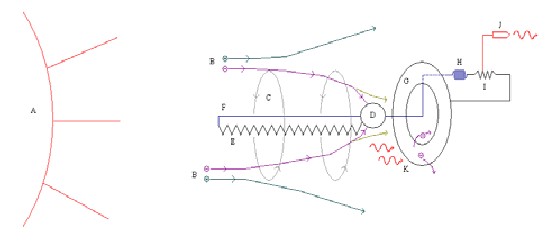
Dyson Harrop Satellte Function. Click image for the largest view.
A bit complicated – but way elegant and self-position supporting as well.
Because the magnetic field diverts positive particles away from the satellite and electrons toward the Receiver, the DHS remains virtually untouched by excess solar wind particles. And since the satellite ejects electrons when their current cycle is complete, even large satellites have a minimal impact on the Sun’s solar wind output. Plus the kinetic energy from the photoelectrical ejection of electrons from the Sail provides a strong stabilizing force; in fact, it may be possible to design a satellite that can remain in a stationary position.
Sounds great – the other hand holds some major problems that could well be solvable. The DHS isn’t very efficient so its big, then so is outer space. Being so simple and large, protection from that high-speed stuff out there is a major concern. Staying in position while seemingly designed in has to be engineered and work. Then the DHS doesn’t self-start – a pre charge to get it in a self-sustaining cycle needs to be provided. Finally the DHS is going to get hot – shedding the heat is going pose an engineering task of considerable significance.
These all seem to be solvable problems, but there is one more.
One DHS could fully power humanity’s needs if the power could be brought down. Various transmission ideas are working, but so far nothing really seizes attention as a great way to get the power down here.
When such a space energy collection system exists, the orbital photovoltaic projects will need a rethink. Meanwhile, so much power so cheap can be its own lure. Its not such a giant leap to imagine that life off planet is much more practical if the DHS is made fully workable and redundantly reliable. That makes ideas like life off planet would be the main while the life on the planet itself would be a privilege or a resort kind of thing.
The resources out there are stupendous and with cheap energy at hand the idea of getting to them is quite alluring. The DHS concept is certainly one to watch – the numbers are simply too good to ignore.
More at: http://www.lpi.usra.edu/meetings/abscicon2010/pdf/5469.pdf
From: http://nextbigfuture.com/2010/09/interview-of-david-criswell-who.html
September 01, 2010
Interview of David Criswell Who Advocates Solar Power on the Moon by Sander Olson
32Share
Ad Support : Nano Technology Netbook Technology News Computer Software
Here is the David Criswell interview by Sander Olson. Dr. Criswell is an advocate of building solar power stations on the moon to generate solar power that can be beamed to the earth. Dr. Criswell believes that a series of solar power stations on the moon could be made from materials found in lunar regolith, and that these stations could continuously send electricity to earth. Such stations would only need to take up .2% of the lunar surface in order to meet the current energy needs of earth.
Question: How much continuous power does a sustainably prosperous Earth require?
Answer: Today Earth’s 6.7 billion people are provided an average of 225 watts of thermal power per person. They need at least 6,000 to 7,000 watts of thermal power per person to enable the level of power consumption and prosperity achieved by the 1 billion people in the developed nations. The developed nations are slowly converting to consuming electric power. Electric power is approximately 3 times more economically productive than thermal power. Future power systems need to provide at least 2,000 watts of electric power per person to achieve the same or greater economic output as in the developed nations. This implies 20,000,000,000,000 watts of electric power for 10 billion people. In scientific notation the power is 20•10^12 watts-electric or 20 terawatts-electric.
Most commercial power is produced today by using fossil carbon and hydrocarbons fuels to consume the oxygen of Earth’s atmosphere. The fuels and oxygen are consumed and carbon dioxide, ashes, and acids that are released lead to greenhouse heating of the biosphere and the degradation of our air, land, fresh water, and oceans. We must have a non-carbon fuel source of electricity that eliminates the use of molecules of fuels and air to generate electricity within the biosphere. The Lunar Solar Power System does this by directly and dependably collecting solar energy in space and outputting pure electric energy on Earth.
Question: What aspect of the moon makes it so advantageous for power generation?
Answer: The sunward hemisphere of the Moon dependably receives 13,000 terawatts of solar power. Capturing only a few percent of that dependable solar power and delivering it consistently as low-intensity microwaves to Earth will enable sustainable global prosperity.
All of the main resources for power generation – reliable solar power, lunar real estate, and appropriate materials - are readily available on the moon. I have examined the concept of using modified phased-array radars to transmit electrical power, and found the concept viable. It is well demonstrated that microwave power can be converted back into electric power at 90% efficiency. My research shows that generating power from the moon is at least 50 times more cost efficient than competing approaches such as large solar arrays on Earth or solar power satellites deployed to orbit about the Earth either from the Earth or from the Moon.
Question: How much of the moon would need to be covered in solar cells to deliver 20 terawatts-electric (20 TWe) to Earth and how does that vary with the efficiency of the solar cells?
Answer: Lunar Solar Power bases that employ 1980s technology and 10% efficient solar cells that occupy on 10% of the area of a power base would occupy approximately 25% of the lunar surface. The energy can be reliably provided for less than 1 cent per kilowatt-hour. LSP System bases scaled to 2020s technology, with contiguous solar arrays (35% efficient), and solar mirrors in orbit about the Moon could occupy as little as 0.2% of the lunar surface.
Question: So 20 TWe could be delivered 24/7, with no energy storage requirements?
Answer: Yes, for 24/7 operation the LSP System uses power beam relay satellites around earth. These relay satellites will transfer multiple beams down to earth.
Question: Would even the very first lunar power station be constructed out of lunar soil?
Answer: All construction and operating systems will be demonstrated on Earth prior to the first deployment to the Moon. The first LSP base components would be made from the lunar soils. LSP construction is primarily a glass-making process. For instance, fiberglass coated with metal would provide the microwave reflectors. Glass housing would be made for microwave transmitters. These would be coated with iron or aluminum, which is found in regolith. The ultrathin sheets of silicon solar cells would be created using solar power. Soon after the production of electric power on the Moon approximately 90% of mass of the machines of production on the Moon could be made out of lunar regolith.
Question: How thoroughly has this concept been tested?
Answer: Adequate solar cell technology has been available for decades. The power transmission concept does not require new technological. It simply requires scale-up of existing technologies and proven concepts, such as radar. We've been sending radar beams to space for decades with ballistic missile defense radars and to the moon with planetary radars such as the one near Arecibo, Puerto Rico. The Arecibo beam passes through the lower ionosphere at 10% of the power level recommended for beaming commercial power to Earth.
Question: Is there any danger that all of the energy sent to earth would increase earth temperatures?
Answer: This LSP System is designed and operated to be thermally neutral. The rectennas that would receive the electricity can be 80% or more transparent to sunlight. The area below them could be painted white to reflect, averaged over a year, an equal flow of sunlight back into space. Each rectenna can be thermally neutral and not contribute excess thermal power to the biosphere.
Question: Have any studies been done specifically comparing the costs of lunar power generation with alternate power sources, such as solar or nuclear?
Answer: I’ve been doing studies since 1980 comparing the costs of power generation of lunar power with competing energy generation methods. Once the system is in place, lunar power generation is clearly more cost-effective than any other approach. It can be ramped up exponentially to provide electricity without having to move molecules within the biosphere. For more details see chapter 9 of Watts, R. G. (editor) (2002) "Innovative Energy Strategies for CO2 Stabilization" Cambridge University Press
Question: Some have argued that employing solar cells on only 2% of the Sahara desert could meet all of the earth's electricity needs.
Answer: Two percent of the Sahara desert is approximately 0.2 million square kilometers. To provide worldwide 20 terawatts of terrestrial solar power would require global power lines between solar arrays located in all the major deserts, massive power storage facilities, and likely over 2 million square kilometers of solar arrays. Even this enormous system will experience power reductions due to weather and events like dust and smoke from volcanoes and regional fires. Realistic studies employing renewable technologies like wind and solar to provide 20 terawatts of electric power require similar enormous areas and will be extremely expensive. In comparison, the LSP System rectennas can output 20 TWe from 0.1 million square kilometers of land. The LSP electric power will not require the massive global power lines or power storage facilities.
Question: The costs of establishing such a solar-power infrastructure on Earth would be tiny compared to the costs of establishing a lunar infrastructure.
Answer: Renewable systems on Earth are expensive compared to coal and natural gas even though they provide only a fraction of the total commercial energy consumed in a given large region. As they are scaled up beyond 20% of local power production to be the dominant source of commercial power the cost of delivering dependable electric energy rapidly increases. That is why the installation of new wind or solar facilities stops when government subsidies are eliminated.
The world now spends over 300 billion dollars a year on oil exploration and development to maintain the global production of 85 million barrels of oil per day. The global oil industry would have to produce 1,000 million barrels of oil per day to generate 20 TWe. That will never happen. About 2 years of the global oil production cost would cover the cost of implementing the LSP System and bringing it to economic breakeven. Thereafter the LSP System would grow exponentially to provide the 20 TWe, or much more if needed. Its growth would be paid from selling the electric power on Earth. Operating costs will decrease as more electric energy is delivered to Earth. There aren't weather or clouds on the moon, so the equipment will last longer and operate more safely and reliably than similar facilities on Earth. Moreover, no energy storage facilities would be needed on the moon, since all of the electricity would be immediately sent to earth.
Your readers can email me for a recent overview paper, Enabling Sustainable & Rapidly Growing Global Wealth by Implementing the Lunar Solar Power System, that was presented in Beijing, China late May at the IAF Global Lunar Utilization Conference. [ drcriswell@comcast.net ]
Question: What is your background and how long have you been studying the concept of deriving power from the moon?
Answer: I obtained my PhD in space physics and astronomy from Rice University back in the 1960s. I worked for TRW in the 1968-1970 during the peak of the Apollo program and during the 1970s I worked at the Lunar Science Institute near the Johnson Space Center. I administrated the review of the first 3,500 proposals submitted to NASA for studies of the Moon and conducted research on lunar dust motion driven by electric fields and several other topics. In the mid 1970s I became intrigued by the concept of developing materials industries on the Moon and space-based commercial solar power. I also began collaborating with Gerard O'Neill at Princeton University and a NASA grant to study the conversion of the common lunar materials into industrial feedstocks.
Dr. Robert Waldron (deceased) and I developed the LSP System concept toward the end of the joint NASA-Department of Energy studies on space solar power satellites deployed from Earth. We asked ourselves a simple question. Why build satellites in space? The Moon exists. It is much larger than any satellite that humans could build and we knew that it had the right materials and environment to build solar collectors. I have been studying and promoting the Lunar Solar Power System concept ever since.
If you liked this article, please give it a quick review on Reddit, or StumbleUpon. Thanks
From: http://www.netnewspublisher.com/u-s-india-business-council-launches-solar-power-task-force/
U.S.-India Business Council Launches Solar Power Task Force
Posted on admin on September 6, 2010 // Leave Your Comment
U.S.-India Business Council (USIBC)The U.S.-India Business Council (USIBC) announced the launch of a major new initiative to promote U.S.-India trade and investment in the burgeoning solar power sector. Comprised of private-sector companies, the USIBC Solar Power Task Force will help to bridge the United States’ aspirations to export leading technologies, while furthering India’s goal of attaining energy security by reducing its dependence on imported coal and fossil fuels. The USIBC Solar Task Force is a subcommittee of USIBC’s Energy, Environment, Enterprise (EEE) Executive Committee, comprised of more than 100 members.
Bryan Ashley, chief marketing officer of Suniva, and Aparna Doshi, chief operating officer of Astonfield, will Co-Chair the Task Force.
“The aim of the USIBC Solar Task Force is to ensure robust cooperation – both financial and technological – between American and Indian firms participating in this vital sector, and to promote an enabling environment that will spur the application of efficient, clean solar-powered energy throughout India and the globe,” said USIBC President Ron Somers. The U.S. and India signed a memorandum of understanding in November of 2009 on Energy Security, Energy Efficiency, Clean Energy and Climate Change to intensify cooperation in energy efficiency and “green” power development. The USIBC Solar Task Force will support the two governments’ efforts to accelerate utility-scale solar deployment.
The Government of India announced the Jawaharlal Nehru National Solar Mission (JNNSM) on November 19, 2009, with more than 20,000 MW of new solar generation targeted by 2022. The breakthrough program is attempting to mitigate the impact of climate change, while promoting rural development and energy security. The Government of India seeks to become a solar power generating hub, as well as a leader in solar services and equipment. USIBC’s Solar Power Task Force will support policy formulation leading to the success of the JNNSM, providing clean energy to sustain India’s double digit growth.
In the eight months since JNNSM’s introduction, the Government of India has worked diligently to develop the supporting mechanisms to ensure execution against the program’s milestones, the first being 1100 MW of solar generation by March 2013. In order for this goal to be met, it is essential that the solar policy, associated regulatory mechanisms, and contracting relationships be commercially viable and embraced by the private sector and financial community.
The USIBC Solar Task Force will support the JNNSSM by:
i. Sharing regulatory and policy best practices with the Government of India and respective states that will enable India to develop into one of the largest solar power markets and facilitate the development of commercially viable solar power plants;
ii. Advising of the latest developments in terms of leading solar technologies and implementation practices;
iii. Addressing risks, removal of difficulties, and encouraging discussion between all stakeholders to promote efficient implementation of effective policies for the transparent and competitive growth of the Indian solar sector;
iv. Facilitating financing of solar power projects and solar equipment manufacturing in India.
Source: Business Wire
Tags: Alternative Energy, clean energy, Energy economics, india, Renewable energy commercialization, solar energy, solar equipment, solar power, Sustainable energy, U.S.-India Business Council, usibc, USIBC Solar Task Force
Leave a Reply
Click here to cancel reply.
Subscribe to:
Posts (Atom)
