$1,440 already pledged for this new endeavor on Space Solar Power:
http://www.kickstarter.com/projects/450844280/space-solar-power-and-the-sps-alpha-concept25 May 2012

Building Space Solar Power Satellites using Lunar Materials and In-Space Habitats
http://www.nss.org/settlement/journal/NSSJOURNAL_AnalysisOfONeill-GlaserModel_2011.pdf
If the 1 billion people were separated into 200 O’Neill habitats, each would house 5 million people, which is the lower population density (O'Neill, 1974) for the original double cylindrical habitat design. This migration could be accomplished in about 35 years, be completely financed by profits from SPS while stabilizing Earth’s global carbon emissions. The probability of human self-extinction during the natural life span of a child born today would decrease from some number uncomfortably close to 1 to a probability less then 1 in ten million.
If human population of 1 billion, all with habitat destroying technology, are dispersed in 50 or less habitats self-extinction within a decade is highly probable. However, with just 160 habitats the chances of self-extinction per year decrease to about one in a million.
Since the mid 20th century we had the technological power to destroy our species and our home planet. This technological power and its associated risks continue to grow with time at an exponential rate. When the human propensity for self destruction and the growth of the availability of technologies of mass destruction are considered, our self-extinction probability can be expected to approach 1 well before the end of this century.
If, on the other hand, a few hundred artificial worlds (as advocated by O'Neill) are placed in the solar system with enough space between them that if one self destructs its neighbor would not be directly affected then the chances of human self-extinction would fall to about 1 chance in 1 million per year.
The results are quite dramatic. While the ground based approach does not appear to be financially practical, the space based approach is financially compelling, promising extraordinary profit if implemented.
The world electricity consumption was about 1966 GW in 2005 and it is projected to be about 4,000 GW by the year 2036, which would be about year 27 of these analyses. Figure 5 gives the economics of the space derived (O’Neill – Glaser) SPS construction model for meeting world electrical power growth requirements and that for stabilization of CO2 emissions. Figure 7 gives the corresponding SPS power delivered to Earth. The “electricity” plan will create 970 GW by year 27, which is 24 percent of the world electricity demand. The higher demand plan will create 8660 GW by year 27, which meets the requirements of Garret’s thermal dynamic global warming model (Garrett, 20009) by replacing 2.1% percent of the total energy consumed each year by non-carbon-emitting sources in order to stabilize world CO2 emissions.From comparison of the curves in Figure 6 it is apparent that the economics of space derived SPS for the higher demand level needed to stabilize global CO2 are even more favorable than for the new electrical demand model. This occurs because after the space infrastructure is in place, there is a high profit margin on SPS production. Ramping up to this higher production requires greater initial investment (about $800 billion at year 17) however program break even occurs 4 years sooner at, at year 20. The profit projected by program year 25 is over $8 trillion.
The space derived (optimized O’Neill – Glaser) model requires an investment of $300 Billion to build the infrastructure on the Moon and in space to allow utilization of lunar materials and space based labor. Once the infrastructure is in place, however, the SPS are constructed more than an order of magnitude cheaper than by Earth launch. These inexpensive SPS have a very large profit margin even when selling electricity below Earth market values. The peak investment of about $460 Billion is paid back at program year 24 and by program year 27 the project is projected to realize $600 Billion in profits.
As shown in Figure 8, the space derived SPS program is capable of financing in
the first 35 years 800 thousand people for the electricity scenario and 1.1 billion people in
space for the CO2 stabilization scenario. This includes construction of large vista O’Neill
habitats, transportation of the population from Earth to the space habitation, and the population’s
living expenses in space. Again 80% of the population is employed in building SPS or
habitation. After this space real estate focus the space population can be naturally deployed
to develop a solar system based economy.
The solar system economy would have little near term limits to growth since the carrying capacity of the asteroid belt alone utilizing O’Neill habitats is estimated to be 10-100 trillion people (Billingham et al, 1979).
21 May 2012
The Inadequacy of Current Space Law to Protect and Encourage Investment
From: http://www.dailymail.co.uk/sciencetech/article-2137806/Legal-expert-says-James-Camerons-multi-billion-space-mining-venture-hit-lawsuits.html

Not clear who OWNS asteroids
Under 1967 Space Treaty, space is a 'global commons'
University of Nebraska expert says venture may face serious legal problems
New venture backed by Google chiefs and Avatar's James Cameron
100-foot asteroid can contain $50 BILLION of platinum
Spacecraft could mine near-earth rocks for platinum
Plan would add 'trillions' to global GDP
Planetary Resources, the Seattle-based 'asteroid mining' company set up by Google chiefs Larry Page and Eric Schmidt and filmmaker James Cameron could run into legal problems.
It's not clear who actually OWNS asteroids.
Frans von der Dunk, professor of space law at the University of Nebraska-Lincoln said that existing laws applying to space meant there was no certainty that ‘asteroid mining’ was legal.
It’s also not certain, von der Dunk said, about who owns rocks in space, which is, according to the 1967 Global Space Treaty, ‘a global commons’.


The plan to bring back trillions of pounds worth of platinum from space rocks might not be as simple as some have hoped.
‘Neither the pubic interests, ranging from security, safety and the environment to protecting Neil Armstrong’s footsteps, nor the interests of the company in securing its investments are properly protected,’ said von der Dunk.
The Nebraska professor said that the venture would be open to legal suits - and that it would also have no defence against rivals.
‘Consequently, there is no legal certainty that those activities would not become seriously challenged.’
‘This prompts several questions: What rights of protection would the mining company have against others wishing to ‘intrude,’ given that a global commons is in a principled fashion open to everyone?’ Von der Dunk said.
‘And, who is going to be held liable – and to what extent – when mining activities cause damage to other space activities or are harmed by them?’


But wealth beyond the dreams of avarice may NOT be immediately forthcoming.
Several scientists not involved in the project said they were simultaneously thrilled and wary, calling the plan daring, difficult - and pricey.
They don't see how it could be cost-effective, even with platinum and gold worth nearly $1,600 an ounce.
An upcoming NASA mission to return just 2 ounces (60 grams) of an asteroid to Earth will cost about $1 billion.
Scientists question how the company can reduce costs to the point where 'space mining' will be profitable.
Planetary Resources, based in Bellevue, Washington, initially will focus on developing and selling extremely low-cost robotic spacecraft for surveying missions, the company announced this week.
A demonstration mission in orbit around Earth is expected to be launched within two years, said company co-founders Peter Diamandis and Eric Anderson.
Anderson acknowledged the many potential pitfalls.
'There will be times when we fail,' he said. 'There will be times when we have to pick up the pieces and try again.'


Within five to 10 years, however, the company expects to progress from selling observation platforms in orbit around Earth to prospecting services.
It plans to tap some of the thousands of asteroids that pass relatively close to Earth and extract their raw materials.
A 98-foot asteroid can hold as much as $50 billion worth of platinum (£31 billion) at today's prices, said a company spokesperson.
Not all missions would return precious metals and minerals to Earth. In addition to mining for platinum and other precious metals, the company plans to tap asteroids' water to supply orbiting fuel depots, which could be used by NASA and others for robotic and human space missions.
'We have a long view. We're not expecting this company to be an overnight financial home run. This is going to take time,' Anderson said in an interview with Reuters.
The real payoff, which is decades away, will come from mining asteroids for platinum group metals and rare minerals.

'If you look back historically at what has caused humanity to make its largest investments in exploration and in transportation, it has been going after resources, whether it's the Europeans going after the spice routes or the American settlers looking toward the west for gold, oil, timber or land,; Diamandis said.
'Those precious resources caused people to make huge investments in ships and railroads and pipelines. Looking to space, everything we hold of value on Earth - metals, minerals, energy, real estate, water - is in near-infinite quantities in space.
'The opportunity exists to create a company whose mission is to be able to go and basically identify and access some of those resources and ultimately figure out how to make them available where they are needed,' he said.
Diamandis and Anderson declined to discuss how much money has been raised for their venture so far.
In addition to Google billionaires Page and Schmidt and filmmaker Cameron, Planetary Resources investors include former Microsoft chief software architect Charles Simonyi, a two-time visitor to the International Space Station, Google founding director K. Ram Shriram and Ross Perot Jr.
Planetary Resources also declined to discuss specifics about how and when asteroid mining would begin.


The shortage of sources for raw materials on the planet has caused global inflation to spike in recent years causing tensions to rise between nations, experts have said.
The company's first step is to develop technologies to cut the cost of deep-space robotic probes to one-tenth to one-hundredth the cost of current space missions, which run hundreds of millions of dollars, Diamandis said.
Among the targeted technologies is optical laser communications, which would eliminate the need for large radio antennas aboard spacecraft.
Space entrepreneurs Peter Diamandis and Eric Anderson are just two of the names behind Planetary Resource. In a press release, the company announced its intentions to create 'a new industry in space and a new definition of natural resources'.
Diamandis and Anderson - both known for their aspirations for commercial space exploration - will host the launch event along with two former NASA officials.
A driving force behind the Ansari X-Prize competition to spur on non-goverment space flight, Diamandis has made no secret of his goal to one day become an asteroid miner.
In an interview earlier this year with Forbes magazine, he said: 'The earth is a crumb in a supermarket of resources.
'Now we finally have the technology to extract resources outside earth for the benefit of humanity without having to rape and pillage our planet.'
Hollywood film maker James Cameron is no stranger to daring exploration.
Just last month the director of Titanic and Avatar became the first solo diver to reach the bottom of the Challenger Deep - the deepest point on Earth.


 It might seem like a radical concept, but scientists have been toying with the idea of mining asteroids for their natural resources for longer than the space program has been running.
Experts believe it is only now that we have the technology and ability to discover and characterise a sufficient number of small near-Earth asteroids (NEA).
The mining could yield a large amount of water - frozen inside the asteroids - oxygen and metals which could not only be brought back to Earth but could help further space exploration by allowing humans to fuel spacecraft and build space stations.
Nasa believes capturing placing an NEA in lunar orbit could provide a unique, meaningful and easy-to-reach destination for exploration by astronaut crews in the next decade.
It is only now that the sufficiently-powerful electric propulsion systems necessary to transport a captured NEA are becoming available.
Mining asteroids could take several forms. This includes sending humans in a spacecraft to an asteroid to explore and mine it.
Another possible scenario could involve launching a robotic spacecraft to either to mine an asteroid directly or transport it closer to Earth so it could be reached by humans more easily.
Extracting raw materials, such as iron and nickel, from the space rocks is a possibility that has been discussed for decades.
However, the obstacles for such a mission has always been the cost, sufficient scientific expertise and technical prowess.
It could cost tens of billions of dollars - and could take well over a decade - for astronauts to successfully land on an asteroid, NASA experts have said in the past.
Source: The Institute for Space Studies
Read more: http://www.dailymail.co.uk/sciencetech/article-2137806/Legal-expert-says-James-Camerons-multi-billion-space-mining-venture-hit-lawsuits.html#ixzz1vWHEq6Hf

Hang on, do you actually OWN all those asteroids full of platinum? Legal expert says James Cameron's multi-billion space mining venture may be hit with lawsuits
By ROB WAUGH All By This Author - 01/05/2012 14:46:18
Frans von der Dunk, professor of space law at the University of Nebraska-Lincoln said that existing laws applying to space meant there was no certainty that ‘asteroid mining’ was legal.
It's not clear who actually OWNS asteroids.
Frans von der Dunk, professor of space law at the University of Nebraska-Lincoln said that existing laws applying to space meant there was no certainty that ‘asteroid mining’ was legal.
It’s also not certain, von der Dunk said, about who owns rocks in space, which is, according to the 1967 Global Space Treaty, ‘a global commons’.
We're hiring! Two of Google's bosses and other technology luminaries in Seattle, USA, launched a company called Planetary Resources, aimed at developing robotic spaceships to mine near-Earth asteroids
James Cameron gives two thumbs-up as he emerges from the Deepsea Challenger: Planetary Resources, the Seattle-based 'asteroid mining' company set up by Google chiefs and Cameron could run into legal problems
The plan to bring back trillions of pounds worth of platinum from space rocks might not be as simple as some have hoped.
‘Neither the pubic interests, ranging from security, safety and the environment to protecting Neil Armstrong’s footsteps, nor the interests of the company in securing its investments are properly protected,’ said von der Dunk.
The Nebraska professor said that the venture would be open to legal suits - and that it would also have no defence against rivals.
‘Consequently, there is no legal certainty that those activities would not become seriously challenged.’
‘This prompts several questions: What rights of protection would the mining company have against others wishing to ‘intrude,’ given that a global commons is in a principled fashion open to everyone?’ Von der Dunk said.
‘And, who is going to be held liable – and to what extent – when mining activities cause damage to other space activities or are harmed by them?’
Miners wanted: A computer generated image of swarms of low-cost robotic spacecraft that will enable extraction of resources from Near-Earth asteroids
The new gold rush? Clint Eastwood, Lee Marvin and Jean Seberg in Gold Rush-themed musical 'Paint Your Wagon'
Several scientists not involved in the project said they were simultaneously thrilled and wary, calling the plan daring, difficult - and pricey.
They don't see how it could be cost-effective, even with platinum and gold worth nearly $1,600 an ounce.
An upcoming NASA mission to return just 2 ounces (60 grams) of an asteroid to Earth will cost about $1 billion.
Scientists question how the company can reduce costs to the point where 'space mining' will be profitable.
Planetary Resources, based in Bellevue, Washington, initially will focus on developing and selling extremely low-cost robotic spacecraft for surveying missions, the company announced this week.
A demonstration mission in orbit around Earth is expected to be launched within two years, said company co-founders Peter Diamandis and Eric Anderson.
Anderson acknowledged the many potential pitfalls.
'There will be times when we fail,' he said. 'There will be times when we have to pick up the pieces and try again.'
Cosmic quarry: A team of scientists have unveiled plans to mine asteroids for their raw materials
Mars Rover Curiosity - currently on its way to the Red Planet: The new company aims to reduce the cost of hardware for space exploration by a factor of 100
It plans to tap some of the thousands of asteroids that pass relatively close to Earth and extract their raw materials.
A 98-foot asteroid can hold as much as $50 billion worth of platinum (£31 billion) at today's prices, said a company spokesperson.
Not all missions would return precious metals and minerals to Earth. In addition to mining for platinum and other precious metals, the company plans to tap asteroids' water to supply orbiting fuel depots, which could be used by NASA and others for robotic and human space missions.
'We have a long view. We're not expecting this company to be an overnight financial home run. This is going to take time,' Anderson said in an interview with Reuters.
The real payoff, which is decades away, will come from mining asteroids for platinum group metals and rare minerals.
Nasa has already successsfully landed a probe on an asteroid, Eros, 196 million miles from Earth
'Those precious resources caused people to make huge investments in ships and railroads and pipelines. Looking to space, everything we hold of value on Earth - metals, minerals, energy, real estate, water - is in near-infinite quantities in space.
'The opportunity exists to create a company whose mission is to be able to go and basically identify and access some of those resources and ultimately figure out how to make them available where they are needed,' he said.
Diamandis and Anderson declined to discuss how much money has been raised for their venture so far.
In addition to Google billionaires Page and Schmidt and filmmaker Cameron, Planetary Resources investors include former Microsoft chief software architect Charles Simonyi, a two-time visitor to the International Space Station, Google founding director K. Ram Shriram and Ross Perot Jr.
Planetary Resources also declined to discuss specifics about how and when asteroid mining would begin.
NASA's infrared sky-scans track space objects such as asteroids. A recent scan with the NeoWISE instruments found that there were 19,000 'mid-sized' asteroids within 120 million miles of Earth
Backing: Film maker and explorer James Cameron (left) is supporting the project, as is billionaire Charles Simonyi (right)
Untapped resource: NASA scientists say the high concentration of raw materials found in asteroids could supply Earth with vital stockpiles of natural resources
Space man: Entrepreneur Peter Diamandis
The company's first step is to develop technologies to cut the cost of deep-space robotic probes to one-tenth to one-hundredth the cost of current space missions, which run hundreds of millions of dollars, Diamandis said.
Among the targeted technologies is optical laser communications, which would eliminate the need for large radio antennas aboard spacecraft.
Space entrepreneurs Peter Diamandis and Eric Anderson are just two of the names behind Planetary Resource. In a press release, the company announced its intentions to create 'a new industry in space and a new definition of natural resources'.
Diamandis and Anderson - both known for their aspirations for commercial space exploration - will host the launch event along with two former NASA officials.
A driving force behind the Ansari X-Prize competition to spur on non-goverment space flight, Diamandis has made no secret of his goal to one day become an asteroid miner.
In an interview earlier this year with Forbes magazine, he said: 'The earth is a crumb in a supermarket of resources.
'Now we finally have the technology to extract resources outside earth for the benefit of humanity without having to rape and pillage our planet.'
Hollywood film maker James Cameron is no stranger to daring exploration.
Just last month the director of Titanic and Avatar became the first solo diver to reach the bottom of the Challenger Deep - the deepest point on Earth.
Radical concept, but old idea: Experts believe it is only now that we have the ability to discover and characterise a sufficient number of small near-Earth asteroids
Straight out of a sci-fi film: A scene from the movie Armageddon, where Bruce Willis's character is sent into space to mine an asteroid before it hits the Earth
COSMIC QUARRIES: AN IDEA AS OLD AS THE SPACE PROGRAM
Experts believe it is only now that we have the technology and ability to discover and characterise a sufficient number of small near-Earth asteroids (NEA).
The mining could yield a large amount of water - frozen inside the asteroids - oxygen and metals which could not only be brought back to Earth but could help further space exploration by allowing humans to fuel spacecraft and build space stations.
Nasa believes capturing placing an NEA in lunar orbit could provide a unique, meaningful and easy-to-reach destination for exploration by astronaut crews in the next decade.
It is only now that the sufficiently-powerful electric propulsion systems necessary to transport a captured NEA are becoming available.
Mining asteroids could take several forms. This includes sending humans in a spacecraft to an asteroid to explore and mine it.
Another possible scenario could involve launching a robotic spacecraft to either to mine an asteroid directly or transport it closer to Earth so it could be reached by humans more easily.
Extracting raw materials, such as iron and nickel, from the space rocks is a possibility that has been discussed for decades.
However, the obstacles for such a mission has always been the cost, sufficient scientific expertise and technical prowess.
It could cost tens of billions of dollars - and could take well over a decade - for astronauts to successfully land on an asteroid, NASA experts have said in the past.
Source: The Institute for Space Studies
Read more: http://www.dailymail.co.uk/sciencetech/article-2137806/Legal-expert-says-James-Camerons-multi-billion-space-mining-venture-hit-lawsuits.html#ixzz1vWHEq6Hf
The galactic shredder: Nasa captures huge black hole pulling star to pieces after red giant 'wanders too close'
By ROB WAUGH All By This Author - 03/05/2012 12:52:17
A star that wandered too close to the centre of a galaxy 2.7 billion light years away was pulled in by the enormous gravity of the black hole - and shredded.

Nasa probe flies past Saturn's icy moon Enceladus just 46 miles up - and captures mystery 'jets' of ice which may harbour life
By ROB WAUGH All By This Author - 03/05/2012 16:41:10
A hair-raisingly close fly-by by Nasa's Cassini Probe aims to learn more about what lurks beneath the icy moon Enceladus's surface - and what exactly lurks in the 'geysers' of ice it spews into space.

This is the way the world ends: Planets turned to dust devoured by a white dwarf star offer a glimpse of our own apocalypse
By ROB WAUGH All By This Author - 04/05/2012 12:06:37
University of Warwick researchers found four white dwarves surrounded by the dust of shattered 'Earths' White dwarfs are the final stage of life of stars like our Sun - once the furnace inside a star 'burns out'.
Zayed Future Energy Prize
http://www.zayedfutureenergyprize.com/en/
A new prize for global energy...will Zayed discover SBSP
A new prize for global energy...will Zayed discover SBSP
Space Solar Swarm!
From: http://www.dailymail.co.uk/sciencetech/article-2145149/Solar-satellites-offer-hope-green-energy-actually-WORK.html?ito=feeds-newsxml
|
On Earth, solar power has had a slow start, thanks to high prices and inefficient panels - but the first tests on 'solar satellites' offer hope of 'green energy' that actually works.
Researchers at Stratchclyde University have already tested equipment in space, a first step for solar panels to collect energy and transfer it back to earth through microwaves or lasers.
The researchers aim to produce a 'swarm' of satellites that could one day power whole cities.


Initially the tiny satellites wouldn't replace ordinary power grids - instead, they could swiftly resupply power to disaster areas or outlying districts that are difficult to reach.
A 'receiver' on Earth would turn the precisely targeted microwave or laser beams into usable electricity.
The idea of solar panels in space has been much discussed - but the new research proves that at least a small-scale version IS possible.
Dr Massimiliano Vasile, of the University of Strathclyde’s Department of Mechanical and Aerospace Engineering, who is leading the space based solar power research, said: ‘Space provides a fantastic source for collecting solar power and we have the advantage of being able to gather it regardless of the time of the day or indeed the weather conditions.‘In areas like the Sahara desert where quality solar power can be captured, it becomes very difficult to transport this energy to areas where it can be used.
'However, our research is focusing on how we can remove this obstacle and use space based solar power to target difficult to reach areas.
'This would provide a reliable, quality source of energy and would remove the need for storing energy coming from renewable sources on ground as it would provide a constant delivery of solar energy.
‘Initially, smaller satellites will be able to generate enough energy for a small village but we have the aim, and indeed the technology available, to one day put a large enough structure in space that could gather energy that would be capable of powering a large city.’
Last month, a team of science and engineering students at Strathclyde developed an innovative ‘space web’ experiment which was carried on a rocket from the Arctic Circle to the edge of space.

The experiment, known as Suaineadh – or ‘twisting’ in Scots Gaelic, was an important step forward in space construction design and demonstrated that larger structures could be built on top of a light-weight spinning web, paving the way for the next stage in the solar power project.
Dr Vasile added: ‘The success of Suaineadh allows us to move forward with the next stage of our project which involves looking at the reflectors needed to collect the solar power.
‘The current project, called SAM (Self-inflating Adaptable Membrane) will test the deployment of an ultra light cellular structure that can change shape once deployed. The structure is made of cells that are self-inflating in vacuum and can change their volume independently through nanopumps.
‘The structure replicates the natural cellular structure that exists in all living things. The independent control of the cells would allow us to morph the structure into a solar concentrator to collect the sunlight and project it on solar arrays. The same structure can be used to build large space systems by assembling thousands of small individual units.’
The project is part of a NASA Institute for Advanced Concepts (NIAC) study led by Dr John Mankins of Artemis Innovation. The University of Strathclyde represents the European section of an international consortium involving American researchers, and a Japanese team, led by Professor Nobuyuki Kaya of the University of Kobe, a world leader in wireless power transmission.
The NIAC study is demonstrating a new conceptual design for large scale solar power satellites. The role of the team at the University of Strathclyde is to develop innovative solutions for the structural elements and new solutions for orbit and orbit control.
Read more: http://www.dailymail.co.uk/sciencetech/article-2145149/Solar-satellites-offer-hope-green-energy-actually-WORK.html#ixzz1vVpIXEQc
Beams' from space that could power cities: First tests on solar satellites offer hope of green energy that might actually WORK
Floating solar panels 'beam' energy to Earth using lasers or microwaves
Equipment tested in space to deploy 'swarm' of solar panels
Initially will supply power to disaster areas or outlying regions
Eventually 'swarm' of tiny satellites could power cities
|
On Earth, solar power has had a slow start, thanks to high prices and inefficient panels - but the first tests on 'solar satellites' offer hope of 'green energy' that actually works.
Researchers at Stratchclyde University have already tested equipment in space, a first step for solar panels to collect energy and transfer it back to earth through microwaves or lasers.
The researchers aim to produce a 'swarm' of satellites that could one day power whole cities.
Initially, the tiny satellites wouldn't replace ordinary power grids - instead, they could swiftly resupply power to disaster areas or outlying districts that are difficult to reach
Solar satellite: The researchers aim to produce a 'swarm' of satellites that could one day power whole cities
Dr Massimiliano Vasile, of Strathclyde¿s Department of Mechanical and Aerospace Engineering, is leading the research
A 'receiver' on Earth would turn the precisely targeted microwave or laser beams into usable electricity.
The idea of solar panels in space has been much discussed - but the new research proves that at least a small-scale version IS possible.
Dr Massimiliano Vasile, of the University of Strathclyde’s Department of Mechanical and Aerospace Engineering, who is leading the space based solar power research, said: ‘Space provides a fantastic source for collecting solar power and we have the advantage of being able to gather it regardless of the time of the day or indeed the weather conditions.‘In areas like the Sahara desert where quality solar power can be captured, it becomes very difficult to transport this energy to areas where it can be used.
'However, our research is focusing on how we can remove this obstacle and use space based solar power to target difficult to reach areas.
'This would provide a reliable, quality source of energy and would remove the need for storing energy coming from renewable sources on ground as it would provide a constant delivery of solar energy.
‘Initially, smaller satellites will be able to generate enough energy for a small village but we have the aim, and indeed the technology available, to one day put a large enough structure in space that could gather energy that would be capable of powering a large city.’
Last month, a team of science and engineering students at Strathclyde developed an innovative ‘space web’ experiment which was carried on a rocket from the Arctic Circle to the edge of space.
The researchers already deployed a network of satellites which could be used to 'beam' power back to Earth
Dr Vasile added: ‘The success of Suaineadh allows us to move forward with the next stage of our project which involves looking at the reflectors needed to collect the solar power.
‘The current project, called SAM (Self-inflating Adaptable Membrane) will test the deployment of an ultra light cellular structure that can change shape once deployed. The structure is made of cells that are self-inflating in vacuum and can change their volume independently through nanopumps.
‘The structure replicates the natural cellular structure that exists in all living things. The independent control of the cells would allow us to morph the structure into a solar concentrator to collect the sunlight and project it on solar arrays. The same structure can be used to build large space systems by assembling thousands of small individual units.’
The project is part of a NASA Institute for Advanced Concepts (NIAC) study led by Dr John Mankins of Artemis Innovation. The University of Strathclyde represents the European section of an international consortium involving American researchers, and a Japanese team, led by Professor Nobuyuki Kaya of the University of Kobe, a world leader in wireless power transmission.
The NIAC study is demonstrating a new conceptual design for large scale solar power satellites. The role of the team at the University of Strathclyde is to develop innovative solutions for the structural elements and new solutions for orbit and orbit control.
Read more: http://www.dailymail.co.uk/sciencetech/article-2145149/Solar-satellites-offer-hope-green-energy-actually-WORK.html#ixzz1vVpIXEQc
NASA survey counts potentially hazardous asteroids
From: http://www.kurzweilai.net/nasa-survey-counts-potentially-hazardous-asteroids
NASA survey counts potentially hazardous asteroids
May 21, 2012
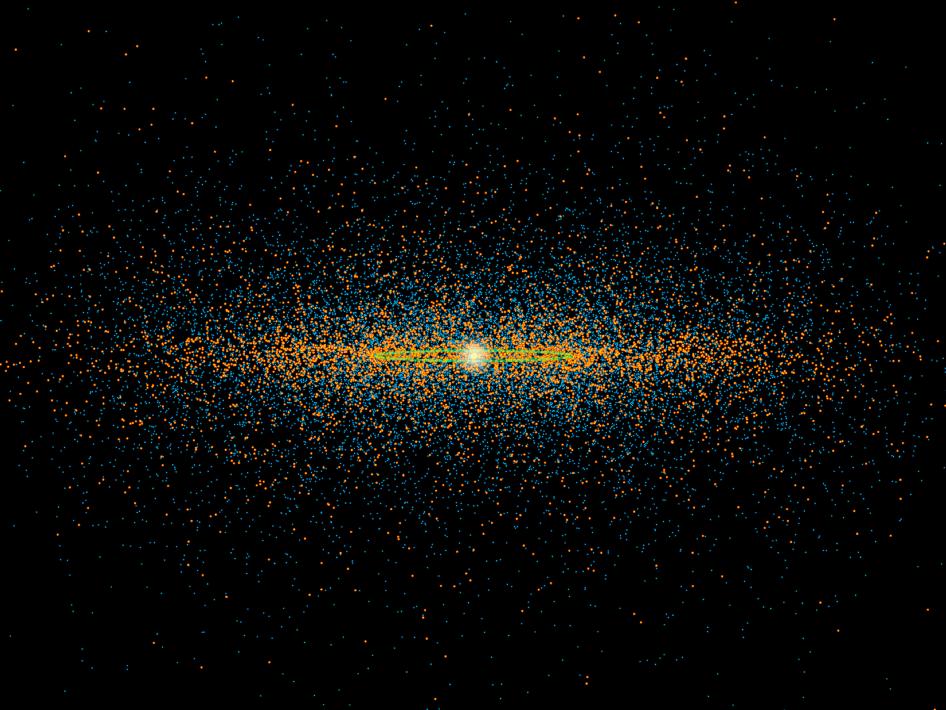
New results from NASA's NEOWISE survey find that more potentially hazardous asteroids, or PHAs, are closely aligned with the plane of our solar system than previous models suggested, coming within 5 million miles (about 8 million kilometers) of Earth (credit: NASA/JPL-Caltech)
Potentially hazardous asteroids are a subset of the larger group of near-Earth asteroids. The PHAs have the closest orbits to Earth’s, coming within five million miles (about eight million kilometers), and they are big enough to survive passing through Earth’s atmosphere and cause damage on a regional, or greater, scale.
The new results come from the asteroid-hunting portion of the WISE mission, called NEOWISE. The project sampled 107 PHAs to make predictions about the entire population as a whole. Findings indicate there are roughly 4,700 PHAs, plus or minus 1,500, with diameters larger than 330 feet (about 100 meters). So far, an estimated 20 to 30 percent of these objects have been found.
While previous estimates of PHAs predicted similar numbers, they were rough approximations. NEOWISE has generated a more credible estimate of the objects’ total numbers and sizes. It suggests that about twice as many PHAs as previously thought are likely to reside in “lower-inclination” orbits, which are more aligned with the plane of Earth’s orbit.
In addition, these lower-inclination objects appear to be somewhat brighter and smaller than the other near-Earth asteroids that spend more time far away from Earth. A possible explanation is that many of the PHAs may have originated from a collision between two asteroids in the main belt lying between Mars and Jupiter. A larger body with a low-inclination orbit may have broken up in the main belt, causing some of the fragments to drift into orbits closer to Earth and eventually become PHAs.
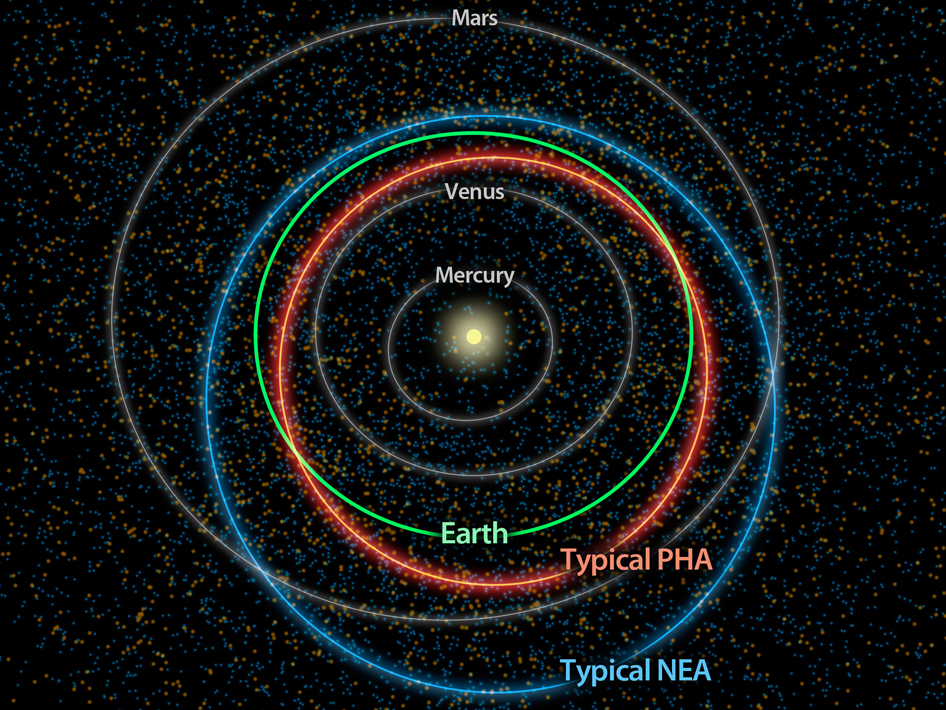
This diagram illustrates the differences between orbits of a typical near-Earth asteroid (blue) and a potentially hazardous asteroid, or PHA (orange). PHAs are a subset of the near-Earth asteroids (NEAs). They have the closest orbits to Earth's orbit, coming within 5 million miles (about 8 million kilometers), and they are large enough to survive passage through Earth's atmosphere and cause damage on a regional, or greater, scale. (Credit: NASA/JPL-Caltech)
“NASA’s NEOWISE project, which wasn’t originally planned as part of WISE, has turned out to be a huge bonus,” said Amy Mainzer, NEOWISE principal investigator, at NASA’s Jet Propulsion Laboratory in Pasadena, Calif. “Everything we can learn about these objects helps us understand their origins and fate. Our team was surprised to find the overabundance of low-inclination PHAs. Because they will tend to make more close approaches to Earth, these targets can provide the best opportunities for the next generation of human and robotic exploration.”
The discovery that many PHAs tend to be bright says something about their composition; they are more likely to be either stony, like granite, or metallic. This type of information is important in assessing the space rocks’ potential hazards to Earth. The composition of the bodies would affect how quickly they might burn up in our atmosphere if an encounter were to take place.
100 Year Starship
18 May 2012
100-Year Starship: Mae Jemison reaches for the stars

Astronaut Mae Jemison flew onboard Space Shuttle Endeavour (Copyright: Nasa)
Mae Jemison fulfilled a childhood dream to travel to space. Now she wants to take humanity to the stars.
The 100-Year Starship, funded by the Defense Advanced Research Projects Agency (Darpa), isn’t about building the Starship Enterprise, at least not yet. Rather, it’s about creating a nonprofit organization that can sustain efforts over the next century to enable interstellar travel. The Dorothy Jemison Foundation, headed by Mae Jemison, was selected earlier this year to lead the 100-Year Starship.
This week the foundation announced its plans for shooting for the stars. First on the agenda is a gathering of scientists and the public in Houston, Texas, to discuss ways to advance interstellar travel.
Jemison spoke exclusively with BBC Future to talk about how she plans to lead humanity on an interstellar journey.
Q: You have signed up for an ambitious project. Are you sure that in 100 years, we’ll be ready to launch a starship?
Let me put it this way: It should happen within the 100 years. But if we can figure out how to do it faster, in 20 to 30 years, I’m good, because that way I get to go. Why do I think the technology arc is sufficient? If you think about it, HG Wells wrote First Men in the Moon in 1901. Imagine how incredulous, fantastical that idea was in 1901. We didn’t have rockets, we didn’t have the materials, and we weren’t really flying. It was incredible. Less than 100 years later, we were on the moon. I know we will have the technological knowledge if we choose to pursue it.
Q: To get to the stars, you need to push technology forward. What do you think needs to be a priority?
We’re in the process of developing the research issues. The first one is energy. Even if you say, I’ll take a 1,000 years to get there, you still have to figure how to generate enough energy to power a vehicle for [that length of time]. You can’t do that necessarily with solar energy. If you say I want to do it in a human lifetime, then enormous amounts of energy also have to be created.
Q: Your first step towards the stars will happen in Houston this September. Can you tell us what to expect?
What we really want to do with the symposium is provide a place where folks who are deep into [interstellar travel], whether from the social sciences or plasma physics, can have technical discussions, as well as being able to engage the public writ large in advocacy, participation, and in understanding what’s going on.
Q: What comes after that?
The symposium is a very strong declaration of, “we’re here.” At the same time, we have been actually working on the overall program. What we see with the 100-Year Starship is that it’s really a multidimensional organization. By that I mean, it’s an organization that has at its core a nonprofit foundation. That nonprofit foundation is there to make sure we maintain its purpose. We have the capacity to spinoff for-profit organizations as well: companies, ventures, and partnerships based on things that come around opportunistically.
Part of the nonprofit organization is also a research institute called the The Way, aptly named because it’s going to have us figure out the way to get to the stars. It not something that assumes we’re going to do all the work. It’s an institute to push the technologies, and advocate for radical leaps forward in technology.
We are not saying our organization, is going to be the one that necessarily launches a mission to the stars in a next 100 years. We want to be the little piece that crystalizes out, the effort, the energy, and the capacity to make sure that the capabilities exist within in the next 100 years in case somebody wants to launch a mission.
Q: So, do you think it’ll a public or private organization that actually launches a starship in the next 100 years?
If we start with an assumption right now that that it has to be public, or it has to be private, we may miss something along the way. Our approach right now is to come with a clean slate and say: what are some of the issues that need to be addressed in order to make that happen? And what are some of the benefits that occur if we go to interstellar space?
Some of the ideas that came out from this blank slate include how would economies change? How do you develop an economy that is not directly connected back with the United States? We have the example of people talking about asteroid mining, and bringing it back to Earth. What’s the benefit of not bringing it back to Earth? What does that economy look like? This is re-envisioning fundamental things.
Q: Part of the role the foundation will be fundraising for space travel. What will be your message to organizations or people you’re trying to raise money from.
Our proposal was titled: “An Inclusive Audacious Journey Transforms Life Here on Earth & Beyond.” That title goes to the very heart of what we’re doing. The first term is inclusive. I think we all know that we would have a lunar base right now, 40 years after Apollo 11, if there had been a public commitment. The fact we don’t have a lunar base has nothing to do with the technology. It has to do with public commitment and societal support.
Why did we have this gung ho spirit for a while, but we were not able to sustain it? I think it’s because many people did not see themselves as beneficiaries of it. That doesn’t mean you get money directly from it. It means, could you participate, could your children participate? Not necessarily being on the vehicle, but how does it impact your world? How does it impact your imagination, your aspiration? We want to look at inclusion, not only in terms of who builds the vehicle, or who does the research, but also the gender, ethnicity, and cultural pieces. We also want to look across disciplines. Something like this requires inclusion of the behavioral sciences, economics, art, and entertainment.
Q: You mention there wasn’t support for a lunar base. How will you ensure there’s support for something as ambitious as a 100-Year Starship?
We’re inviting the public to take part. The public didn’t leave space, they were left out. Nasa and many space organizations tried to do things, such as with teachers and education, but it didn’t feel like it was a public program.
I think that people need an adrenalin rush. Folks need something aspirational, they need to do something that is hard. That’s what ignites the imagination. I grew up during the Apollo-era, in the 1960s. When I was a little girl: I thought when I had an opportunity to go into space, I thought I would at a minimum be working on Mars, or another large planet because we were doing all of these incredible things. But we stagnated, because we didn’t continue that push. We started to get a little bit timid. Timidity does not inspire bold acts.
Interstellar by 2112!
Mae Jemison and Team Establish 100 Year Starship With Goal to Make Interstellar Space Travel Reality by 2112
by admin
HOUSTON, TX, May 17 2012 — The Dorothy Jemison Foundation for Excellence has been selected by the Defense Advanced Research Projects Agency (DARPA) to receive seed funding to form 100 Year Starship(TM) (100YSS(TM)), an independent, non-governmental, long-term initiative which will ensure that the capabilities for human interstellar flight exist as soon as possible, and definitely within the next 100 years. The winning 100YSS proposal “An Inclusive, Audacious Journey Transforms Life Here on Earth and Beyond,” was created by Dorothy Jemison Foundation for Excellence with team members Icarus Interstellar and the Foundation for Enterprise Development.
Former NASA astronaut Dr. Mae Jemison will lead the global multi-partner organization. Dr. Jemison, the world’s first woman of color to travel in space (1992’s Space Shuttle Endeavour), brings to her leadership role her vast experience as an engineer, physician, professor, former Peace Corps medical officer, and entrepreneur. Known for achieving the improbable, Dr. Jemison also brings a spirit of audacity, innovation and inclusion to 100YSS.
“Yes, it can be done. Our current technology arc is sufficient,” says Dr. Jemison. “100 Year Starship is about building the tools we need to travel to another star system in the next hundred years. We’re embarking on a journey across time and space. If my language is dramatic, it is because this project is monumental. This is a global aspiration. And each step of the way, its progress will benefit life on earth. Our team is both invigorated and sobered by the confidence DARPA has in us to start an independent, private initiative to help make interstellar travel a reality.”
100 Year Starship will bring in experts from myriad fields to help achieve its goal – utilizing not only scientists, engineers, doctors, technologists, researchers, sociologists and computer experts, but also architects, writers, artists, entertainers, and leaders in government, business, economics, ethics and public policy. 100YSS will also collaborate with existing space exploration and advocacy efforts from both private enterprise and the government.
In its first year, 100YSS will seek investors, establish membership opportunities, encourage public participation in research projects, and develop the visions for interstellar exploration. A 100 Year Starship Public Symposium will be held in Houston September 13-16, 2012, inaugurating what will be an annual event open to scientific papers, engineering challenges, philosophical and socio-cultural considerations, economic incentives, application of space technologies to improve life on earth, imaginative exploration of the stumbling blocks and opportunities to the stars, and broad public involvement.
The 100 Year Starship also will include a scientific research institute, The Way whose major emphasis will be speculative, long-term science and technology.
Alongside the Dorothy Jemison Foundation for Excellence, a non-profit organization that promotes science, technology, engineering and mathematics (STEM) awareness and achievement, the principal 100 Year Starship team members are: Icarus Interstellar, a non-profit research and development organization dedicated to the research that will enable interstellar flight; and the Foundation for Enterprise Development centered on governance, innovation, entrepreneurship, technology and R&D based organizational planning, management, and strategic planning. The SETI Institute, a private, non-profit organization dedicated to astronomy, life sciences, education, and public outreach, will hold a permanent seat on the 100YSS Advisory Council.
To sign up for e-mail alerts from 100 Year Starship or learn more about the 100YSS Public Symposium visit www.100YSS.org. Follow 100 Year Starship on Twitter (@100YSS). Contact 100 Year Starship at info@100YSS.org.

The Daedalus Starship. Designed by members of the British Interplanetary Society
in the 1970s – an inspiration for researchers of today. Image courtesy Adrian Mann.
5 Kt Meteor Blast over California
NASA's Goddard Space Flight Center and Astrophysical Journal,
A sonic boom heard in California last week had an out-of-this world origin as ”a large meteoric event” according to NASA’s Meteoroid Environment Office. Scientists now estimate the blast measured in near 5 kilotons or roughly 1/3 the power of the atomic bomb dropped on Hiroshima, Japan during World War II. Bill Cooke of the Meteoroid Environment Office at NASA’s Marshall Space Flight Center, estimates the object was about the size of a minivan, and weighed in at around 154,300 pounds.
A sonic boom heard in California last week had an out-of-this world origin as ”a large meteoric event” according to NASA’s Meteoroid Environment Office. Scientists now estimate the blast measured in near 5 kilotons or roughly 1/3 the power of the atomic bomb dropped on Hiroshima, Japan during World War II. Bill Cooke of the Meteoroid Environment Office at NASA’s Marshall Space Flight Center, estimates the object was about the size of a minivan, and weighed in at around 154,300 pounds.
"Most meteors you see in the night’s sky are the size of tiny stones or even grains of sand and their trail lasts all of a second or two," said Don Yeomans of NASA’s Near-Earth Object Program Office at the Jet Propulsion Laboratory in Pasadena, California. “Large meteors can be seen in the daytime and are many times that size – anywhere from a baseball-sized object to something as big as a minivan.” The meteor appears to be much more valuable than scientists first thought. Meteorite hunters found fragments of the rock, identified by the "fusion crust" that forms when it burns in the atmosphere. NASA and the SETI Institute in Mountain View, California, also mobilized a search team of about 30 scientists to search for the small black rocks. The meteorite turned out to be a very rare type of rock called CM chondrite, which makes up less than 1 per cent of the meteorites that fall to Earth. According to Bill Cooke of NASA's Meteoroid Environment Office at the Marshall Space Flight Center in Huntsville, Alabama, it is not clear whether it is rare because it easily burns up in the atmosphere or there are just fewer of these rocks in space.
13 May 2012
May 10, 2012
SpaceX and Bigelow Aerospace Join Forces to Offer Crewed Missions to Private Space Stations
Hawthorne, CA, and Las Vegas, NV– Space Exploration Technologies (SpaceX) and Bigelow Aerospace (BA) have agreed to conduct a joint marketing effort focused on international customers. The two companies will offer rides on SpaceX’s Dragon spacecraft, using the Falcon launch vehicle to carry passengers to Bigelow habitats orbiting the Earth.
According to Bigelow Aerospace’s President and Founder, Robert T. Bigelow, “We’re very excited to be working with our colleagues at SpaceX to present the unique services that our two companies can offer to international clientele. We’re eager to join them overseas to discuss the substantial benefits that BA 330 leasing can offer in combination with SpaceX transportation capabilities”.
The BA 330 is a habitat that will provide roughly 330 cubic meters of usable volume and can support a crew of up to six. Bigelow Aerospace plans to connect two or more BA 330s in orbit to provide national space agencies, companies, and universities with unparalleled access to the microgravity environment.
“SpaceX and BA have a lot in common. Both companies were founded to help create a new era in space enterprise,” said SpaceX President Gwynne Shotwell. “Together we will provide unique opportunities to entities -- whether nations or corporations -- wishing to have crewed access to the space environment for extended periods. I’m looking forward to working with Bigelow Aerospace and engaging with international customers,” Shotwell explained.
SpaceX’s Dragon spacecraft will be capable of carrying seven passengers to orbit. With the company’s Falcon family of rockets, SpaceX is working to create the world’s safest human spaceflight system.
The companies will kick off their marketing effort in Asia. Representatives from Bigelow and SpaceX will meet with officials in Japan shortly after the next launch of the Falcon 9 and Dragon spacecraft.
About SpaceX
SpaceX designs, manufactures and launches the world’s most advanced rockets and spacecraft. With a diverse manifest of launches to deliver commercial and government satellites to orbit, SpaceX is the world’s fastest growing space launch company. In 2010, SpaceX became the first commercial company in history to put a spacecraft into orbit and return it safely to Earth. With the retirement of the space shuttle, the SpaceX Falcon 9 rocket and Dragon spacecraft will soon carry cargo and astronauts to and from the International Space Station for NASA. Founded in 2002 by Elon Musk, SpaceX is a private company owned by management and employees, with minority investments from the Founders Fund, Draper Fisher Jurvetson, and Valor Equity Partners. The company has over 1,700 employees in California, Texas, Washington, D.C., and Florida. For more information, visit spacex.com.
About Bigelow Aerospace
Bigelow Aerospace is an entrepreneurial company dedicated to revolutionizing space commerce and exploration via the development of next-generation expandable habitat technology. Bigelow Aerospace’s habitats will offer unprecedented amounts of volume on-orbit while providing astronauts with enhanced protection against radiation and physical debris. Bigelow habitats are also lighter and more affordable than traditional rigidized metallic structures. Bigelow Aerospace is the first and only organization to demonstrate expandable habitat technology in orbit, via the successful launch of Genesis I in 2006 and Genesis II in 2007. Bigelow Aerospace has manufacturing facilities and offices in Nevada and Maryland. For more information, visit bigel owaerospace.com.
30 April 2012
Bring Asteroids to the Astronauts?
This looks like an idea worth considering:
http://space.alglobus.net/presentations/DraftAsteroidMiningTalk2012.pdf


http://space.alglobus.net/presentations/DraftAsteroidMiningTalk2012.pdf

More on this Keck study of feasibility:
The prospect of mining asteroids may sound like science fiction, but that's exactly what the ambitious new company Planetary Resources, Inc. plans to do — and a recent study by NASA, university and private groups says it's actually possible.
The in-depth study of the feasibility of asteroid mining was prepared for the Keck Institute for Space Studies (KISS) at the California Institute ofTechnology in Pasadena. It was released April 2, three weeks before today's unveiling by Planetary Resources of its billionaire-backed plan to tap into the riches locked inside near-Earth asteroids.
While Planetary Resources is still years away from actually snatching up an asteroid and staking a cosmic claim, the KISS asteroid retrieval study details in extreme detail exactly how such a project could work.
Two participants in the study were former Mars mission manager Chris Lewicki, now CEO of Planetary Resources, and former astronaut Tom Jones, who is advising the new company.
The Asteroid Capture and Return mission — the central focus of the KISS study — blueprints the technological know-how to moving an asteroid weighing about 1.1 million-pound (500,000 kilograms) to a high lunar orbit by the year 2025. The mission's cost is expected to be $2.6 billion.
Is asteroid mining really possible today?
The top conclusions from the KISS study are that it appears feasible to identify, capture and return close to Earth an entire asteroid that is roughly 23 feet (7 meters) wide. This so-called near-Earth asteroid (NEA) would weigh in the neighborhood of 500 tons, according to the study.
"What the study did was show that, for the first time in history, this was now feasible using technology available in this decade," said study co-leader John Brophy of the JPL. [Images: Asteroid Mining by Planetary Resources]
This feasibility rests on three major advances, Brophy told SPACE.com:
- Development of a ground-based observation campaign to discover and characterize potential target asteroids for return;
- Development of a sufficiently powerful solar electric propulsion system necessary to transport the asteroid back to lunar orbit in a reasonable time;
- Establishment of a human presence in lunar orbit to investigate and exploit this resource.
Using current or soon-to-be technology, the asteroid could be fetched, and then deposited into high lunar orbit using a containerlike robotic spacecraft powered by a solar electric propulsion system.
Moreover, such an endeavor "may be essential technically and programmatically for the success of both near-term and long-term human exploration beyond low-Earth orbit," the report says.
Planetary Resources plans to build swarms of low-cost robotic spacecraft to extract resources from near-Earth asteroids.
CREDIT: Planetary Resources
CREDIT: Planetary Resources
How much will it cost?
According to a Collaborative Modeling for Parametric Assessment of Space Systems (COMPASS) team at NASA Glenn Research Center in Cleveland, the estimate is in the ballpark of $2.6 billion.
According to the study:
- Placing a 500-ton asteroid in high lunar orbit would provide a unique, meaningful and affordable destination for astronaut crews in the next decade.
- This disruptive capability would have a positive impact on a wide range of the nation’s humanspace exploration interests. It would provide a high-value target in cislunar space that would require a human presence to take full advantage of this new resource.
- Such a venture represents a new synergy between robotic and human missions in which robotic spacecraft retrieve significant quantities of valuable resources for exploitation by astronaut crews to enable human exploration farther out into the solar system.
- Water or other material extracted from a captured volatile-rich near-Earth asteroid could be used to provide affordable spacecraft shielding against galactic cosmic rays. The extracted water could also be used for propellant to transport a shielded habitat.
- This undertaking could jump-start an entire in situ resource utilization industry. The availability of a multi-hundred-ton asteroid in lunar orbit could also stimulate the expansion of international cooperation in space as agencies come together to determine how to sample and process raw material from an asteroid.
One other bonus flagged in the study is that of planetary defense.
The capture, transportation, examination and dissection of an entire near-Earth asteroid, the study notes, would provide important information for planetary defense activities that may someday have to deflect a much larger near-Earth object. [Video: Asteroid Threat Becomes a Promise]
Nearly 9,000 near-Earth asteroids are known today, and more than 1,500 of them are easier to reach than the surface of the moon, aspiring space-rock miners say.
CREDIT: Planetary Resources, Inc.
CREDIT: Planetary Resources, Inc.
Why mine asteroids?
The KISS report makes clear that the idea of exploiting the natural resources of asteroids dates back over 100 years. However, only now has the technology become available to make this idea a reality.
As identified in the report, the feasibility of this retrieval concept is made possible by three key developments.
Firstly, the ability to discover and characterize an adequate number of sufficiently small near-Earth asteroids for mining.
Secondly, there is evolving ability to implement sufficiently powerful solar electric propulsion systems to enable transportation of the captured asteroid.
Lastly, the proposed human presence in cislunar space in the 2020s both enables exploration and exploitation of the returned near-Earth asteroid.
"Ever since the completion of the cold-war-based Apollo program there has been no over-arching geo-political rationale for the nation’s space ventures. Retrieving an asteroid for human exploration and exploitation would provide a new rationale for global achievement and inspiration," the report concludes. "For the first time humanity would begin modification of the heavens for its benefit."
One KISS study participant, John Lewis, is a leading expert on space resources, and was also anticipating the unveiling today of the new startup company Planetary Resources. Lewis, professor emeritus of cosmochemistry and planetary atmospheres at the University of Arizona, Tucson, said that while NASA's charter includes basic research and development, "the future of space resource exploitation lies in the private sector." [How Asteroid Mining Could Work (Infographic)]
"NASA's findings are put in the public domain, as in the earlier cases of communication, weather and navigation satellites, for use by competing commercial enterprises," Lewis told SPACE.com. These companies can then work to generate revenues — and pay taxes — while lowering the cost of access to resources for the good of all, he said.
"That is what I hope we are seeing in today's unveiling of Planetary Resources. Clearly some billionaires also see the possibilities," Lewis said.
Leonard David has been reporting on the space industry for more than five decades. He is a winner of last year's National Space Club Press Award and a past editor-in-chief of the National Space Society's Ad Astra and Space World magazines. He has written for SPACE.com since 1999.
27 April 2012
Go Planetary Resources!
A nice short summary of the important points of the hour-long press conference.
A very cool video of who is on the technical team.
The Complete Webcast of the Launch:
24 April 2012
Plans for asteroid mining emerge
From: http://www.bbc.co.uk/news/science-environment-17827347?print=true

The founders include film director and explorer James Cameron as well as Google's chief executive Larry Page and its executive chairman Eric Schmidt.
They even aim to create a fuel depot in space by 2020.
However, several scientists have responded with scepticism, calling the plan daring, difficult and highly expensive.
They struggle to see how it could be cost-effective, even with platinum and gold worth nearly £35 per gram ($1,600 an ounce). An upcoming Nasa mission to return just 60g (two ounces) of material from an asteroid to Earth will cost about $1bn.
The inaugural step, to be achieved in the next 18 to 24 months, would be launching the first in a series of private telescopes that would search for asteroid targets rich in resources. The intention will be to open deep-space exploration to private industry.
 Backers of the venture include James Cameron who recently dived to the deepest place on Earth
Within five to 10 years, however, the company expects to progress from selling observation platforms in orbit around Earth to prospecting services. It plans to tap some of the thousands of asteroids that pass relatively close to Earth and extract their raw materials.
The company, known as Planetary Resources, is also backed by space tourism pioneer Eric Anderson, X-Prize founder Peter Diamandis, Ross Perot Jr, son of the former US presidential candidate, and veteran astronaut Tom Jones.
The founders of the venture are to give further details in a press conference on Tuesday.
Long game
"We have a long view. We're not expecting this company to be an overnight financial home run. This is going to take time," Eric Anderson told the Reuters news agency.
The billionaires are hoping that the real financial returns, which are decades away, will come from mining asteroids for platinum group metals and rare minerals.
"If you look back historically at what has caused humanity to make its largest investments in exploration and in transportation, it has been going after resources, whether it's the Europeans going after the spice routes or the American settlers looking toward the west for gold, oil, timber or land," Mr Diamandis explained.
Water from asteroids could be broken down in space to liquid oxygen and liquid hydrogen for rocket fuel. Water is very expensive to get off the ground so the plan is to take it from an asteroid to a spot in space where it can be converted into fuel.
From there, it could be shipped to Earth orbit for refueling commercial satellites or spacecraft.
"A depot within a decade seems incredible. I hope there will be someone to use it," Dr Andrew Cheng, a planetary scientist at Johns Hopkins University's Applied Physics Laboratory told the Associated Press.
"And I have high hopes that commercial uses of space will become profitable beyond Earth orbit. Maybe the time has come."
Prof Jay Melosh from Purdue University said that the costs were just too high, calling space exploration "a sport that only wealthy nations, and those wishing to demonstrate their technical prowess, can afford to indulge."
Eric Anderson, who co-founded the space tourism firm Space Adventures, said he was used to sceptics.
"Before we started launching people into space as private citizens, people thought that was a pie-in-the-sky idea," He said.
"We're in this for decades. But it's not a charity. And we'll make money from the beginning."

Details have been emerging of the plan by billionaire entrepreneurs to mine asteroids for their resources.
The multi-million-dollar plan would use robotic spacecraft to squeeze chemical components of fuel and minerals such as platinum and gold out of the rocks.The founders include film director and explorer James Cameron as well as Google's chief executive Larry Page and its executive chairman Eric Schmidt.
They even aim to create a fuel depot in space by 2020.
However, several scientists have responded with scepticism, calling the plan daring, difficult and highly expensive.
They struggle to see how it could be cost-effective, even with platinum and gold worth nearly £35 per gram ($1,600 an ounce). An upcoming Nasa mission to return just 60g (two ounces) of material from an asteroid to Earth will cost about $1bn.
The inaugural step, to be achieved in the next 18 to 24 months, would be launching the first in a series of private telescopes that would search for asteroid targets rich in resources. The intention will be to open deep-space exploration to private industry.
Backers of the venture include James Cameron who recently dived to the deepest place on Earth The company, known as Planetary Resources, is also backed by space tourism pioneer Eric Anderson, X-Prize founder Peter Diamandis, Ross Perot Jr, son of the former US presidential candidate, and veteran astronaut Tom Jones.
The founders of the venture are to give further details in a press conference on Tuesday.
Long game
"We have a long view. We're not expecting this company to be an overnight financial home run. This is going to take time," Eric Anderson told the Reuters news agency.
The billionaires are hoping that the real financial returns, which are decades away, will come from mining asteroids for platinum group metals and rare minerals.
"If you look back historically at what has caused humanity to make its largest investments in exploration and in transportation, it has been going after resources, whether it's the Europeans going after the spice routes or the American settlers looking toward the west for gold, oil, timber or land," Mr Diamandis explained.
Water from asteroids could be broken down in space to liquid oxygen and liquid hydrogen for rocket fuel. Water is very expensive to get off the ground so the plan is to take it from an asteroid to a spot in space where it can be converted into fuel.
From there, it could be shipped to Earth orbit for refueling commercial satellites or spacecraft.
"A depot within a decade seems incredible. I hope there will be someone to use it," Dr Andrew Cheng, a planetary scientist at Johns Hopkins University's Applied Physics Laboratory told the Associated Press.
"And I have high hopes that commercial uses of space will become profitable beyond Earth orbit. Maybe the time has come."
Prof Jay Melosh from Purdue University said that the costs were just too high, calling space exploration "a sport that only wealthy nations, and those wishing to demonstrate their technical prowess, can afford to indulge."
Eric Anderson, who co-founded the space tourism firm Space Adventures, said he was used to sceptics.
"Before we started launching people into space as private citizens, people thought that was a pie-in-the-sky idea," He said.
"We're in this for decades. But it's not a charity. And we'll make money from the beginning."
17 March 2012
2011 AG5 a 2040 risk?
From: http://www.space.com/14872-asteroid-2011-ag5-earth-impact.html

A massive asteroid that may be on a collision course with Earth should be studied in more detail, according to a former Apollo astronaut who specializes in monitoring potentially hazardous space rocks. Asteroid 2011 AG5 has been the object of attention because scientists say it may swing close to our planet in the year 2040. The big space rock is on NASA’s impact hazards list, but more definitive tracking of the object is still needed, scientists say. In fact, some near-Earth object (NEO) experts say it’s time to start hammering out a plan in case the asteroid needs to be deflected. Former Apollo astronaut Russell Schweickart is calling upon NASA to undertake a detailed engineering and mission planning analysis of 2011 AG5.
From: http://www.huffingtonpost.com/2012/03/13/asteroid-2011-ag5-risk-unclear_n_1341355.html
By: Leonard David
Published: 03/12/2012 06:09 PM EDT on SPACE.com
Published: 03/12/2012 06:09 PM EDT on SPACE.com
A massive asteroid that may be on a collision course with Earth should be studied in more detail, according to a former Apollo astronaut who specializes in monitoring potentially hazardous space rocks.
Asteroid 2011 AG5 has been the object of attention because scientists say it may swing close to our planet in the year 2040.
The big space rock is on NASA’s impact hazards list, but more definitive tracking of the object is still needed, scientists say. In fact, some near-Earth object (NEO) experts say it’s time to start hammering out a plan in case the asteroid needs to be deflected.
Former Apollo astronaut Russell Schweickart is calling upon NASA to undertake a detailed engineering and mission planning analysis of 2011 AG5.
In a March 3 open letter to NASA administrator Charles Bolden, Schweickart spotlighted what he sees as the potential deflection challenges posed by asteroid 2011 AG5, should the object happen to be headed for a so-called keyhole in 2023, setting up a possible impact with Earth in 2040. [The 7 Strangest Asteroids in the Solar System]
Keyholes are small regions in space near Earth through which a passing NEO may be perturbed — due to gravitational forces — placing it onto a path that would strike Earth.
In this most recent communiqué, Schweickart questioned a view held by Bolden from an earlier exchange of letters between the two that a Deep Impact-like intercept of asteroid 2011 AG5 could be staged in enough time to derail a space rock from hitting Earth.
NASA’s Deep Impact probe was purposely crashed into comet Tempel 1 on July 4, 2005.
A more daunting challenge
While Deep Impact was a very successful mission, it is a poor analogy for the potential deflection challenges presented by 2011 AG5, Schweickart noted. To depend on such an impact mission to justify waiting until after the next tracking opportunities — before doing any further engineering analysis — is ill advised, he said.
Schweickart contends that a 2011 AG5 deflection campaign requires two missions, not one, as was used on Deep Impact. In addition, intercepting and impacting 2011 AG5 presents far more daunting challenges than was posed by comet Tempel 1.
In his open letter, Schweickart told Bolden that, "neither you nor I would have risked our lives without solid engineering having gone into our respective missions. In this instance again, there are potentially lives at stake, and I know you take that responsibility seriously, as do I." [Photos: Asteroids in Deep Space]
"To be clear, what I am asking for is specific engineering and mission planning analysis to be performed now in order to insure that we fully understand the timeline requirements, in the unlikely event that AG5 should be headed for the 2023 keyhole," Schweickart wrote.
"We all realize it is highly likely that AG5 is not headed for an impact. But we must also hedge against the possibility that this will not be the case by being prepared to act, and not find ourselves awkwardly beyond the point where deflection remains an option," Schweickart concluded in his open letter to the NASA chief.
NASA's response
In response to the letter, Schweickart told SPACE.com that a NASA-organized teleconference was held on March 8 involving himself, as well as John Grunsfeld, NASA's Associate Administrator for the Science Mission Directorate, Jim Green, Director of Planetary Science, and Lindley Johnson, NEO Observations Program Executive.
"It was a very constructive discussion and as a result we will be getting together in the next few weeks to discuss the various issues and options which would apply to a variety of future scenarios regarding 2011 AG5," Schweickart said. "I’m looking forward to these substantive discussions and I commend John Grunsfeld and NASA for this positive response."
Schweickart's new letter to Bolden, "presents points we at NASA have considered in looking at the 2011 AG5 scenario," Lindley Johnson told SPACE.com.
"A big concern with any mission analysis is that they are only as good the initial input conditions. The results you obtain are always dependent on those conditions," he said.
Johnson said that if 2011 AG5’s orbit model in hand now turns out to be a good representation of where the NEO will be in the future, then a mission analysis could be done now, and such work would be worthwhile. [5 Reasons to Care About Asteroids]
But, if the asteroid’s orbit isn’t that well defined, then a mission analysis would need to be mostly re-done after a better orbit is ascertained, he said.
"We are certain we will have a higher confidence model after observations are collected in another orbit of AG5," Johnson said, "and we are confident we will have more than sufficient time to do both the mission analysis and undertake any response still necessary after that observation opportunity."
"However, we will continue to study the AG5 situation, as we do continuously for all objects on theimpact hazards list," Johnson concluded.
Tools to monitor 2011 AG5
"There are logical reasons to start really planning to do something really soon … and analyzing AG5 really soon," said Clark Chapman, a noted specialist in asteroids and a planetary scientist at the Southwest Research Institute in Boulder, Colo.
It has been generally thought that 2011 AG5 can't be observed again until September of 2013, Chapman told SPACE.com. "That’s not true. We can see it again in August of this year."
What’s needed is one of the largest ground-based telescopes on Earth, or the Hubble Space Telescope, Chapman advised. Doing so wouldn’t be too easy, "but in all probability could be done."
For one, the asteroid is very faint and ground-based telescopes would need to slew toward the horizon in a really dark sky.
"Telescopes are sort of designed to look more or less up … rather than over," Chapman noted. In the case of the Hubble Space Telescope, caution is the rule as it would be necessary to point the scope 42 degrees away from the sun to observe 2011 AG5, "but exceptions have been made in the past."
Odds of an impact
Still, whether using these tools to eye the asteroid will improve our understanding of the asteroid's track isn’t a given.
"We simply don’t know whether observations in August can make that much of a difference … but that's another arena in which studies should be done in the very near term," Chapman said.
In the meantime, more information about 2011 AG5 is needed, Chapman said.
"We don’t know how big this thing is," he said. "And if it’s on the big side, it would be hard to move it away from the keyhole with only a few years planning. And if it’s really big, it’s hard to move it away from the Earth if it goes through the keyhole."
Chapman stressed that the most probable result of more tracking of the asteroid is that the 2040 impact of Earth probability will drop to zero.
"I’m of the view that you can’t say, 'let’s just wait and the odds are likely to go to zero.' Yes, the odds are likely to go to zero…but suppose they don’t," Chapman said.
Leonard David has been reporting on the space industry for more than five decades. He is a winner of last year's National Space Club Press Award and a past editor-in-chief of the National Space Society's Ad Astra and Space World magazines. He has written for SPACE.com since 1999.
Subscribe to:
Posts (Atom)
