Showing posts with label Obama Space Solar Power. Show all posts

16 November 2011

Google Top News Story Status "Space Solar Power IAA " as of ~10:30 pm EST


Full coverage

Orbital solar panels could resolve all power needs

The Daily Star - ‎3 hours ago‎
The study said government pump-priming likely would be needed to get the concept, known as space solar power, to market. Private-sector funding is unlikely to proceed alone because of the “economic uncertainties” of the development and demonstration ...

Solar satellite plan blasts fossil fuels with eco-laser

SlashGear - ‎3 hours ago‎
This project notes that the space solar power solution would be a long-term energy fix for Earth that would include a potential for “essentially zero” terrestrial environmental impact. The study's environmental impact bit is according to the National ...

Scientists Predict Giant Orbiting Power Plants CouldPower the Earth by 2041

Inhabitat - ‎4 hours ago‎
Solar power has been studied and tested for nearly 40 years, but only within the last few years have we seen innovations truly make leaps and bounds. Looking towards the future, scientists are now saying with the technology we ...

Tomorrow's energy will come from space based solarstations, no later than 2016

ZME Science - ‎6 hours ago‎
Space solar stations are not a new idea at all – they have been researched since the 1970; but as years pass, scientists understand more and more the numerous benefits this type of technology could bring – a true revolution in renewable energy...

Space-based solar power collectors possible in twenty years

Geek.com - ‎6 hours ago‎
It would also cut down on fossil fuel emissions since solar is “clean” energy. Critics of the study say that the IAA didn't do broad enough research, or an accurate cost analysis in its findings. They are afraid that the cost of development is still ...

Space Lasers! (for Clean Energy, Obviously)

CleanTechnica - ‎8 hours ago‎
Orbiting solar power stations have been a continuous source of debate for decades – someone always brings up the idea of power plants IN SPACE and it always gets shot down as being unfeasible. (What's not realistic about having energy beamed down from...

Enormous orbiting solar raygun power plants touted

Register - ‎8 hours ago‎
NASA's former head of concepts John Mankins (now head of Artemis Innovation Management Solutions of California) is quoted as saying “solar power derived fromspace could play a tremendously important role in meeting the global need for energyduring ...

Giant orbiting power plants could harvest the sun'senergy to provide world's ...

Mail on Sunday - ‎9 hours ago‎
The study said government money would probably be needed to get the concept, known as space solar power, to market. Private-sector funding is unlikely to proceed alone because of the 'economic uncertainties' of the development, it said. ...

Giant orbiting power plants could harvest the sun'senergy to provide world's ...

Daily Mail - ‎10 hours ago‎
The study said government money would probably be needed to get the concept, known as space solar power, to market. Private-sector funding is unlikely to proceed alone because of the 'economic uncertainties' of the development, it said. ...

Giant orbiting power plants could harvest the sun'senergy to provide world's ...

Daily Mail - ‎10 hours ago‎
The study said government money would probably be needed to get the concept, known as space solar power, to market. Private-sector funding is unlikely to proceed alone because of the 'economic uncertainties' of the development, it said. ...

Spaced based solar power stations of the future

The Economic Voice - ‎12 hours ago‎
This will be a 1 kilometre wide free floating Mylar mirror, which will focus the sun's rays onto a smaller mirror aimed at solar panels. They hope to have it in place by 2016. The Japanese also hope to have their version of a space based solar energy ...

Energy of the Future: Spaced Based Solar Stations

OilPrice.com - ‎13 hours ago‎
Space based solar power stations are not a new idea, in fact they have been researched since the 1970's. Back in 2009 the Californian state regulators granted approval to the Pacific Gas & Electric Co. and Solaren Corp. to start creating a solarbased ...

Orbital solar plants could power Earth

Mumbai Mirror - ‎14 hours ago‎
The study said government pump-priming likely would be needed to get the concept, known as space solar power, to market. Private-sector funding is unlikely to proceed alone because of the “economic uncertainties” of the development and demonstration ...

Space solar power station possible within three decades – IAA

EcoSeed - ‎15 hours ago‎
The International Academy of Astronautics has completed the first international study looking into whether collecting solar energy out in space is possible. While it found that the idea of a space solar power or SSP system is technically feasible ...

IAA says 'Yes We Can' to power plants in orbit

PhysOrg.com - ‎17 hours ago‎
The IAA's three-year, ten-nation study, as the first broadly based international assessment of collecting solar energy in space, is considered significant. The study was conducted from 2008 to 2010 and was under peer review. John Mankins, the former...

Could space lasers deliver clean energybreakthrough?

Environmental Expert (press release) - ‎22 hours ago‎
Orbiting solar power stations could meet much of the world's energy requirements within 30 years, according to a major new study to be released later today. The report from the International Academy of Astronautics, an advanced copy of which was ...

Orbital solar power plants touted for energy needs

TODAYonline - ‎Nov 14, 2011‎
The concept, known as space solar power, is a potential long-term energy solution for Earth with "essentially zero" terrestrial environmental impact, according to the National Space Society, an advocacy group that was set to publicise the study at a ...

Exclusive: Orbital solar power plants touted forenergy needs

ECNmag.com - ‎Nov 14, 2011‎
The study said government pump-priming likely would be needed to get the concept, known as space solar power, to market. Private-sector funding is unlikely to proceed alone because of the "economic uncertainties" of the development and demonstration ...

Orbital solar plants could help solve Earth's energycrisis

Globe and Mail - ‎Nov 14, 2011‎
The study said government pump-priming likely would be needed to get the concept, known as space solar power, to market. Private-sector funding is unlikely to proceed alone because of the “economic uncertainties” of the development and demonstration ...

Orbital solar power plants could meet Earth's energyneeds

msnbc.com - ‎Nov 14, 2011‎
The study said government pump-priming likely would be needed to get the concept, known as space solar power, to market. Private-sector funding is unlikely to proceed alone because of the "economic uncertainties" of the development and demonstration ...

Solar Power in Orbit

Energy and Capital - ‎Nov 14, 2011‎
According to the report, which will be made public at a conference in Washington on Monday, the most effective way to obtain solar power would be in space. The report shows that within 30 years it could be possible to power the globe this way. ...

Orbital solar power plants touted for energy needs

Mother Nature Network - ‎Nov 14, 2011‎
The study said government pump-priming likely would be needed to get the concept, known as space solar power, to market. Private-sector funding is unlikely to proceed alone because of the "economic uncertainties" of the development and demonstration ...

Orbiting stations would harvest sun's energy

Vancouver Sun - ‎Nov 14, 2011‎
The study said government pump-priming likely would be needed to get the concept, known as space solar power, to market. Private-sector funding is unlikely to proceed alone because of the "economic uncertainties" of the development and demonstration ...

Spacesolar power's next frontier?

SmartPlanet.com (blog) - ‎Nov 14, 2011‎
Private companies have also latched onto the idea of space based solar power. Solaren Corp. struck a deal with Pacific Gas & Electric to begin supplying PG&E with celestial solar energy in 2016. Under IAA's proposal, satellites would be positioned in...

Orbital solar power plants touted for energy needs

DAWN.com - ‎Nov 14, 2011‎
The study said government pump-priming likely would be needed to get the concept, known as space solar power, to market. Private-sector funding is unlikely to proceed alone because of the “economic uncertainties” of the development and demonstration ...

Could space lasers deliver clean energybreakthrough?

Business Green - ‎Nov 14, 2011‎
According to Reuters, the paper provides little precise detail on how the technology could be deployed, nor on the estimated cost of new solar power stations, each of which would be several kilometres across. However, it does state that space solar ...

Orbital solar power plants touted for energy needs

BusinessLIVE - ‎Nov 14, 2011‎
The study said government pump-priming likely would be needed to get the concept, known as space solar power, to market. Private-sector funding is unlikely to proceed alone because of the "economic uncertainties" of the development and demonstration ...

Harvesting sun's power in space 'feasible': study

Calgary Herald - ‎Nov 14, 2011‎
"It is clear that solar power delivered from space could play a tremendously important role in meeting the global need for energy during the 21st century," according to the study led by John Mankins, a 25-year NASA veteran and the US space agency's ...

Harnessing the power of the sun

Independent Online - ‎Nov 14, 2011‎
The study said government pump-priming likely would be needed to get the concept, known as space solar power, to market. Private-sector funding is unlikely to proceed alone because of the “economic uncertainties” of the development and demonstration ...

Space solar power can solve energy crisis

Khaleej Times - ‎Nov 13, 2011‎
The study was billed as the first broadly based international assessment of potential paths to collecting solar energy in space and delivering it to markets on Earth via wireless power transmission. The study said government pump-priming likely would ...

Space solar power touted for energy needs

ABC Online - ‎Nov 13, 2011‎
Orbiting solar panels Harvesting the Sun's energy from space could provide a cost-effective way to meet global power needs in as little as 30 years, says an international scientific group. Orbiting power plants capable of collecting solar energy and ...

Giant solar space panels tipped to power cars, homes of future

Irish Independent - ‎Nov 13, 2011‎
SCIENTISTS are working on a revolutionary plan to supply the world's energy needs by building solar power stations in space. Orbiting power plants capable of collectingsolar energy and beaming it to Earth will be "technically ...

Orbital solar power plants touted for energy needs

Bangladesh News 24 hours - ‎Nov 13, 2011‎
The study said government pump-priming likely would be needed to get the concept, known as space solar power, to market. Private-sector funding is unlikely to proceed alone because of the "economic uncertainties" of the development and demonstration ...

Orbital solar plants 'can solve energy crisis'

Gulf Daily News - ‎Nov 13, 2011‎
It said government pump-priming likely would be needed to get the space solar powerconcept to market. Private-sector funding is unlikely to proceed alone because of the "economic uncertainties" of the development and demonstration phases and the time ...

Orbital Solar Power Plants Touted for Energy Needs

International Business Times - ‎Nov 13, 2011‎
The study said government pump-priming likely would be needed to get the concept, known as space solar power, to market. Private-sector funding is unlikely to proceed alone because of the "economic uncertainties" of the development and demonstration ...

Orbital solar power plants touted for energy needs

Arab News - ‎Nov 13, 2011‎
The study said government pump-priming likely would be needed to get the concept, known as space solar power, to market. Private-sector funding is unlikely to proceed alone because of the “economic uncertainties” of the development and demonstration ...

Orbital solar power plants touted for energy needs

The News International - ‎Nov 13, 2011‎
The study said government pump-priming likely would be needed to get the concept, known as space solar power, to market. Private-sector funding is unlikely to proceed alone because of the "economic uncertainties" of the development and demonstration ...

Orbital solar power plants touted for energy needs

Vision Insights and New Horizons - ‎Nov 13, 2011‎
The study said government pump-priming likely would be needed to get the concept, known as space solar power, to market. Private-sector funding is unlikely to proceed alone because of the "economic uncertainties" of the development and demonstration ...

Exclusive - Orbital solar power plants touted forenergy needs

Reuters UK - ‎Nov 13, 2011‎
The study said government pump-priming likely would be needed to get the concept, known as space solar power, to market. Private-sector funding is unlikely to proceed alone because of the "economic uncertainties" of the development and demonstration ...

Orbital solar power plants touted for energy needs

Khaleej Times - ‎Nov 13, 2011‎
The study said government pump-priming likely would be needed to get the concept, known as space solar power, to market. Private-sector funding is unlikely to proceed alone because of the “economic uncertainties” of the development and demonstration ...

Exclusive: Orbital solar power plants touted forenergy needs

Reuters UK - ‎Nov 13, 2011‎
The study said government pump-priming likely would be needed to get the concept, known as space solar power, to market. Private-sector funding is unlikely to proceed alone because of the "economic uncertainties" of the development and demonstration ...

Exclusive: Orbital solar power plants touted forenergy needs

CNBC.com - ‎Nov 13, 2011‎
The study said government pump-priming likely would be needed to get the concept, known as space solar power, to market. Private-sector funding is unlikely to proceed alone because of the "economic uncertainties" of the development and demonstration ...

EXCLUSIVE-Orbital solar power plants touted forenergy needs

Reuters AlertNet - ‎Nov 13, 2011‎
The study said government pump-priming likely would be needed to get the concept, known as space solar power, to market. Private-sector funding is unlikely to proceed alone because of the "economic uncertainties" of the development and demonstration ...

Exclusive: Orbital solar power plants touted forenergy needs

Reuters India - ‎Nov 13, 2011‎
The study said government pump-priming likely would be needed to get the concept, known as space solar power, to market. Private-sector funding is unlikely to proceed alone because of the "economic uncertainties" of the development and demonstration ...

Orbital solar power plants touted for energy needs

Kyiv Post - ‎Nov 13, 2011‎
The study said government pump-priming likely would be needed to get the concept, known as space solar power, to market. Private-sector funding is unlikely to proceed alone because of the "economic uncertainties" of the development and demonstration ...

03 October 2010

New Space Solar Tech?

http://www.thaindian.com/newsportal/health/satellites-harnessing-solar-winds-can-meet-worlds-energy-needs100bn-times-over_100434444.html


Satellites harnessing solar winds can meet world’s energy needs100bn times over
Saturday, September 25, 2010 4:00:32 PM by ANI ( Leave a comment )

London, Sep 25 (ANI): Bid adieu to wind power or conventional solar power, for scientists have suggested that the world’s energy needs could be met 100 billion times over using a satellite to harness the solar wind and beam the energy to Earth - though focussing the beam could be tricky.

The concept for the so-called Dyson-Harrop satellite begins with a long metal wire loop pointed at the sun.

This wire is charged to generate a cylindrical magnetic field that snags the electrons that make up half the solar wind.

These electrons get funnelled into a metal spherical receiver to produce a current, which generates the wire’s magnetic field - making the system self-sustaining.

Any current not needed for the magnetic field powers an infrared laser trained on satellite dishes back on Earth, designed to collect the energy.

Air is transparent to infrared so Earth’s atmosphere won’t suck up energy from the beam before it reaches the ground.

Back on the satellite, the current has been drained of its electrical energy by the laser - the electrons fall onto a ring-shaped sail, where incoming sunlight can re-energise them enough to keep the satellite in orbit around the sun.

A relatively small Dyson-Harrop satellite using a 1-centimetre-wide copper wire 300 metres long, a receiver 2 metres wide and a sail 10 metres in diameter, sitting at roughly the same distance from the sun as the Earth, could generate 1.7 megawatts of power - enough for about 1000 family homes in the US.

A satellite with the same-sized receiver at the same distance from the sun but with a 1-kilometre-long wire and a sail 8400 kilometres wide could generate roughly 1 billion billion gigawatts (1027 watts) of power, “which is actually 100 billion times the power humanity currently requires”, said researcher Brooks Harrop, a physicist at Washington State University in Pullman who designed the satellite.

Since the satellites are made up mostly of copper, they would be relatively easy to construct.

This satellite is actually something that we can build, using modern technology and delivery methods,” New Scientist quoted Harrop as saying.

Satellites laden with solar panels that can beam their energy down 24 hours a day have been discussed for decades.

California agreed last December to a deal involving the sale of space-based solar power.

Solar panels cost more per pound than the copper making up the Dyson-Harrop satellites, so according to Harrop, “the cost of a solar wind power satellite project should be lower than a comparative solar panel project”.

However, there is one major drawback-to draw significant amounts of power Dyson-Harrop satellites rely on the constant solar wind found high above the ecliptic - the plane defined by the Earth’s orbit around the sun.

Consequently, the satellite would lie tens of millions of kilometres from the Earth. Over those distances, even a sharp laser beam would spread to thousands of kilometres wide by the time it reached Earth.

The study has been published in the International Journal of Astrobiology. (ANI)

From: http://newenergyandfuel.com/http:/newenergyandfuel/com/2010/09/28/a-great-idea-from-the-dyson-sphere/
The quick refresher – a Dyson Sphere is an idea to encase the sun in a ball to collect the whole solar energy output.  There are problems – one is if all the matter in the solar systems was used and made into a material at about steel’s density it would be about 8cm or a little over 3 inches thick at a radius of 1 AU – but that’s too close, it would soon melt.  To get to a low enough temperature the sphere would have to get at least 1.6 AU out – then the material is insufficient to self-support at steel’s strength.
Then moving the sphere – to keep the sun orbiting in the galaxy centered would consume practically all the power output.  The Dyson idea while ambitious remains impractical.
Brian Wang at NextBigFuture caught up to a pdf file and paper abstract that explores an idea based on the Dyson idea called the Dyson-Harrop satellite (DHS). The modeling of such a device pops some big energy gathering numbers.  Brooks L. Harrop and Dirk Schulze-Makuch  at Washington State University published this idea in the International Journal of Astrobiology.
A DHS could be built – a 1-kilometre-long wire and sail 8400 kilometers wide could generate roughly 1 billion billion gigawatts (10^27 watts) of power, which is 100 billion times the power humanity currently requires.  Time to sit up and take notice of orbital solar power?
But all that power has a drawback as well. To beam power from a Dyson-Harrop satellite to Earth, one “would require stupendously huge optics, such as a virtually perfect lens between maybe 10 to 100 kilometers across.”
A DHS would be relatively cheap to construct, given that the system is composed almost entirely of copper and doesn’t require circuitry.  As Wang points out in his narrative, “Later versions could use carbon nanotubes (when they are cheaper and made in higher quantity) for lighter wires that can handle more current.”
A DHS is actually a simplistic, self-sustaining system that draws power from the solar wind and uses a laser to fire energy to collectors (on space stations, bases, etc.) positioned anywhere in the Solar System.  The DHS draws energy from the solar wind’s electrons, using the Sun’s high-energy photons only to eject the electrons once their useful electronic energy has been collected.  That means the electrons out there are collected which can’t get through the atmosphere and the much lower energy photos are used to keep the collector clean.  Physics can be marvelous sometimes.
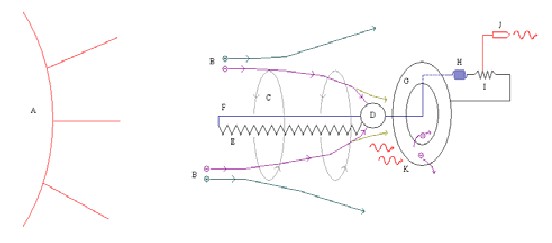
Dyson Harrop Satellte Function. Click image for the largest view.
Here’s how it works.  Looking at the diagram above you’ll see the Sun (A) emits plasma half-composed of electrons, half of protons and positive ions (B).  Electrons are diverted via the Lorentz force from a cylindrical magnetic field (C) from their radial trajectory towards the ‘Receiver’ (D), a metallic spherical shell. When the Receiver is “full”, excess electrons are diverted through the hole in the Sail. The large positive potential on the Sail drives an electron current through the ‘Pre-Wire’ (E), which is a long, folded wire designed to cancel out the magnetic fields of the current towards the Sun. Once it reaches the end of the Pre-Wire, it travels down the ‘Main Wire’ (F), creating the magnetic field (C), which makes the field-current a self-sustaining system. The current passes through a hole in the Receiver and then through the ‘Sail’ (G), passing through the ‘Inductor’ (H), and the ‘Resistor’ (I), which draws off all of the electrical power of the Satellite to the ‘Laser’ (J), which fires the electrical-turned-photonic energy off to a designated target. Drained of its electrical energy, the current continues to “fall” to the Sail (G). Here, electrons will stay until hit by appropriately-energetic photons from the Sun, at which point they will leap off (K) from the Sail towards the Sun, and then be repelled by the magnetic fields (C) and excess solar wind electrons (B) away from the Satellite, imparting kinetic energy to the Satellite away from the Sun.
A bit complicated – but way elegant and self-position supporting as well.
Because the magnetic field diverts positive particles away from the satellite and electrons toward the Receiver, the DHS remains virtually untouched by excess solar wind particles. And since the satellite ejects electrons when their current cycle is complete, even large satellites have a minimal impact on the Sun’s solar wind output.  Plus the kinetic energy from the photoelectrical ejection of electrons from the Sail provides a strong stabilizing force; in fact, it may be possible to design a satellite that can remain in a stationary position.
Sounds great – the other hand holds some major problems that could well be solvable. The DHS isn’t very efficient so its big, then so is outer space.  Being so simple and large, protection from that high-speed stuff out there is a major concern.  Staying in position while seemingly designed in has to be engineered and work.  Then the DHS doesn’t self-start – a pre charge to get it in a self-sustaining cycle needs to be provided.  Finally the DHS is going to get hot – shedding the heat is going pose an engineering task of considerable significance.
These all seem to be solvable problems, but there is one more.
One DHS could fully power humanity’s needs if the power could be brought down.  Various transmission ideas are working, but so far nothing really seizes attention as a great way to get the power down here.
When such a space energy collection system exists, the orbital photovoltaic projects will need a rethink.  Meanwhile, so much power so cheap can be its own lure. Its not such a giant leap to imagine that life off planet is much more practical if the DHS is made fully workable and redundantly reliable.  That makes ideas like life off planet would be the main while the life on the planet itself would be a privilege or a resort kind of thing.
The resources out there are stupendous and with cheap energy at hand the idea of getting to them is quite alluring.  The DHS concept is certainly one to watch – the numbers are simply too good to ignore.

More at: http://www.lpi.usra.edu/meetings/abscicon2010/pdf/5469.pdf 


From: http://nextbigfuture.com/2010/09/interview-of-david-criswell-who.html
September 01, 2010
Interview of David Criswell Who Advocates Solar Power on the Moon by Sander Olson
32Share
Ad Support : Nano Technology   Netbook    Technology News    Computer Software

Here is the David Criswell interview by Sander Olson. Dr. Criswell is an advocate of building solar power stations on the moon to generate solar power that can be beamed to the earth. Dr. Criswell believes that a series of solar power stations on the moon could be made from materials found in lunar regolith, and that these stations could continuously send electricity to earth. Such stations would only need to take up .2% of the lunar surface in order to meet the current energy needs of earth.

Question: How much continuous power does a sustainably prosperous Earth require?
Answer: Today Earth’s 6.7 billion people are provided an average of 225 watts of thermal power per person. They need at least 6,000 to 7,000 watts of thermal power per person to enable the level of power consumption and prosperity achieved by the 1 billion people in the developed nations. The developed nations are slowly converting to consuming electric power. Electric power is approximately 3 times more economically productive than thermal power. Future power systems need to provide at least 2,000 watts of electric power per person to achieve the same or greater economic output as in the developed nations. This implies 20,000,000,000,000 watts of electric power for 10 billion people. In scientific notation the power is 20•10^12 watts-electric or 20 terawatts-electric.

Most commercial power is produced today by using fossil carbon and hydrocarbons fuels to consume the oxygen of Earth’s atmosphere. The fuels and oxygen are consumed and carbon dioxide, ashes, and acids that are released lead to greenhouse heating of the biosphere and the degradation of our air, land, fresh water, and oceans. We must have a non-carbon fuel source of electricity that eliminates the use of molecules of fuels and air to generate electricity within the biosphere. The Lunar Solar Power System does this by directly and dependably collecting solar energy in space and outputting pure electric energy on Earth.

Question: What aspect of the moon makes it so advantageous for power generation?
Answer: The sunward hemisphere of the Moon dependably receives 13,000 terawatts of solar power. Capturing only a few percent of that dependable solar power and delivering it consistently as low-intensity microwaves to Earth will enable sustainable global prosperity.

All of the main resources for power generation – reliable solar power, lunar real estate, and appropriate materials - are readily available on the moon. I have examined the concept of using modified phased-array radars to transmit electrical power, and found the concept viable. It is well demonstrated that microwave power can be converted back into electric power at 90% efficiency. My research shows that generating power from the moon is at least 50 times more cost efficient than competing approaches such as large solar arrays on Earth or solar power satellites deployed to orbit about the Earth either from the Earth or from the Moon.

Question: How much of the moon would need to be covered in solar cells to deliver 20 terawatts-electric (20 TWe) to Earth and how does that vary with the efficiency of the solar cells?
Answer: Lunar Solar Power bases that employ 1980s technology and 10% efficient solar cells that occupy on 10% of the area of a power base would occupy approximately 25% of the lunar surface. The energy can be reliably provided for less than 1 cent per kilowatt-hour. LSP System bases scaled to 2020s technology, with contiguous solar arrays (35% efficient), and solar mirrors in orbit about the Moon could occupy as little as 0.2% of the lunar surface.

Question: So 20 TWe could be delivered 24/7, with no energy storage requirements?
Answer: Yes, for 24/7 operation the LSP System uses power beam relay satellites around earth. These relay satellites will transfer multiple beams down to earth.

Question: Would even the very first lunar power station be constructed out of lunar soil?
Answer: All construction and operating systems will be demonstrated on Earth prior to the first deployment to the Moon. The first LSP base components would be made from the lunar soils. LSP construction is primarily a glass-making process. For instance, fiberglass coated with metal would provide the microwave reflectors. Glass housing would be made for microwave transmitters. These would be coated with iron or aluminum, which is found in regolith. The ultrathin sheets of silicon solar cells would be created using solar power. Soon after the production of electric power on the Moon approximately 90% of mass of the machines of production on the Moon could be made out of lunar regolith.

Question: How thoroughly has this concept been tested?
Answer: Adequate solar cell technology has been available for decades. The power transmission concept does not require new technological. It simply requires scale-up of existing technologies and proven concepts, such as radar. We've been sending radar beams to space for decades with ballistic missile defense radars and to the moon with planetary radars such as the one near Arecibo, Puerto Rico. The Arecibo beam passes through the lower ionosphere at 10% of the power level recommended for beaming commercial power to Earth.

Question: Is there any danger that all of the energy sent to earth would increase earth temperatures?
Answer: This LSP System is designed and operated to be thermally neutral. The rectennas that would receive the electricity can be 80% or more transparent to sunlight. The area below them could be painted white to reflect, averaged over a year, an equal flow of sunlight back into space. Each rectenna can be thermally neutral and not contribute excess thermal power to the biosphere.

Question: Have any studies been done specifically comparing the costs of lunar power generation with alternate power sources, such as solar or nuclear?
Answer: I’ve been doing studies since 1980 comparing the costs of power generation of lunar power with competing energy generation methods. Once the system is in place, lunar power generation is clearly more cost-effective than any other approach. It can be ramped up exponentially to provide electricity without having to move molecules within the biosphere. For more details see chapter 9 of Watts, R. G. (editor) (2002) "Innovative Energy Strategies for CO2 Stabilization" Cambridge University Press

Question: Some have argued that employing solar cells on only 2% of the Sahara desert could meet all of the earth's electricity needs.
Answer: Two percent of the Sahara desert is approximately 0.2 million square kilometers. To provide worldwide 20 terawatts of terrestrial solar power would require global power lines between solar arrays located in all the major deserts, massive power storage facilities, and likely over 2 million square kilometers of solar arrays. Even this enormous system will experience power reductions due to weather and events like dust and smoke from volcanoes and regional fires. Realistic studies employing renewable technologies like wind and solar to provide 20 terawatts of electric power require similar enormous areas and will be extremely expensive. In comparison, the LSP System rectennas can output 20 TWe from 0.1 million square kilometers of land. The LSP electric power will not require the massive global power lines or power storage facilities.

Question: The costs of establishing such a solar-power infrastructure on Earth would be tiny compared to the costs of establishing a lunar infrastructure.
Answer: Renewable systems on Earth are expensive compared to coal and natural gas even though they provide only a fraction of the total commercial energy consumed in a given large region. As they are scaled up beyond 20% of local power production to be the dominant source of commercial power the cost of delivering dependable electric energy rapidly increases. That is why the installation of new wind or solar facilities stops when government subsidies are eliminated.

The world now spends over 300 billion dollars a year on oil exploration and development to maintain the global production of 85 million barrels of oil per day. The global oil industry would have to produce 1,000 million barrels of oil per day to generate 20 TWe. That will never happen. About 2 years of the global oil production cost would cover the cost of implementing the LSP System and bringing it to economic breakeven. Thereafter the LSP System would grow exponentially to provide the 20 TWe, or much more if needed. Its growth would be paid from selling the electric power on Earth. Operating costs will decrease as more electric energy is delivered to Earth. There aren't weather or clouds on the moon, so the equipment will last longer and operate more safely and reliably than similar facilities on Earth. Moreover, no energy storage facilities would be needed on the moon, since all of the electricity would be immediately sent to earth.

Your readers can email me for a recent overview paper, Enabling Sustainable & Rapidly Growing Global Wealth by Implementing the Lunar Solar Power System, that was presented in Beijing, China late May at the IAF Global Lunar Utilization Conference. [ drcriswell@comcast.net ]

Question: What is your background and how long have you been studying the concept of deriving power from the moon?
Answer: I obtained my PhD in space physics and astronomy from Rice University back in the 1960s. I worked for TRW in the 1968-1970 during the peak of the Apollo program and during the 1970s I worked at the Lunar Science Institute near the Johnson Space Center. I administrated the review of the first 3,500 proposals submitted to NASA for studies of the Moon and conducted research on lunar dust motion driven by electric fields and several other topics. In the mid 1970s I became intrigued by the concept of developing materials industries on the Moon and space-based commercial solar power. I also began collaborating with Gerard O'Neill at Princeton University and a NASA grant to study the conversion of the common lunar materials into industrial feedstocks.

Dr. Robert Waldron (deceased) and I developed the LSP System concept toward the end of the joint NASA-Department of Energy studies on space solar power satellites deployed from Earth. We asked ourselves a simple question. Why build satellites in space? The Moon exists. It is much larger than any satellite that humans could build and we knew that it had the right materials and environment to build solar collectors. I have been studying and promoting the Lunar Solar Power System concept ever since.

If you liked this article, please give it a quick review on Reddit, or StumbleUpon. Thanks

From: http://www.netnewspublisher.com/u-s-india-business-council-launches-solar-power-task-force/
U.S.-India Business Council Launches Solar Power Task Force
Posted on admin on September 6, 2010 // Leave Your Comment

U.S.-India Business Council (USIBC)The U.S.-India Business Council (USIBC) announced the launch of a major new initiative to promote U.S.-India trade and investment in the burgeoning solar power sector. Comprised of private-sector companies, the USIBC Solar Power Task Force will help to bridge the United States’ aspirations to export leading technologies, while furthering India’s goal of attaining energy security by reducing its dependence on imported coal and fossil fuels. The USIBC Solar Task Force is a subcommittee of USIBC’s Energy, Environment, Enterprise (EEE) Executive Committee, comprised of more than 100 members.

Bryan Ashley, chief marketing officer of Suniva, and Aparna Doshi, chief operating officer of Astonfield, will Co-Chair the Task Force.

“The aim of the USIBC Solar Task Force is to ensure robust cooperation – both financial and technological – between American and Indian firms participating in this vital sector, and to promote an enabling environment that will spur the application of efficient, clean solar-powered energy throughout India and the globe,” said USIBC President Ron Somers. The U.S. and India signed a memorandum of understanding in November of 2009 on Energy Security, Energy Efficiency, Clean Energy and Climate Change to intensify cooperation in energy efficiency and “green” power development. The USIBC Solar Task Force will support the two governments’ efforts to accelerate utility-scale solar deployment.

The Government of India announced the Jawaharlal Nehru National Solar Mission (JNNSM) on November 19, 2009, with more than 20,000 MW of new solar generation targeted by 2022. The breakthrough program is attempting to mitigate the impact of climate change, while promoting rural development and energy security. The Government of India seeks to become a solar power generating hub, as well as a leader in solar services and equipment. USIBC’s Solar Power Task Force will support policy formulation leading to the success of the JNNSM, providing clean energy to sustain India’s double digit growth.

In the eight months since JNNSM’s introduction, the Government of India has worked diligently to develop the supporting mechanisms to ensure execution against the program’s milestones, the first being 1100 MW of solar generation by March 2013. In order for this goal to be met, it is essential that the solar policy, associated regulatory mechanisms, and contracting relationships be commercially viable and embraced by the private sector and financial community.

The USIBC Solar Task Force will support the JNNSSM by:
            i.        Sharing regulatory and policy best practices with the Government of India and respective states that will enable India to develop into one of the largest solar power markets and facilitate the development of commercially viable solar power plants;
            ii.        Advising of the latest developments in terms of leading solar technologies and implementation practices;
            iii.        Addressing risks, removal of difficulties, and encouraging discussion between all stakeholders to promote efficient implementation of effective policies for the transparent and competitive growth of the Indian solar sector;
            iv.        Facilitating financing of solar power projects and solar equipment manufacturing in India.

Source: Business Wire


Tags: Alternative Energy, clean energy, Energy economics, india, Renewable energy commercialization, solar energy, solar equipment, solar power, Sustainable energy, U.S.-India Business Council, usibc, USIBC Solar Task Force
Leave a Reply
Click here to cancel reply.

25 September 2010

More on India USA Space Based Solar Power

Earlier I reported on the New IDSA-CFR Paper Proposing a Joint Space Solar Power Program:
http://www.idsa.in/occasionalpapers/SkysNoLimit_pgarretson_2010

http://www.cfr.org/publication/22918/skys_no_limit.html
And that it had been endorsed by the National Space Society:
http://www.nss.org/news/releases/pr20100913.pdf
I had also re-posted several articles reviewing the paper:
"India-US space-based solar power programme urged" which occurred across a number of news outlets across India, and "India-US space-based solar power plan could solve major energy issues - study" from ADP news, and "Making the Case An Indo-USA Space-Based Solar Power Programme"
By Bill Moore In EV World, and the review on the SpaceEnergy Newsletter.  Don Flournoy's piece "Why Not Space Solar Power" also amplified India's possible partnership role.
One can now also find earlier references, including this interview in the Times of India:
http://timesofindia.indiatimes.com/home/opinion/interviews/Space-based-solar-power-could-solve-energy-crisis/articleshow/4759530.cms
http://m.timesofindia.com/PDATOI/articleshow/4759530.cms
http://www.pugwashindia.org/article_detail.asp?aid=198
http://www.punemirror.in/index.aspx?Page=article&sectname=News%20-%20City&sectid=2&contentid=20090413200904130234463648ecfff86
http://www.google.com/url?sa=t&source=web&cd=4&ved=0CCoQFjAD&url=http%3A%2F%2Fwww.tifr.res.in%2F~aset%2Ffull_text%2FFT_2009%2FSpace-Based%2520Solar%2520Power--The%2520Opportunity%2520of%2520a%2520Century%2520Indian%2520Tech%2520Societies%2520(IIT%2520Madrass).pdf&rct=j&q=garretson%20india%20space%20solar%20power&ei=5BGeTM2gD4a8lQfRybDsAg&usg=AFQjCNF1CIhSehLCAwkOj6QDLHAqFTmetQ&sig2=Q3pwYCo66VmuXRE6yYBJOQ&cad=rja

Now, several New articles have appeared:
For Instance:
"Report proposes Indo US space based solar energy program by 2025" in EcoFriend
"Multilateral Space-based Solar Energy Program Led by India, US Proposed" in Scientific American & Clean Technica
"Missile Man of India" in Hollywood Issues
"New Report Asks US and India to Take Solar Energy Into Space" in CleanTechies
"American Indian Solar Space Partnership" in GreenMuze
"India-US solar power initiative urged" in Overseas Indian
"India and U.S., the future rulers of the photovoltaic space?" bnrenergia.it
"Photovoltaic space: in 2025 will start a joint program maxi USA - India?"  greenme.it
 
From: http://www.ecofriend.org/entry/report-proposes-indo-us-space-based-solar-energy-program-by-2025/
Report proposes Indo US space based solar energy program by 2025
Sukhmani | Sep 20 2010
Eco Factor: Report proposes space-based solar energy programs to meet energy needs.

A report published by an Indian Defense ministry-backed think tank has proposed the establishment of an Indo –US international space-based solar energy program. Is this ever happens it could well become the second most important deal inked by the two nations ever since the signing of the nuclear deal. The project envisages the establishment of solar collectors in geostationary orbit to collect solar radiation throughout the year even during the night. The energy laden microwaves would then be transmitted to ground based collectors. If initiated the path breaking could become a commercially viable business venture by 2025.

The massive project holds great significance for both countries apart from taking their strategic relationship forward. Both the countries have gigantic energy needs and are under immense international pressure to own up and reduce their carbon emissions. Fortunately both are blessed in terms of solar energy sources which all the more sense why they seriously work on the project.
   
https://www.scientificamerican.com/article.cfm?id=multilateral-space-based-solar-ener-2010-09
http://cleantechnica.com/2010/09/18/multilateral-space-based-solar-energy-program-led-by-india-us-proposed/
Multilateral Space-based Solar Energy Program Led by India, US Proposed
September 18, 2010 in Clean Energy, Policy, Solar Energy, Space
Mridul Chadha
Student, Environmental Engineer, Writer

A report published by an Indian Defense ministry-backed think tank has proposed for the establishment of an international space-based solar energy program with India and the United States initiating this massive project. The report is prepared by Peter Garretson, a US Air Force lieutenant colonel, working with the Institue of Defense Studies and Analyses, New Delhi. The reports calls for the Indian and the United States’ governments to extend their strategic partnerships to initiate this pathbreaking project and make the space-based solar energy a commercially viable business venture by 2025.

The report proposes that the two countries should wait no more and kick start the project through a joint statement during President Obama’s visit to India in November. The author of the report has proposed a three-tiered approach for the implementation of the program.

    Expanding on the three-stage plan, Garretson says an initial five-year $10-30 million programme will develop contributing technologies and build a competent work force culminating in a roadmap for a demonstration prototype.

    A second, $10 billion, 10-year phase will see the formation of an international consortium to construct a sub-scale space solar power system that can directly be scaled up by industry. The final stage will entail India-US leadership to set up an international for-profit consortium along the lines of the INTELSAT model to address energy security and carbon mitigation concerns.

Energy and Climate Change

Both India and the United States are among the top five greenhouse gas emitters in the world. Both are under immense pressure to curb their carbon emissions production. While India is being pressurized to cut back on its carbon emissions resulting from its rapidly growing industrial and power sector, the United States is constantly being reminded of its historical responsibility to reduce its carbon emissions.

India needs to expand its power generation capacity in order to maintain a high economic growth rate and improve the living standards of its billion plus population. While India is immensely blessed in terms of solar energy resources, the problem land availability to execute large-scale solar energy power plants is one of the major hurdles in a comprehensive solar energy infrastructure expansion.

Space-based solar power, therefore, seems to be a great choice for India. Space-based solar collectors placed in a geostationary orbit can collect solar radiation for 99 percent time of the year and even during the night. This radiation would be then transmitted to ground-based collectors in the form of microwaves. These microwaves would have far more energy than the normal radiation we receive on the earth’s surface.

Strategic Advantage

Such a project can reap tremendous scientific and strategic benefits for both the countries. India is an emerging global power especially in Asia, looking to counter China’s increasing influence and might in the region. United States is desperately looking for new partners in Asia as Japan seems no longer capable of countering China’s increasing economic, military and strategic prowess.

The Catch

The author of the report has specified that in order to ensure the successful execution of this ambitious program India would have to sign the Missile Technology Control Regime which prevents the proliferation of missile technology. India has thus far refused to sign the MTCR. Perhaps, realizing the strategic and energy-related advantages of this projects the two countries can work out a solution similar to the Indo-US nuclear deal which gave India access to nuclear fuel and technology even though it is not a signatory to the Nuclear Non-proliferation Treaty.

India and the United States have long history of space science cooperation. The United States helped the Indian Space Research Organization to help launch some of India’s earliest satellites in 1970s. Earlier this year, the two countries signed a historic agreement allowing ISRO to launch non-commercial, US-made satellites. It was NASA’s Moon Mineralogy Mapper riding on India’s first unmanned moon orbiter, Chandryaan-1, that detected the presence of water ice on the moon in 2009.

Image: NASA

The views presented in the above article are author’s personal views and do not represent those of TERI/TERI University where the author is currently pursuing a Master’s degree.
From: http://www.hollywoodissues.com/tag/council
Missile Man of India: Latest News Updates India and the US should explore the feasibility of a space-based solar power (SBSP) programme with the ultimate aim of putting in place a commercially viable system by 2025, a report by a defence ministry funded think tank says.
There is, however, a catch. India would first have to accede to the Missile Technology Control Regime (MTCR) before the system is put in place, says the report that has been prepared by Peter Garretson, a US Air Force lieutenant colonel on a sabbatical as an international fellow at the New Delhi-based Institute for Defence Studies and Analyses (IDSA).
Noting that SBSP can be ‘the next major step in the Indo-US strategic partnership’, the 174-page report says the launch of such a potentially revolutionary programme can begin with a joint statement by Prime Minister Manmohan Singh and US President Barak Obama during the latter’s visit to New Delhi in November.
Besides helping to ’solve the linked problems of energy security, development and climate change’, the SBSP will provide an opportunity for India to use its successful space programme while shaping a future peaceful space regime, Garretson said.
He has proposed a three-tiered programme, moving from basic technology and capacity building to a multi-lateral demonstrator and ultimately to an international commercial public-private-partnership entity to supply commercial power in the 2025 timeframe.
The report concludes that SBSP ‘does appear to be a good fit for the US domestic, Indian domestic and bilateral agendas, and there are adequate political space and precursor agreements to begin a bilateral program’.
Expanding on the three-stage plan, Garretson says an initial five-year $10-30 million programme will develop contributing technologies and build a competent work force culminating in a roadmap for a demonstration prototype.
A second, $10 billion, 10-year phase will see the formation of an international consortium to construct a sub-scale space solar power system that can directly be scaled up by industry. The final stage will entail India-US leadership to set up an international for-profit consortium along the lines of the INTELSAT model to address energy security and carbon mitigation concerns.
The overall program goal must be to enable, by 2025, space-based solar power as a viable economic replacement for fossil fuel energy, and second, to position the US and Indian technical and industrial bases to enjoy a competitive edge in what is expected to be a significant and profitable market,’ the report says.
Garretson says that the US and India have demonstrated via a number of recent steps that they are ready for a deeper partnership, inclusive of sensitive and strategic technology in space and energy.
‘An international SBSP demo project is within reach of present engineering and mega science budgets, and can be done with existing launch vehicles,’ he says.
From the US side, the programme can be managed out of the Department of State’s Office of Ocean Environment and Science with funds coming from the Department of Energy’s Advanced Research Projects Agency for Energy. On the Indian side, the report says, the high-level oversight can be provided by the Prime Minister’s Council on Climate Change.
According to the report, such a programme linking the technical bases of the world’s largest democracies might be a way out of India’s (and the world’s) climate-energy dilemma.
‘It will also become one of the grandest and most ambitious humanitarian and environmentalist causes that will be sure to excite a generation as did the Apollo program that put a man on the moon,’ the report says.
From: http://blog.cleantechies.com/2010/09/21/new-report-us-and-india-solar-energy-space/
New Report Asks US and India to Take Solar Energy Into Space
JustmeansPublished on Date September 21st, 2010 by Justmeans
Posted in Category Asia-Pacific, Category North America, Category Solar
Several months ago, I mentioned the Shimizu Corporation’s plan to place solar panels on the moon to generate renewable energy that would be transferred back to Earth and distributed along power lines. Shimizu Corporation’s hope was that they could begin working on their project sometime in 2020 when Japan planned to have a solar powered base upon the moon. Now, a plan coming out of India is suggesting that it is time for India and the United States to form a partnership that would allow them to begin developing a program for space solar power.

The report pushing for space based solar energy was published by a think tank that is being supported by the Indian Defense Ministry with the aid of one Lieutenant Colonel Peter Garretson of the United States Air Force. The report lays out a three step plan that would have India and the United States entered into a commercial energy business venture that would be generating large quantities of solar energy from installations placed in orbit around the Earth. The first stage, according to the report, details how an investment of $10 – $30 million over the course of five years would be required to develop the technology required for both the satellites and the means in which to deliver them to space. The second step would see a further investment of nearly $10 billion over the course of ten years as the two countries developed a system to retrieve and sell the power on a commercial and industrial scale. The final scale would have the two countries establishing what the report calls an “international for-profit consortium … to address energy security and carbon mitigation concerns.” This would result in a fully realized program, ideally, by 2025.

The research and the proposed program for solar energy are mired in a variety of political obstacles. While the creation of a large scale solar program like this would go far in aiding India in cutting down on carbon emissions without taking up already precious city space they would be required to sign the Missile Technology Control Regime treaty. The agreement, which was signed in 1987 by several nations to prevent the proliferation of missile technology, has long been refused by India. The report also indicates that it would be necessary to coordinate their efforts with the United Nations and other countries in order to prepare for the increased amount of travel that would be going to and from Earth as a consequence of initiating this program. Though the political issues remain, the people involved are confident they would be easy to remedy and are optimistic that an agreement can be made between India and the United States regarding this program in November when President Obama plans to meet with Prime Minister Manmohan Singh.

Though some may be concerned that tossing more satellites into Earth’s orbit would be contributing to the already crowded situation going on up there, the fact remains that this would be a considerable leap forward for solar energy. Taking solar energy collection into space also presents an ideal alternative to countries like India or Japan who are faced with the obstacle of limited space within their nations for the construction of vast solar farms. With any luck, the next news we may hear about this project may come in November during the aforementioned visit.

Article by Richard Cooke, appearing courtesy Justmeans.

From:
American Indian Solar Space Partnership
Wednesday, 22 September 2010 GreenMuze Staff

An Indian Defense Ministry-backed report suggests a joint US$10 billion (€7.65 billion) Indian-US space based solar power generation program would be good for political relations as well as reducing greenhouse gases. US Air Force lieutenant colonel Peter Garretson, in conjunction with the Institute of Defense Studies, New Delhi (India), wrote a report recommending the Indian and US governments forge a strategic partnership to make space-based solar energy commercially viable by 2025. President Obama’s November visit to India may be the venue to announce the partnership.

The proposal is to have a five year pre-program development program, costing US$10-30 million (€7.65 - €22.96 million) to eliminate risk and to identify the advanced technology needed for the project. Followed by a US$10 billion (€7.65 billion), ten year international project to design, manufacture, and launch an orbital solar power generation system.

Since India and the US are both major greenhouse gas emitters, developing technology that will reduce their emissions is seen as a progressive approach to dealing with climate change. India has great solar power potential but scarce land areas to implement it, while the US would like to be a world leader in the renewable energy and, being a late entrant in the field, needs to play catch up.

A space-based system therefore seems to fit into the plans of both countries. For India, it is a potential major international step up, and a great opportunity to grow in stature in Asia, and counter China’s growing influence. Unfortunately, politics always gets in the way, and India has yet to sign the Missile Technology Control Regime, meant to prevent the spread of missile technology. The US is concerned about the spread of nuclear weapons technology (such as from Pakistan to North Korea) and nuclear weapons delivery systems.

In a world facing great uncertainty due to the causes, effects and consequences of global climate change, it seems the last thing that we need is to add in global politics that are likely to muddy the waters and likely add greater risk of projects failing to deliver on their clean energy promises.

From: http://overseasindian.in/2010/sept/news/20101409-095018.shtml
India-US solar power initiative urged

Bengaluru, Sep 14 India and the U.S. should explore the feasibility of a space-based solar power (SBSP) programme with the ultimate aim of putting in place a commercially viable system by 2025, a report by a Defence Ministry funded think tank says.

There is, however, a catch. India would first have to accede to the Missile Technology Control Regime (MTCR) before the system is put in place, says the report that has been prepared by Peter Garretson, a US Air Force lieutenant colonel on a sabbatical as an international fellow at the New Delhi-based Institute for Defence Studies and Analyses (IDSA).

Noting that SBSP can be "the next major step in the Indo-US strategic partnership", the 174-page report says the launch of such a potentially revolutionary programme can begin with a joint statement by Prime Minister Dr. Manmohan Singh and U.S. President Barak Obama during the latter's visit to New Delhi in November.

Besides helping to "solve the linked problems of energy security, development and climate change", the SBSP will provide an opportunity for India to use its successful space programme while shaping a future peaceful space regime, Garretson said.

He has proposed a three-tiered programme, moving from basic technology and capacity building to a multi-lateral demonstrator and ultimately to an international commercial public-private-partnership entity to supply commercial power in the 2025 timeframe.

The report concludes that SBSP "does appear to be a good fit for the U.S. domestic, Indian domestic and bilateral agendas, and there are adequate political space and precursor agreements to begin a bilateral programme".

Expanding on the three-stage plan, Garretson says an initial five-year $10-30 million programme will develop contributing technologies and build a competent work force culminating in a roadmap for a demonstration prototype.

A second, $10 billion, 10-year phase will see the formation of an international consortium to construct a sub-scale space solar power system that can directly be scaled up by industry. The final stage will entail India-US leadership to set up an international for-profit consortium along the lines of the INTELSAT model to address energy security and carbon mitigation concerns.

"The overall program goal must be to enable, by 2025, space-based solar power as a viable economic replacement for fossil fuel energy, and second, to position the US and Indian technical and industrial bases to enjoy a competitive edge in what is expected to be a significant and profitable market," the report says.

Garretson says that the U.S. and India have demonstrated via a number of recent steps that they are ready for a deeper partnership, inclusive of sensitive and strategic technology in space and energy.

"An international SBSP demo project is within reach of present engineering and mega science budgets, and can be done with existing launch vehicles," he says.

From the US side, the programme can be managed out of the Department of State's Office of Ocean Environment and Science with funds coming from the Department of Energy's Advanced Research Projects Agency for Energy. On the Indian side, the report says, the high-level oversight can be provided by the Prime Minister's Council on Climate Change.

According to the report, such a programme linking the technical bases of the world's largest democracies might be a way out of India's (and the world's) climate-energy dilemma.

"It will also become one of the grandest and most ambitious humanitarian and environmentalist causes that will be sure to excite a generation as did the Apollo program that put a man on the moon," the report says.

"If there is a desire to pursue simultaneous development of low cost access to orbit, then the Missile Technology Control Regime (MTCR) assurance document must be signed (by India)," the report says.

India has thus far resolutely declined to sign the MTCR, terming it discriminatory.

It is also important that direct engagement with United Nations governance bodies will be required, even before the demonstration stage, "to cope with the significantly increased traffic to and from and in space", the report says.

 From: http://translate.google.com/translate?hl=en&sl=it&u=http://www.bnrenergia.it/leggi_news.asp%3Fid%3D1208&ei=CxWeTLuWOsKBlAfK94CnCg&sa=X&oi=translate&ct=result&resnum=7&ved=0CEUQ7gEwBg&prev=/search%3Fq%3Dindia%2BUS%2Bspace%2Bsolar%2Bpower%2Bsite:.it%26hl%3Den%26lr%3D%26client%3Dfirefox-a%26hs%3D4iC%26rls%3Dorg.mozilla:en-US:official%26tbs%3Dqdr:m
India and U.S., the future rulers of the photovoltaic space?

A new brick could be added to the long history of scientific cooperation between two of the biggest polluters in the world.  A report published by the Indian Ministry of Defence suggests that the two countries can pave the way for a program to use solar energy in orbit
 (Rinnovabili.it) - A great opportunity for collaboration and growth in the energy is introduced to India and the U.S. to jointly launch a program to capture solar energy in space to be transformed into a commercially viable by 2025 . To support and the report compiled by Peter Garretson, a U.S. Air Force lieutenant colonel who worked in collaboration with the Institute for Research and Defense Analysis in New Delhi.
The report calls on the governments of both countries to extend their strategic partnership, already well proven in the field of an astronaut on a pioneering project to harness the solar energy in space.  A program that dell'SBSP (Space-Based Solar Power), truly revolutionary not only for bilateral relations between India and the United States but for all the objectives of energy security, supply and fight against Climate Change in it. Both, in fact, affected by the pressure from several fronts on the production of greenhouse gas emissions and seek new and innovative sources of clean energy supply has become the 'gold rush' of these years
 The authors are also firmly convinced that the program provides the opportunity to win New Delhi to move forward in its perpetual competition with China.
The idea contained in 174 pages is that which is already the currency
 Japan

Pacific Gas & Electric Pacific Gas & Electric
 Position in geostationary orbit solar collectors can gather solar radiation, 24 h 24 h with an efficiency much higher than the unitary ground installations, and then be sent back to earth via microwaves.
Garretson proposes a three-level, through the development of technology demonstrator based on a multi-lateral, to the creation of an international body based on a public-private partnership for commercial energy supply by the year 2025.
For the Asian giant, however, there is an obstacle, well outlined in the report, the failure to adhere to the Missile Technology Control Regime (MTCR) - India considered discriminatory -, however, a delicate issue at the international level.  Once approved, the MTCR, the author explains, the operation of the program would require "only" an initial funding in the order of 10-30 million dollars to cover a period of 5 years and 10 billion dollars for the next decade .

From: http://translate.google.com/translate?hl=en&sl=it&u=http://www.greenme.it/informarsi/energie-rinnovabili/3080-fotovoltaico-spaziale-nel-2025-partira-un-maxi-programma-congiunto-usa-india&ei=CxWeTLuWOsKBlAfK94CnCg&sa=X&oi=translate&ct=result&resnum=10&ved=0CE8Q7gEwCQ&prev=/search%3Fq%3Dindia%2BUS%2Bspace%2Bsolar%2Bpower%2Bsite:.it%26hl%3Den%26lr%3D%26client%3Dfirefox-a%26hs%3D4iC%26rls%3Dorg.mozilla:en-US:official%26tbs%3Dqdr:m

Photovoltaic space: in 2025 will start a joint program maxi USA - India?

Martedì 21 Settembre 2010 15:11 Scritto da Piergiorgio Pescarolo Tuesday, September 21, 2010 15:11 Written by Piergiorgio Pescarolo

fotovoltaico_spaziale

Allies in a big program calendar to be launched into space by 2025.  . E 'can be the result of a technical partnership to address eco friendly between India and U.S. , and which would, in fifteen years, creating a system of commercial exploitation of space photovoltaics .
He informed these days, a report conducted by Peter Garretson , Lieutenant-Colonel 's U.S. Air Force, who worked together to' study for the Institute for Defense Analyses and New Delhi, on the development a joint project between the two powers. More specifically, the report indicates a request to be made to both governments (India and the USA) to verify the conditions for the extension of a partnership in exploiting the ' solar energy in space for which has already been identified Name: SBSP ( Space-Based Solar Power ).

On a technical level, the project includes the placement of solar collectors in geostationary orbit, which are able to capture the sun's radiation, and send them to Earth via a microwave system. The procurement, in that case, would be constant (24 hours out of 24) and lead to significantly higher efficiency when compared with terrestrial plants.

 This would be an extension of the strategic alliance already in place in the field of aerospace, and which - if implemented - could prove to be innovative in the political relationship between the U.S. and India, and for the purposes ecologic and contained in the report: in it, In fact, we speak of the need for energy security of supply and climate change all "voices" to which both countries should take into account.  If for no other reason than the economic aspect of the matter: the field of research and development in renewable energy is the most important frontier in the economy in recent years.

The "Indian side," however, will be prejudiced by not adhering to the Missile Technology Control Plan (MTCR - Missile Technology Control Regime), India believes that it is discriminatory and that, internationally, an issue to be addressed carefully.

Lieutenant Colonel Garretson, however, assumed - once past this obstacle - even the need for financial supply for the project: a first tranche of funding (albeit nebulous, since it indicates an amount ranging from 10 to 30 million dollars) for the first 5 years, and a second appropriation (listed in the $ 10 billion) would cover the next decade.

Piergiorgio Pescarolo Piergiorgio Pescarolo