Showing posts with label Space Solar Power. Show all posts

24 April 2015

CALTECH beats MIT -- Too much Ivy on the launch pad

At least with regard to this old rivalry it is clear to the space and energy community who has the bigger vision and ambition as of today! (http://blog.nss.org/?p=4727)

A bit surprising since MIT has been in the lead, with a 2007 workshop, and their relationship with Masdar in the UAE where there is apparently strong interest in Space Solar Power from its visionary leader His Highness Sheikh Mohammed bin Rashid Al Maktoum.  It could have been MIT making these headlines...and imagine the progress that little engineering school could have made in that time.

Looks like the NE school has ceded the final frontier to their West-coast rival where the Silicon Valley space billionaires reside. 

What's that famous energy mantra?...."Burn baby burn"

MIT Space Solar Power Workshop
Photo
May 14-16, 2007
Sponsored by: MIT Technology and Development Program
Leading experts from industry, government, and academia participated in this two day workshop motivated by the pressing need to develop alternative clean renewable energy supplies. The group agreed that exploring alternative energy sources (wind, hydro-electric, terrestrial solar power, geothermal, and bio-fuels) as well as promoting conservation are high priorities. And it stressed that space solar and existing sources of power are not competitors.
Working groups:
  • Space Systems Technology for Space Solar Power
  • Solar Energy Technology: Terrestrial vs. Space Solar Power
  • Economics, the Environment, Public Policy, and Legal Issues
  • Integration Strategies
Each working group discussed many topics, including: the advantages of space solar power, technical unknowns and challenges, what research needs to be done, and what issues are unresolved.
The Future Cannot Be Sustained by Present Technologies
Workshop participants concluded that the United States, Japan, and Europe must take the lead in Space Solar Power, but acceptance and active participation by developing countries is essential. Awareness of Space Solar Power must be increased, a goal this group and others may pursue with future workshops and initiatives.
For list of program committee members and participants, visit: http://web.mit.edu/space_solar_power/index.html

03 March 2012

Space Solar Power Article in Strategic Studies Quarterly (SSQ)

http://www.au.af.mil/au/ssq/2012/spring/garretson.pdf

Here is just the opening:

Solar Power in Space?
Peter Garretson, Lieutenant Colonel, USAF

Whoever takes the lead in the development and utilization of clean
and renewable energy and the space and aviation industry will be
the world leader.
—Prof. Wang Xiji, Chinese space program pioneer

Space-based solar power (SBSP) is a concept for a revolutionary energy system. It involves placing into orbit stupendously large orbital power plants—kilometers across—which collect the sun’s raw energy and beam it down to where it is needed on the earth. In theory, SBSP could scale to meet all of humanity’s energy needs, providing virtually unlimited green, renewable power to an energy-hungry world.

Most renewable energy schemes sufer from intermittency and low energy density, requiring vast amounts of land and extensive storage as well as fossil fuel backup systems. Not so with SBSP systems. When placed in orbit where the sun shines constantly, they can deliver stable, uninterrupted, 24-hour, large-scale power to the urban centers where the majority of humanity lives. A network of thousands of solar-power satellites (SPS) could provide all the power required for an Earth-based population as large as 10 billion people, even for a fully developed “irst world” lifestyle but without the environmental downsides of nuclear or coal.

Should space-based solar power have a role in the US grand strategy for space? Should Airmen advocate for a US program in SBSP? Depend­ing on your viewpoint, SBSP is either the most important space project of our generation—critical to securing American long-term interests and requiring the advocacy of Airmen—or a fool’s errand, an impossible dream threatening to divert valuable resources from where they are most needed today

30 November 2011

Three Space Solar Power Videos

Mke Snead's New Video


The IAA Press Conference


The Georgia Tech Space Power Grid Idea

16 November 2011

Google Top News Story Status "Space Solar Power IAA " as of ~10:30 pm EST


Full coverage

Orbital solar panels could resolve all power needs

The Daily Star - ‎3 hours ago‎
The study said government pump-priming likely would be needed to get the concept, known as space solar power, to market. Private-sector funding is unlikely to proceed alone because of the “economic uncertainties” of the development and demonstration ...

Solar satellite plan blasts fossil fuels with eco-laser

SlashGear - ‎3 hours ago‎
This project notes that the space solar power solution would be a long-term energy fix for Earth that would include a potential for “essentially zero” terrestrial environmental impact. The study's environmental impact bit is according to the National ...

Scientists Predict Giant Orbiting Power Plants CouldPower the Earth by 2041

Inhabitat - ‎4 hours ago‎
Solar power has been studied and tested for nearly 40 years, but only within the last few years have we seen innovations truly make leaps and bounds. Looking towards the future, scientists are now saying with the technology we ...

Tomorrow's energy will come from space based solarstations, no later than 2016

ZME Science - ‎6 hours ago‎
Space solar stations are not a new idea at all – they have been researched since the 1970; but as years pass, scientists understand more and more the numerous benefits this type of technology could bring – a true revolution in renewable energy...

Space-based solar power collectors possible in twenty years

Geek.com - ‎6 hours ago‎
It would also cut down on fossil fuel emissions since solar is “clean” energy. Critics of the study say that the IAA didn't do broad enough research, or an accurate cost analysis in its findings. They are afraid that the cost of development is still ...

Space Lasers! (for Clean Energy, Obviously)

CleanTechnica - ‎8 hours ago‎
Orbiting solar power stations have been a continuous source of debate for decades – someone always brings up the idea of power plants IN SPACE and it always gets shot down as being unfeasible. (What's not realistic about having energy beamed down from...

Enormous orbiting solar raygun power plants touted

Register - ‎8 hours ago‎
NASA's former head of concepts John Mankins (now head of Artemis Innovation Management Solutions of California) is quoted as saying “solar power derived fromspace could play a tremendously important role in meeting the global need for energyduring ...

Giant orbiting power plants could harvest the sun'senergy to provide world's ...

Mail on Sunday - ‎9 hours ago‎
The study said government money would probably be needed to get the concept, known as space solar power, to market. Private-sector funding is unlikely to proceed alone because of the 'economic uncertainties' of the development, it said. ...

Giant orbiting power plants could harvest the sun'senergy to provide world's ...

Daily Mail - ‎10 hours ago‎
The study said government money would probably be needed to get the concept, known as space solar power, to market. Private-sector funding is unlikely to proceed alone because of the 'economic uncertainties' of the development, it said. ...

Giant orbiting power plants could harvest the sun'senergy to provide world's ...

Daily Mail - ‎10 hours ago‎
The study said government money would probably be needed to get the concept, known as space solar power, to market. Private-sector funding is unlikely to proceed alone because of the 'economic uncertainties' of the development, it said. ...

Spaced based solar power stations of the future

The Economic Voice - ‎12 hours ago‎
This will be a 1 kilometre wide free floating Mylar mirror, which will focus the sun's rays onto a smaller mirror aimed at solar panels. They hope to have it in place by 2016. The Japanese also hope to have their version of a space based solar energy ...

Energy of the Future: Spaced Based Solar Stations

OilPrice.com - ‎13 hours ago‎
Space based solar power stations are not a new idea, in fact they have been researched since the 1970's. Back in 2009 the Californian state regulators granted approval to the Pacific Gas & Electric Co. and Solaren Corp. to start creating a solarbased ...

Orbital solar plants could power Earth

Mumbai Mirror - ‎14 hours ago‎
The study said government pump-priming likely would be needed to get the concept, known as space solar power, to market. Private-sector funding is unlikely to proceed alone because of the “economic uncertainties” of the development and demonstration ...

Space solar power station possible within three decades – IAA

EcoSeed - ‎15 hours ago‎
The International Academy of Astronautics has completed the first international study looking into whether collecting solar energy out in space is possible. While it found that the idea of a space solar power or SSP system is technically feasible ...

IAA says 'Yes We Can' to power plants in orbit

PhysOrg.com - ‎17 hours ago‎
The IAA's three-year, ten-nation study, as the first broadly based international assessment of collecting solar energy in space, is considered significant. The study was conducted from 2008 to 2010 and was under peer review. John Mankins, the former...

Could space lasers deliver clean energybreakthrough?

Environmental Expert (press release) - ‎22 hours ago‎
Orbiting solar power stations could meet much of the world's energy requirements within 30 years, according to a major new study to be released later today. The report from the International Academy of Astronautics, an advanced copy of which was ...

Orbital solar power plants touted for energy needs

TODAYonline - ‎Nov 14, 2011‎
The concept, known as space solar power, is a potential long-term energy solution for Earth with "essentially zero" terrestrial environmental impact, according to the National Space Society, an advocacy group that was set to publicise the study at a ...

Exclusive: Orbital solar power plants touted forenergy needs

ECNmag.com - ‎Nov 14, 2011‎
The study said government pump-priming likely would be needed to get the concept, known as space solar power, to market. Private-sector funding is unlikely to proceed alone because of the "economic uncertainties" of the development and demonstration ...

Orbital solar plants could help solve Earth's energycrisis

Globe and Mail - ‎Nov 14, 2011‎
The study said government pump-priming likely would be needed to get the concept, known as space solar power, to market. Private-sector funding is unlikely to proceed alone because of the “economic uncertainties” of the development and demonstration ...

Orbital solar power plants could meet Earth's energyneeds

msnbc.com - ‎Nov 14, 2011‎
The study said government pump-priming likely would be needed to get the concept, known as space solar power, to market. Private-sector funding is unlikely to proceed alone because of the "economic uncertainties" of the development and demonstration ...

Solar Power in Orbit

Energy and Capital - ‎Nov 14, 2011‎
According to the report, which will be made public at a conference in Washington on Monday, the most effective way to obtain solar power would be in space. The report shows that within 30 years it could be possible to power the globe this way. ...

Orbital solar power plants touted for energy needs

Mother Nature Network - ‎Nov 14, 2011‎
The study said government pump-priming likely would be needed to get the concept, known as space solar power, to market. Private-sector funding is unlikely to proceed alone because of the "economic uncertainties" of the development and demonstration ...

Orbiting stations would harvest sun's energy

Vancouver Sun - ‎Nov 14, 2011‎
The study said government pump-priming likely would be needed to get the concept, known as space solar power, to market. Private-sector funding is unlikely to proceed alone because of the "economic uncertainties" of the development and demonstration ...

Spacesolar power's next frontier?

SmartPlanet.com (blog) - ‎Nov 14, 2011‎
Private companies have also latched onto the idea of space based solar power. Solaren Corp. struck a deal with Pacific Gas & Electric to begin supplying PG&E with celestial solar energy in 2016. Under IAA's proposal, satellites would be positioned in...

Orbital solar power plants touted for energy needs

DAWN.com - ‎Nov 14, 2011‎
The study said government pump-priming likely would be needed to get the concept, known as space solar power, to market. Private-sector funding is unlikely to proceed alone because of the “economic uncertainties” of the development and demonstration ...

Could space lasers deliver clean energybreakthrough?

Business Green - ‎Nov 14, 2011‎
According to Reuters, the paper provides little precise detail on how the technology could be deployed, nor on the estimated cost of new solar power stations, each of which would be several kilometres across. However, it does state that space solar ...

Orbital solar power plants touted for energy needs

BusinessLIVE - ‎Nov 14, 2011‎
The study said government pump-priming likely would be needed to get the concept, known as space solar power, to market. Private-sector funding is unlikely to proceed alone because of the "economic uncertainties" of the development and demonstration ...

Harvesting sun's power in space 'feasible': study

Calgary Herald - ‎Nov 14, 2011‎
"It is clear that solar power delivered from space could play a tremendously important role in meeting the global need for energy during the 21st century," according to the study led by John Mankins, a 25-year NASA veteran and the US space agency's ...

Harnessing the power of the sun

Independent Online - ‎Nov 14, 2011‎
The study said government pump-priming likely would be needed to get the concept, known as space solar power, to market. Private-sector funding is unlikely to proceed alone because of the “economic uncertainties” of the development and demonstration ...

Space solar power can solve energy crisis

Khaleej Times - ‎Nov 13, 2011‎
The study was billed as the first broadly based international assessment of potential paths to collecting solar energy in space and delivering it to markets on Earth via wireless power transmission. The study said government pump-priming likely would ...

Space solar power touted for energy needs

ABC Online - ‎Nov 13, 2011‎
Orbiting solar panels Harvesting the Sun's energy from space could provide a cost-effective way to meet global power needs in as little as 30 years, says an international scientific group. Orbiting power plants capable of collecting solar energy and ...

Giant solar space panels tipped to power cars, homes of future

Irish Independent - ‎Nov 13, 2011‎
SCIENTISTS are working on a revolutionary plan to supply the world's energy needs by building solar power stations in space. Orbiting power plants capable of collectingsolar energy and beaming it to Earth will be "technically ...

Orbital solar power plants touted for energy needs

Bangladesh News 24 hours - ‎Nov 13, 2011‎
The study said government pump-priming likely would be needed to get the concept, known as space solar power, to market. Private-sector funding is unlikely to proceed alone because of the "economic uncertainties" of the development and demonstration ...

Orbital solar plants 'can solve energy crisis'

Gulf Daily News - ‎Nov 13, 2011‎
It said government pump-priming likely would be needed to get the space solar powerconcept to market. Private-sector funding is unlikely to proceed alone because of the "economic uncertainties" of the development and demonstration phases and the time ...

Orbital Solar Power Plants Touted for Energy Needs

International Business Times - ‎Nov 13, 2011‎
The study said government pump-priming likely would be needed to get the concept, known as space solar power, to market. Private-sector funding is unlikely to proceed alone because of the "economic uncertainties" of the development and demonstration ...

Orbital solar power plants touted for energy needs

Arab News - ‎Nov 13, 2011‎
The study said government pump-priming likely would be needed to get the concept, known as space solar power, to market. Private-sector funding is unlikely to proceed alone because of the “economic uncertainties” of the development and demonstration ...

Orbital solar power plants touted for energy needs

The News International - ‎Nov 13, 2011‎
The study said government pump-priming likely would be needed to get the concept, known as space solar power, to market. Private-sector funding is unlikely to proceed alone because of the "economic uncertainties" of the development and demonstration ...

Orbital solar power plants touted for energy needs

Vision Insights and New Horizons - ‎Nov 13, 2011‎
The study said government pump-priming likely would be needed to get the concept, known as space solar power, to market. Private-sector funding is unlikely to proceed alone because of the "economic uncertainties" of the development and demonstration ...

Exclusive - Orbital solar power plants touted forenergy needs

Reuters UK - ‎Nov 13, 2011‎
The study said government pump-priming likely would be needed to get the concept, known as space solar power, to market. Private-sector funding is unlikely to proceed alone because of the "economic uncertainties" of the development and demonstration ...

Orbital solar power plants touted for energy needs

Khaleej Times - ‎Nov 13, 2011‎
The study said government pump-priming likely would be needed to get the concept, known as space solar power, to market. Private-sector funding is unlikely to proceed alone because of the “economic uncertainties” of the development and demonstration ...

Exclusive: Orbital solar power plants touted forenergy needs

Reuters UK - ‎Nov 13, 2011‎
The study said government pump-priming likely would be needed to get the concept, known as space solar power, to market. Private-sector funding is unlikely to proceed alone because of the "economic uncertainties" of the development and demonstration ...

Exclusive: Orbital solar power plants touted forenergy needs

CNBC.com - ‎Nov 13, 2011‎
The study said government pump-priming likely would be needed to get the concept, known as space solar power, to market. Private-sector funding is unlikely to proceed alone because of the "economic uncertainties" of the development and demonstration ...

EXCLUSIVE-Orbital solar power plants touted forenergy needs

Reuters AlertNet - ‎Nov 13, 2011‎
The study said government pump-priming likely would be needed to get the concept, known as space solar power, to market. Private-sector funding is unlikely to proceed alone because of the "economic uncertainties" of the development and demonstration ...

Exclusive: Orbital solar power plants touted forenergy needs

Reuters India - ‎Nov 13, 2011‎
The study said government pump-priming likely would be needed to get the concept, known as space solar power, to market. Private-sector funding is unlikely to proceed alone because of the "economic uncertainties" of the development and demonstration ...

Orbital solar power plants touted for energy needs

Kyiv Post - ‎Nov 13, 2011‎
The study said government pump-priming likely would be needed to get the concept, known as space solar power, to market. Private-sector funding is unlikely to proceed alone because of the "economic uncertainties" of the development and demonstration ...

15 November 2011

Outstanding Article from Reuters!

One must ask the natural question: Now that this IAA study is out, how will the Congress and Executive Branch follow up?

Check out this outstanding exclusive from Reuters (I've highlighted an excerpt below):

Go to for the full article: http://www.newsdaily.com/stories/tre7ac0j1-us-space-energy-solar/


Exclusive: Orbital solar power plants touted for energy needs
By Jim Wolf  Posted 2011/11/13 at 8:16 am EST

WASHINGTON, Nov. 13, 2011 (Reuters) — The sun's abundant energy, if harvested in space, could provide a cost-effective way to meet global power needs in as little as 30 years with seed money from governments, according to a study by an international scientific group.

Orbiting power plants capable of collecting solar energy and beaming it to Earth appear "technically feasible" within a decade or two based on technologies now in the laboratory, a study group of the Paris-headquartered International Academy of Astronautics said.

Such a project may be able to achieve economic viability in 30 years or less, it said, without laying out a road map or proposing a specific architecture.

"It is clear that solar power delivered from space could play a tremendously important role in meeting the global need for energy during the 21st century," according to the study led by John Mankins, a 25-year NASA veteran and the U.S. space agency's former head of concepts.

The academy is headed by Madhavan Nair, former chairman of the Indian Space Research Organization. The study was billed as the first broadly based international assessment of potential paths to collecting solar energy in space and delivering it to markets on Earth via wireless power transmission.

The study said government pump-priming likely would be needed to get the concept, known as space solar power, to market. Private-sector funding is unlikely to proceed alone because of the "economic uncertainties" of the development and demonstration phases and the time lags, the study said.

Both governments and the private sector should fund research to pin down the economic viability of the concept, the study said, amid concerns about humankind's continuing reliance on finite fossil fuels that contribute to global pollution.

The study did not estimate a potential overall price tag for completing the project.

Space solar power is a potential long-term energy solution for Earth with "essentially zero" terrestrial environmental impact, according to the National Space Society, an advocacy group set to hold a news conference in Washington on Monday to publicize the academy's 248-page final report.

A copy of the study was obtained by Reuters ahead of its release.

TURN SUNLIGHT INTO ELECTRICITY

The idea is to put first one, then a few, and later scores of solar-powered satellites in geosynchronous orbit over the equator. Each as wide as several kilometers across (one kilometer equals 0.6 miles), the spacecraft would collect sunlight up to 24 hours a day, compared with half that, at most, for surface panels now used to turn sunlight into electricity.

The power would be converted to electricity on-board and sent to wherever it is needed on Earth by a large microwave-transmitting antenna or by lasers, then fed into a power grid.

Skeptics deem the concept a nonstarter, at least until the cost of putting a commercial power plant into orbit drops by a factor of 10 or more. Other hurdles include space debris, a lack of focused market studies and high development costs.

The study, conducted from 2008 to 2010 then subjected to peer review, found that the commercial case had substantially improved during the past decade, partly as a result of government incentives for nonpolluting "green" energy systems.

A pilot project to demonstrate the technology even as big as the 400-tonne International Space Station could go ahead using low-cost expendable launch vehicles being developed for other space markets, Mankins said in a telephone interview.

A moderate-scale demonstration would cost tens of billions of dollars less than previously projected as a result of not needing costly, reusable launch vehicles early on, said Mankins, president of Artemis Innovation Management Solutions LLC, a California consultancy.

"This was a really important finding," Mankins said, referring to a relatively modestly priced pilot project.

'IT'S A START'

His company has been awarded a NASA contract of a little less than $100,000 to pursue space-based solar power options -- small "but at least it's a start," Mankins said.

Ultimately, tens of billions of dollars would be needed to develop and deploy a sufficiently low-cost fleet of reusable, earth-to-orbit vehicles to launch full-scale commercial solar power satellites, the study group estimated.

The group said the necessary research and development work should be undertaken by countries and organizations in concert, including space agencies, companies, universities and nongovernmental organizations.

International interest in the concept has grown during the past decade, spurred in part by fears that in coming decades global production of petroleum and possibly other fossil fuels will peak and start to decline.

Adding to a quest for new energy sources are projected jumps in worldwide per capita demand for energy to fuel economic development and concern over the accumulation in Earth's atmosphere of fossil fuel-derived greenhouse gases.

The idea of harnessing solar power in space has been studied off and on for 40 years, including by the U.S. Energy Department and NASA.

U.S. and Indian business, policy and national security analysts in September called for a joint U.S.-Indian feasibility study on a cooperative program to develop space-based solar power with a goal of fielding a commercially viable capability within two decades.

The study group, co-sponsored by the Council on Foreign Relations think tank and Aspen Institute India, included former U.S. Director of National Intelligence Dennis Blair and Naresh Chandra, a former Indian ambassador to the United States.

Colonel Michael Smith, the U.S. Air Force's chief futurist as director of the Center for Strategy and Technology at Maxwell Air Force Base in Alabama, said the idea has the potential to send safe, clean electrical energy worldwide "if we can make it work."

"Isn't that what government and industry should be working to do?" he said in a telephone interview.

Jeff Peacock, who heads satellite-builder Boeing Co's ground-based solar cell product line, said in theory it could double the amount of solar power collected, compared with the Earth-bound technology equivalent.

(Editing by Will Dunham)

01 November 2010

AN ALERT TO A SIGNIFICANT EVENT OF VITAL INTEREST TO INDIA-US RELATIONS


---------- Forwarded message ----------
From: Ram Narayanan 
Date: Mon, Nov 1, 2010 at 10:55 AM
Subject: AN ALERT TO A SIGNIFICANT EVENT OF VITAL INTEREST TO INDIA-US RELATIONS
To:

Dear Friends:

On October 10, 2010, I had sent you a message titled, "A POSSIBLE BIG TICKET ITEM FOR THE OBAMA VISIT."

It had focused on a landmark 160-page paper on "Sky’s no limit: Space-based Solar Power, the next major step in the Indo-US Strategic Partnership," published by India’s Institute for Defence Studies and Analyses (IDSA).

According to the Washington-based National Space Society, the paper was sponsored by the US-based Council on Foreign Relations (CFR), and represents 16 months of in-country research by a member of the National Space Society, Peter Garretson, to examine the possibilities of Indo-US cooperation in space and renewable energy.

The paper "examines the relevance of Space-Based Solar Power, a highly scalable, revolutionary, renewable energy technology in the context of the Indo-US strategic partnership. After providing an overview of the concept and its significance to the compelling problems of sustainable growth, economic development, energy security and climate change, it evaluates the utility of the concept in the context of respective Indian and US political context and long-term energy-climate trajectories. The paper examines multiple models of potential cooperation, and ultimately concludes that a bilateral initiative to develop Space-Based Solar Power is highly consistent with the objectives of the Indo-US strategic partnership, and ultimately recommends an actionable three-tiered program to realize its potential."

Gary Barnhard, Executive Director of the National Space Society, said, "This is a serious effort to articulate an agenda for Indo-US strategic partnership in space cooperation, clean energy, and climate change. This is a truly ambitious proposal that could top the Indo-US ’123’ civil nuclear deal in scope and significance. It’s timing right before President Obama’s visit could not be better, and we hope those developing his agenda are paying attention. Our hat is off to IDSA and CFR for sponsoring such visionary work in the policy realm that is likely to advance the interests of the United States, India, and the world. We are taking its recommendations very seriously in formulating our own initiative."
This is to alert you to a major press conference scheduled for, Thursday, November 4, 2010 hosted by the National Space Society (NSS) at the National Press Club to reveal one of the first initiatives ever undertaken by a non-profit American organization and a former head of state. That initiative pairs India’s eleventh President, Dr. A.P.J. Abdul Kalam with America’s National Space Society. Its name? The Kalam-NSS Energy Initiative.

The press conference will be held at the National Press Club, 529 14th St. NW, 13th Floor, Bloomberg Room in Washington DC. It will begin at 9:30 AM and conclude by 11:00 AM.

Free continental breakfast will be available
.

A quote that Dr. Kalam, former President of India, wrote for the press conference is given below. Dr. T. K. Alex and John Mankins will be participating in the press conference via speaker phone from India and California respectively. They will both be making statements and answering questions. It has just been announced that Dr Abdul Kalam will also be present by phone.

Dr. T. K. Alex is the Director of the Indian Space Research Organization (ISRO) Satellite Centre, Bangalore. The most important project that was led by him was Chandrayaan-1, the first Indian mission to the Moon, which resulted in the famous discovery of water on Moon’s surface. Now he is guiding and directing the development of Chandrayaan-2 and sixteen new Indian satellites.

John Mankins is the world’s leading expert on Space Solar Power (SPS). He was in charge of the last major study of SPS by America’s National Aeronautics and Space Administration (NASA).
I am told all are welcome to the press conference. If you live in or near Washington DC, you may be interested to join in at this important press conference. Please also forward this message to your friends and relatives who live in the area.

If you have any questions, please contact Gary Barnhard at 202-420-1600 or
 
gary.barnhard@nss.org 
Additional details are furnished below along with the quote Dr Kalam wrote for the press conference.
Cheers,

Ram Narayanan
US-India Friendship 
http://www.usindiafriendship.net/ 


The Kalam-NSS Energy Initiative 
The Kalam-NSS Energy Initiative’s goals? To solve the global energy crisis. To solve the global carbon crisis. And to solve America’s next generation jobs crisis. How? By harvesting solar power in space.

Mark Hopkins, the CEO of the National Space Society, says, "The Kalam-NSS initiative is a transformative idea that can upshift the US and Indian economies by meeting the urgent global need for a scalable, carbon-neutral, green, 24-hr renewable power source. It is a game-changing technology that addresses energy security, sustainable development, climate change, and multinational cooperation."

Energy and India are hot topics. President Barack Obama is meeting with Indian Prime Minister Manmohan Singh November 7th and 8th. The two are committed to joint research and development on energy issues. The National Space Society and former Indian President Dr. Kalam believe that Obama and Prime Minister Singh should adopt space solar power as one long-term answer to their nations’ needs. To that end, the next step in the Kalam-NSS Energy Initiative will be a National Space Society joint Indian-American conference on space solar power at the Von Braun Center in Huntsville, Alabama, May 18-22.

Space solar power has the potential to reverse America’s half a trillion dollar a year balance of payments deficit and to generate a new generation of American jobs. Why? Space solar power is a source whose basic technology is already here. The United States has been harvesting solar power in space and transmitting it to Earth since 1962, when Telstar, the first commercial satellite, went up. That satellite, Telstar, looked like a beach ball encrusted with square medallions. The medallions were photovoltaic panels. And India has been harvesting solar energy in space since 1975, when its first satellite, Aryabhata A, went into orbit. Every square centimeter of Aryabhata’s exterior was tiled with solar panels. Today harvesting energy in space and transmitting it to Earth is a quarter of a trillion dollar industry…the commercial satellite business. You use solar energy harvested in space when you watch soccer games from other continents, when you tune into satellite TV or satellite radio, when you use the Global Positioning System (GPS), when you consult the pictures in Google Earth, and when you use your cell phone.
Concludes Dr. A.P.J. Abdul Kalam, "I am convinced that harvesting solar power in space can bring India and United States of America together in whole new ways. And I am certain that harvesting solar power in space can upgrade the living standard of the human race." 

The NSS Press Conference Announcement
The Kalam-NSS International Preliminary
Feasibility Study on Space Based Solar
Power Stati
ons 

Our Vision for this unique initiative, now emerging from India and the United States, the largest and oldest democracies in the world, is for all nations of the world working together to enhance the quality of human life, inspire the spirit of space exploration, expand the horizons of knowledge, and ensure space security for all nations of the world. I am of the view that the present capabilities of major space faring nations are not optimally utilized. The launch vehicles of the world, the spacecraft of the world, the application potential of the world, the space scientific research potential of the world and above all the huge costs envisaged for long term space programmes would call for a "paradigm shift" in nations to work together to bring the benefits of space to humanity as a whole. This is possible, as my experience suggests, only if we have strong cooperation of each nation contributing substantially in technology and resources.

The constraints on growth of electric power capacity like land availability, water and fuel supply chains (for coal as well as nuclear power) and silting of dams etc, are among the major factors that have, so far, limited power capacity growth world-wide, and India with its large population is among those significantly concerned. I have been discussing with leaders, professionals and common citizens in India and various parts of the world on this serious issue of energy. When I was recently in USA, whether it was in Arkansas, Houston, Kentucky or Washington DC, it was apparent that energy independence is a key focus. Both developed countries and developing countries, while trying to overcome deficits in energy, are also discussing at public policy and implementation levels, as to how to intensify research and development on renewable energy systems. This is not only from the point of view of energy availability but also from the view point of a sustainable environment.

In India, the need for space based solar power stations was identified as far back as 1993. Since then, indeed earlier from 1987, work has been carried out in India on advanced space transportation system design concepts for affordable space solar power. ISRO (Indian Space Research Organization) have recently carried out some preliminary concept studies on Space Solar Power and examined three SSP configurations. ISRO has also welcomed an International Preliminary Feasibility Study.

In the USA, by 1995, NASA took a “Fresh Look” at Space Solar power, in the light of several advances made in systems architectures, solar cell weight and efficiency, light weight array structures. They concluded that the technology state-of-art was adequate to establish cost-effective SSP systems.

By 2050, even if we use every available energy resource we have, clean and dirty, conventional and alternative, solar, wind, geothermal, nuclear, coal, oil, and gas, the world will fall short of the energy we need by 66%. There is an answer. An answer for both the developed and developing countries. That is a solar energy source that is close to infinite, an energy source that produces no carbon emissions, an energy source that can reach the most distant villages of the world, and an energy source that can turn countries into net energy exporters.

I am convinced that harvesting solar power in space can bring India and United States of America together in whole new ways. And I am certain that harvesting solar power in space can upgrade the living standard of the human race. Hence, the Kalam-NSS Energy Initiative, to benefit the world community.
27th October, 2010
A P J Abdul Kalam
New Delhi
_____________________

31 October 2010

National Space Society Announces the Kalam-NSS Energy Initiative

From: http://www.nss.org/

National Space Society Announces the Kalam-NSS Energy Initiative
(Washington, DC -- October 30, 2010)
The National Space Society will hold a press conference Thursday, November 4 at the National Press Club to reveal one of the first initiatives ever undertaken by a non-profit American organization and a former head of state. That initiative pairs India's eleventh President, Dr. A.P.J. Kalam with America’s National Space Society. Its name? The Kalam-NSS Energy Initiative.
The Kalam-NSS Energy Initiative’s goals? To solve the global energy crisis. To solve the global carbon crisis. And to solve America’s next generation jobs crisis. How? By harvesting solar power in space.
Mark Hopkins, the CEO of the National Space Society, says, "The Kalam-NSS initiative is a transformative idea that can upshift the US and Indian economies by meeting the urgent global need for a scalable, carbon-neutral, green, 24-hr renewable power source. It is a game-changing technology that addresses energy security, sustainable development, climate change, and multinational cooperation." Concludes Dr. A.P.J. Kalam, "I am convinced that harvesting solar power in space can bring India and United States of America together in whole new ways. And I am certain that harvesting solar power in space can upgrade the living standard of the human race."

PRESS CONFERENCE! 4 NOV

Hope you can attend! Apparently both Dr. APJ Kalam and ISRO ISAT's PRESS CONFERENCE! 4 NOV The National Space Society will hold a press conference Thursday, November 4 at the National Press Club to reveal one of the first initiatives ever undertaken by a non-profit American organization and a former head of state. That initiative pairs India's eleventh President, Dr. A.P.J. Kalam with America’s National Space Society. Its name? The Kalam-NSS Energy Initiative. The Kalam-NSS Energy Initiative’s goals? To solve the global energy crisis. To solve the global carbon crisis. And to solve America’s next generation jobs crisis. How? By harvesting solar power in space. World electricity demand by the year 2035 is projected to increase by 87%. Renewable power generation systems (water, wind, solar, geothermal, etc.) will only meet 23% of that demand. According to Dr. A.P.J. Kalam, “By 2050, even if we use every available energy resource we have: clean and dirty, conventional and alternative, solar, wind, geothermal, nuclear, coal, oil, and gas, the world will fall short of the energy we need.” He adds that, “There is an answer… an energy source that produces no carbon emissions, an energy source that can reach to most distant villages of the world, and an energy source that can turn both countries into net energy and technology exporters.” It's space solar power. Dr. T.K. Alex, Director of the Indian Space Research Organization (ISRO) Satellite Centre, Bangalore, and leader of the Chandrayan-1 project that discovered water on the moon, and John Mankins, a 25-year NASA veteran considered the world’s leading authority on space solar power, will give the details via electronic feed, and National Space Society CEO Mark Hopkins will explain in person at the November 4th press conference. # # # Energy and India are hot topics. President Barack Obama is meeting with Indian Prime Minister Manmohan Singh November 7th and 8th. The two are committed to joint research and development on energy issues. The National Space Society and former Indian President Dr. Kalam believe that Obama and Prime Minister Singh should adopt space solar power as one long-term answer to their nations’ needs. To that end, the next step in the Kalam-NSS Energy Initiative will be a National Space Society joint Indian-American conference on space solar power at the Von Braun Center in Huntsville, Alabama, May 18-22. Space solar power has the potential to reverse America’s half a trillion dollar a year balance of payments deficit and to generate a new generation of American jobs. Why? Space solar power is a source whose basic technology is already here. The United States has been harvesting solar power in space and transmitting it to Earth since 1962, when Telstar, the first commercial satellite, went up. That satellite, Telstar, looked like a beach ball encrusted with square medallions. The medallions were photovoltaic panels. And India has been harvesting solar energy in space since 1975, when its first satellite, Aryabhata A, went into orbit. Every square centimeter of Aryabhata’s exterior was tiled with solar panels. Today harvesting energy in space and transmitting it to Earth is a quarter of a trillion dollar industry…the commercial satellite business. You use solar energy harvested in space when you watch soccer games from other continents, when you tune into satellite TV or satellite radio, when you use the Global Positioning System (GPS), when you consult the pictures in Google Earth, and when you use your cell phone. Mark Hopkins, the CEO of the National Space Society, says, "The Kalam-NSS initiative is a transformative idea that can upshift the US and Indian economies by meeting the urgent global need for a scalable, carbon-neutral, green, 24-hr renewable power source. It is a game-changing technology that addresses energy security, sustainable development, climate change, and multinational cooperation." Concludes Dr. A.P.J. Kalam, “I am convinced that harvesting solar power in space can bring India and United States of America together in whole new ways. And I am certain that harvesting solar power in space can upgrade the living standard of the human race.” # # # Dr. T. K. Alex, who will be available to answer questions at this press conference, is the Director of the Indian Space Research Organization (ISRO) Satellite Centre, Bangalore. He led the Chandrayaan-1 project, the first Indian mission to the Moon, which resulted in the discovery of water on the Moon’s surface. Now he is guiding and directing the development of Chandrayaan-2 and sixteen new Indian satellites. John Mankins, who will also be available, is a 25-year NASA veteran who ran NASA’s most recent multi-million dollar study of space solar power. For more information, please contact Gary Barnhard at 202-420-1600 or gary.barnhard@nss.org When Thu, November 4, 9:30am – 11:00am GMT+05:30 Where National Press Club, 529 14th St. NW, 13th Floor, Bloomberg Room Who (Guest list has been hidden at organizer's request) Dr. TK Alex will be present by phone. When: 9:30 am-11:00 am November 4, 2010 Where: National Press Club, 529 14th St. NW, 13th Floor, Bloomberg Room From: http://www.nss.org/ National Space Society Announces the Kalam-NSS Energy Initiative (Washington, DC -- October 30, 2010) The National Space Society will hold a press conference Thursday, November 4 at the National Press Club to reveal one of the first initiatives ever undertaken by a non-profit American organization and a former head of state. That initiative pairs India's eleventh President, Dr. A.P.J. Kalam with America’s National Space Society. Its name? The Kalam-NSS Energy Initiative. The Kalam-NSS Energy Initiative’s goals? To solve the global energy crisis. To solve the global carbon crisis. And to solve America’s next generation jobs crisis. How? By harvesting solar power in space. Mark Hopkins, the CEO of the National Space Society, says, "The Kalam-NSS initiative is a transformative idea that can upshift the US and Indian economies by meeting the urgent global need for a scalable, carbon-neutral, green, 24-hr renewable power source. It is a game-changing technology that addresses energy security, sustainable development, climate change, and multinational cooperation." Concludes Dr. A.P.J. Kalam, "I am convinced that harvesting solar power in space can bring India and United States of America together in whole new ways. And I am certain that harvesting solar power in space can upgrade the living standard of the human race." Read the full announcement here [PDF file].
When
Thu, November 4, 9:30am – 11:00am GMT+05:30
Where
National Press Club, 529 14th St. NW, 13th Floor, Bloomberg Room
Who
(Guest list has been hidden at organizer's request)

29 August 2010

How Far We've Come! (Space-Based Solar Power)

Check out this presentation from Shreyankur Tripathi of Amity University, Uttar Pradesh, India, "The objective of the paper is to understand the Space based Solar Power along with its advantages, disadvantages, design and other important aspects and then finally discussing about its feasibility."

When I started looking at Space Solar Power close to 7 years ago, you could only find a very few links on the Internet...perhaps 1 on NASA, and 2 on Space.com, one on SFF, and Permanent.com.  How things have changed.  I was doing some surfing for images, and look at these beautiful NEW images and web articles:


SolarEn to capture the Sun raw in outer space
Posted by: Shaweta Chauhan | May 4 2009

Here is yet another move to meet the global energy needs. The solar power generation is not a new concept, however, placing solar arrays in space to capture the maximum energy of the Sun can be a step further. Californian utility PG & E and SolarEn corp. have joined hands to fix solar panel arrays in space. The concept is estimated to generate 200MW of power by 2016. The plant costing an estimated $2 billion will provide sufficient energy to light up 250,000 homes.
Converting solar energy in space to electricity
SolarEn proposes to launch satellite, draped with solar panels, in the Earths’ orbit 22,000 miles above the Equator. These satellites will collect and convert solar energy into radio frequencies. The RF is transferred to its ground station in California, which then converts it into electricity and transmitted through power grids to the PG&E delivery point.

Impact on Environment
The Space-based solar power plant has minimal impact on the environment. By placing the satellite into their proper orbit, natural fuels like H2, O2, etc will be made use of. When in proper operations, this power plant will have zero carbon emissions thus making the environment free from mercury and sulfur footprints. The SSP Ground Receiver Station, which converts RF energy into electricity, does not require water for thermal cooling and power generation.
Challenges
The SSP plant faces technological and economic challenges before it becomes a reality.
• Getting a supersized solar array into the space is the major concern of SolarEn.
• High development cost is a major drawback of the project.
Failed projects of Space based solar power
• In August 2008, NASA launched the Nano-Sail D mission into the space, which was designed to test the feasibility of solar sails. The mission failed a few minutes after its launch.
• On 21st June 2005, the engine of Volna booster rocket (a joint Russian - U.S. project), failed minutes after its takeoff.
• In 1999, Russia launched a project similar to Volna booster from its Mir space with a sun-reflecting device. Due to some technical failure, the system burned in the atmosphere.
Read more: http://www.greendiary.com/entry/solaren-to-capture-the-sun-raw-in-outer-space/#ixzz0y218UGRx 


Plan To Transform The Moon Into a Solar Plant is Sheer LUNAcy

by Ariel Schwartz, 06/01/10
filed under: Renewable Energy, Solar Power

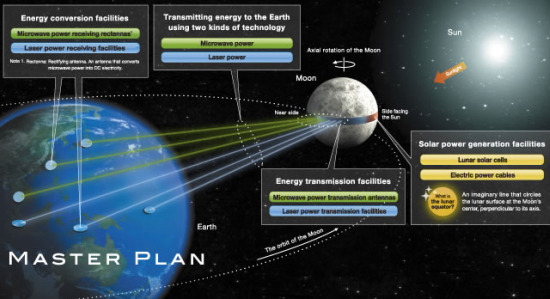
We’ve heard about schemes to gather solar power directly from space before, but designers at Japan’s Shimizu Corporation have taken the idea to a new level with the Luna Ring, a concept solar power plant on the moon. The plan involves building a 6,800 mile “solar belt” around the moon, beaming electricity to earth with microwaves and lasers, and setting up receiving stations on Earth where the power can then be used.

Shimizu even has a grand plan for bringing the resources for the solar plant to the moon. Humans will barely be involved–all construction will be taken care of by robots with oversight from astronauts. The company explains that, “Water can be produced by reducing lunar soil with hydrogen that is imported from the Earth. Cementing material can also be extracted from lunar resources. These materials will be mixed with lunar soil and gravel to make concrete. Bricks, glass fibers and other structural materials can also be produced by solar-heat treatments.”

Compelling ideas, to be sure, but we’d like to see evidence that any of this is possible. If we can’t get robots to fix an oil spill 5,000 feet below the ocean’s surface, how can we possibly expect them to build a gigantic solar power plant on the moon? Even if this whole scheme was proven possible, the costs would be astronomical — pun fully intended. Still, we can’t fault Shimizu for being ambitious. And while a 6,800 mile solar belt may be far-fetched, that doesn’t mean a more reasonably-sized solar power plant can’t someday end up on the moon.

+ Shimizu Corporation

Via Pink Tentacle

Read more: The Insane Plan to Transform The Moon Into a Giant Solar Plant | Inhabitat - Green Design Will Save the World 


Mega-engineering: awesome future concepts from Shimizu Corporation
Paul Raven @ 02-06-2010 
Get yourself over to Pink Tentacle right away; they’re hosting a bunch of mega-engineering promo images and design concepts from Japan’s Shimizu Corporation, who plainly aren’t afraid to think in directions with strong science fictional undertones. Directions such as floating lily-pad cities, million-citizen pyramidal cities, space hotels… and turning the moon into a gargantuan solar power station.

This one’s the winner for me, because any image of a planetary satellite re-engineered into a solar power plant that has the words “MASTER PLAN” masked onto it in large letters is, by any sane and reasonable metric, better than pretty much any other image. Of anything.

Bonus! Compare and contrast with these images of Russian space-race installations and rolling stock decaying the middle of nowhere [via Chairman Bruce]. Maybe one day in the deeper future, people will tut and shake their heads at images of Shimizu’s lunar power station, pocked with impact damage and slowly drowning in lunar dus


PowerSat: Space Solar Flies Closer to Earth
By Jennifer Kho Jun. 16, 2009, 5:05pm PDT 1 Comment
Do you like this story?

Solar from space: It may sound like a bad sci-fi movie, but a growing number of companies think it could solve the world’s energy crisis. Among them is Everett, Wash.-based PowerSat Corp., which said today it’s filed a provisional patent for two technologies it claims could help make the transmission of solar power from space more cost-effective. CEO William Maness also told us that the 8-year-old company has received commitments for $3-$5 million in angel funding, which it’s using to develop wireless power demonstrations on Earth, and is currently in negotiations for a first venture round in the single-digit millions.

The PowerSat news comes after Manhattan Beach, Calif.-based Solaren, another space solar company, in April signed a deal to provide power to northern California utility PG&E. And Swiss startup Space Energy recently said it’s working to launch a prototype satellite into space in 2-3 years.

Solar In Space

Space solar promises virtually unlimited power, with no carbon dioxide emissions. Undiminished by atmosphere or cloud cover, the sun’s energy is five times more powerful than can be found on even the brightest desert on the planet, according to PowerSat’s web site. And since the sun shines at full power all the time, solar energy-capturing satellites — called powersats — can receive more than 25 times as much power as a ground-based system of the same size, the company says.

Here’s how space solar would work: Power satellites armed with solar arrays would generate direct-current electricity, then convert that electricity into radio-frequency energy, which they would transmit the same way that radio travels to your car. But instead of using electricity to transmit information, as a radio signal does, these satellites would be sending the electricity itself. The radio frequency would get converted back into DC electricity at the receiver on the ground.

The huge potential has been apparent for decades, but space solar faces plenty of challenges. The biggest challenge so far, says Maness, is that it’s considered a risky investment. Nobody wants to invest billions of dollars to launch unproven technology into space, but it’s hard to prove the technology works without trying it out on location. Those billions of dollars represent another major hurdle. Even SpaceX‘s target price of $500 per pound, with its Falcon 9 spaceship, is about 20 percent too high to make a commercial space-solar project viable, and other launch estimates “aren’t even in the ballpark,” Maness said.

PowerSat’s Innovation

Now, PowerSat has come up with two technologies that it claims could shave off roughly $1 billion in launch and operation costs for a 2.5-megawatt power station. The first of these is called BrightStar. Instead of one large satellite, Brightstar uses a cluster of hundreds of small ones, which work together — similar to cloud computing — to transmit the power as a group.

The second technology, called Solar Power Orbital Transfer or SPOT, uses the same solar array needed for wireless power transmission to power the electronic thrusters that boost the satellites from what’s called “low Earth orbit,” which is 300-1,000 miles up, to “geosynchronous Earth orbit,” which is 22,236 miles up. Other satellites use a chemically fueled “space tug” to get to the geosynchronous level, and eliminating that power source reduces the weight of a satellite by 67 percent, dramatically decreasing launch costs, Maness said.

The company is developing a 10-kilowatt demonstration project with unnamed potential clients. In about three years, PowerSat hopes to launch a low-earth-orbit project, which will cost about $100 million. And within five years, the startup plans to look for a partnership with a utility, a public-private partnership involving the government or an initial public offering to raise the money for a full-sized project.

PowerSat plans to launch a prototype project into geosynchronous orbit in 2015 and to reach full power production between 2019 and 2021. It expects the smallest economically viable project, with a capacity of 2.5 gigawatts, to cost between $4-$5 billion.

Raising that kind of money, even with proof in place, will be a colossal task. And a long path — the company hasn’t even raised its first single-digit million venture round, although it has closed angel funding. It’s clear that while space solar may be flying closer, it still has a long way to go.


How Do You Feel About “Space Based Solar Power”?Filed Under Tech Questions 
Tuesday, 20 October 2009 | Posted by John
That is correct.  Solar Based Solar Power is one thing that might be considered and would change everything!  I see the picture and I think to myself “what if this things is tilted 10 degrees in the wrong direction”?  Is there any possibility of this thing creating a major disaster on Earth?
The article says that “low powered beams are considered safe”, but what happens when you put your cat in the microwave?  (please do not abuse your kitty).  The technology is simple and really, it seems like a great idea, but to only support the electricity for 1,000 homes, just doesn’t seem worth it to me.
There is a receiving grid a mile wide, even that takes up too much room.  I would put the worth of the idea higher if it could power 10,000 homes.  Small cities could take advantage and maybe even help to fund projects like this.  To power only 1,000 homes, the city I live near would have to send up 50 light collectors and have a receiving area even larger to convert the light on Earth.
It is nice to see others “looking outside the box”, at least.  The ideas may seem far fetched, but at least they are in idea form.  I would like to talk to whomever thinks it’s cost effective to send up a solar collector that can only power 1,000 homes.


SSPS (Space Solar Power Satellites) & Ground Collectors

Nasa and a number of other agencies have proposed placing giant satellites in geosynchronous Earth Orbit (GEO) to collect sunlight with solar cells. The energy would be converted to a maser beam which would be beamed to the ground to supply earth's energy needs with free, clean, sustainable energy. The basic concept of the SSPS is to beam microwaves from space. The energy would be collected by vast collectors at the ground at high efficiency (around 90%).

The basic technology is now entirely proven with satellite communication relays. The barriers to its development to high power levels are mainly associated with launch costs, a limitation that may well be overcome with BEP technology. 

Space Solar Power Satellite
Maser powered from space By concentrating on our future domestic energy supply, the proponents of SSPSs have so far failed to stress the very real potential this technology has to supply the energy needed to get the whole system into space both cheaply and efficiently. They also apparently ignore the obvious fact that, assuming BE propulsion is developed first, then the cost of launching these payloads into space could be reduced 1000x.

Enthusiasts propose placing a series of massive SSPS's (each 1km-5km in diameter) in GEO. Each 1km2 of satellite collector would receive 1.36Gigawatts of solar energy and, using solid-state technology, convert a modest percentage (~30%?) of this energy into coherent microwaves (ie a maser) to produce a near-constant 400Mw at the ground.

The higher E/D in space and the high total hours of operation, (24/7 for 99% of the year) would make a space installation 4x-5x more effective than any ground-based solar collector. The energy is also made available when other (solar-based) supplies are off line (ie in winter and at night.

When the world converts to solar, night time energy will be at a premium

Ground Power Stations

Ground stations would go hand-in-hand with the space collectors. An efficient ground reciever would be a light metal grid or netting 5km-6km in diameter. It could be situated almost anywhere on the ground below (or in shallow water) from the equator to the arctic circle. Aerial relays positioned in the upper atmosphere could also feed smaller ground arrays or extend this range, if necessary.


Space-Based Solar Power?
Labels: solar

Excerpt: The Economist (December 4, 2008)

Around the clock, 1.3 gigawatts of energy pour through every square kilometre of space around the earth. This energy could be captured by vast arrays of photovoltaic cells mounted on a satellite in orbit around the planet. These solar cells would be illuminated at all times of day, whatever the weather or the season, overcoming one of the main drawbacks of solar power on the earth’s surface. And with no atmosphere in the way to absorb or scatter the incoming sunlight, solar panels in space would produce over five times as much energy as those on the ground. (Some proposals for SSP involve large arrays of mirrors or lenses to concentrate the light onto a smaller array of panels.)

The logical place to put the satellite would be in a geostationary orbit, 35,800 kilometres above the earth’s equator, so that it completes one circuit of the planet per day, and thus appears (from the ground) to hover in a fixed place in the sky, like the communications satellites used to broadcast television signals. The solar-power satellite would send the collected energy down to earth in the form of a microwave beam, which would be picked up on the ground by a huge array of antennae, spread over several square kilometres in open country. The power density of the beam at the receiver would be little greater than what leaks out from a domestic microwave oven, so there would be no danger of incinerating entire cities. Microwave communications links are already used in the telecoms industry without doing any harm to wildlife.

Posted by Robert Volpe at Saturday, January 31, 2009


Back to Bright idea or sci-fi?
Bright idea or sci-fi?
September 09, 2009

Tyler Hamilton

Researcher Nobuyuki Kaya showed how solar power could be sent back to Earth from space using microwaves.
TYLER HAMILTON/TORONTO STAR
It sounds like something out of a sci-fi novel. Solar power plants orbiting the planet, each the size of 700 Canadian football fields, beaming clean energy down to Earth 24 hours a day so we can run our factories, charge our gadgets and keep our home appliances humming.

But for the scientists and engineers attending the International Symposium on Solar Energy from Space, a three-day conference this week in Toronto, there's nothing fictional about it. In their view, building massive space-based solar power systems represents, over the long term, one of the most effective ways of tackling the double menace of global warming and peak oil.

"Space-based solar power is a tremendously exciting prospect," said Liberal MP Marc Garneau, the first Canadian in space, speaking yesterday at the Ontario Science Centre about the potential for Canadian involvement in the project. "This country has all the fundamentals to play a leading role."

The Japanese are already leading the charge. Earlier this month, it was reported that Japan's government, working with a consortium of 16 companies, had committed to a $24 billion project to have a 1,000-megawatt solar station in space within three decades. This would generate enough electricity to power 300,000 homes, though getting the equipment into space would likely require more than 1,000 rocket launches.

Eco website TreeHugger called it Japan's "moon shot." The power station would consist of four square kilometres of solar photovoltaic arrays fixed in orbit about 36,000 kilometres above the planet's surface. Energy collected by the panels would be beamed by microwave to a receiving station back on Earth and converted into electricity before connecting to the land-based power grid.

Scientists say the advantage of putting a solar station in space is that it would face the sun 24 hours a day and would not be limited by cloud cover or air pollution. That would allow it to continuously generate power in the same manner as nuclear and fossil-fuel plants, but without the associated waste and greenhouse-gas emissions.

The idea has been around for 40 years, attracting serious attention from NASA and the U.S. Department of Defense during the 1970s, but funding eventually dried up. It wasn't until the late 1990s that interest in the concept resurfaced, partly as a result of concerns related to global warming and energy security.

Two years ago, the Pentagon's National Security Space Office issued a report that concluded solar-based power "is more technically executable than ever before."

The solar panels are more efficient and less costly to manufacture, technology exists to have robots assemble the station in space, and our understanding of wireless power transmission has improved dramatically.

Former NASA executive John Mankins, now president of the Space Power Association, said he believes space-based solar power could be economically competitive with other options.

Mankins added that he believes a small 10-megawatt demonstration plan could be in orbit within the next 10 years. "It's a reasonable time frame," he said.

At the conference, Nobuyuki Kaya, vice-dean of graduate engineering at Kobe University in Japan, demonstrated how the power could be transmitted wirelessly. Assisted by a team of students, he was able to light up a cluster of red LED lights and power a simple robot by beaming energy about 10 metres across a room.

Kieran Carroll, chief technology officer for Space Canada, which is hosting the conference, said such a system could be safely designed to accept and convert large amounts of energy from space. The trick is to transmit at low intensity by sending it down on a wide beam, about 10 kilometres across.

There would have to be no-fly zones around the area, but it wouldn't fry anyone walking through it.

"The power flux density in the middle of the (receiving) field would be perfectly safe for any life," said Carroll.

"In Canada, on a winter's day, one of the big problems would be that birds would probably hover over the field to get warm."

A reality check, however, came from power developer Wael Almazeedi, who warned of the legal, financial and regulatory challenges the plan would face, as well as the difficulty of "promoting a concept based on science fiction."

---------------------
Here is a Public Policy Discussion on YouTube regarding Space-Based Solar Power at "SpaceUP DC"