Showing posts with label asteroid. Show all posts

16 February 2013

The Death Star is Dead; Long Live DE-("Life") Star!

[HUMOR]

Citizens for the Death Star, Take Heart: Recycle your plans!

Just last month, the Obama administration rejected calls from 34,435 of its citizens calling for the administration to "Secure resources and funding, and begin construction of a Death Star by 2016," stating that, by "focusing our defense resources into a space-superiority platform and weapon system such as a Death Star, the government can spur job creation in the fields of construction, engineering, space exploration, and more, and strengthen our national defense."

The administration rejected the proposal, partially on expense, but also based on a stated policy that the administration "does not support blowing up planets."

However, it is unclear if the administration pro-planetary rights position extends to asteroids and meteors that threaten Earth.

In light of the recent asteroid close pass, meteor strike over Russia, and Russian calls for a planetary defense system, perhaps these citizens should seek a compromise position.

Certainly, these  34,435 citizens could achieve most of their stated objectives of spurring job construction engineering and space exploration by pursuing Space-Based Solar Power (recommended by the Pentagon itself), building multi-kilometer across giant space stations which send power to Earth via Lasers or Microwaves.  Sure, the capability of lighting a planet through infinite green energy may not be as spectactular or perceived as "cool" as the capability to blow one up, but at least it is still perceived by Chinese space program pioneers such as Prof Wang Xiji as the key to global domination ("Whoever takes the lead in the development and utilization of clean and renewable energy and the space and aviation industry will be the world leader.")

Sure, you'd have to live with the fact that you are doing good instead of evil, but  at least you get the giant space station beaming gigawatts of energy.

Sure, you might not make as many enemies in the process, but at least you could join forces with most American citizens, who, when surveyed by and large favor constructing Space Solar Power Satellites to every other potential space mission (with asteroid defense being #2), and who have separately petitioned the administration to make SBSP part of our space program.

You'd have to scope your ambitions...instead of thousands of years to construct, you'd have to cope with the reality articulated by the International Academy of Astronautics IAA 2011 report that "As of 2010, the fundamental research to achieve technical feasibility for the SPS [solar-power satellites] was already accomplished. Whether it requires 5–10 years or 20–30 years to mature the technologies for economically viable SPS now depends more on the development of appropriate platform systems concepts and the availability of adequate budgets."

Sure, you'd have to bite a really big bullet, because an SBSP program is unfortunately NOT going to cost (errr..inject stimulus dollars) of $850,000 Trillion (Obama administration estimate)...since an individual multi-gigawatt Space Solar Power Satellite only cost in the tens of billions, but at least they would pay-back economically.  And of course it would only take about $10 billion and 10 years to get the first demonstration in operation, and the IAA estimated job creation in the multiple millions.

But if giant multi-gigawatt orbiting power monsters delivering infinite green energy to planet Earth is not a close enough compromise, consider this most recent proposal by the Scientists at UC Santa Barbara might just fit th

e bill! Philip M. Lubin, and Gary B. Hughes are proposing a spaced based laser system 10 kilometers in diameter (about 100 times the size of the ISS) that could deliver 1.4 megatons of energy per day to its target, taking care of a pesky little asteroid like

2012 DA14 in about an hour, or destroy asteroids 10 times larger in about a year, with evaporation starting at a distance as far away as the Sun. Sure, saving a planet isn't destroying one...but at least you get the giant space station and jobs!


From: http://www.ia.ucsb.edu/pa/display.aspx?pkey=2943

NEWS RELEASE


California Scientists Propose System to Vaporize Asteroids That Threaten Earth


February 14, 2013

Click for downloadable image Full description below. †


Click for downloadable image Full description below. ††


Click for downloadable image Full description below. †††

(Santa Barbara, Calif.) –– As an asteroid roughly half as large as a football field –– and with energy equal to a large hydrogen bomb –– readies for a fly-by of Earth on Friday, two California scientists are unveiling their proposal for a system that could eliminate a threat of this size in an hour. The same system could destroy asteroids 10 times larger than the one known as 2012 DA14 in about a year, with evaporation starting at a distance as far away as the Sun.


UC Santa Barbara physicist and professor Philip M. Lubin, and Gary B. Hughes, a researcher and professor from California Polytechnic State University, San Luis Obispo, conceived DE-STAR, or Directed Energy Solar Targeting of Asteroids an exploRation, as a realistic means of mitigating potential threats posed to the Earth by asteroids and comets.


"We have to come to grips with discussing these issues in a logical and rational way," said Lubin, who began work on DE-STAR a year ago. "We need to be proactive rather than reactive in dealing with threats. Duck and cover is not an option. We can actually do something about it and it's credible to do something. So let's begin along this path. Let's start small and work our way up. There is no need to break the bank to start."


Described as a "directed energy orbital defense system," DE-STAR is designed to harness some of the power of the sun and convert it into a massive phased array of laser beams that can destroy, or evaporate, asteroids posing a potential threat to Earth. It is equally capable of changing an asteroid's orbit –– deflecting it away from Earth, or into the Sun –– and may also prove to be a valuable tool for assessing an asteroid's composition, enabling lucrative, rare-element mining. And it's entirely based on current essential technology.


"This system is not some far-out idea from Star Trek," Hughes said. "All the components of this system pretty much exist today. Maybe not quite at the scale that we'd need –– scaling up would be the challenge –– but the basic elements are all there and ready to go. We just need to put them into a larger system to be effective, and once the system is there, it can do so many things."


The same system has a number of other uses, including aiding in planetary exploration.


In developing the proposal, Lubin and Hughes calculated the requirements and possibilities for DE-STAR systems of several sizes, ranging from a desktop device to one measuring 10 kilometers, or six miles, in diameter. Larger systems were also considered. The larger the system, the greater its capabilities.


For instance, DE-STAR 2 –– at 100 meters in diameter, about the size of the International Space Station –– "could start nudging comets or asteroids out of their orbits," Hughes said. But DE-STAR 4 –– at 10 kilometers in diameter, about 100 times the size of the ISS –– could deliver 1.4 megatons of energy per day to its target, said Lubin, obliterating an asteroid 500 meters across in one year.


The speed of interplanetary travel –– far beyond what is possible with chemical propellant rockets used today –– could be increased with this sized system, according to Lubin. It could also power advanced ion drive systems for deep space travel, he said. Able to engage multiple targets and missions at once, DE-STAR 4 "could simultaneously evaporate an asteroid, determine the composition of another, and propel a spacecraft."


Larger still, DE-STAR 6 could enable interstellar travel by functioning as a massive, orbiting power source and propulsion system for spacecraft. It could propel a 10-ton spacecraft at near the speed of light, allowing interstellar exploration to become a reality without waiting for science fiction technology such as "warp drive" to come along, Lubin said.


"Our proposal assumes a combination of baseline technology –– where we are today –– and where we almost certainly will be in the future, without asking for any miracles," he explained. "We've really tried to temper this with a realistic view of what we can do, and we approached it from that point of view. It does require very careful attention to a number of details, and it does require a will to do so, but it does not require a miracle."


Recent and rapid developments in highly efficient conversion of electrical power to light allow such a scenario now, Lubin said, when just 20 years ago it would not have been realistic to consider.


"These are not just back-of-the-envelope numbers," Hughes concurred. "They are actually based on detailed analysis, through solid calculations, justifying what is possible. And it's all available under current theory and current technology.


"There are large asteroids and comets that cross the Earth's orbit, and some very dangerous ones going to hit the Earth eventually," he added. "Many have hit in the past and many will hit in the future. We should feel compelled to do something about the risk. Realistic solutions need to be considered, and this is definitely one of those."


Three UCSB undergraduate students are assisting Lubin and Hughes with the DE-STAR project: Johanna Bible and Jesse Bublitz, both from the College of Creative Studies, and chemistry major Joshua Arriola.


(172)


[RETURN TO TOP]


† Top image: Concept drawing of the DE-STAR system engaging both an asteroid for evaporation or composition analysis, and simultaneously propelling an interplanetary spacecraft.

Courtesy Philip M. Lubin


†† Middle image: This plot shows time to evaporate an Apophis-like asteroid versus diameter of the asteroid, versus several laser power levels. The baseline DE-STAR 4 system has approximately 100 gigawatts of laser power.

Courtesy Philip M. Lubin


††† Bottom image: This plot shows DE-STAR laser power and spot diameter versus DE-STAR array size. The DE-STAR system is modular and can be built up in sections each of which is immediately operational.

Courtesy Philip M. Lubin


###

So...the Improbable DOES happen!


What an amazing and unprecedented post-Valentine's day surprise!

In the same day that the close approach of 2012 DA14, a 50 meter "city killer" class asteroid, discovered less than one year ago, came zipping by within 27,700 km of the Earth, well inside the band of communications satellites in Geosynchronous orbit, and less than 1/13th the distance to the Moon, there Siberia Russia experienced its second major meteor strike in barely 100 years, and the first-ever meteor strike in the modern era to result in human injuries. Is it wishful thinking that such events might elevate Asteroids in the public discourse and lead to some proactive policymaking?

From: http://abcnews.go.com/GMA/video/russian-city-hit-meteor-1200-people-hurt-18518828
1,200 People injured, 4,000 Buildings damaged, 1 million square feet of glass shattered
Meteor weighed more than Eiffel Tower

From: http://www.latimes.com/news/world/worldnow/la-wn-fg-chelyabinsk-meteor-lessons-20130216,0,4643856.story

"It is high time Russia should start heavily investing in building an advanced space danger monitoring and warning system and above that a system capable of destroying such super bombs falling on us from the skies."

The Chelyabinsk region has long been one of the most important military-industrial regions of Russia, where you "can’t drive a mile without passing a defense or a nuclear industry installation," the scientist said.

"We should be thankful to fate that this meteor in fact was a blessing in disguise and instead of destroying a significant part of Russia with quite dire consequences to the rest of the world, it sent us a clear warning signal by simply blowing up a bunch of windows and lightly injuring over 1,000 people," Lipunov said.

Bagrov spoke in favor of creating an early warning system of satellites monitoring space for signs of approaching danger instead of restoring a global land- and sea-based system. Lipunov argues that a space system would be more expensive and may take a decade to install -- and even then it would not be as reliable as an Earth-based system equipped with powerful telescopes.

Regional Gov. Mikhail Yurevich told reporters Saturday that the material damage to the region already exceeds $33 million. He said that 30% of about 100 square meters of broken windows had already been replaced.

The explosion damaged 3,000 residential houses, 34 hospitals and clinics and 360 schools and kindergartens, as well as several businesses. High school and university students received a day off Saturday. At least three hockey games were canceled because of damage to the local rink.
From: http://www.foxnews.com/science/2013/02/15/injuries-reported-after-meteorite-falls-in-russia-ural-mountains/
The meteor -- estimated to be about 10 tons and 49 feet wide -- entered the Earth's atmosphere at a hypersonic speed of at least 33,000 mph and shattered into pieces about 18-32 miles above the ground, the Russian Academy of Sciences said in a statement. But even small asteroids pack a tremendous punch, explained Andrew Cheng of the Johns Hopkins Applied Physics Laboratory. 
"It doesn’t take a very large object. A 10-meter size object already packs the same energy as a nuclear bomb," Cheng, who led a 2000-2001 mission for NASA to orbit and land on an asteroid, told FoxNews.com. 

"There was panic. People had no idea what was happening," said Sergey Hametov, a resident of Chelyabinsk, a city of 1 million about 930 miles east of Moscow.

The meteor hit less than a day before Asteroid 2012 DA14 is to make the closest recorded pass of an asteroid to the Earth for a rock of its size -- about 17,150 miles. But the European Space Agency said its experts had determined there was no connection -- just cosmic coincidence.
The meteor released several kilotons of energy above the region, the Russian science academy said. According to NASA, it was about 15 meters or 49 feet wide before it hit the atmosphere, about one-third the size of the passing asteroid.
Lessons had just started at Chelyabinsk schools when the meteor exploded, and officials said 258 schoolchildren were among those injured. Amateur video footage showed a teacher speaking to her class as a powerful shockwave hit the room.

The site of Friday's spectacular show is about 3,000 miles west of Tunguska, which in 1908 was the site of the largest recorded explosion of a space object plunging to Earth. That blast, attributed to a comet or asteroid fragment, is generally estimated to have been about 10 megatons; it leveled some 80 million trees.
Scientists believe that a far larger meteorite strike on what today is Mexico's Yucatan Peninsula may have been responsible for the extinction of the dinosaurs about 66 million years ago. According to that theory, the impact would have thrown up vast amounts of dust that blanketed the sky for decades and altered the climate on Earth.
The meteor could have produced much more serious problems. Chelyabinsk is an industrial town long held to be one of the world's most polluted areas, and the area around it hosts nuclear and chemical weapons disposal facilities.

Vladimir Chuprov of Greenpeace Russia said the Russian government has underestimated potential risks of the region. He noted that the meteor struck only 60 miles from the Mayak nuclear storage and disposal facility, which holds dozens of tons of weapons-grade plutonium.
A chemical weapons disposal facility at Shchuchye also contains some 6,000 tons of nerve agents, including sarin and VX, about 14 percent of the chemical weapons that Russia is committed to destroy.

Jim Green, NASA's director of planetary science, called the back-to-back celestial events an amazing display.
"This is indeed very rare and it is historic," he said on NASA TV. "These fireballs happen about once a day or so, but we just don't see them because many of them fall over the ocean or in remote areas."

Read more: http://www.foxnews.com/science/2013/02/15/injuries-reported-after-meteorite-falls-in-russia-ural-mountains/#ixzz2L5QFgH9U


21 May 2012

The Inadequacy of Current Space Law to Protect and Encourage Investment

From: http://www.dailymail.co.uk/sciencetech/article-2137806/Legal-expert-says-James-Camerons-multi-billion-space-mining-venture-hit-lawsuits.html
Cosmic quarry: A team of scientists have unveiled plans to mine asteroids for their raw materials

Hang on, do you actually OWN all those asteroids full of platinum? Legal expert says James Cameron's multi-billion space mining venture may be hit with lawsuits

By ROB WAUGH All By This Author - 01/05/2012 14:46:18

Frans von der Dunk, professor of space law at the University of Nebraska-Lincoln said that existing laws applying to space meant there was no certainty that ‘asteroid mining’ was legal.


  • Not clear who OWNS asteroids
  • Under 1967 Space Treaty, space is a 'global commons'
  • University of Nebraska expert says venture may face serious legal problems
  • New venture backed by Google chiefs and Avatar's James Cameron
  • 100-foot asteroid can contain $50 BILLION of platinum
  • Spacecraft could mine near-earth rocks for platinum
  • Plan would add 'trillions' to global GDP


  • Planetary Resources, the Seattle-based 'asteroid mining' company set up by Google chiefs Larry Page and Eric Schmidt and filmmaker James Cameron could run into legal problems.
    It's not clear who actually OWNS asteroids.
    Frans von der Dunk, professor of space law at the University of Nebraska-Lincoln said that existing laws applying to space meant there was no certainty that ‘asteroid mining’ was legal.
    It’s also not certain, von der Dunk said, about who owns rocks in space, which is, according to the 1967 Global Space Treaty, ‘a global commons’.

    We're hiring! Two of Google's bosses and other technology luminaries in Seattle, USA, launched a company called Planetary Resources, aimed at developing robotic spaceships to mine near-Earth asteroids
    We're hiring! Two of Google's bosses and other technology luminaries in Seattle, USA, launched a company called Planetary Resources, aimed at developing robotic spaceships to mine near-Earth asteroids
    James Cameron gives two thumbs-up as he emerges from the Deepsea Challenger: Planetary Resources, the Seattle-based 'asteroid mining' company set up by Google chiefs and Cameron could run into legal problems
    James Cameron gives two thumbs-up as he emerges from the Deepsea Challenger: Planetary Resources, the Seattle-based 'asteroid mining' company set up by Google chiefs and Cameron could run into legal problems

    The plan to bring back trillions of pounds worth of platinum from space rocks might not be as simple as some have hoped.
    ‘Neither the pubic interests, ranging from security, safety and the environment to protecting Neil Armstrong’s footsteps, nor the interests of the company in securing its investments are properly protected,’ said von der Dunk.
    The Nebraska professor said that the venture would be open to legal suits - and that it would also have no defence against rivals.
    ‘Consequently, there is no legal certainty that those activities would not become seriously challenged.’
    ‘This prompts several questions: What rights of protection would the mining company have against others wishing to ‘intrude,’ given that a global commons is in a principled fashion open to everyone?’ Von der Dunk said.
    ‘And, who is going to be held liable – and to what extent – when mining activities cause damage to other space activities or are harmed by them?’
    Miners wanted: A computer generated image of swarms of low-cost robotic spacecraft that will enable extraction of resources from Near-Earth asteroids
    Miners wanted: A computer generated image of swarms of low-cost robotic spacecraft that will enable extraction of resources from Near-Earth asteroids

    The new gold rush? Clint Eastwood, Lee Marvin and Jean Seberg in Gold Rush-themed musical 'Paint Your Wagon'
    The new gold rush? Clint Eastwood, Lee Marvin and Jean Seberg in Gold Rush-themed musical 'Paint Your Wagon'
    But wealth beyond the dreams of avarice may NOT be immediately forthcoming.
    Several scientists not involved in the project said they were simultaneously thrilled and wary, calling the plan daring, difficult - and pricey.
    They don't see how it could be cost-effective, even with platinum and gold worth nearly $1,600 an ounce.
    An upcoming NASA mission to return just 2 ounces (60 grams) of an asteroid to Earth will cost about $1 billion.
    Scientists question how the company can reduce  costs to the point where 'space mining' will be profitable.
    Planetary Resources, based in Bellevue, Washington, initially will focus on developing and selling extremely low-cost robotic spacecraft for surveying missions, the company announced this week.
    A demonstration mission in orbit around Earth is expected to be launched within two years, said company co-founders Peter Diamandis and Eric Anderson.
    Anderson acknowledged the many potential pitfalls.
    'There will be times when we fail,' he said. 'There will be times when we have to pick up the pieces and try again.'

    Cosmic quarry: A team of scientists have unveiled plans to mine asteroids for their raw materials
    Cosmic quarry: A team of scientists have unveiled plans to mine asteroids for their raw materials

    Mars Rover Curiosity - currently on its way to the Red Planet: The new company aims to reduce the cost of hardware for space exploration by a factor of 100
    Mars Rover Curiosity - currently on its way to the Red Planet: The new company aims to reduce the cost of hardware for space exploration by a factor of 100
    Within five to 10 years, however, the company expects to progress from selling observation platforms in orbit around Earth to prospecting services.
    It plans to tap some of the thousands of asteroids that pass relatively close to Earth and extract their raw materials.   
    A 98-foot asteroid can hold as much as  $50 billion worth of platinum (£31 billion) at today's prices, said a company spokesperson.    

    Not all missions would return precious metals and minerals to Earth. In addition to mining for platinum and other precious metals, the company plans to tap asteroids' water to supply orbiting fuel depots, which could be used by NASA and others for robotic and human space missions.    
    'We have a long view. We're not expecting this company to be an overnight financial home run. This is going to take time,' Anderson said in an interview with Reuters.    
    The real payoff, which is decades away, will come from mining asteroids for platinum group metals and rare minerals.   
    Nasa has already successsfully landed a probe on an asteroid, Eros, 196 million miles from Earth
    Nasa has already successsfully landed a probe on an asteroid, Eros, 196 million miles from Earth
    'If you look back historically at what has caused humanity to make its largest investments in exploration and in transportation, it has been going after resources, whether it's the Europeans going after the spice routes or the American settlers looking toward the west for gold, oil, timber or land,;     Diamandis said.    
    'Those precious resources caused people to make huge investments in ships and railroads and pipelines. Looking to space, everything we hold of value on Earth - metals, minerals, energy, real estate, water - is in near-infinite quantities in space.
    'The opportunity exists to create a company whose mission is to be able to go and basically identify and access some of     those resources and ultimately figure out how to make them available where they are needed,' he said.    
    Diamandis and Anderson declined to discuss how much money has been raised for their venture so far.
    In addition to Google billionaires Page and Schmidt and filmmaker Cameron, Planetary Resources investors include former Microsoft chief software architect Charles Simonyi, a two-time visitor to the International Space Station, Google founding director K. Ram Shriram and Ross Perot Jr.    
    Planetary Resources also declined to discuss specifics about how and when asteroid mining would begin.
    NASA's infrared sky-scans found fewer 'mid-sized' asteroids than expected - and by mid-sized, NASA means rocks that can destroy cities
    NASA's infrared sky-scans track space objects such as asteroids. A recent scan with the NeoWISE instruments found that there were 19,000 'mid-sized' asteroids within 120 million miles of Earth
    Film maker James Cameron
    Billionaire Charles Simonyi
    Backing: Film maker and explorer James Cameron (left) is supporting the project, as is billionaire Charles Simonyi (right)
    Untapped resource: NASA scientists say the high concentration of raw materials found in asteroids could supply Earth with vital stockpiles of natural resources
    Untapped resource: NASA scientists say the high concentration of raw materials found in asteroids could supply Earth with vital stockpiles of natural resources
    Space man: Entrepreneur Peter Diamandis
    Space man: Entrepreneur Peter Diamandis
    The shortage of sources for raw materials on the planet has caused global inflation to spike in recent years causing tensions to rise between nations, experts have said.
    The company's first step is to develop technologies to cut the cost of deep-space robotic probes to one-tenth to one-hundredth the cost of current space missions, which run hundreds of millions of dollars, Diamandis said. 
    Among the targeted technologies is optical laser communications, which would eliminate the need for large radio antennas aboard spacecraft.   
    Space entrepreneurs Peter Diamandis and Eric Anderson are just two of the names behind Planetary Resource. In a press release, the company announced its intentions to create 'a new industry in space and a new definition of natural resources'.
    Diamandis and Anderson - both known for their aspirations for commercial space exploration - will host the launch event along with two former NASA officials.
    A driving force behind the Ansari X-Prize competition to spur on non-goverment space flight, Diamandis has made no secret of his goal to one day become an asteroid miner.
    In an interview earlier this year with Forbes magazine, he said: 'The earth is a crumb in a supermarket of resources.
    'Now we finally have the technology to extract resources outside earth for the benefit of humanity without having to rape and pillage our planet.'
    Hollywood film maker James Cameron is no stranger to daring exploration.
    Just last month the director of Titanic and Avatar became the first solo diver to  reach the bottom of the Challenger Deep - the deepest point on Earth.
    Radical concept, but old idea: Experts believe it is only now that we have the ability to discover and characterise a sufficient number of small near-Earth asteroids
    Radical concept, but old idea: Experts believe it is only now that we have the ability to discover and characterise a sufficient number of small near-Earth asteroids
    Straight out of a sci-fi film: A scene from the movie Armageddon, where Bruce Willis's character is sent into space to mine an asteroid before it hits the Earth
    Straight out of a sci-fi film: A scene from the movie Armageddon, where Bruce Willis's character is sent into space to mine an asteroid before it hits the Earth

    COSMIC QUARRIES: AN IDEA AS OLD AS THE SPACE PROGRAM

    Asteroid
    It might seem like a radical concept, but scientists have been toying with the idea of mining asteroids for their natural resources for longer than the space program has been running.
    Experts believe it is only now that we have the technology and ability to discover and characterise a sufficient number of small near-Earth asteroids (NEA).
    The mining could yield a large amount of water - frozen inside the asteroids - oxygen and metals which could not only be brought back to Earth but could help further space exploration by allowing humans to fuel spacecraft and build space stations.
    Nasa believes capturing placing an NEA in lunar orbit could provide a unique, meaningful and easy-to-reach destination for exploration by astronaut crews in the next decade.
    It is only now that the sufficiently-powerful electric propulsion systems necessary to transport a captured NEA are becoming available.
    Mining asteroids could take several forms. This includes sending humans in a spacecraft to an asteroid to explore and mine it.
    Another possible scenario could involve launching a robotic spacecraft to either to mine an asteroid directly or transport it closer to Earth so it could be reached by humans more easily.
    Extracting raw materials, such as iron and nickel, from the space rocks is a possibility that has been discussed for decades.
    However, the obstacles for such a mission has always been the cost, sufficient scientific expertise and technical prowess.
    It could cost tens of billions of dollars - and could take well over a decade - for astronauts to successfully land on an asteroid, NASA experts have said in the past.
    Source: The Institute for Space Studies

    Read more: http://www.dailymail.co.uk/sciencetech/article-2137806/Legal-expert-says-James-Camerons-multi-billion-space-mining-venture-hit-lawsuits.html#ixzz1vWHEq6Hf

    A star that wandered too close to the centre of a galaxy 2.7 billion light years away was pulled in by the enormous gravity of the black hole - and shredded.

    The galactic shredder: Nasa captures huge black hole pulling star to pieces after red giant 'wanders too close'

    By ROB WAUGH All By This Author - 03/05/2012 12:52:17

    A star that wandered too close to the centre of a galaxy 2.7 billion light years away was pulled in by the enormous gravity of the black hole - and shredded.
    Enceladus

    Nasa probe flies past Saturn's icy moon Enceladus just 46 miles up - and captures mystery 'jets' of ice which may harbour life

    By ROB WAUGH All By This Author - 03/05/2012 16:41:10

    A hair-raisingly close fly-by by Nasa's Cassini Probe aims to learn more about what lurks beneath the icy moon Enceladus's surface - and what exactly lurks in the 'geysers' of ice it spews into space.
    Planet

    This is the way the world ends: Planets turned to dust devoured by a white dwarf star offer a glimpse of our own apocalypse

    By ROB WAUGH All By This Author - 04/05/2012 12:06:37

    University of Warwick researchers found four white dwarves surrounded by the dust of shattered 'Earths' White dwarfs are the final stage of life of stars like our Sun - once the furnace inside a star 'burns out'.

    NASA survey counts potentially hazardous asteroids

    From: http://www.kurzweilai.net/nasa-survey-counts-potentially-hazardous-asteroids

    NASA survey counts potentially hazardous asteroids

    May 21, 2012
    NASA_near_earth_asteroids1
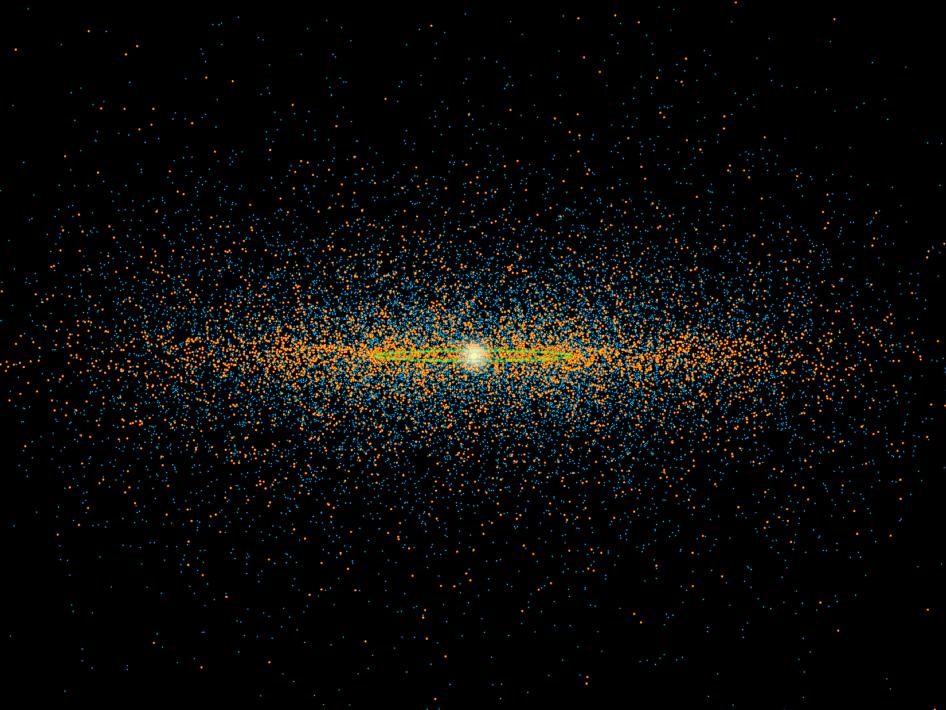
    New results from NASA's NEOWISE survey find that more potentially hazardous asteroids, or PHAs, are closely aligned with the plane of our solar system than previous models suggested, coming within 5 million miles (about 8 million kilometers) of Earth (credit: NASA/JPL-Caltech)
    There are roughly 4,700 potentially hazardous asteroids (PHAs) with diameters larger than 330 feet (about 100 meters). So far, an estimated 20 to 30 percent of these objects have been found, according to observations from NASA’s Wide-field Infrared Survey Explorer (WISE), which have led to the best assessment yet of our solar system’s population of potentially hazardous asteroids.
    Potentially hazardous asteroids are a subset of the larger group of near-Earth asteroids. The PHAs have the closest orbits to Earth’s, coming within five million miles (about eight million kilometers), and they are big enough to survive passing through Earth’s atmosphere and cause damage on a regional, or greater, scale.
    The new results come from the asteroid-hunting portion of the WISE mission, called NEOWISE. The project sampled 107 PHAs to make predictions about the entire population as a whole. Findings indicate there are roughly 4,700 PHAs, plus or minus 1,500, with diameters larger than 330 feet (about 100 meters). So far, an estimated 20 to 30 percent of these objects have been found.
    While previous estimates of PHAs predicted similar numbers, they were rough approximations. NEOWISE has generated a more credible estimate of the objects’ total numbers and sizes. It suggests that about twice as many PHAs as previously thought are likely to reside in “lower-inclination” orbits, which are more aligned with the plane of Earth’s orbit.
    In addition, these lower-inclination objects appear to be somewhat brighter and smaller than the other near-Earth asteroids that spend more time far away from Earth. A possible explanation is that many of the PHAs may have originated from a collision between two asteroids in the main belt lying between Mars and Jupiter. A larger body with a low-inclination orbit may have broken up in the main belt, causing some of the fragments to drift into orbits closer to Earth and eventually become PHAs.
    NASA_hustle_bustle_solar_system
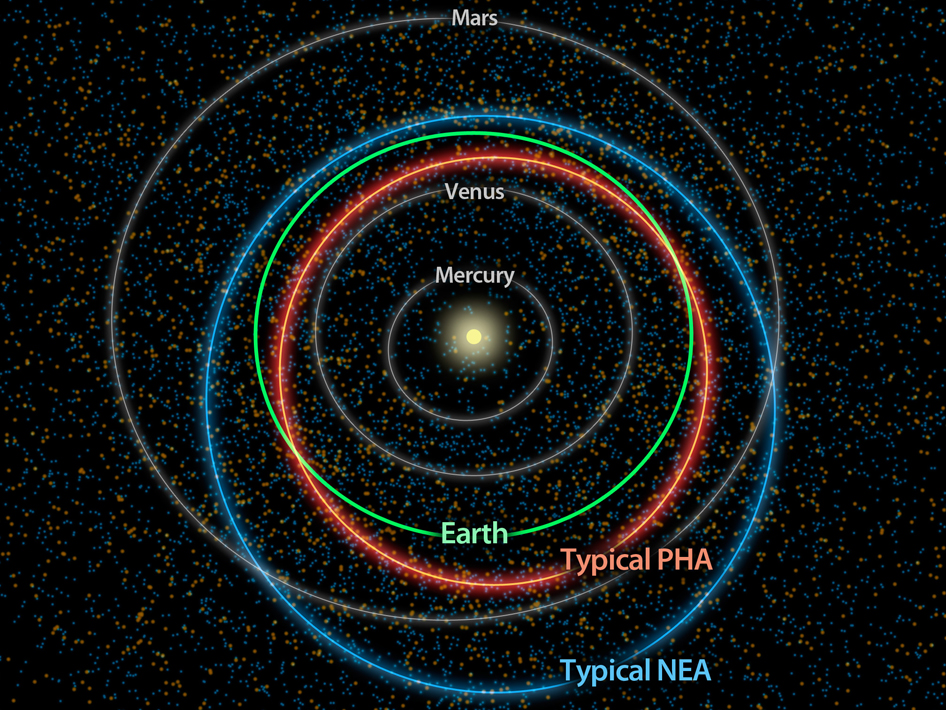
    This diagram illustrates the differences between orbits of a typical near-Earth asteroid (blue) and a potentially hazardous asteroid, or PHA (orange). PHAs are a subset of the near-Earth asteroids (NEAs). They have the closest orbits to Earth's orbit, coming within 5 million miles (about 8 million kilometers), and they are large enough to survive passage through Earth's atmosphere and cause damage on a regional, or greater, scale. (Credit: NASA/JPL-Caltech)
    Asteroids with lower-inclination orbits would be more likely to encounter Earth and would be easier to reach. The results therefore suggest more near-Earth objects might be available for future robotic or human missions.
    “NASA’s NEOWISE project, which wasn’t originally planned as part of WISE, has turned out to be a huge bonus,” said Amy Mainzer, NEOWISE principal investigator, at NASA’s Jet Propulsion Laboratory in Pasadena, Calif. “Everything we can learn about these objects helps us understand their origins and fate. Our team was surprised to find the overabundance of low-inclination PHAs. Because they will tend to make more close approaches to Earth, these targets can provide the best opportunities for the next generation of human and robotic exploration.”
    The discovery that many PHAs tend to be bright says something about their composition; they are more likely to be either stony, like granite, or metallic. This type of information is important in assessing the space rocks’ potential hazards to Earth. The composition of the bodies would affect how quickly they might burn up in our atmosphere if an encounter were to take place.

    5 Kt Meteor Blast over California

    NASA's Goddard Space Flight Center and Astrophysical Journal,
     A sonic boom heard in California last week had an out-of-this world origin as ”a large meteoric event” according to NASA’s Meteoroid Environment Office. Scientists now estimate the blast measured in near 5 kilotons or roughly 1/3 the power of the atomic bomb dropped on Hiroshima, Japan during World War II. Bill Cooke of the Meteoroid Environment Office at NASA’s Marshall Space Flight Center, estimates the object was about the size of a minivan, and weighed in at around 154,300 pounds.

    "Most meteors you see in the night’s sky are the size of tiny stones or even grains of sand and their trail lasts all of a second or two," said Don Yeomans of NASA’s Near-Earth Object Program Office at the Jet Propulsion Laboratory in Pasadena, California. “Large meteors can be seen in the daytime and are many times that size – anywhere from a baseball-sized object to something as big as a minivan.”  The meteor appears to be much more valuable than scientists first thought. Meteorite hunters found fragments of the rock, identified by the "fusion crust" that forms when it burns in the atmosphere. NASA and the SETI Institute in Mountain View, California, also mobilized a search team of about 30 scientists to search for the small black rocks. The meteorite turned out to be a very rare type of rock called CM chondrite, which makes up less than 1 per cent of the meteorites that fall to Earth. According to Bill Cooke of NASA's Meteoroid Environment Office at the Marshall Space Flight Center in Huntsville, Alabama, it is not clear whether it is rare because it easily burns up in the atmosphere or there are just fewer of these rocks in space.

    24 April 2012

    Plans for asteroid mining emerge

    From: http://www.bbc.co.uk/news/science-environment-17827347?print=true

    Details have been emerging of the plan by billionaire entrepreneurs to mine asteroids for their resources.
    The multi-million-dollar plan would use robotic spacecraft to squeeze chemical components of fuel and minerals such as platinum and gold out of the rocks.
    The founders include film director and explorer James Cameron as well as Google's chief executive Larry Page and its executive chairman Eric Schmidt.
    They even aim to create a fuel depot in space by 2020.
    However, several scientists have responded with scepticism, calling the plan daring, difficult and highly expensive.
    They struggle to see how it could be cost-effective, even with platinum and gold worth nearly £35 per gram ($1,600 an ounce). An upcoming Nasa mission to return just 60g (two ounces) of material from an asteroid to Earth will cost about $1bn.
    The inaugural step, to be achieved in the next 18 to 24 months, would be launching the first in a series of private telescopes that would search for asteroid targets rich in resources. The intention will be to open deep-space exploration to private industry.
    James Cameron Backers of the venture include James Cameron who recently dived to the deepest place on Earth
    Within five to 10 years, however, the company expects to progress from selling observation platforms in orbit around Earth to prospecting services. It plans to tap some of the thousands of asteroids that pass relatively close to Earth and extract their raw materials.
    The company, known as Planetary Resources, is also backed by space tourism pioneer Eric Anderson, X-Prize founder Peter Diamandis, Ross Perot Jr, son of the former US presidential candidate, and veteran astronaut Tom Jones.
    The founders of the venture are to give further details in a press conference on Tuesday.
    Long game
    "We have a long view. We're not expecting this company to be an overnight financial home run. This is going to take time," Eric Anderson told the Reuters news agency.
    The billionaires are hoping that the real financial returns, which are decades away, will come from mining asteroids for platinum group metals and rare minerals.
    "If you look back historically at what has caused humanity to make its largest investments in exploration and in transportation, it has been going after resources, whether it's the Europeans going after the spice routes or the American settlers looking toward the west for gold, oil, timber or land," Mr Diamandis explained.
    Water from asteroids could be broken down in space to liquid oxygen and liquid hydrogen for rocket fuel. Water is very expensive to get off the ground so the plan is to take it from an asteroid to a spot in space where it can be converted into fuel.
    From there, it could be shipped to Earth orbit for refueling commercial satellites or spacecraft.
    "A depot within a decade seems incredible. I hope there will be someone to use it," Dr Andrew Cheng, a planetary scientist at Johns Hopkins University's Applied Physics Laboratory told the Associated Press.
    "And I have high hopes that commercial uses of space will become profitable beyond Earth orbit. Maybe the time has come."
    Prof Jay Melosh from Purdue University said that the costs were just too high, calling space exploration "a sport that only wealthy nations, and those wishing to demonstrate their technical prowess, can afford to indulge."
    Eric Anderson, who co-founded the space tourism firm Space Adventures, said he was used to sceptics.
    "Before we started launching people into space as private citizens, people thought that was a pie-in-the-sky idea," He said.
    "We're in this for decades. But it's not a charity. And we'll make money from the beginning."

    17 March 2012

    2011 AG5 a 2040 risk?

    From: http://www.space.com/14872-asteroid-2011-ag5-earth-impact.html


    A massive asteroid that may be on a collision course with Earth should be studied in more detail, according to a former Apollo astronaut who specializes in monitoring potentially hazardous space rocks. Asteroid 2011 AG5 has been the object of attention because scientists say it may swing close to our planet in the year 2040. The big space rock is on NASA’s impact hazards list, but more definitive tracking of the object is still needed, scientists say. In fact, some near-Earth object (NEO) experts say it’s time to start hammering out a plan in case the asteroid needs to be deflected. Former Apollo astronaut Russell Schweickart is calling upon NASA to undertake a detailed engineering and mission planning analysis of 2011 AG5.

    From: http://www.huffingtonpost.com/2012/03/13/asteroid-2011-ag5-risk-unclear_n_1341355.html


    By: Leonard David
    Published: 03/12/2012 06:09 PM EDT on SPACE.com
    A massive asteroid that may be on a collision course with Earth should be studied in more detail, according to a former Apollo astronaut who specializes in monitoring potentially hazardous space rocks.
    Asteroid 2011 AG5 has been the object of attention because scientists say it may swing close to our planet in the year 2040.
    The big space rock is on NASA’s impact hazards list, but more definitive tracking of the object is still needed, scientists say. In fact, some near-Earth object (NEO) experts say it’s time to start hammering out a plan in case the asteroid needs to be deflected.
    Former Apollo astronaut Russell Schweickart is calling upon NASA to undertake a detailed engineering and mission planning analysis of 2011 AG5.
    In a March 3 open letter to NASA administrator Charles Bolden, Schweickart spotlighted what he sees as the potential deflection challenges posed by asteroid 2011 AG5, should the object happen to be headed for a so-called keyhole in 2023, setting up a possible impact with Earth in 2040. [The 7 Strangest Asteroids in the Solar System]
    Keyholes are small regions in space near Earth through which a passing NEO may be perturbed — due to gravitational forces — placing it onto a path that would strike Earth.


    In this most recent communiqué, Schweickart questioned a view held by Bolden from an earlier exchange of letters between the two that a Deep Impact-like intercept of asteroid 2011 AG5 could be staged in enough time to derail a space rock from hitting Earth.
    NASA’s Deep Impact probe was purposely crashed into comet Tempel 1 on July 4, 2005.
    A more daunting challenge
    While Deep Impact was a very successful mission, it is a poor analogy for the potential deflection challenges presented by 2011 AG5, Schweickart noted. To depend on such an impact mission to justify waiting until after the next tracking opportunities — before doing any further engineering analysis — is ill advised, he said.
    Schweickart contends that a 2011 AG5 deflection campaign requires two missions, not one, as was used on Deep Impact. In addition, intercepting and impacting 2011 AG5 presents far more daunting challenges than was posed by comet Tempel 1.
    In his open letter, Schweickart told Bolden that, "neither you nor I would have risked our lives without solid engineering having gone into our respective missions. In this instance again, there are potentially lives at stake, and I know you take that responsibility seriously, as do I." [Photos: Asteroids in Deep Space]
    "To be clear, what I am asking for is specific engineering and mission planning analysis to be performed now in order to insure that we fully understand the timeline requirements, in the unlikely event that AG5 should be headed for the 2023 keyhole," Schweickart wrote.
    "We all realize it is highly likely that AG5 is not headed for an impact. But we must also hedge against the possibility that this will not be the case by being prepared to act, and not find ourselves awkwardly beyond the point where deflection remains an option," Schweickart concluded in his open letter to the NASA chief.
    NASA's response
    In response to the letter, Schweickart told SPACE.com that a NASA-organized teleconference was held on March 8 involving himself, as well as John Grunsfeld, NASA's Associate Administrator for the Science Mission Directorate, Jim Green, Director of Planetary Science, and Lindley Johnson, NEO Observations Program Executive.
    "It was a very constructive discussion and as a result we will be getting together in the next few weeks to discuss the various issues and options which would apply to a variety of future scenarios regarding 2011 AG5," Schweickart said. "I’m looking forward to these substantive discussions and I commend John Grunsfeld and NASA for this positive response."
    Schweickart's new letter to Bolden, "presents points we at NASA have considered in looking at the 2011 AG5 scenario," Lindley Johnson told SPACE.com.
    "A big concern with any mission analysis is that they are only as good the initial input conditions. The results you obtain are always dependent on those conditions," he said.
    Johnson said that if 2011 AG5’s orbit model in hand now turns out to be a good representation of where the NEO will be in the future, then a mission analysis could be done now, and such work would be worthwhile. [5 Reasons to Care About Asteroids]
    But, if the asteroid’s orbit isn’t that well defined, then a mission analysis would need to be mostly re-done after a better orbit is ascertained, he said.
    "We are certain we will have a higher confidence model after observations are collected in another orbit of AG5," Johnson said, "and we are confident we will have more than sufficient time to do both the mission analysis and undertake any response still necessary after that observation opportunity."
    "However, we will continue to study the AG5 situation, as we do continuously for all objects on theimpact hazards list," Johnson concluded.
    Tools to monitor 2011 AG5
    "There are logical reasons to start really planning to do something really soon … and analyzing AG5 really soon," said Clark Chapman, a noted specialist in asteroids and a planetary scientist at the Southwest Research Institute in Boulder, Colo.
    It has been generally thought that 2011 AG5 can't be observed again until September of 2013, Chapman told SPACE.com. "That’s not true. We can see it again in August of this year."
    What’s needed is one of the largest ground-based telescopes on Earth, or the Hubble Space Telescope, Chapman advised. Doing so wouldn’t be too easy, "but in all probability could be done."
    For one, the asteroid is very faint and ground-based telescopes would need to slew toward the horizon in a really dark sky.
    "Telescopes are sort of designed to look more or less up … rather than over," Chapman noted. In the case of the Hubble Space Telescope, caution is the rule as it would be necessary to point the scope 42 degrees away from the sun to observe 2011 AG5, "but exceptions have been made in the past."
    Odds of an impact
    Still, whether using these tools to eye the asteroid will improve our understanding of the asteroid's track isn’t a given.
    "We simply don’t know whether observations in August can make that much of a difference … but that's another arena in which studies should be done in the very near term," Chapman said.
    In the meantime, more information about 2011 AG5 is needed, Chapman said.
    "We don’t know how big this thing is," he said. "And if it’s on the big side, it would be hard to move it away from the keyhole with only a few years planning. And if it’s really big, it’s hard to move it away from the Earth if it goes through the keyhole."
    Chapman stressed that the most probable result of more tracking of the asteroid is that the 2040 impact of Earth probability will drop to zero.
    "I’m of the view that you can’t say, 'let’s just wait and the odds are likely to go to zero.' Yes, the odds are likely to go to zero…but suppose they don’t," Chapman said.
    Leonard David has been reporting on the space industry for more than five decades. He is a winner of last year's National Space Club Press Award and a past editor-in-chief of the National Space Society's Ad Astra and Space World magazines. He has written for SPACE.com since 1999.