Showing posts with label Solaren. Show all posts

03 January 2010

California's Renewable Mandate


From: http://www.forbes.com/forbes/2010/0118/outfront-california-renewable-clean-energy-or-bust.html

California's Renewable Mandate
Lee Gomes, 01.18.10, 12:00 AM ET
Solar energy beamed to earth from outer space: It's Popular Mechanics-style engineering with a whiff of science fiction--the stuff, maybe, of a Discovery Channel documentary. But a way for a quarter-million California homes to be getting their electrical power, and not in 60 years, but in 6?

That's the plan. The state's Public Utilities Commission in December approved a proposal by Pacific Gas & Electric to buy power from a southern California startup named Solaren.

Solaren is the creation of ten or so veterans of the region's aeronautics and defense industries; as of a few weeks ago it had neither a Web site nor an office. What it has is some grandiose ideas.

So why is PG&E mixed up in this? Utilities are facing a requirement from the legislature to get 20% of their power from renewable sources by 2010, though an extension will likely be granted. PG&E currently gets 14% from renewables, including geothermal and biomass. You'd think getting to 20% would be an easy task in a big state with deserts, coastlines and windy mountain passes. PG&E is having a rough time at it, though.

In some cases renewable energy technologies remain expensive or unproven. At other times solar and wind farms have been blocked by environmentalists or neighbors who didn't care to look at these things. So the company says it is taking something of a portfolio theory approach to alternative energy sources, embracing a collection of them with the expectation some might not work out. Solaren would seem to be the riskiest of the lot.

Solar panels would be lifted by rockets into an orbit 22,000 miles high, where they would unfurl themselves into an array roughly a third the size of New York's Central Park. Rays from the sun, which are plentiful at that elevation, would be converted to electricity and then beamed down via microwaves to someplace along the PG&E grid. Birds and airplanes would have to keep a distance from the beams.

All of the individual pieces of such a power system have been built before, many times. But never at such a scale. The folks at Solaren say they have concrete ideas on how to make the whole thing work--how to assemble a solar array without astronauts, for example--but aren't providing many details to outsiders.

PG&E says its only commitment to Solaren has been to agree to buy whatever power the company can generate (estimated at 2% of PG&E's needs today). Solaren estimates that to get its panels off the ground it will need several billion dollars, which it is in the process of raising from private investors.

Naturally the plan has attracted skeptics. Not because of the basic idea; space solar power is being pursued in various forms all over the world, including by Japan's space agency. The doubts involve whether the meager resources available to Solaren are up to the moon-shot ambitions of the undertaking.

Martin Hoffert, a New York University physicist who is a big believer in space power, says this is properly the work of a government outfit like NASA. The science might be mostly on the mark, but what's happening in California, he says, "is the wrong business plan."

It may not be wrong for PG&E, though. If Solaren's panels never fly, the utility can say it tried very, very hard to get renewable energy and needs another extension.

09 December 2009

Solar Plant in Space Gets Go-Ahead

From: http://greeninc.blogs.nytimes.com/2009/12/03/solar-plant-in-space-gets-go-ahead/

Solar Plant in Space Gets Go-Ahead

by Todd Wood


California regulators on Thursday went where no regulators have gone before — approving a utility contract for the nation’sfirst space-based solar power plant.
The 200-megawatt orbiting solar farm would convert solar energy collected in space into radio frequency waves, which would be beamed to a ground station near Fresno, Calif. The radio waves would then be transformed back into electricity and fed into the power grid.
“At the conceptual level, the advantages of space-based systems are significant,” said Michael Peevey, president of the California Public Utilities Commission, during a hearing on Thursday. “This technology would offer around-the-clock access to clean renewable energy, and while there’s no doubt this project has many hurdles to overcome, both regulatory and technological, it’s hard to argue with the audacity of the project.”

“It’s hard to argue with the audacity of the project.”


A Southern California start-up called Solaren will loft components for the solar power plant into orbit and sell the electricity it generates to Pacific Gas and Electric, the major utility in Northern California, under a 15-year contract. The project is supposed to be turned on in 2016.

Solaren, founded by veterans of Hughes Aircraft, Boeing and Lockheed, plans to deploy a free-floating inflatable Mylar mirror one kilometer (0.62 miles) in diameter. This will collect and concentrate sunlight on a smaller mirror, that in turn will focus the rays on photovoltaic modules, according to the company’s patent.
In an interview with Grist in April, Gary Spirnak, Solaren’s chief executive, said that the vital part of making a space-based solar farm economically viable was to take the weight out of the system to reduce the number of rocket launches.
Still, Mr. Spirnak, who previously ran space shuttle flights for the United States Air Force, acknowledged that putting a solar power plant in space would cost a few billion dollars more than a terrestrial photovoltaic farm generating the equivalent amount of electricity.
The rate that P.G.& E. agreed to pay Solaren for the electricity produced by the solar station remains confidential. Also, regulators said on Thursday that the utility could not count the project toward its renewable energy mandates unless certain milestones were met.

28 July 2009

Solaren Video Clip

The Science Channel Reviews Solaren's plans to supply Green Power to 150,000 California homes by 2016:
http://science.discovery.com/videos/brink-news-solar-power-in-space.html
Discusses Asimov's advocacy role in the 40's, and features Senior Science Advisor, Department of Energy, Dwight Williams--"Really its been engineering.

Also:

And STRATFOR reports that the US and China have signed a Clean Energy Memorandum of Understanding on 28 July for working together to reverse climate change and for cooperating on clean energy technology. Sec Clinton said the agreement “highlights the importance of climate change in our bilateral relationship by creating a platform for climate policy, dialogue and cooperation.” That comes just one day after U.S. President Barack Obama called for for mutual development of clean energy with China.

21 July 2009

"If you gave me $2 billion today, I'd head for Brazil, quick :-) :-) -- but yes, I think it could be done" Discuss: Space Solar Power & Laser Launch

Today, ideas like Space Solar Power literally do not get off the ground because of the cost of launch. Space Solar Power needs high-volume launch, and today, there is not a sufficient market in being to justify the expense of taking the risk to develop new launch systems.

But that does not mean there are not ideas. From traditional Two-State to Orbit, to Ideas for airplane-like Single State to Orbit, to Partial Tether Stages, and Mag-lev first stages, to Lunar materials, and even mass-produced segmented expendables, ideas abound. One under-explored idea is Laser launch, for which a good open discussion led by Jordan Kare can be found here:
"I generally estimate the overall cost of a 100 MW "test" launch system at $2 billion (less than 1 shuttle orbiter, and well within the reach of, say, Boeing), and the cost of a 1GW system, built for continuous flat out use, at $20 billion.  Someone at a talk once asked me "You mean, if I gave you $2 billion today, you would build this?", and I said, "If you gave me $2 billion today, I'd head for Brazil, quick :-) :-) -- but yes, I think it could be done".
In fact, Brazil has a laser launch research facility, under the supervision of Marco A. S. Minucci, Centro Technico Aerospacial - CTA, Instituto De Estudos Avancados, São José dos Campos, Brazil that has in the past collaborated with Leik Myrabo from RPI, inventor of the Lightcraft. (http://www.rpi.edu/dept/mane/deptweb/faculty/member/myrabo.html and http://www.lightcrafttechnologies.com/media.html). Brazil is attractive because it can launch directly from the equator, to equatorial orbits, which are highly desirable, particularly for Geostationary satellites.

This year, the Sixth International Symposium on Beamed Energy Propulsion (http://www.aibep.org/ISBEP_6/ISBEP_6.htm), which will be held on November 1 – 5, 2009 at Doubletree Paradise Valley Resort, Scottsdale, Arizona. The program of ISBEP 6 will cover ALL aspects related to the science and technology of beamed-energy propulsion in its various forms and applications. One can see the impressive list of contributors and countries from the last symposium (http://www.aibep.org/ISBEP_5/Program.html), including the US Air Force, NASA, Brazil, Japan, Canada, Russia, Germany, Korea, China,

The subject is also likely to be covered at the Space, Propulsion & Energy Sciences International Forum (http://www.ias-spes.org/SPESIF.html), Feb 23-26, 2010 at John Hopkins University Applied Physics Laboratory (JHU/APL), which replaced the STAIF conference as the premier place to discuss advanced space concepts, particularly propulsion, and serious PhD-level, peer reviewed discussions on Physics related to interstellar travel & communication (everything from nuclear pulse detination Orion-style to VASIMIR, to IEC fusion, to FTL, Warp-Drive and Worm-hole physics)

A specific discussion on upscaling Laser Launch for Space Solar Power, with both an attractive financial return, and a scaling to levels that are relevant to both energy security and CO2 mitigation in our lifetime, see Keith Henson's Post on The Oil Drum:
http://www.theoildrum.com/node/5485 for which back-up calculations can be found here: www.htyp.org/dtc

Solar Satellite Power with Laser Propulsion and Reusable Launch Vehicle

This is a guest post by Keith Henson.

Could Satellite Solar Power (SSP) solve worldwide energy problems and even sequester serious amounts of carbon dioxide? In this post, I look at SSP built with laser propulsion and a new Reusable Launch Vehicle (RLV) combination, since this approach seems to be lower cost than other approaches and still could produce a huge amount of electric power. If there is enough electric power, some of it might even be used to sequester carbon dioxide by converting it to synthetic oil.

In this post, I prepare a financial model (available as a spreadsheet in PDF form) of what this approach to SSP might cost. Based on my calculations, the total investment required would be $58 billion, spread over a little over eight years. The system would produce a huge amount of electricity, so that long-term, the cost per kWh would only be $ .02.

While this proposed approach may not come about, or could take 20 years, it does offer a way out, if it can be made to work. There have been two recent posts on SSP that may be of interest to readers - one by Darel Preble and another by Big Gav.

With substantial input from Jordin Kare, Spike Jones, Howard Davidson, Ron Clark and others, I have been working for the past year on a new approach to SSP’s primary problem - reducing launch cost to orbit. If power from space were abundant and low enough in cost, we could even put carbon dioxide back into empty oil fields as synthetic oil.1 The goal is to reduce the cost of transport to Geosynchronous Earth Orbit (GEO) by a factor of ~200 over current expendable rockets.

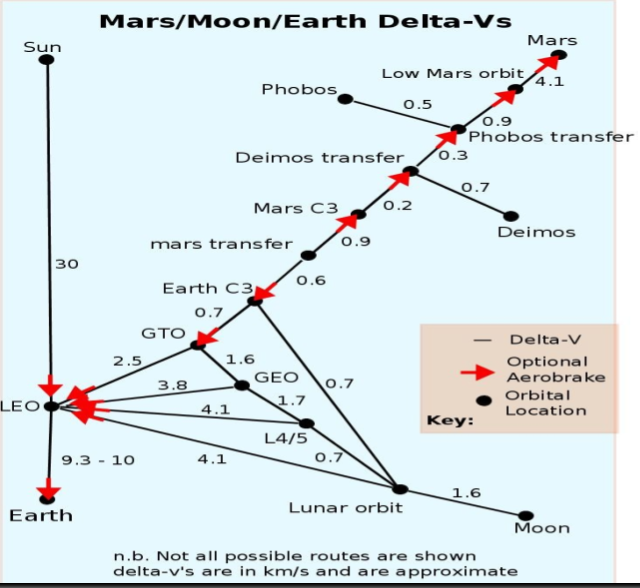
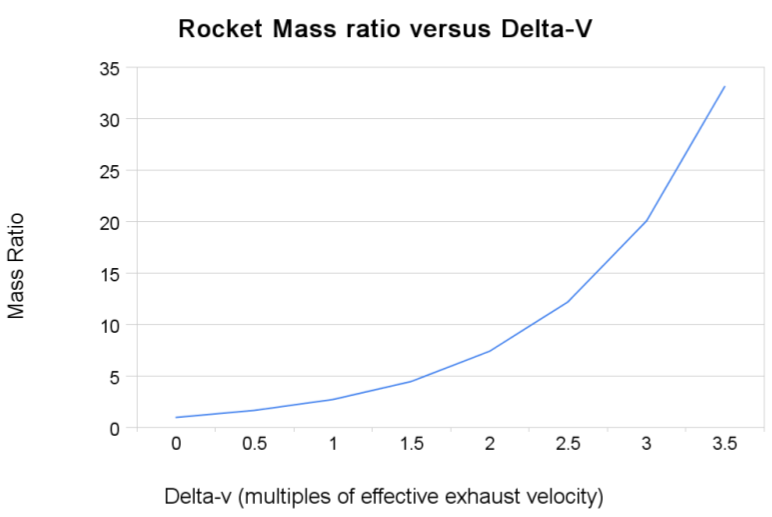
This work has been on "pop up and push," i.e., rocket boost to a few hundred km and a long ablation laser push for the rest of the delta V, (change in orbital velocity) to GEO. This takes advantage of the large thrust available from chemical rockets and the high exhaust velocity of lasers. The method allows much larger payloads than laser propulsion alone. It offers a substantial improvement over rockets. With chemical rockets, only one part in sixty of the lift off mass gets to GEO. It's 14 km/sec to GEO, (Figure 1), and 14/4.5 is about 3. As you can see from Figure 2, fuel is 20 times the rocket and payload together.


Figure 1


Figure 2

The combination of a mass ratio 3 rocket first stage (4 km/sec) and mass ratio 2 laser second stage (10 km/sec) could (according to the rocket equation)
deliver one part in twelve of the lift-off mass to GEO, a significant 5 to one improvement.

The problem with that scheme is that many very expensive lasers must be in place before the first launch. I have not run a pro forma financial analysis because the rough numbers (well over $100 billion) are so daunting.

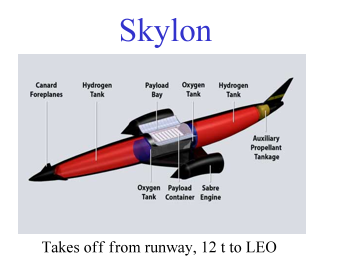
Recently another option came to my attention, the Skylon Spaceplane designed by Reaction Engines Ltd, in the UK.2 Performance, development and production cost of Skylon and SABRE (Synergic Air BReathing Engine) was obtained from Reaction Engines. By using air in place of oxygen to 26 km and Mach 5.5, then shifting SABRE to rocket mode, a Skylon is projected to place a modest (12 t) payload into LEO (Low Earth Orbit).


Figure 3

The April 2009 contract between PG&E and Solaren for 200 MW of space solar power generated many news stories and demonstrated the strong market for clean SSP energy - even though it has never been fully demonstrated (due to SSP’s intrinsically large scale).

A pro forma financial model was created using cost information provided by Reaction Engines, prior knowledge of laser propulsion, informal cost estimates for high kg/kW SSP and propulsion lasers and the 2016 delivery time for the PG&E/Solaren contract.

Pro Forma Model Assumptions (PDF spreadsheet here)

The model uses Reaction Engine's published development numbers. We doubled this to $21.7 B and compressed the development time in half to five years starting in 2010. First vehicle flies in 2015. Production Skylons in the pro forma model decline from $450 M to $292 M after 10,000 flights and vehicle life increases from 200 flights to 500.

Laser and GEO focusing mirror development is assumed to require $2 billion.

The proposed power satellite design is a very conservative 5 kg/kW or 5,000 tonnes per GW. (The project would still make money at 10,000 t per GW.) Development cost of $4 B seems reasonable by taking a low-tech approach and not being too concerned with mass. Four billion dollars should be enough money to rough design three (one PV and two solar dynamic cycles). A substantial fraction of this money will be for design of construction facilities at GEO. Other than being able to be broken down into loads that fit the transportation system, mass is even less of a factor for the "dockyard."

Working capital is also not included in the model because the time between purchasing parts for a power satellite and selling the new power satellite is under 90 days. The construction facility at GEO to build 1 GW power satellites is assumed in the model to be equal to the first power satellite mass (5000 tonnes). One GW is not optimal for power sats. As the increasing flow of materials makes larger-size power satellites practical, the model enlarges the construction facilities by 5000 tonnes per GW.

There is no provision in the financial model for robot assembly or teleoperators. The model assumes up to 1000 workers at GEO. Food and oxygen supply for the workers is not included because it is no more than 1 part in 240 (ten tons per day out of 2400). Wages for the workers in space is not included either because wages (at $500,000 per worker per year) would be one part in 365. (A GW turned out every two days and the net profit after transport cost and parts is a billion dollars per GW.)

Flights to orbit (sub-orbital as more lasers come on line) increase by three additional flights per day per quarter. I assumed the lasers to take over providing delta V in a linear way. As the lasers grow from a few MW to eight GW, payload per flight grows from six tonnes to twenty-five.3

Skylon's ability to go to LEO means that a single 6 MW laser built for $60 million (after development) can raise six tonnes of power sat parts from LEO to GEO in a day. This is a huge improvement over building $40 B of lasers.

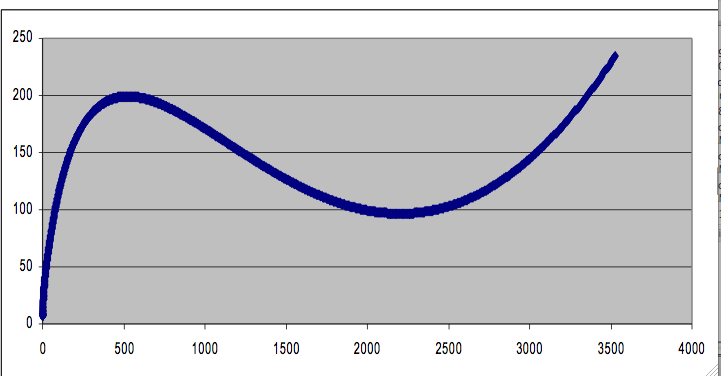
Figure 4. This graph shows the trajectory resulting from a 290 tonne Skylon booster vehicle, carrying a 40 tonne laser stage sub-orbital. The stage is then boosted to GEO by 4 GW of ground based lasers. Payload to GEO is 14.5 tonnes. Laser stage mass rises to 50 t and payload to GEO to 25 t with 8 GW of laser. The vertical axis is nautical miles altitude; horizontal axis is downrange. The constant laser acceleration applied is 1.1 g , much less than the rocket burnout of 3.5 g.

We still build the lasers, but in this model, we buy the lasers over a long time with power-satellite sales. Each laser requires a focusing mirror in GEO. Only one mirror has to go to GEO the hard way (with rockets). We bootstrap the rest up at 50 mirrors a quarter with laser power from the first.

The model has been adjusted so that by the end of 2016, there is ~10,000 tonnes at GEO, enough for the construction facility and parts for the first 1 GW power sat. A linear ramp from zero over 18 months would put the first flight in mid-2015. The flight rate over the next year ramps up to 12 per day. The fleet size assumes flying 1.5 times a day.

Production of Skylons (counting the prototype) by the end of 2016 is 14 with a peak rate of five per quarter. Skylons are similar in size to 747s. Boeing built 747s at higher rates.

The focusing mirrors for the lasers reduce net cargo to GEO by 250 tonnes per quarter. We assume the lasers and focusing mirrors will cost $10/watt. Depending on how much laser power will fit into a standard shipping module, the project installs 50-250 laser modules per quarter.

This involves purchase or construction of 200-1000 "on the ground" laser modules per year. Scaling the factory size from locomotives, the plant making the lasers might be a square mile. The cost of this factory has not been included. In this model, we ramp up and install lasers at a GW per year for 8 years. The factory should reach excellent economy of scale with a production run this long. Financing for the factory could be based on a firm order of this size.

The model accounts for power satellites not sold but diverted internally to make Skylon propellants and to power the lasers. (The cost of the propellant plant and the laser infrastructure such as a refrigeration plant to cool the lasers has not been included.) By the beginning of 2018, the lasers and propellant plants in the model are using ten GW of the 84 GW produced by that date (split almost evenly between lasers and propellant).

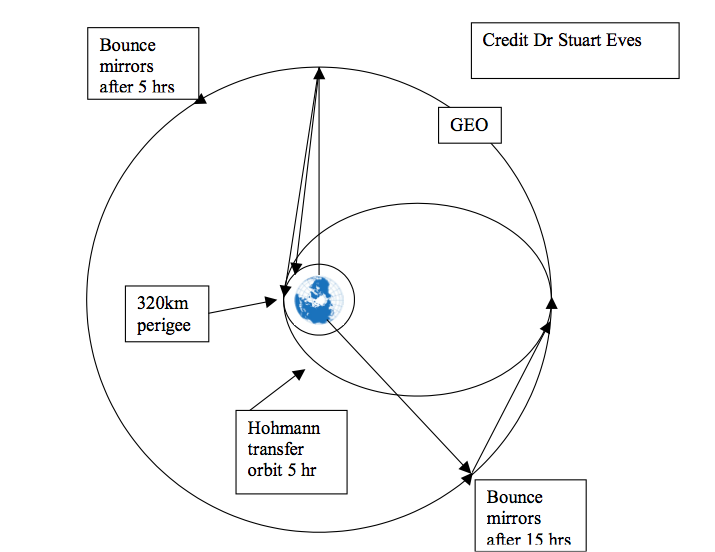
Figure 5. A mature laser boost system as envisioned by Dr. Stuart Eves, Surrey Satellite Technology. The laser stage makes 1 1/2 orbits so the mirrors will be in the correct place to circularize the orbit at GEO.

The initial design capacity of the system builds up over 8 years. At that point of maturity, it is launching 50-ton laser stages and using 8 GW of lasers (1600 modules). There are 4 sub-orbital Skylon flights an hour, less than 100 flights per day. They lift about 800 million kg per year on sub-orbital flights. Not taking the Skylons into LEO might extend their life (though it may complicate recovery). The price per kg lifted to GEO falls from an initial $750/kg (based on twice the depreciation of the Skylons and mass ratio 2 laser stages) to $50/kg. This reduction is due to the cost per flight (lower cost, higher life) and the payload at GEO rising from six t per flight to 25 t per flight due to more lasers.

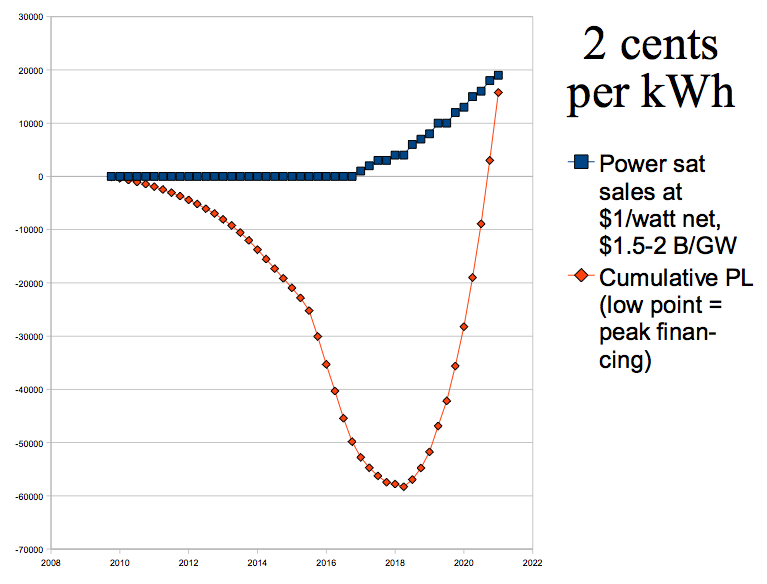
For a simple financial model, we have conservatively figured net profit for power satellites (not counting transportation otherwise covered) at $1 per watt. If power satellite parts cost $600/kw, then a 1 GW power satellite would sell for $1.6 B. This is 2 cents per kWh based on a ten-year recovery of capital. (It does not include the customer’s associated rectenna.) The market for power in the 1-2 cents per kWh range is close to unlimited because of the demand for low cost synthetic oil.

The model is full of feedback loops because of the bootstrapping. When it first starts, one laser/mirror lifts the cargo of one Skylon flown once a day. That is 12 tons per to LEO and six tons per day to GEO. Two lasers/mirrors allow the Skylon to fly twice a day for 12 tons per day to GEO. More Skylon and lasers rapidly build up the cargo capacity (the effects multiply). (Missing, the cost to boost the first mirror to GEO. IOSTAR's tug may be how we maneuver it into place.)

Figure 6. In this draft model the red line tracks cumulative profit / loss (in millions of dollars) each year and the black line shows annual sales - $1.5 - $2 Billion/Gigawatt. The debt bottoms out in 8.25 years at just over $58 billion dollars. That is about twice what the Chinese spent on Three Gorges Dam. For that they obtained 22 GW at a human cost of displacing 1.24 million people. Mature, this project would provide 22 GW of new generating capacity every 44 days.

At the peak investment, power satellite sales in the model are over $4B/year. Refining the model will cause this peak investment and timing to grow or shrink due to conceptual improvements, the minor items mentioned above, those cost items not yet considered and a more realistic (higher) initial sales price for power satellites.4

The current model shows repayment of the entire investment from selling power satellites only nine quarters after reaching the bottom at 8.25 years. (Interest on the capital investment has been included.) The delivery of power satellite parts and power satellite sales grows rapidly after that point.

Current world energy demand is around 15 TW. The "Manhattan Project" crash program outlined here has ~30 TW on line by 2043. World usage of fossil fuels beyond 2040 should be negligible. (Lower cost carbon neutral synthetic fuels would displace liquid fossil fuels.)

The model shows producing over four TW/year of new power satellites by 2040. Four years of power satellite production at this rate would be over 15 TW, enough to put 100 ppm of CO2 back in the ground as synthetic oil in two decades following 2040.

The proposed power satellite financial model makes considerable profit in addition to solving carbon dioxide and energy problems. How to finance it and who might finance this approach to solving the carbon dioxide and energy problems as well as potential military uses of the propulsion lasers are outside the scope of this analysis.

Notes

1 The area of the earth is ~5.1 x 10¹⁴ square meters; air pressure is ~100,000 N/m2. The force would be ~5.1 x 10¹⁹ and the mass (force/acceleration of 9.8 m/sec2) is ~5.2 x 10¹⁸kg or 5.2 x 10¹⁵ t. One ppm would be 5.2 x 10⁹ t and 100 ppm would be ~520 billion tonnes.

It takes ~100kWh to remove a ton of CO2 from the atmosphere.

http://www.eurekalert.org/pub_releases/2008-09/uoc-cd092908.php

Removing 100 ppm of CO2 from the air would take 52000 billion kWh or 52,000 TWh, or since a year is about 8700 hours, about six TW years. A TW is about twice the installed power in the US.

It would take a 1000 1GW nuclear reactors 6 years to bring the CO2 level back to the level of 1960 if no new CO2 was being added.

The problem is what to do with the CO2? Liquid CO2 has a density of 1.1. As liquid, this much CO2 would occupy ~470 cubic km. It would cause a real problem downwind if it blew out of storage. We know that oil stayed in the ground for millions of years.

It takes ~50 times as much energy to convert CO2 to synthetic oil as it does to capture it. So to convert 100 ppm of CO2 to synthetic oil would take ~300 TW-years. If we are already feeding 15 TW into making synthetic oil, we could dedicate another 15 TW into making more and pumping it back into empty oil fields. It would take two decades at this rate to bring the current CO2 level back to that of 1960. We might be able to take the CO2 level down far enough to get the earth to go into an ice age (for those who like to ski).

For the details on the energy cost of making synthetic oil see www.htyp.org/dtc

2 http://en.wikipedia.org/wiki/Reaction_Engines_Skylon

3It is our economic judgment that lasers become useful when there is enough power to raise a 12-ton stage with mass ratio of two to GEO in a day. LEO to GEO is 4.1 km/sec. For a mass ratio of two, the exhaust velocity is 4,1/.69 which is ~six km/sec (ISP of only 600!). We assume multi impulse Hohmann transfer rather than spiral. Twenty-four hours is 86,000 sec.

V=at, a=v/t a 4100/86000 =~0.05 m/sec2. One m/sec2 is ~0.1 g so this is half a percent of a g.

How much mass must be blown off in one second to get 0.05 m/sec2

MV = mv where M is the current laser stage mass, V is 0.05 m/sec and m is the mass blown off in one second at velocity v, 6000 m/sec.

m/sec = 0.05M/v = 0.05m/sec2 x 12,000kg/6000m/sec

m/sec is 0.1k/sec

Ke (of exhaust) =1/2mv2

Ke = 1/2 (0.1) (6000)2 =1.8 x MJ

Laser efficiency of 30% increases this to six MJ.

Since this is over a second, the laser power to provide six MJ/sec is six MW.

The payload multiplier as a function of laser power is from this number and other work indicating delivery of 25 t of payload from a 50 t laser stage placed in a 300 km sub orbital flight.

4There may be resistance to paying a great deal more than the projected cost in a few years.

22 April 2009

Will Space-Based Solar Power Finally See the Light of Day?

This is one of the best, most comprehensive articles written on the subject. Kudos to Adam Hadhazy and SCIAM!
Scientific American: Features - April 16, 2009
Will Space-Based Solar Power Finally See the Light of Day?
A satellite that reaps the sun's energy in space and beams it down to Earth for use as electricity may leave the realm of sci-fi and edge closer to reality this week following an energy deal in California
By Adam Hadhazy
Pacific Gas & Electric Co. (PG&E) has long invested in renewable energy sources, including geothermal, wind and solar. Earlier this week, the utility company reached for the stars in announcing the first-ever deal of its kind: The California power utility, says spokesperson Jonathan Marshall, plans to purchase clean energy generated by a satellite beaming solar power from orbit.The agreement between PG&E and Solaren Corp., an eight-year-old company based in Manhattan Beach, Calif., still hinges on state regulatory approval. If the deal gets the green light, Solaren must then privately raise billions of dollars to design, launch and operate a satellite as well as an energy-receiving ground station slated for the Fresno County area, says Cal Boerman, director of energy services for Solaren.The challenges of building this satellite (due to be completed in 2016) and introducing so-called space-based solar power (SBSP) remain formidable. But driven by the urgency of climate change and the lowering costs of solar technology, a growing number of countries and companies believe an energy revolution could be in the offing.Why bother harvesting solar energy directly from space? It is abundant, and "you can get [this] power 24/7," says Marty Hoffert, an emeritus professor of physics at New York University. Sunlight is some five to 10 times stronger in space, and its shine would reach energy-gathering satellites placed into geostationary (fixed) orbits—the realm of many currently deployed communications spacecraft—more than 99 percent of the time.SBSP could, according to energy experts, provide constant, pollution-free power—unlike intermittent wind and cloud cover–sensitive ground-based solar, and without the emissions of fossil fuels or radioactive waste from nuclear power. "[SBSP] is a disruptive technology [in that] it could change the whole energy equation," says Frederick Best, director of the Center for Space Power (CSP) at Texas A&M University in College Station, Tex.The premise (and promise) of SBSP has been considered scientifically feasible since the late 1960s. The basic concept of beaming microwave frequencies to Earth from orbit has already been proved: A fleet of solar-powered communication satellites routinely beam various electromagnetic frequencies to ground receivers, linking cell phone calls or relaying TV signals to rooftop dishes, for example. Converting solar energy beamed from space into electricity in a power grid, however, has not yet been demonstrated.Space Energy, a Switzerland-based SBSP start-up, aims to change that by deploying a prototype orbiter in the next several years, possibly before Solaren's pilot plant reaches orbit. "You can argue the physics [of SBSP] all day, but you'll only know with a prototype," says Peter Sage, a co-founder of Space Energy, started in 2008.Last year, U.S. and Japanese researchers crossed an important SBSP threshold when they wirelessly transmitted microwave energy between two Hawaiian islands about 90 miles (145 kilometers) apart, representing the distance through Earth's atmosphere that a transmission from orbit would have to penetrate, says Frank Little, associate director of the CSP.Many other technologies relevant to SBSP have made "enormous progress" in recent years, says John Mankins, who led the Hawaiian island test as chief operating officer and co-founder of Ashburn, Va.–based Managed Energy Technologies, LLC. A little over a decade ago, the best photovoltaic efficiency, or sunlight conversion into electricity, was 10 percent, Mankins says; now it can reach 40 percent. And satellite technology has also improved: Autonomous computer systems as well as advanced, lightweight building materials have also made leaps and bounds, he says.Despite such progress, and spending some $80 million, SBSP has not gotten past the U.S. government's drawing board so far. A key reason, Little says: NASA does not do energy, and the U.S. Department of Energy (DoE) does not do space.The U.S. Department of Defense, however, has recently shown interest in SBSP. Air Force Colonel M. V. "Coyote" Smith cites high fuel costs, along with risks to personnel when supplying petroleum to U.S. combat theaters and bases. A 2007 Defense report (pdf) from the Pentagon's National Security Space Office (NSSO), viewed the commercial development of SBSP quite favorably, especially as traditional, fossil fuel energy sources get ever scarcer in the years ahead. "We've got to identify sources of safe, clean energy in order to help us prevent energy wars in the future," says Smith, one of the authors of the 2007 report.The NSSO report said it would be in the fed's interest to encourage the commercial development of SBSP, but that the government should not design or operate the eventual orbiting power plants.The previous government work, including a joint NASA and DoE report from the 1970s about SBSP, has left its mark on many current architectural schemes, though. This textbook approach calls for a massive, microwave-beaming satellite several miles wide that would sport multiple enormous solar arrays connected to a central hub [like the artist's conception on the first page of the article]. The craft would be perched in orbit about 22,400 miles (36,050 kilometers) above Earth, or a tenth the distance to the moon. There, the satellite would maintain a geostationary, or fixed, position relative to a point on Earth's surface while its solar panel arrays bask in the constant sunlight.Captured solar energy then gets converted on board the satellite into electromagnetic carrier waves, specifically microwaves, ideally at a frequency of either 2.45 or 5.8 gigahertz (both fall on the spectrum between infrared and FM/AM radio signals) for subsequent beaming back to the ground. At that frequency, the waves pass easily through the atmosphere, although some energy—physicists do not know exactly how much yet—would be lost during the transfer, Smith says.This invisible column of microwave energy, measuring perhaps a mile or two (two to three kilometers) across, would be beamed at an oval-shaped, ground-based rectifying antenna, or a "rectenna," of similar size, and from there the energy would flow into the traditional electrical grid.Despite the clear analogy to a science fiction death ray, scientists believe the diffuse energy beam from above would not pose a health threat to people or wildlife, even at its most intense center."Microwave radiation is nonionizing, just like visible light or radio signals," says Jim Logan, former chief of medical operations at NASA's Johnson Space Center and an expert on aerospace medicine. That means it lacks sufficient energy, like x-rays and gamma rays, to remove an electron from an atom or a molecule to make a charged particle that can damage DNA and biomolecules, he says.Birds passing through the heart of the carrier wave from space might feel some warmth, Logan wrote in a February white paper on SBSP safety for Space Energy, but not at elevated levels. And should the beam stray from its rectenna target, it would be designed to defocus, Logan says, and not "run amok all over the landscape." Sage of Space Energy says: "We won't be frying birds or turning clouds to steam."Space Energy's first operational array, which adheres to the typical SBSP setup just described, would be designed to generate one gigawatt almost continuously, about the same output as a large nuclear plant. Pursuant to a successful prototype experiment in several years, Space Energy expects that investors would pony up the billions estimated to make a full-scale commercial plant a reality.Building segments of the plant's solar arrays on Earth, along with supports and a central transmitter, would take two years or so, says Stephan Tennsel, CEO and co-founder of Space Energy. Some 40 to 60 launches would boost all the components for the first SBSP satellite into a low Earth orbit (LEO) where a combination of automatic panel unfurling ("like an umbrella," Tennsel says) and robots would assemble and integrate them.Dangers and engineering challenges abound, however: Space junk like that which recently threatened the International Space Station, for example, could collide with the skeletal space solar satellite during assembly. And keeping the satellite's huge beam and the distant rectenna reliably synced up also stands as an unsolved technical issue, says CSP's Little.Overall, the how may be much easier to overcome than the how much. "Technically, we're a lot closer to space-based solar power than we are economically," Little says. The biggest obstacle, he says, continues to be launch costs. "Large structures in space are not showstoppers, but the cost of getting up into space is the real hang-up [for SBSP]," CSP's Best says. In Space Energy's business plan, for instance, half of the $250 million allotted for their communication satellite–size prototype goes toward just lofting the approximately 1,760-pound (800-kilogram) craft into orbit.Though Solaren is tight-lipped about what its pilot power plant will look like, a 2005 patent retained by the company indicates that the firm intends to use mirrors—another oft-explored SBSP element—to gather and focus sunlight prior to converting it to microwaves. According to the patent, Solaren also looks to eliminate many of the structural connectors on its craft—that is, some or all of the satellite's components, including the mirrors, power module and microwave emitter could be "free-floating" in space, orbiting in tandem. "The big thing is to get the weight down so the weight costs don't kill you," says Solaren's Boerman.Backers of SBSP hope that the rising commercialization of space—sparked by the allure of space tourism and the economics of cheaper access—will bring down the expense of rocketing into orbit. Some of the best-known entrepreneurial ventures include Richard Branson's Virgin Galactic and Elon Musk's SpaceX, but almost 20 companies are trying their hand at lowering launch overhead. "These organizations could potentially change the picture of launch costs," Best says.Many other obstacles stand in the way of commercially viable SBSP. A crucial regulatory matter: getting clearance from the U.N.'s International Telecommunication Union (ITU) that allocates use of the electromagnetic spectrum. SBSP's ideal microwave frequencies are already used by wireless systems such as Bluetooth, according to Smith. "Even if we could narrow the beam [from space] down and ensure complete signal integrity in the broadcast wave area," the ITU may deem the possible interference from SBSP as too disruptive to some extant technologies, he says.Some think that SBSP efforts should zero in on lasers rather than microwave transmission to avoid this and other confounding issues. "I think an approach using microwaves is doomed," N.Y.U.'s Hoffert says. Given the necessary size of microwave transmitters and their solar arrays, "it's a huge capital investment before you get one kilowatt of power," he adds.A higher efficiency, laser-based approach would require far smaller satellites and transmitters, perhaps requiring just one launch, Hoffert notes. One proposal involves capturing sunlight in space via photovoltaics, converting the energy into a visible or an infrared laser and then beaming this concentrated light onto existing solar panel arrays in the desert around the clock. Weather can disrupt laser transmissions, however, and Hoffert says other technical hurdles remain for both microwave and laser light approaches.The Japan Aerospace Exploration Agency (JAXA) is covering all bases as Scientific American magazine reported last year. JAXA hopes to have a one-gigawatt satellite in geostationary orbit around 2030 that may use either microwaves or lasers to send its energy back home.Yet another school of thought involves placing solar-power generators and microwave transmitters on the surface of the moon, or even using a lunar base to construct the satellites before launching them (with relative ease, due to moon's far weaker gravity) into a geostationary orbit. Many of the raw materials for crafting the satellites could be mined from the moon as well.If these and other far-flung, future missions ever come to pass, their creators may look back on PG&E's faith this week in Solaren as a key moment in the history of SBSP development, Logan predicts. "If [Solaren] is able to deliver this energy, you're talking about the first time space-based resources have ever been imported to Earth," he says. "It's a significant breakthrough in the awareness of the fact that we're not limited to just the resources on the planet."Auspiciousness aside, Solaren has a long road ahead of it in terms of raising capital and constructing the first-of-its-kind SBSP operation. Soothing local fears of death rays from space will also take some finessing, Logan admits.In the end, PG&E has not invested its customers' or shareholders' finances in the deal, says Marshall, the company spokesperson; rather, Solaren is on the hook to deliver the power first. Over 15 years, Solaren has agreed to provide 200 megawatts of electricity almost continuously, enough for a quarter million homes, starting in June 2016. "Even though PG&E took pains to assure the public they were not investing and that it was only a supply contract, it is still a big step," says CSP's Little. "If another energy supply contract is signed in the near future, I expect interest in space solar will really accelerate."

20 April 2009

More on PG&E and Space Solar

from: http://anz.theoildrum.com/node/5314
The benefits of space based solar power
If Solaren (or other companies pursuing similar ambitions, such as Heliosat, Space Energy, Space Island Group, Powersat and the Welsom Space Consortium) can collect solar energy in space and transmit it to earth they will have opened up a significant new energy resource. The sun's energy is almost continuously available to a satellite located in a geosynchronous orbit about the earth (leading promoters of space based solar power schemes to dub it "baseload solar power").
A 2007 study by the Pentagon’s National Security Space Office which included representatives from DOE/NREL, DARPA, Boeing and Lockheed-Martin found that a one-kilometer-wide band of space in earth orbit receives enough solar energy in just one year (approximately 212 terawatt-years) nearly equal to “the amount of energy contained within all known recoverable conventional oil reserves on Earth today” (approximately 250 TW-yrs). The Pentagon study suggested such a system could be tested as early as 2012, with the likely first customer being the US military.
There are a number of key advantages that make space based solar power an interesting alternative to ground-based solar power:
•There is more energy to be collected - the sun is more intense in orbit than on the surface of the Earth
•Space based systems can collect energy almost around the clock
•Ground-based systems suffer from weather phenomena such as clouds, precipitation, and dust - space based system do not (though the increasing amount of junk in orbit poses a similar hazard)
Real estate costs are minimal - the only land that need be acquired is the land for the receiving station.
•Transmission line costs are greatly reduced compared to remote generation facilities if the ground station is located near existing transmission lines
The video below is from the National Space Society, showing what a space based solar plant might look like.
Challenges
There are 2 primary challenges to making space based solar a reality.
The first is the technological challenge of making a scheme like this work - this is not been so much converting solar energy into radio frequencies (which has been done before, though not on Solaren’s scale) - but in getting a supersized solar array into space and successfully commissioning it.
The second challenge is one of economics - can the cost involved in building a solar power plant in space ever be competitive with ground based concentrating solar thermal, regular solar PV or thin film solar power plants.
Plans for space based solar have traditionally included kilometre long structures of solar arrays connected to satellites, and launching thousands of tons of heavy metal into orbit is exorbitantly expensive.
Solaren's Spirnak says he has a solution - “We want to take the weight out of these systems. We came up with this design concept to break these things into pieces instead of trying to construct many, many kilometers of structures in orbit, which would essentially be unbuildable.”
Instead, his station will consist of two to four components that will float free in space (kept in alignment by software controls and small booster rockets rather than heavy wires, cables and struts). According to Solaren’s patent, an inflatable Mylar mirror a kilometer in diameter will collect and concentrate sunlight on a smaller mirror that will focus the rays on the solar array. By adopting a concentrating solar power approach, a smaller and lighter array can be deployed, reducing the cost of lifting the components of the structure into orbit.
At this point there is little information about cost available for Solaren's proposal, though Grist quotes Spirnak as saying the price tag for the 200-megawatt solar power station for PG&E will be “in the several billion dollar range” and will require 4 or 5 rocket launches.
History
The concept of space based solar power was first proposed in 1941 by science fiction author Isaac Asimov in his book “Reason,” about a space station that collects solar energy and beams it to Earth.
Wikipedia's article on the topic includes a good timeline of developments in the field, noting that Dr Peter Glaser was granted a US patent in 1973 for his "method of transmitting power over long distances (eg, from an SPS to the Earth's surface) using microwaves from a very large (up to one square kilometer) antenna on the satellite to a much larger one on the ground, now known as a rectenna".
Asimov continued to promote the idea throughout his life, with this talk (part 1, part 2) on "Threats To Humanity", delivered to The Humanist Institute In New York in 1989, in which he described the threats of global warming and fossil fuel depletion, and recommended the solution as space based solar power whose delivery is managed by a federal world government / "stable world order".
Another peak oil observer who has regularly promoted the idea of space based solar power is JD at Peak Oil Debunked, who has looked at the idea of solar power plants based on the moon a number of times (Lunar Solar Power, More on Lunar Solar Power).
Skepticism
Another space based energy panacea, using helium 3 from the moon to fuel fusion reactors, has caused some cynics to mutter that this is just a scheme to funnel large amounts of funds to well connected aerospace companies. I suspect that similar charges will be laid against spaced based solar power plans until the economics of them can be proven to match those of terrestrial renewable energy projects.
The authors of the Pentagon report mentioned earlier noted that space based solar “has the potential to be a disruptive game changer on the battlefield ... [enabling] entirely new force structures and capabilities such as ultra long endurance airborne or terrestrial surveillance or combat systems” - which implies that there might be more than one reason for wanting to deploy space based solar power - like the symbiosis between nuclear weapons development and the nuclear power industry, it may be that space based solar power provides a civilian friendly reason for building 'star wars" type platforms in space.
Cryptogon has some speculation along these lines, and goes on to wonder if this is another possible example of the introduction of technology developed in "black" military projects (there is a section in my "Shockwave Rider" review that talks about the 5000 secret patents registered by the USPTO) into the civilian sector (echoing his speculation about the role of the new GM CEO appointed by the Obama administration).
Another skeptic commenting on the Solaren proposal at Peak Energy wondered cynically if this was a form of greenwashing by PG&E, saying "This is an opportunity for PG&E to get some free green publicity and "demonstrate" their interest in meeting their RPS requirements. When the power doesn't appear in 2016, they can just throw up their hands and say "we tried, not our fault"."
Most skeptics focus purely on the economics though, with the Motley Fool declaring Space-Based Solar? That's Just Silly and Energy & Capital asking "Why would anyone be interested in space-based solar power when commercial utility scale solar technology on the ground today costs 0.3% of its price?" in The Solar Race Will Be Lost in Space.
Also:
http://southmauisustainability.wordpress.com/2009/04/10/space-based-solar-power-agreement/
http://www.gizmag.com/pge-sign-up-for-200-mw-of-baseload-space-solar-power/11495/

15 April 2009

Space Solar Power---Money on the Table!


Pacific Gas & Electric is going to great lengths--all the way to space--in its quest for renewable energy.
The California utility on Monday said that it will seek approval from regulators to purchase 200 megawatts worth of solar energy delivered from stealth space solar power company Solaren over 15 years The idea of space-based solar power (SBSP) is to place a device in space that can convert solar energy into a usable form and have it transmitted wirelessly to Earth. Scientists have thought to capture solar energy from space for decades but has it has never been done commercially.
Solaren proposes placing solar panels on a satellite to generate electricity that is converted to radio frequency energy on-board and sent to a ground station in California. The receiver then converts the radio frequency energy to electricity and it is fed into the power grid.
The goal of the project is to provide electricity to PG&E by 2016, said Solaren CEO Gary Spirnak in a Q and A posted on PG&E's company blog.
"While a system of this scale and exact configuration has not been built, the underlying technology is very mature and is based on communications satellite technology. For over 45 years, satellites have collected solar energy in earth orbit via solar cells, and converted it to radio frequency energy for transmissions to earth receive stations. This is the same energy conversion process Solaren uses for its (space solar power) plant," he said.
PG&E, which has significant investments in different forms of renewable energy, said that there is no risk to the utility since it only pays for power produced.
The advantage of space solar power is that energy can be harnessed at all times, even at night or when it's cloudy. Solaren's contract calls for it to deliver baseload power, the electricity needed to meet customer demand.
In its posting, PG&E executives said that generating space solar power cost effectively is a major challenge, but the people at Solaren have a lot of experience in space and satellites. The field also can also draw on years of research.
Another company called Space Energy has been formed to also tap solar energy from space using a similar technique as Solaren.
PG&E makes deal for space solar power
Utility to buy orbit-generated electricity from Solaren in 2016, at no risk
By Alan Boyle
Science editor
msnbc.com
updated 10:41 p.m. ET April 13, 2009
California's biggest energy utility announced a deal Monday to purchase 200 megawatts of electricity from a startup company that plans to beam the power down to Earth from outer space, beginning in 2016.
San Francisco-based Pacific Gas & Electric said it was seeking approval from state regulators for an agreement to purchase power over a 15-year period from Solaren Corp., an 8-year-old company based in Manhattan Beach, Calif. The agreement was first reported in a posting to Next100, a Weblog produced by PG&E.
Solaren would generate the power using solar panels in Earth orbit and convert it to radio-frequency transmissions that would be beamed down to a receiving station in Fresno, PG&E said. From there, the energy would be converted into electricity and fed into PG&E's power grid.
PG&E is pledging to buy the power at an agreed-upon rate, comparable to the rate specified in other agreements for renewable-energy purchases, company spokesman Jonathan Marshall said. Neither PG&E nor Solaren would say what that rate was, due to the proprietary nature of the agreement. However, Marshall emphasized that PG&E would make no up-front investment in Solaren's venture.
"We've been very careful not to bear risk in this," Marshall told msnbc.com.
Solaren's chief executive officer, Gary Spirnak, said the project would be the first real-world application of space solar power, a technology that has been talked about for decades but never turned into reality.
"While a system of this scale and exact configuration has not been built, the underlying technology is very mature and is based on communications satellite technology," he said in a Q&A posted by PG&E. A study drawn up for the Pentagon came to a similar conclusion in 2007. However, that study also said the cost of satellite-beamed power would likely be significantly higher than market rates, at least at first.
In contrast, Spirnak said Solaren's system would be "competitive both in terms of performance and cost with other sources of baseload power generation."
Solaren's director for energy services, Cal Boerman, said he was confident his company would be able to deliver the power starting in mid-2016, as specified in the agreement. "There are huge penalties associated with not performing," he told msnbc.com. He said PG&E would be "our first client" but was not expected to be the only one.
The biggest questions surrounding the deal have to do with whether Solaren has the wherewithal, the expertise and the regulatory support to get a space-based solar power system up and running in seven years. "Quite a few hurdles there to leap," Clark Lindsey of RLV and Space Transport News observed.
In the Q&A, Spirnak said his company currently consists of about 10 engineers and scientists, and plans to employ more than 100 people a year from now. He said each member of the Solaren team had at least 20 years of experience in the aerospace industry, primarily with Hughes Aircraft Co. and the U.S. Air Force. Spirnak himself is a former Air Force spacecraft project engineer with experience at Boeing Satellite Systems as well.
"The impetus for forming Solaren was the convergence of improved high-energy conversion devices, heavy-launch vehicle developments, and a revolutionary Solaren-patented SSP [space solar power] design that is a significant departure from past efforts and makes SSP not only technically but economically viable," Spirnak said.
Boerman said Solaren's plan called for four or five heavy-lift launches that would put the elements of the power-generating facility in orbit. Those elements would dock automatically in space to create the satellite system. Boerman declined to describe the elements in detail but noted that each heavy-lift launch could put 25 tons of payload into orbit.
"We've talked with United Launch Alliance, and gotten an idea of what's involved and what the cost is," he said.
The plan would have to be cleared by the Federal Aviation Administration as well as the Federal Communications Commission and federal and state safety officials, Boerman said.
In the nearer term, PG&E's deal would have to be approved by the California Public Utilities Commission, Marshall said.
He said the space-power agreement was part of PG&E's effort to forge long-term deals for renewable energy, including deals for terrestrial-based solar power. Marshall pointed out that space-based and terrestrial-based solar power generation were "really very different animals."
Unlike ground-based solar arrays, space satellites could generate power 24 hours a day, unaffected by cloudy weather or Earth's day-night cycle. The capacity factor for a ground-based solar is typically less than 25 percent. In contrast, the capacity factor for a power-generating satellite is expected to be 97 percent, Marshall said.
"The potential for generating much larger amounts of power in space for any given area of solar cells makes this a very promising opportunity," Marshall said.
He said the agreement called for 800 gigawatt-hours of electricity to be provided during the first year of operation, and 1,700 gigawatt-hours for subsequent years. The larger figure is roughly equal to the annual consumption of 250,000 average homes.
PG&E has 5.1 million electric customer accounts and 4.2 million natural-gas customer accounts in Northern and Central California.
Space Based Solar Power A Reality By 2016?
by Energy Matters
The idea of harvesting solar power from space via orbiting solar farms has been around for a while, but may be closer to reality than many of us realised.The solar energy available in space is up to ten times greater than on Earth as there's no atmospheric or cloud interference to contend with, no real night and no seasons. This means that if solar power could somehow be harvested from space, it could be a baseload resource instead of an intermittent source of power.Baseload issues are one the last frontiers in terms of many forms of renewable energy and one of the few remaining arguments supporting the need for fossil fuel or nuclear based power.But how do you get the power from the solar panels affixed to orbiting platforms back to Earth? The general concept has been to convert it to radio frequency energy for transmission to a receiving station, which then converts it back into electricity.While this technology may seem decades away, perhaps only possible next century; US company Portland Gas & Electric is seeking approval from regulators for a power purchase agreement with Solaren Corp., a Southern California company that has contracted to deliver 200 megawatts of clean, renewable power from space over a 15 year period, commencing in 2016.Solaren will place solar panels in earth orbit, transmit the energy to a receiving station in Fresno County, which will then be converted to electricity and fed into PG&E's power grid.If successful, the pilot project could address issues such as the use of environmentally sensitive areas for sprawling solar farms. However, one issue that hasn't been addressed is the energy required to produce and put these solar panels into space versus the amount of energy they may generate - and that's where space elevators may come into play.