From: http://telescopesforbeginners.shopping-in-us.co.cc/killer-asteroids-lessons-from-asteroid-tc3/
Killer Asteroids – Lessons from Asteroid TC3
Posted under Telescopes For Beginners by admin on Friday 10 September 2010 at 9:38 AM
Like something from a science fiction novel. A huge asteroid fall to the ground and threatens to destroy everything in its path. Well, in this case was not a pulp novel, but a real asteroid to a direct confrontation with the planet. In this case, the asteroid in question "TC3 hit" is not actually the earth's surface, instead of breaking into the atmosphere over Sudan 7th October this year. The asteroid hit the atmosphere corresponds to a liberating forceKilotons of explosives, a pretty impressive sight, if by chance the good fortune to see him on the field. The rest of us can see video clips of the line impact earth orbiting satellites over. This was closely followed 17th October through what was believed to be a real impact around the remote communities of the West Wallace Rock Hole Alice Springs, Australia NT. In this case, residents pointed lights, felt the sound of an explosion and a concussion of the earth. TheAustralian Government Department of Earth Sciences Geoscience Australia has confirmed that it was almost certainly a meteorite.
Although no one was in these incidents, violated what if a much larger asteroid was hit on the Earth? The damage could be devastating, especially when the asteroid was land in a populated region. As we can see, asteroid / Earth collisions are not just limited to the realm of science fiction, but can and must be done. Although there is relativelyrare that an asteroid is large enough to make it through the Earth's atmosphere without burning, a certainty that one day will happen.
The prospect of a catastrophic event linked with an asteroid colliding with Earth can not keep us all night, but the danger is real and there is no research being done to protect the planet from such a disaster. The probability of a collision with an asteroid or comet large enough to be in the near future a few, but bearmentioned that after the American National Aeronautics and Space Association (NASA), currently there are nearly a thousand different objects (both asteroids and comets), which are classified as a PHA (potentially hazardous asteroids).
Classification PHA includes objects that take a very low probability of ever the earth, but there are plenty of dangers for the planet as close call TC3 with Africa has a greater public interest in the topic of planetary stimulatedDefense. The first official conference on planetary defense was last winter in Washington DC and served as a forum for astronomers, astrophysicists and other experts to develop strategies that studies in order to protect the earth from a possible future effects of asteroid discuss. Another conference (the first of the International Academy of Astronauts place) is to perform in the spring of 2009 and in the continuing discussions on issues of global commitment involvedDefense.
It is already known that the impact of an event with an asteroid or comet can be absolutely devastating. There were scattered impact event in recorded human history, but no further back in 1908 look at the so-called Tunguska. A large area near the Tunguska River, a remote area in Siberia, was largely beyond the air of a comet or asteroid flattened decay in flight over the area. That's right, never the subjectSurface but caused such devastation. Twenty years later, when photographed by Leonid Kulik expedition in the area, the damage was still clearly – were intact forests flattened as if a giant hand. And all this was caused by an object estimated to cause no more than 100-200 meters in diameter.
The need for some type of planetary defense strategy is obvious: If a relatively small as seen in the complete destruction caused Tunguska objectWhat would happen if a large object was traveling for a collision with a densely populated area? Even a Tunguska-size object would be enough to destroy most of a large metropolitan area. The result would be a tragedy, perhaps unprecedented in the history of mankind.
During the development of an effective system of planetary defense is still years away, probably some years away, which now has the technology to see the sky and be advised by frequent reports about the possible impact event. We know thatProbability of each type of impact events is low in the near future – hopefully this will protect humanity complacent about the need to do to us and our planet from such events. The great interest of the public at events like the recent collision with the TC3 can put the attention on actions to be taken to help protect against the risks of rare but devastating events impacts of asteroids and comets.
10 September 2010

07 September 2010
Space Based Solar Power for India - US Strategic Partnership
Just two months to the day before President Obama visits India, India' premier strategic think tank publishes this
"Skies No Limit: Space-Based Solar Power as the Next Major step in the Indo-US strategic Partnership"
http://www.idsa.in/occasionalpapers/SkysNoLimit_pgarretson_2010
Providing a blueprint for binational cooperation to address the linked problems of energy security, sustainable development and climate change!
"Skies No Limit: Space-Based Solar Power as the Next Major step in the Indo-US strategic Partnership"
http://www.idsa.in/occasionalpapers/SkysNoLimit_pgarretson_2010
Providing a blueprint for binational cooperation to address the linked problems of energy security, sustainable development and climate change!
06 September 2010
Next giant leap: With support growing, NASA takes a small step toward walking on an asteroid
From: http://www.chron.com/disp/story.mpl/nation/7188211.html
Hollywood fancies that when an asteroid threatens Earth, NASA will respond by rounding up a crew and nuking the space rock.
Before doing this, though, it would be nice to know exactly what we'd be nuking, and the fact is scientists just don't know.
But that may soon change.
There's growing support for the idea that NASA's next human flight beyond low-Earth orbit should target a near-Earth asteroid, rather than our already visited celestial neighbor, the moon.
"It's a concept that I think a lot of people can relate to," said Laurie Leshin, deputy administrator for NASA's Exploration Program.
As a destination, an asteroid appeals to NASA because it's a challenging but doable mission that will test much of the technology that would be needed for a flight to Mars.
Innumerable small asteroids, remnants from the formation of the solar system that weren't swept up by planets, glide around the sun on orbits bringing them close to Earth. About the size of a house or a small building, they could at a minimum destroy a large city on impact.
...Such a mission also appeals to scientists, Leshin said, who know little about the interior of asteroids and would like to study large samples that could be returned.
And there's the planetary defense community, which is interested to know the interior composition of asteroids, in case one needs to be deflected.
Finally, the mission has the potential to capture the public's attention, which already has been primed to fear killer asteroids by Hollywood.
05 September 2010
More on NASA's Asteroid Mission
From: http://news.gather.com/viewArticle.action?articleId=281474978484620
The planned manned asteroid mission is heavily viewed as a “Plymouth Rock” opportunity to set foot on Mars or another celestial body beyond our moon. NASA believes it will be a chance to gain a wealth of intelligence and data about the possibility of going even deeper into space.
Others view it as a mission for planetary defense as we contend with the possibility of a “killer asteroid” impacting our earth at some point in the future. With so many cosmic bodies floating around in space, the possibility of a close encounter is always factored into any equation of planetary defense.
A manned asteroid mission is tentative at best, and could launch by 2025. This “dress-rehearsal” would be a lead-in to the so called “Plymouth Rock” plans to step foot on Mars by the mid to late 2030’s.
The workshop's primary goals Were "to Increase the collective understanding of NEOs, communiquer NASA's plans for a human mission to a NEO in the 2024-2026 timeframe, and Receive community input on mission objective," Said Douglas Cooke, NASA's associate administrator for Exploration Systems .
Determining What technologies and Other Information Will Be Even Before Attempting year required asteroid-bound mission with astronauts, gold setting planetary defense plans in case of potential impacts is Vital
ALSO: videos of the conference and Q&A discussion on Planetary Defense can be found here:
http://www.nasa.gov/exploration/new_space_enterprise/home/neoworkshop.html
ALSO: videos of the conference and Q&A discussion on Planetary Defense can be found here:
http://www.nasa.gov/exploration/new_space_enterprise/home/neoworkshop.html
04 September 2010
Scientists Discover Two Multiple-Planet Solar Systems
From: http://news.yahoo.com/s/time/20100827/hl_time/08599201402400
By MICHAEL D. LEMOMICK – Fri Aug 27, 6:25 pm ET
In the old days - which is to say, the 1990s - discovering a new planet orbiting a distant star was enough to keep an astronomer in the news for days, and maybe even lead to a cover story in TIME. Nowadays, with the extrasolar planet count well into the 400s, even finding an entire alien solar system, while not exactly routine, is not unheard of.
This week, in fact, it's been heard of twice. On Tuesday, a team of stargazers using the European Southern Observatory in the high Chilean desert announced they'd detected a system of at least five, and maybe as many as seven, planets circling a star known as HD 10180, about 127 light-years from Earth, in the direction of the constellation Hydrus. And just two days later, a paper appeared in Science trumpeting the discovery of a multiplanetary system circling a star called Kepler-9, 2,000 light-years away in the constellation Lyra. The latter solar system has only two or three worlds - but the space telescope that found it is so powerful that this discovery is just a hint of the other worlds and other solar systems it may discover in the next few months. (See pictures of five nations' space programs.)
Both detections are scientific tours de force in different ways. In the first, scientists found the planets indirectly, by noting how HD 10180 is being tugged back and forth by a swarm of circling planets. That's how the first extrasolar planets were found in the mid-1990s, but the effect is so subtle that doing a clear analysis of the mass and orbit of even a single planet is tough. Untangling multiple, independent, overlapping sets of wobbles is excruciatingly hard. (See the top 50 space moments since Sputnik.)
In this case, the untangling showed five worlds between 13 and 25 times as massive as Earth, which puts them in the general range of our own Neptune. Unlike our relatively uncluttered system, though, the five Neptunes are crammed into what we'd call the inner solar system: the most distant of the planets orbits at about the distance of Mars, with a year that lasts about 600 days. The closest is snuggled far closer to its star than Mercury is to our sun, with a year of only six days - and there are three Neptunes in between.
That's not all: the new system may also contain a Saturn-like world orbiting much farther out - and, most tantalizingly, a planet just 1.4 times larger than Earth, orbiting even closer to its star than the innermost Neptune. If it's confirmed, this will be the smallest extrasolar planet, or exoplanet, ever found and thus, the closest yet to the ultimate goal of discovering something exactly Earthlike - in size, anyway. Temperature would be a different matter since a planet that close to a star would sizzle in the thousands of degrees.
As for the Kepler-9 system, it was found by NASA's Earth-orbiting Kepler spacecraft, which looks not for wobbles but for the silhouette of distant planets as they transit or pass in front of their stars. Kepler scientists have announced only five new worlds since the probe was launched early in 2009. But this past June, they revealed that they had some 700 more candidates in the can, which will next be subjected to an exhaustive confirmation process.
This system, with two Saturn-size worlds circling their sun inside what would be Mercury's orbit, is the first time a multiple-planet system has been found this way. And as with the European discovery, this system may be home to a still unverified superhot planet, only a little bigger than Earth. (See an illustrated history of planet Earth.)
But these, say the Kepler scientists, aren't the most exciting things about the new find. One big advantage of transiting planets is that you can tell how physically large they are, not just how massive, because the amount of starlight a planet blocks is a direct measure of its size. If you know the size and if you can also figure out the mass, you know the planet's density - a powerful clue to what it's made of. A transiting planet announced last winter by Kepler, for example, has the approximate density of Styrofoam, suggesting that it's made mostly of gas. Another, found by the ground-based MEarth Project (that's not a typo; it looks for planets around stars known as M dwarfs), has the density of water - and might in essence be a gigantic water droplet.
In the latest case, the Kepler scientists were also able to get the planets' masses - but this time, they did it with a brand-new technique. As the Saturns orbit, they tug not only on their star but also on each other. As result, says the Science paper's lead author Matthew Holman, of the Harvard-Smithsonian Center for Astrophysics, their orbits are slowly changing in velocity, and that lets the scientists calculate each planet's mass. (Comment on this story.)
They can't do the same yet for the tiny hot planet in the system, but further observations might nail down that much trickier measurement for this and for the other solar systems Kepler is inevitably going to find. "We've only looked at the first seven months of data," says Bill Borucki, the Kepler mission's principal investigator, and a co-author on the Science paper. "Within the next few years we should be able to give you a lot more information. Within the next few years," he adds, "we will have answers to the questions of how frequently Earth-mass planets occur, and how often they orbit in the habitable zones of their stars." It's in the habitable zone - on Earthlike worlds - that life as we know it is likeliest to be found.
By MICHAEL D. LEMOMICK – Fri Aug 27, 6:25 pm ET
In the old days - which is to say, the 1990s - discovering a new planet orbiting a distant star was enough to keep an astronomer in the news for days, and maybe even lead to a cover story in TIME. Nowadays, with the extrasolar planet count well into the 400s, even finding an entire alien solar system, while not exactly routine, is not unheard of.
This week, in fact, it's been heard of twice. On Tuesday, a team of stargazers using the European Southern Observatory in the high Chilean desert announced they'd detected a system of at least five, and maybe as many as seven, planets circling a star known as HD 10180, about 127 light-years from Earth, in the direction of the constellation Hydrus. And just two days later, a paper appeared in Science trumpeting the discovery of a multiplanetary system circling a star called Kepler-9, 2,000 light-years away in the constellation Lyra. The latter solar system has only two or three worlds - but the space telescope that found it is so powerful that this discovery is just a hint of the other worlds and other solar systems it may discover in the next few months. (See pictures of five nations' space programs.)
Both detections are scientific tours de force in different ways. In the first, scientists found the planets indirectly, by noting how HD 10180 is being tugged back and forth by a swarm of circling planets. That's how the first extrasolar planets were found in the mid-1990s, but the effect is so subtle that doing a clear analysis of the mass and orbit of even a single planet is tough. Untangling multiple, independent, overlapping sets of wobbles is excruciatingly hard. (See the top 50 space moments since Sputnik.)
In this case, the untangling showed five worlds between 13 and 25 times as massive as Earth, which puts them in the general range of our own Neptune. Unlike our relatively uncluttered system, though, the five Neptunes are crammed into what we'd call the inner solar system: the most distant of the planets orbits at about the distance of Mars, with a year that lasts about 600 days. The closest is snuggled far closer to its star than Mercury is to our sun, with a year of only six days - and there are three Neptunes in between.
That's not all: the new system may also contain a Saturn-like world orbiting much farther out - and, most tantalizingly, a planet just 1.4 times larger than Earth, orbiting even closer to its star than the innermost Neptune. If it's confirmed, this will be the smallest extrasolar planet, or exoplanet, ever found and thus, the closest yet to the ultimate goal of discovering something exactly Earthlike - in size, anyway. Temperature would be a different matter since a planet that close to a star would sizzle in the thousands of degrees.
As for the Kepler-9 system, it was found by NASA's Earth-orbiting Kepler spacecraft, which looks not for wobbles but for the silhouette of distant planets as they transit or pass in front of their stars. Kepler scientists have announced only five new worlds since the probe was launched early in 2009. But this past June, they revealed that they had some 700 more candidates in the can, which will next be subjected to an exhaustive confirmation process.
This system, with two Saturn-size worlds circling their sun inside what would be Mercury's orbit, is the first time a multiple-planet system has been found this way. And as with the European discovery, this system may be home to a still unverified superhot planet, only a little bigger than Earth. (See an illustrated history of planet Earth.)
But these, say the Kepler scientists, aren't the most exciting things about the new find. One big advantage of transiting planets is that you can tell how physically large they are, not just how massive, because the amount of starlight a planet blocks is a direct measure of its size. If you know the size and if you can also figure out the mass, you know the planet's density - a powerful clue to what it's made of. A transiting planet announced last winter by Kepler, for example, has the approximate density of Styrofoam, suggesting that it's made mostly of gas. Another, found by the ground-based MEarth Project (that's not a typo; it looks for planets around stars known as M dwarfs), has the density of water - and might in essence be a gigantic water droplet.
In the latest case, the Kepler scientists were also able to get the planets' masses - but this time, they did it with a brand-new technique. As the Saturns orbit, they tug not only on their star but also on each other. As result, says the Science paper's lead author Matthew Holman, of the Harvard-Smithsonian Center for Astrophysics, their orbits are slowly changing in velocity, and that lets the scientists calculate each planet's mass. (Comment on this story.)
They can't do the same yet for the tiny hot planet in the system, but further observations might nail down that much trickier measurement for this and for the other solar systems Kepler is inevitably going to find. "We've only looked at the first seven months of data," says Bill Borucki, the Kepler mission's principal investigator, and a co-author on the Science paper. "Within the next few years we should be able to give you a lot more information. Within the next few years," he adds, "we will have answers to the questions of how frequently Earth-mass planets occur, and how often they orbit in the habitable zones of their stars." It's in the habitable zone - on Earthlike worlds - that life as we know it is likeliest to be found.
Remote Sensing, Planetary Defense – Who Will Save Earth? – Neo’s – a Cosmic Threat to Civilization’s Survival – What have been Your Odds of Dying From an Asteroid Impact?
From: http://earthobservationofglobalchange.augine.com/remote-sensing-planetary-defense-who-will-save-earth-neos-a-cosmic-threat-to-civilizations-survival-what-have-been-your-odds-of-dying-from-an-asteroid-impact/
Scientists Study Recent Developments In Jan 2008 there was the little headlines which an asteroid, well known as 2007 WD5, competence strike Mars. The ensuing stroke was projected to be identical in distance to Meteor Crater, an stroke void the mile-wide in Arizona, shaped in the peep of white light as well as fireball, when an asteroid struck there 50,000 years ago.
Around the same time, another asteroid known as 2007 TU 24 was discovered in November 2007 by the Catalina Sky Survey on October 11, 2007. Calculations determined it would pass near the Earth, on January 29, 2008, just outside the orbit of the Moon, which is considered very close in astronomical terms.
2007 TU 24 is between 150 and 600 meters in diameter. The average interval between actual Earth impacts for an object this size is estimated to be about 37,000 years. Radar Observations of 2007 TU 24 were made at the Goldstone, California in late January and early February. This will permit later 3D shape reconstruction.
In Jul 1994, twenty-one fragments of Comet Shoemaker-Levy 9 crushed in to Jupiter, withdrawal black as well as brownish-red blotches upon a world for over a year, any smear itself, a distance of Earth. Astronomers have nonetheless to declare an asteroid stroke with an additional planet.
Therefore a event to declare a 2007 WD5 stroke upon Mars was sparkling to astronomers as good as scientists who longed for to have measurements of these sorts of objects as good as calculations as good as stroke scenarios of what competence occur should an asteroid, or a comet, stroke with a Earth.
The Mars impact never took place as the asteroid cruised by without incident; a disappointment to astronomers who lost an opportunity to observe the direct effects of an asteroid impact on a planet similar to Earth.
Luckily for us though, the asteroid 2007 TU 24 also missed Earth. I couldn’t help wondering how we would actually have responded if the scientists had told us that the Earth-bound asteroid was headed directly for us and that, according to their calculations there was no way it was going to miss us!
How Worried Should We Be? One of a categorical problems you have right right away is a miss of an in effect response. Even if you knew which an asteroid or comet was headed true for us, as well as even if you had copiousness of notice forward of time, what would you do? Once you acknowledge them you still have to figure out a little approach to safely as well as reliably fall short or inhibit them. To date, such methods do not exist in practicum, usually in theory. No missions to infer a capability to pierce or fall short an asteroid or comet have ever been undertaken by any country.
If an asteroid were to hit Earth, impact would likely be in the oceans as Earth is over 70% water. The effects of such an impact could include Tsunamis, which would be devastating to small Island nations and coastlines on the main land on both sides of the ocean, or could be as devastating as planet-wide environmental collapse if the projectile is large enough to punch through the ocean floor.
An asteroid could also hit land, including cities, again causing anywhere from local to global devastation depending on the size of the impactor. Food chains, transportation, infrastructure could all be leveled with a moderate impact and civilization itself can be jeopardized.
A large stroke would jeopardise a presence of a complete planet, not only food bondage as well as civilization, by kicking up tones of dirt as well as slag tall in to a atmosphere, identical to enormous volcanic eruptions that would retard out a object as well as shift climate, murdering off foliage as temperatures plunge as well as no entrance to solar appetite for photosynthesis.
When looking at the Moon, Mercury, Mars and even the Earth itself, we can see the pock-marks that tell the tale of their respective histories. As the Moon and Mercury are not subject to the forces of erosion, their battle-worn landscapes bear the scars of countless impact craters displayed in plain view; harsh reminders of the reality of every planet’s life in the brutal environment of space. These pock-marks should act as a reminder that “It’s not a matter of If an impact will happen, but when!” According to David Morrison at NASA-AMES in an article he wrote in September 1998, on average a NEO with about 1 million megatons energy (roughly 2 km in diameter) collides with the Earth once or twice per million years, statistically speaking.
An impact of this size would kill a substantial proportion of the Earth’s population and have a devastating and lasting effect on Earth’s environment. What such a statistic does not tell you of course is whether the impact will occur one million years from today, or one week from today. What is interesting to note is that the impact that most scientists believe is responsible for causing the extinction of the dinosaurs occurred 65 million years ago. That may well make us long overdue for an extinction-level strike. .
Is Anyone Doing Anything About This Situation?. US Military budgets do not embody Earth’s protection. The US troops does not even have a goal to be concerned about it. The troops bulletin of all countries is to urge their particular countries’ interests. To date, NEO’s have been not of grave seductiveness to any military. No nation or firm of countries has undertaken a task, officially, to strengthen a Earth from NEOs. .
Scientists Study Recent Developments In Jan 2008 there was the little headlines which an asteroid, well known as 2007 WD5, competence strike Mars. The ensuing stroke was projected to be identical in distance to Meteor Crater, an stroke void the mile-wide in Arizona, shaped in the peep of white light as well as fireball, when an asteroid struck there 50,000 years ago.
Around the same time, another asteroid known as 2007 TU 24 was discovered in November 2007 by the Catalina Sky Survey on October 11, 2007. Calculations determined it would pass near the Earth, on January 29, 2008, just outside the orbit of the Moon, which is considered very close in astronomical terms.
2007 TU 24 is between 150 and 600 meters in diameter. The average interval between actual Earth impacts for an object this size is estimated to be about 37,000 years. Radar Observations of 2007 TU 24 were made at the Goldstone, California in late January and early February. This will permit later 3D shape reconstruction.
In Jul 1994, twenty-one fragments of Comet Shoemaker-Levy 9 crushed in to Jupiter, withdrawal black as well as brownish-red blotches upon a world for over a year, any smear itself, a distance of Earth. Astronomers have nonetheless to declare an asteroid stroke with an additional planet.
Therefore a event to declare a 2007 WD5 stroke upon Mars was sparkling to astronomers as good as scientists who longed for to have measurements of these sorts of objects as good as calculations as good as stroke scenarios of what competence occur should an asteroid, or a comet, stroke with a Earth.
The Mars impact never took place as the asteroid cruised by without incident; a disappointment to astronomers who lost an opportunity to observe the direct effects of an asteroid impact on a planet similar to Earth.
Luckily for us though, the asteroid 2007 TU 24 also missed Earth. I couldn’t help wondering how we would actually have responded if the scientists had told us that the Earth-bound asteroid was headed directly for us and that, according to their calculations there was no way it was going to miss us!
How Worried Should We Be? One of a categorical problems you have right right away is a miss of an in effect response. Even if you knew which an asteroid or comet was headed true for us, as well as even if you had copiousness of notice forward of time, what would you do? Once you acknowledge them you still have to figure out a little approach to safely as well as reliably fall short or inhibit them. To date, such methods do not exist in practicum, usually in theory. No missions to infer a capability to pierce or fall short an asteroid or comet have ever been undertaken by any country.
If an asteroid were to hit Earth, impact would likely be in the oceans as Earth is over 70% water. The effects of such an impact could include Tsunamis, which would be devastating to small Island nations and coastlines on the main land on both sides of the ocean, or could be as devastating as planet-wide environmental collapse if the projectile is large enough to punch through the ocean floor.
An asteroid could also hit land, including cities, again causing anywhere from local to global devastation depending on the size of the impactor. Food chains, transportation, infrastructure could all be leveled with a moderate impact and civilization itself can be jeopardized.
A large stroke would jeopardise a presence of a complete planet, not only food bondage as well as civilization, by kicking up tones of dirt as well as slag tall in to a atmosphere, identical to enormous volcanic eruptions that would retard out a object as well as shift climate, murdering off foliage as temperatures plunge as well as no entrance to solar appetite for photosynthesis.
When looking at the Moon, Mercury, Mars and even the Earth itself, we can see the pock-marks that tell the tale of their respective histories. As the Moon and Mercury are not subject to the forces of erosion, their battle-worn landscapes bear the scars of countless impact craters displayed in plain view; harsh reminders of the reality of every planet’s life in the brutal environment of space. These pock-marks should act as a reminder that “It’s not a matter of If an impact will happen, but when!” According to David Morrison at NASA-AMES in an article he wrote in September 1998, on average a NEO with about 1 million megatons energy (roughly 2 km in diameter) collides with the Earth once or twice per million years, statistically speaking.
An impact of this size would kill a substantial proportion of the Earth’s population and have a devastating and lasting effect on Earth’s environment. What such a statistic does not tell you of course is whether the impact will occur one million years from today, or one week from today. What is interesting to note is that the impact that most scientists believe is responsible for causing the extinction of the dinosaurs occurred 65 million years ago. That may well make us long overdue for an extinction-level strike. .
Is Anyone Doing Anything About This Situation?. US Military budgets do not embody Earth’s protection. The US troops does not even have a goal to be concerned about it. The troops bulletin of all countries is to urge their particular countries’ interests. To date, NEO’s have been not of grave seductiveness to any military. No nation or firm of countries has undertaken a task, officially, to strengthen a Earth from NEOs. .
29 August 2010
REX-J construction Robot
Japan's new REX-J robot experiment for the ISS has construction implications for Space Solar Power Satellites. The video even shows the construction of the same sort of Hexagonal components (Powertiles) such as being pursued by Kobe University's Space Solar team.
Builds on JAXA's other wonderful video on Space Solar Power:
Builds on JAXA's other wonderful video on Space Solar Power:
How Far We've Come! (Space-Based Solar Power)
Check out this presentation from Shreyankur Tripathi of Amity University, Uttar Pradesh, India, "The objective of the paper is to understand the Space based Solar Power along with its advantages, disadvantages, design and other important aspects and then finally discussing about its feasibility."


SolarEn to capture the Sun raw in outer space
Posted by: Shaweta Chauhan | May 4 2009
Here is yet another move to meet the global energy needs. The solar power generation is not a new concept, however, placing solar arrays in space to capture the maximum energy of the Sun can be a step further. Californian utility PG & E and SolarEn corp. have joined hands to fix solar panel arrays in space. The concept is estimated to generate 200MW of power by 2016. The plant costing an estimated $2 billion will provide sufficient energy to light up 250,000 homes.
Converting solar energy in space to electricity
SolarEn proposes to launch satellite, draped with solar panels, in the Earths’ orbit 22,000 miles above the Equator. These satellites will collect and convert solar energy into radio frequencies. The RF is transferred to its ground station in California, which then converts it into electricity and transmitted through power grids to the PG&E delivery point.
Impact on Environment
The Space-based solar power plant has minimal impact on the environment. By placing the satellite into their proper orbit, natural fuels like H2, O2, etc will be made use of. When in proper operations, this power plant will have zero carbon emissions thus making the environment free from mercury and sulfur footprints. The SSP Ground Receiver Station, which converts RF energy into electricity, does not require water for thermal cooling and power generation.
Challenges
The SSP plant faces technological and economic challenges before it becomes a reality.
• Getting a supersized solar array into the space is the major concern of SolarEn.
• High development cost is a major drawback of the project.
Failed projects of Space based solar power
• In August 2008, NASA launched the Nano-Sail D mission into the space, which was designed to test the feasibility of solar sails. The mission failed a few minutes after its launch.
• On 21st June 2005, the engine of Volna booster rocket (a joint Russian - U.S. project), failed minutes after its takeoff.
• In 1999, Russia launched a project similar to Volna booster from its Mir space with a sun-reflecting device. Due to some technical failure, the system burned in the atmosphere.
Read more: http://www.greendiary.com/entry/solaren-to-capture-the-sun-raw-in-outer-space/#ixzz0y218UGRx
from: http://inhabitat.com/2010/06/

Plan To Transform The Moon Into a Solar Plant is Sheer LUNAcy
by Ariel Schwartz, 06/01/10
filed under: Renewable Energy, Solar Power
We’ve heard about schemes to gather solar power directly from space before, but designers at Japan’s Shimizu Corporation have taken the idea to a new level with the Luna Ring, a concept solar power plant on the moon. The plan involves building a 6,800 mile “solar belt” around the moon, beaming electricity to earth with microwaves and lasers, and setting up receiving stations on Earth where the power can then be used.
Shimizu even has a grand plan for bringing the resources for the solar plant to the moon. Humans will barely be involved–all construction will be taken care of by robots with oversight from astronauts. The company explains that, “Water can be produced by reducing lunar soil with hydrogen that is imported from the Earth. Cementing material can also be extracted from lunar resources. These materials will be mixed with lunar soil and gravel to make concrete. Bricks, glass fibers and other structural materials can also be produced by solar-heat treatments.”
Compelling ideas, to be sure, but we’d like to see evidence that any of this is possible. If we can’t get robots to fix an oil spill 5,000 feet below the ocean’s surface, how can we possibly expect them to build a gigantic solar power plant on the moon? Even if this whole scheme was proven possible, the costs would be astronomical — pun fully intended. Still, we can’t fault Shimizu for being ambitious. And while a 6,800 mile solar belt may be far-fetched, that doesn’t mean a more reasonably-sized solar power plant can’t someday end up on the moon.
+ Shimizu Corporation
Via Pink Tentacle
Read more: The Insane Plan to Transform The Moon Into a Giant Solar Plant | Inhabitat - Green Design Will Save the World
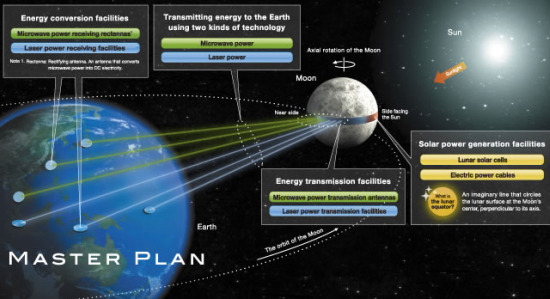
Mega-engineering: awesome future concepts from Shimizu Corporation
Paul Raven @ 02-06-2010
Get yourself over to Pink Tentacle right away; they’re hosting a bunch of mega-engineering promo images and design concepts from Japan’s Shimizu Corporation, who plainly aren’t afraid to think in directions with strong science fictional undertones. Directions such as floating lily-pad cities, million-citizen pyramidal cities, space hotels… and turning the moon into a gargantuan solar power station.
This one’s the winner for me, because any image of a planetary satellite re-engineered into a solar power plant that has the words “MASTER PLAN” masked onto it in large letters is, by any sane and reasonable metric, better than pretty much any other image. Of anything.
Bonus! Compare and contrast with these images of Russian space-race installations and rolling stock decaying the middle of nowhere [via Chairman Bruce]. Maybe one day in the deeper future, people will tut and shake their heads at images of Shimizu’s lunar power station, pocked with impact damage and slowly drowning in lunar dus
PowerSat: Space Solar Flies Closer to Earth
By Jennifer Kho Jun. 16, 2009, 5:05pm PDT 1 Comment
Do you like this story?
Solar from space: It may sound like a bad sci-fi movie, but a growing number of companies think it could solve the world’s energy crisis. Among them is Everett, Wash.-based PowerSat Corp., which said today it’s filed a provisional patent for two technologies it claims could help make the transmission of solar power from space more cost-effective. CEO William Maness also told us that the 8-year-old company has received commitments for $3-$5 million in angel funding, which it’s using to develop wireless power demonstrations on Earth, and is currently in negotiations for a first venture round in the single-digit millions.
The PowerSat news comes after Manhattan Beach, Calif.-based Solaren, another space solar company, in April signed a deal to provide power to northern California utility PG&E. And Swiss startup Space Energy recently said it’s working to launch a prototype satellite into space in 2-3 years.
Solar In Space
Space solar promises virtually unlimited power, with no carbon dioxide emissions. Undiminished by atmosphere or cloud cover, the sun’s energy is five times more powerful than can be found on even the brightest desert on the planet, according to PowerSat’s web site. And since the sun shines at full power all the time, solar energy-capturing satellites — called powersats — can receive more than 25 times as much power as a ground-based system of the same size, the company says.
Here’s how space solar would work: Power satellites armed with solar arrays would generate direct-current electricity, then convert that electricity into radio-frequency energy, which they would transmit the same way that radio travels to your car. But instead of using electricity to transmit information, as a radio signal does, these satellites would be sending the electricity itself. The radio frequency would get converted back into DC electricity at the receiver on the ground.
The huge potential has been apparent for decades, but space solar faces plenty of challenges. The biggest challenge so far, says Maness, is that it’s considered a risky investment. Nobody wants to invest billions of dollars to launch unproven technology into space, but it’s hard to prove the technology works without trying it out on location. Those billions of dollars represent another major hurdle. Even SpaceX‘s target price of $500 per pound, with its Falcon 9 spaceship, is about 20 percent too high to make a commercial space-solar project viable, and other launch estimates “aren’t even in the ballpark,” Maness said.
PowerSat’s Innovation
Now, PowerSat has come up with two technologies that it claims could shave off roughly $1 billion in launch and operation costs for a 2.5-megawatt power station. The first of these is called BrightStar. Instead of one large satellite, Brightstar uses a cluster of hundreds of small ones, which work together — similar to cloud computing — to transmit the power as a group.
The second technology, called Solar Power Orbital Transfer or SPOT, uses the same solar array needed for wireless power transmission to power the electronic thrusters that boost the satellites from what’s called “low Earth orbit,” which is 300-1,000 miles up, to “geosynchronous Earth orbit,” which is 22,236 miles up. Other satellites use a chemically fueled “space tug” to get to the geosynchronous level, and eliminating that power source reduces the weight of a satellite by 67 percent, dramatically decreasing launch costs, Maness said.
The company is developing a 10-kilowatt demonstration project with unnamed potential clients. In about three years, PowerSat hopes to launch a low-earth-orbit project, which will cost about $100 million. And within five years, the startup plans to look for a partnership with a utility, a public-private partnership involving the government or an initial public offering to raise the money for a full-sized project.
PowerSat plans to launch a prototype project into geosynchronous orbit in 2015 and to reach full power production between 2019 and 2021. It expects the smallest economically viable project, with a capacity of 2.5 gigawatts, to cost between $4-$5 billion.
Raising that kind of money, even with proof in place, will be a colossal task. And a long path — the company hasn’t even raised its first single-digit million venture round, although it has closed angel funding. It’s clear that while space solar may be flying closer, it still has a long way to go.

How Do You Feel About “Space Based Solar Power”?Filed Under Tech Questions
Tuesday, 20 October 2009 | Posted by John
That is correct. Solar Based Solar Power is one thing that might be considered and would change everything! I see the picture and I think to myself “what if this things is tilted 10 degrees in the wrong direction”? Is there any possibility of this thing creating a major disaster on Earth?
The article says that “low powered beams are considered safe”, but what happens when you put your cat in the microwave? (please do not abuse your kitty). The technology is simple and really, it seems like a great idea, but to only support the electricity for 1,000 homes, just doesn’t seem worth it to me.
There is a receiving grid a mile wide, even that takes up too much room. I would put the worth of the idea higher if it could power 10,000 homes. Small cities could take advantage and maybe even help to fund projects like this. To power only 1,000 homes, the city I live near would have to send up 50 light collectors and have a receiving area even larger to convert the light on Earth.
It is nice to see others “looking outside the box”, at least. The ideas may seem far fetched, but at least they are in idea form. I would like to talk to whomever thinks it’s cost effective to send up a solar collector that can only power 1,000 homes.

SSPS (Space Solar Power Satellites) & Ground Collectors
Nasa and a number of other agencies have proposed placing giant satellites in geosynchronous Earth Orbit (GEO) to collect sunlight with solar cells. The energy would be converted to a maser beam which would be beamed to the ground to supply earth's energy needs with free, clean, sustainable energy. The basic concept of the SSPS is to beam microwaves from space. The energy would be collected by vast collectors at the ground at high efficiency (around 90%).
The basic technology is now entirely proven with satellite communication relays. The barriers to its development to high power levels are mainly associated with launch costs, a limitation that may well be overcome with BEP technology.
Space Solar Power Satellite
Maser powered from space By concentrating on our future domestic energy supply, the proponents of SSPSs have so far failed to stress the very real potential this technology has to supply the energy needed to get the whole system into space both cheaply and efficiently. They also apparently ignore the obvious fact that, assuming BE propulsion is developed first, then the cost of launching these payloads into space could be reduced 1000x.
Enthusiasts propose placing a series of massive SSPS's (each 1km-5km in diameter) in GEO. Each 1km2 of satellite collector would receive 1.36Gigawatts of solar energy and, using solid-state technology, convert a modest percentage (~30%?) of this energy into coherent microwaves (ie a maser) to produce a near-constant 400Mw at the ground.
The higher E/D in space and the high total hours of operation, (24/7 for 99% of the year) would make a space installation 4x-5x more effective than any ground-based solar collector. The energy is also made available when other (solar-based) supplies are off line (ie in winter and at night.
When the world converts to solar, night time energy will be at a premium
Ground Power Stations
Ground stations would go hand-in-hand with the space collectors. An efficient ground reciever would be a light metal grid or netting 5km-6km in diameter. It could be situated almost anywhere on the ground below (or in shallow water) from the equator to the arctic circle. Aerial relays positioned in the upper atmosphere could also feed smaller ground arrays or extend this range, if necessary.

Space-Based Solar Power?
Labels: solar
Excerpt: The Economist (December 4, 2008)
Around the clock, 1.3 gigawatts of energy pour through every square kilometre of space around the earth. This energy could be captured by vast arrays of photovoltaic cells mounted on a satellite in orbit around the planet. These solar cells would be illuminated at all times of day, whatever the weather or the season, overcoming one of the main drawbacks of solar power on the earth’s surface. And with no atmosphere in the way to absorb or scatter the incoming sunlight, solar panels in space would produce over five times as much energy as those on the ground. (Some proposals for SSP involve large arrays of mirrors or lenses to concentrate the light onto a smaller array of panels.)
The logical place to put the satellite would be in a geostationary orbit, 35,800 kilometres above the earth’s equator, so that it completes one circuit of the planet per day, and thus appears (from the ground) to hover in a fixed place in the sky, like the communications satellites used to broadcast television signals. The solar-power satellite would send the collected energy down to earth in the form of a microwave beam, which would be picked up on the ground by a huge array of antennae, spread over several square kilometres in open country. The power density of the beam at the receiver would be little greater than what leaks out from a domestic microwave oven, so there would be no danger of incinerating entire cities. Microwave communications links are already used in the telecoms industry without doing any harm to wildlife.
Posted by Robert Volpe at Saturday, January 31, 2009

Back to Bright idea or sci-fi?
Bright idea or sci-fi?
September 09, 2009
Tyler Hamilton
Researcher Nobuyuki Kaya showed how solar power could be sent back to Earth from space using microwaves.
TYLER HAMILTON/TORONTO STAR
It sounds like something out of a sci-fi novel. Solar power plants orbiting the planet, each the size of 700 Canadian football fields, beaming clean energy down to Earth 24 hours a day so we can run our factories, charge our gadgets and keep our home appliances humming.
But for the scientists and engineers attending the International Symposium on Solar Energy from Space, a three-day conference this week in Toronto, there's nothing fictional about it. In their view, building massive space-based solar power systems represents, over the long term, one of the most effective ways of tackling the double menace of global warming and peak oil.
"Space-based solar power is a tremendously exciting prospect," said Liberal MP Marc Garneau, the first Canadian in space, speaking yesterday at the Ontario Science Centre about the potential for Canadian involvement in the project. "This country has all the fundamentals to play a leading role."
The Japanese are already leading the charge. Earlier this month, it was reported that Japan's government, working with a consortium of 16 companies, had committed to a $24 billion project to have a 1,000-megawatt solar station in space within three decades. This would generate enough electricity to power 300,000 homes, though getting the equipment into space would likely require more than 1,000 rocket launches.
Eco website TreeHugger called it Japan's "moon shot." The power station would consist of four square kilometres of solar photovoltaic arrays fixed in orbit about 36,000 kilometres above the planet's surface. Energy collected by the panels would be beamed by microwave to a receiving station back on Earth and converted into electricity before connecting to the land-based power grid.
Scientists say the advantage of putting a solar station in space is that it would face the sun 24 hours a day and would not be limited by cloud cover or air pollution. That would allow it to continuously generate power in the same manner as nuclear and fossil-fuel plants, but without the associated waste and greenhouse-gas emissions.
The idea has been around for 40 years, attracting serious attention from NASA and the U.S. Department of Defense during the 1970s, but funding eventually dried up. It wasn't until the late 1990s that interest in the concept resurfaced, partly as a result of concerns related to global warming and energy security.
Two years ago, the Pentagon's National Security Space Office issued a report that concluded solar-based power "is more technically executable than ever before."
The solar panels are more efficient and less costly to manufacture, technology exists to have robots assemble the station in space, and our understanding of wireless power transmission has improved dramatically.
Former NASA executive John Mankins, now president of the Space Power Association, said he believes space-based solar power could be economically competitive with other options.
Mankins added that he believes a small 10-megawatt demonstration plan could be in orbit within the next 10 years. "It's a reasonable time frame," he said.
At the conference, Nobuyuki Kaya, vice-dean of graduate engineering at Kobe University in Japan, demonstrated how the power could be transmitted wirelessly. Assisted by a team of students, he was able to light up a cluster of red LED lights and power a simple robot by beaming energy about 10 metres across a room.
Kieran Carroll, chief technology officer for Space Canada, which is hosting the conference, said such a system could be safely designed to accept and convert large amounts of energy from space. The trick is to transmit at low intensity by sending it down on a wide beam, about 10 kilometres across.
There would have to be no-fly zones around the area, but it wouldn't fry anyone walking through it.
"The power flux density in the middle of the (receiving) field would be perfectly safe for any life," said Carroll.
"In Canada, on a winter's day, one of the big problems would be that birds would probably hover over the field to get warm."
A reality check, however, came from power developer Wael Almazeedi, who warned of the legal, financial and regulatory challenges the plan would face, as well as the difficulty of "promoting a concept based on science fiction."
---------------------
Here is a Public Policy Discussion on YouTube regarding Space-Based Solar Power at "SpaceUP DC"
21 August 2010
PCAST Public Statement on Space Solar Power
Readers of this blog know that Open.gov's #1 public suggestion for NASA, DOE, and OSTP was to hold a conference on Space-Based Solar Power OSTP administers the President's Council of Advisors on Science and Technology (PCAST)
 President Obama specifically tasked the PCAST with providing him with Energy related scientific advice, including: "But energy is our great project, this generation's great project. And that's why I've set a goal for our nation that we will reduce our carbon pollution by more than 80 percent by 2050... I will charge PCAST with advising me about national strategies to nurture and sustain a culture of scientific innovation."
 PCAST recently had a meeting where Mr. John Mankins, President of Artemis Innovation Solutions gave a public statement.
Mr. Mankins has a 25-year career at NASA and JPL, including 10 years as the manager of Advanced Concepts Studies at NASA, and was the manager of Exploration Systems Research and Technlogy overseeing nearly a billion dollar budget of over 100 individual projects and some 3000 personnel.
Check out what he had to say about Space Solar Power:


Mr. Mankins has a 25-year career at NASA and JPL, including 10 years as the manager of Advanced Concepts Studies at NASA, and was the manager of Exploration Systems Research and Technlogy overseeing nearly a billion dollar budget of over 100 individual projects and some 3000 personnel.
Check out what he had to say about Space Solar Power:
COMMENTS TO THE PRESIDENT’S COUNCIL OF ADVISORS ON SCIENCE AND TECHNOLOGY WRITTEN STATEMENT
An Opportunity for Transformation: Space Solar Power
16 July 2010
John C. Mankins President, Artemis Innovation Management Solutions LLC1
To meet the challenges of Energy and the Environment in an increasingly interdependent and competitive world, novel policies and systems concepts must be pursued. Space activities are not generally considered as relevant to these global challenges outside of Earth observing, global positioning, and the like.
However, this may be an oversight of great significance.
A space program goal that could--if achieved--radically change the dynamic for renewable energy is that of space solar power: the capability to deliver on demand energy gathered in space to global markets almost continuously.
Unfortunately, as things now stand theUS U.S.
However, this may be an oversight of great significance.
A space program goal that could--if achieved--radically change the dynamic for renewable energy is that of space solar power: the capability to deliver on demand energy gathered in space to global markets almost continuously.
Unfortunately, as things now stand the
Also, some believe the concept of space solar power is impossible. Such views are based largely on conviction, not engineering. Not for more than a decade has there been in the US
And look how far non--space technology has progressed in the past 10 years. Why should space solar power be impossible, except that it is that we have assumed it is so. Basing policies and programs on such assumptions is no recipe for innovation.

In fact, in 2000 an independent National Research Council review committee found that space solar power was already then technically feasible and that the only R&D issues to resolve involve the question of eventual economic viability.
The revolutionary new systems concept that could enable space solar power is that of intelligent modular systems building truly enormous future space capabilities out of many hundreds and thousands of smaller component systems. This concept applies to space the principals and architectures of networked systems from hives of bees to cloud computing.
Of course, diverse new technologies still in the laboratory must be proven for space solar power in wireless power transmission, robotics, materials, electronics, and other areas. And numerous new supporting infrastructures will be needed, including low cost launch, affordable in-- space transportation, and others. But, recall how the steam engine changed the world and it was first fabricated from known materials by adult craftsmen working in existing shops. Similar systems--level revolutions resulted from internal combustion, electrification, and heavier than air flight. Although innumerable breakthroughs followed, the beginnings of each lay in new concepts, visionary investments and focused development.
In the same way, no breakthroughs are required to build the first space solar power pilot plants.
I believe that in a decade or less, the first space solar power pilot plant could be in orbit, delivering to people in multiple countries both clean energy, and a new vision of the interconnectedness of space and Earth. And that within a generation, space solar power could be established as a competitive green energy source in markets worldwide.
And look how far non--space technology has progressed in the past 10 years. Why should space solar power be impossible, except that it is that we have assumed it is so. Basing policies and programs on such assumptions is no recipe for innovation.

In fact, in 2000 an independent National Research Council review committee found that space solar power was already then technically feasible and that the only R&D issues to resolve involve the question of eventual economic viability.
The revolutionary new systems concept that could enable space solar power is that of intelligent modular systems building truly enormous future space capabilities out of many hundreds and thousands of smaller component systems. This concept applies to space the principals and architectures of networked systems from hives of bees to cloud computing.
Of course, diverse new technologies still in the laboratory must be proven for space solar power in wireless power transmission, robotics, materials, electronics, and other areas. And numerous new supporting infrastructures will be needed, including low cost launch, affordable in-- space transportation, and others. But, recall how the steam engine changed the world and it was first fabricated from known materials by adult craftsmen working in existing shops. Similar systems--level revolutions resulted from internal combustion, electrification, and heavier than air flight. Although innumerable breakthroughs followed, the beginnings of each lay in new concepts, visionary investments and focused development.
In the same way, no breakthroughs are required to build the first space solar power pilot plants.
I believe that in a decade or less, the first space solar power pilot plant could be in orbit, delivering to people in multiple countries both clean energy, and a new vision of the interconnectedness of space and Earth. And that within a generation, space solar power could be established as a competitive green energy source in markets worldwide.
Certainly, a revolution in technology, such as space solar power is urgently needed one that would allow the US, working with others to deliver by mid century 100s of thousands of megawatts of carbon--free power to global markets.
The concept of space solar power is under consideration in several countries around the world, ranging fromIndia where key groups and a former President have proposed an international study of the idea, to Japan US
I urge the PCAST to give consideration to space solar power as a prospective national--level goal that could enhance and engage the best ofU.S.
Thank you for this opportunity to present these views to the Council. A copy of my oral statement to the PCAST is appended, as are extensive references on the topic of space solar power.
The concept of space solar power is under consideration in several countries around the world, ranging from
I urge the PCAST to give consideration to space solar power as a prospective national--level goal that could enhance and engage the best of
Thank you for this opportunity to present these views to the Council. A copy of my oral statement to the PCAST is appended, as are extensive references on the topic of space solar power.
Appendix 2 Discussion Points for OSTP / PCAST Public Statement
Meeting the dual challenges of Energy and the Environment in an interdependent and competitive world demands novel policies and systems concepts. Space activities are not generally considered as relevant to these global challenges outside of Earth observing, global positioning, and the like.
However, this may be an oversight of great significance.
A space program goal that could if achieved radically change the dynamic for renewable energy internationally is that of space solar power: the capability to deliver on demand energy gathered in space to global markets almost continuously.
Unfortunately, as things now stand theUS U.S.
And, some believe space solar power is impossible. However, such views are based largely on conviction, not engineering. For over a decade theUS
Of course, diverse technologies must be proven for space solar power in wireless power transmission, robotics, and other areas. But, recall how the steam engine changed the world and it was first fabricated from known materials by craftsmen working in existing shops.
In a decade or less, the first space solar power pilot plant could be in orbit, delivering to people in multiple countries clean energy, and a new vision of the interconnectedness of space and Earth.
Clearly, a revolution is needed one that can enable theUS
I urge the PCAST to give consideration to space solar power as a prospective national--level goal that could enhance and engage the best ofU.S.
However, this may be an oversight of great significance.
A space program goal that could if achieved radically change the dynamic for renewable energy internationally is that of space solar power: the capability to deliver on demand energy gathered in space to global markets almost continuously.
Unfortunately, as things now stand the
And, some believe space solar power is impossible. However, such views are based largely on conviction, not engineering. For over a decade the
Of course, diverse technologies must be proven for space solar power in wireless power transmission, robotics, and other areas. But, recall how the steam engine changed the world and it was first fabricated from known materials by craftsmen working in existing shops.
In a decade or less, the first space solar power pilot plant could be in orbit, delivering to people in multiple countries clean energy, and a new vision of the interconnectedness of space and Earth.
Clearly, a revolution is needed one that can enable the
I urge the PCAST to give consideration to space solar power as a prospective national--level goal that could enhance and engage the best of
1 For additional Information, please contact: John C. Mankins; President, Artemis Innovation Management Solutions LLC; P.O. Box
6660, Santa Maria , California
93456 USA
Appendix 1 Selected Bibliography of Relevant References Key References
Feingold, Harvey , et al, Space Solar Power A Fresh Look at the Feasibility of Generating Solar Power in Space for Use on Earth (SAIC; Schaumberg , Illinois , USA
Glaser, Peter, Ph.D.; Method and Apparatus for Converting Solar Radiation to Electrical Power.(US Patent No. 3,781,647; U.S. Patent and Trademark Office; Washington , D.C.
25 December 1973.
Howell, Joseph T. and Mankins, John C., Highly Reusable Space Transportation A Summary Report; Retrospective 2009 (Presented at the International Symposium on Solar Energy from Space / IAA SPS 2009 Workshop; Toronto , Canada
Mankins, John C. and Kaya, Nobuyuki, A Report On The Status of the IAA Study Group on Solar Energy from Space, IAC--C3.1.1 (Presented at the 60th International Astronautical Congress; Daejeon, Republic of Korea
Mankins, John C. and Howell, Joseph T.; Overview of the Space Solar Power Exploratory Research and Technology Program ---- AIAA 2000--3060 (35th Intersociety Energy Conversion Engineering Conference; Las Vegas , Nevada USA
National Research Council, Aeronautics and Space Engineering Board, Committee for the Assessment of NASA's Space Solar Power Investment Strategy, Aeronautics and Space Engineering Board, Laying the Foundation for Space Solar Power: An Assessment of NASA's Space Solar Power Investment Strategy. (National Academies Press; Washington , D.C. USA
Additional References
Brandhorst, Henry; Megawatt SEPS and Mars Exploration(International Symposium on Solar Energy from Space / SPS 2009 at the Ontario Science Center ; Toronto , Canada
Criswell, David R., Power Collection and Transmission System and Method
(US Patent No. 3,781,647; U.S. Patent and Trademark Office; Washington , D.C.
28 May 1991.
Commercial Space Transportation Study Team, Commercial Space Transport Study Final Report,(Distributed by W. Piland, NASA Langley Research Center ; Hampton , Virginia ; USA
Ignatiev, Alex, Ph.D., Opportunities to Employ Lunar Surface Materials in a Future Space Solar Power Economy, (Presented at the International Symposium on Solar Energy from Space / IAA SPS 2009 Workshop; Toronto , Canada
Kaya, Nobuyuki; Mankins, John C.; Iwashita, Masashi; Little, Frank; and Marzwell, Neville; Hawaii Demonstation of Microwave Beam Control, supported by the Discovery Channel; (International Symposium on Solar Energy from Space / SPS 2009 at the Ontario Science Center ; Toronto , Canada
Kaya, Nobuyuki, et al.; Crawling Robots On Large Web In Rocket Experiment On Furoshiki Deployment (55th International Astronautical Congress; Vancouver , Canada
Mankins, John C., Space Solar Power: A Fresh Look, AIAA
95--3653 (Presented at the 1995 AIAA Space Programs and Technologies Conference, Huntsville , Alabama
Penn, Jay, and Law, Glenn, Future SSP Systems Concepts: the Laser Option.
Commercial and Military Applications, (Presented at the International Symposium on Solar Energy from Space / IAA SPS 2009 Workshop; Toronto , Canada
8--11 September 2009.
Mankins, John C., A Technical Overview Of The SunTower Solar Power Satellite Concept (IAF--97--R.2.08; 38th International Astronautical Federation, Turin , Italy
6--10 October 1997.
Mankins, John C.; An Affordable Lunar Launch Concept: MagLifter on the Moon
(revisiting the Lunatron); (International Symposium on Solar Energy from Space / SPS
2009 at the Ontario Science Center ; Toronto , Canada
8--10 September 2009.
Mankins, John C.; Technology Readiness Levels Definitions (White Paper NASA Headquarters; Washington , D.C. ; USA
Mankins, John C.; Research & Development Degree of Difficulty A White Paper
(White Paper, Advanced Projects Office, NASA Headquarters; Washington , D.C. ; USA
10 March1998. McSpadden, James; Advances in RF Wireless Power Transmission;
(International Symposium on Solar Energy from Space / SPS 2009 at the Ontario Science Center ; Toronto , Canada
Mihara, Shoichiro; Fuse, Yoshiharu; Saito, Takashi, and Ijichi, Koichi; WPT Technology Demonstration Options at USEF; (International Symposium on Solar Energy from Space / SPS 2009 at the Ontario Science Center ; Toronto , Canada
Office of Technology Assessment, US Congress; Solar Power Satellites. (Washington DC
Powell, James, R., Maise, George and Rather, John, Maglev Launch An Ultra Low Cost Way Toronto , Canada
8--11 September 2009.
Subscribe to:
Posts (Atom)
